seriously’
pp. 5-7 · Read in the full issue
Letters
Take the
New Hebrides
seriously’
I As you know, I don’t always [ agree with Nabanga. But like PIM, they do try to be a journal |of record, and, unlike PIM I (Feb p 11), I agree with them that the Australian press in general really ought to do bet ter in their reporting of the [ New Hebrides.
I don’t object, much, when Mark Baker calls me in his paper ‘one of the few able bodies left from the old Col onial Office’ by which I assume he means one of the few still on their feet. But surely it is time that the world press moved on from the picture of the British and French in the
New Hebrides doing nothing
except tootle their futile bugles and quarrel about the height of
their flagpoles.
As Nabanga rightly says, there are serious and compli cated problems in the New Hebrides in which Britain and France, with the New Hebrides Government, are seriously engaged (and with all possible respect too to Ken Hutton OBE [PIM, Feb plO] I don’t play cricket: my game is squash, as Ken knows very well).
Thank goodness, therefore, for serious and generally objec tive reports like your stories on the constitution (PIM Nov) and the elections (PIM Jan).
But even you seem to find it difficult to avoid digs at the ‘supine British’ (November), or ‘the British have concluded that the New Hebrides matters little to them’ (January).
The truth of the matter is that, as you said in your November article, the New Hebrideans themselves have achieved political miracles over the last year. If all goes well, the New Hebrides could not only be an economically successful and politically stable, multi-lingual society,
with friendship and help from both Britain and France. They could also be an interpreter and a bridge between the
anglophone and francophone
countries of the Pacific. As Stuart Inder, and I, saw at the South Pacific Conference in Tahiti last October, such bridges are badly needed. On the other hand, if things go badly, the New Hebrides could drop into a political and econ omic hole which would be a serious problem not only for the other nations of the Pacific, including Australia, but more importantly, for the leaders and people of the New Hebrides who have done so much to reach a consensus on their own future.
Both the Government of National Unity under Gerard
Leymang, and the Indepen
dence Government under Walter Lini, have been work ing towards this consensus. The job, and the interest, of the metropolitan powers is to help them, jointly. It is not easy. I have never met anything like the Condominium, and I would not seriously rec ommend the system to anyone planning new forms of govern ment. Nor, I am sure, would my French colleague. We may jointly be open to informed criticism, but I do sometimes wish the Australian press would lay off the snide re marks.
A. C. Stuart
British Resident Commissioner British Residency, Vila, New Hebrides • Since we are a journal of re cord it might be as well for us to say that we have not agreed with the way the majority of the Australian press have reported recent developments in the New Hebrides, and that we translated
and published Nabanga’s report
at length because we thought what they had to say about it was
re levant.
Editor.
As one whose backside is still smarting from the ‘French caning for the Australian press’ (PIM Feb p 11) I would like to reply to the reported remarks of that bellicose French PR man Jean Massias.
Mr Massias who has shown great dexterity in mix ing the demands of that osten
sibly independent journal,
Nabanga, with his role as a leading French government adviser accuses the Aus tralian press generally of being ill-informed and biased against the French in its reporting of developments in the New Hebrides.
He attacks me specifically over my reports last November in The Age (not The Sydney Morning Herald, which I have not reported in since last June) about the possibility of independent New Hebrides
hosting governments-in-exile
of South Pacific liberation groups.
As Mr Massias is well aware, sections of the Vanuaaku Party have long favoured giving such material support to kindred groups in New Caledonia and French Polynesia. Indeed, the
Vanuaaku policy platform
published in October last year states one of its foreign affairs
objectives as ‘to help
Melanesian and Polynesian brother nations not yet free from colonial tyranny to gain
their independence’.
I raised the question in an interview with the French resi dent commissioner, Inspector- General Robert, on November 15. Obviously aware of the possibility of governments-in exile, Mr Robert replied: ‘We would regard that as a hostile act. The French Government would have to reconsider the substance or totality of its aid.’
In my report of that inter view I wrote: ‘While the party has not made a firm decision, it may allow the Kanak Liber ation Movement of New Caledonia to establish a government-in-exile in Port Vila’.
At no stage, as PIM has reported, did I state that such a decision was ‘likely’. The word I used was ‘may’.
In an interview on November 17 Father Lini told me that while a decision would have to be influenced by what was the best strategy to help the liberation groups, a Vanuaaku government would still con sider hosting their de facto governments.
Father Lini went on to say: ‘We will continue to be very strong supporters of the move ments in New Caledonia and
Tahiti no matter what France threatens.’
While I cannot speak for other Australian journalists, I
personally reject Mr Massias’
claims that my writings have been ill-informed or unduly biased.
Last year I made two lengthy visits to the New Hebrides dur ing which I interviewed rep resentatives of all the various political persuasions includ ing Mr Massias and many other French officials and Francophone politicians. (Mr Massias claims to have found ‘not a single reference to Gerard Leymand’ in the Aus tralian reports. Father Leymang is quoted or men tioned in at least four articles that I have written.) It is true that much I have written contains criticism of French behaviour in the New Hebrides in recent years. But that criticism is based on a con sidered evaluation of the facts.
I neither regret nor retract a word of it.
Mr Massias and his associ ates should not single out the Australian press. Far worse things have been said about the French by the very people of the New Hebrides whose over whelming support for Vanuaaku in last year’s elec tion can hardly be interpreted as an accolade for Paris’ poli cies and performance in the South Pacific.
Mark Baker
Brisbane Bureau, The Age Storm in the
desert abates
Your February issue did carry my letter to you; this fact proves that yours is not a slan der magazine. Just not always well enough informed.
Therefore I hereby offer you my sincere apologies for calling you that. I am not publicity hungry, I just like to see things
straight. With sincere apologies
I remain,
A. Holgen
Collateral Investments Ltd Honolulu, USA.
Fifty years of
the RIB
I am a Fijian national and a long-term resident of the Marshall Islands, former em ployee of the Trust Territory government, and presently
working for the government of the Marshalls as a Master on one of its vessels.
During my long absence
from Fiji, your magazine has been a great source of inspi ration to me in terms of both entertainment and infor mation. However, since read ing your November 1979 issue I strongly feel you should change your name from PIM to PIB for Pacific Islands Bullshit.
In that issue (pi 2) there was an article ‘US Real Estate Agents Active in the Pacific’.
You pointed out that an American official had infor med PIM in Sydney that buy ing land in desert states like Texas was ‘folly’. How did you ever print such inaccuracies?
From August 6-18 1979 a group of Marshallese land buyers, of which I was one, went on a trip to Van Horn, Texas, to see our land. The tour
was arranged by Green Valley
Acres Inc through Marina Travel Agency Inc of Hawaii.
After looking over the land personally, I am more than sat isfied that it is beautiful and can be cultivated for farming, cattle-raising, and so on.
The sale of the land was
negotiated through Green
Valley Acres Inc, a registered organisation based in Califor nia. It deals mainly in selling real estate in the United States.
How can such transactions
through Green Valley Acres
Inc be called folly?
Could you tell me: What is the name of the US official who warned PIM in Sydney?
What department or agency of US Federal Government does he work for and in what ca pacity? Does he know anything about real estate or is he just an ordinary guy whose bark is bigger than his bite? Is this guy really from the United States or is he from Melbourne.?
Talking about desert land Mr Editor, did you ever con sider what a marvellous thing the early Mormon settlers did in Salt Lake City, which before their arrival was nothing but desert? Did you also forget that one of the most talked about miracles of modern times is the tremendous transformation brought about by the Israelis in
planting huge forests and or ange groves in what for hun dreds of years was desert and barren land?
Criticisms based on unfounded rumours is a com mon weakness of the negative person who always criticises the positive and creative thinker.
I humbly request that in future times you get all your
facts together before printing
articles of this kind. As Shakespeare says, ‘To thine own self be true’ .
M. Cama
Majuro, Marshall Islands
Arrested for muddy
number plate
I could not agree more with Percy Chatterton’s statements (PIM Oct 1979 p 66).
Over the past few years we have suffered physically in the
Papua New Guinea Highlands
because of crimes that are only
encouraged by lack of police
protection. The situation has forced the closing of stores, and will eventually close the schools as well. While students and teachers are endangered by attacks from lawless bands outside the school, we have only ourselves to depend upon for protection. Police have even acknowledged this on sev eral occasions. Yet our students
must suffer ‘payback’ injuries,
including beating with chains
and other weapons at
Kerowagi.
People get the impression
that the Simbu people are law less, but this kind of thing can
happen anywhere when there
is no authority and no respect for those who are supposed to enforce it. It is human nature to try and get away with as much as one can. Witness what happens in other countries when the police go on strike. In our place if the local police went on strike nobody would notice.
The ‘State of Emergency’ was a bad joke played on a lot of people who are normally law-abiding citizens. In their rush to make an impressive number of arrests a lot of inno cent people suffered at the hands of the police.
I myself was detained with the school driver for being in a truck with a muddy number
plate. Three valuable school days were therefore lost in gaol and in courtrooms.
Now members of our school staff have been arrested for criticising the police.
Name And Address Supplied
Port Moresby, Papua New Guinea
Spain’s new
Pacific ties
I have the pleasure to inform you that the Kingdoms of
Spain and Tonga have
established diplomatic re lations by way of issuing a joint
communique published simul
taneously in both countries on November 16, 1979. The diplo matic relations will be con
ducted by Spain through its
Ambassador in Canberra (Aus
tralia). Tonga’s High Com
missioner in London will act for his country.
Following the presentation of my Letters of Credence in Port Moresby on October 23 of last year as first Ambassador of Spain in Papua New Guinea I visited that country for 10 days, as well as Solomon Islands and New Hebrides. It was in the lat ter country that I travelled down to the island of Santo and on to Big Bay, where the
Spanish navigator Pedro Fer
nandez de Quiros founded the city of New Jerusalem and called the discovered and to be-discovered lands to the south of that point Austrialia del Espiritu Santo.
Carlos M. Fernandez-Shaw
(Ambassador of Spain) Canberra, ACT, Australia
Rape a ‘trifling’
matter?
I refer with shock and disgust to the reader’s letter reprinted from Les Nouvelles in Papeete
which recently appeared in
/our magazine (PIM Dec 1979 p4O). The letter contained the
following passage: *... the
people (of a country named) are fighting and killing each other like real savages over trifling matters the rape of a woman or the theft of a pig.’
I would like to think that the letter-writer penned those lines with tongue in cheek, or that you printed them in that spirit but I can’t quite convince myself that this was so. Who is the real savage, the cannibal who consumes human flesh, or
the one who kills a womar emotionally and consumes hei flesh in another way? There’s about one-quarter inch dif ference on the scale of civilis ation between the two.
Jean L. Sherman
Pasadena, Calif, USA
PIM covers: Away
with guilt, shame!
Being an ardent traveller and reader of travel magazines ] had to come across your publi cation. As our daily press
almost consciously ignores the
Pacific, you fill a gap. Youi snippets, titbits and of course the feature articles are very in formative.
I am pleased to see that yours is not a picture-postcard, ‘wish you-were-here’ type of pro duction. Your treatment ol
touchy issues subjects like
French Polynesia, for example
is commendable. Where else would one read about them?
One particular feature is most refreshing your covers Those delectable Pacific maidens are heartwarming How can any healthy and sound person object to them*' The Pacific has suffered
enough from weird religions
and man-made guilt.
Congratulations to a fine
magazine. Ignore the detrac
tors shame, guilt and con servatism do not seem to be one of your major features.
Keep it that way and keep those beauties coming! Be [ sides, it is now easy to track I down PIM at the newsagent.
J. Brandstatter
E Chatswood, NSW, Australia
State Department
‘giveaway’?
After the giving away of the Panama Canal in which the US even paid a tinhorn leftist f Panamanian dictator Omar
[ Torijos for the privilege, our
State Department was hard pressed for an encore. It has now turned its attention to redefining American interests [in the Pacific.
In 1980 the State Depart ment will push for Senate rati fication of two proposals which will turn over US sovereignty to 18 central Pacific islands and hundreds of thousands of square miles of rich fishing waters. The direct beneficiaries of this largesse are two left
leaning emerging nations, the
island republics of Tuvalu and Kiribati. The indirect benefici ary is the Soviet Union with increasing naval and economic clout in the strategic waters of Micronesia and Polynesia.
Our territorial claims being waived include islands in the Line, Phoenix and Ellice groups that have been American controlled since the 1800 s. Some like Christmas Island and Hull Island (named after the War of 1812 Com mander of the USS Consti tution) have rich histories. Nine of these strategic islands have warranted US military bases on them from World War II through the 19705.
Each of the islands in these widespread groups commands a radius of two hundred miles in territorial limits into rich
fishing waters. Unfriendly con
trol of these islands could spell sconomic disaster for the multi-million dollar tuna fish
ing and canning industry in
nearby American Samoa. The
republics of Kiribati (formerly
icnown as the Gilbert Islands)
and Tuvalu have already
ndicated that each plans to
charge a heavy ‘conservation
fee’ for the future privilege of US fishing interests using what are in reality American waters.
The island republics of Tuvalu and Kiribati, both under British control until the 19705, have combined popu lations of less than 60 000. Yet they clearly have more than enough clout to have the State Department buckle under to their demands. They are active member states in the anti- American third world con ference group called the South Pacific Forum. They have voted against US entry into that organisation and have made overtures in favour of the Red Chinese as well as Rus sians.
The treaty with Kiribati which cedes 14 of the 18 islands in question was signed on Sep tember 20, 1979. It is ironic that this unmeritorious action oc curred on the island of Tarawa in which over 3500 Americans gave up their lives in protect ing the interest of the United States in the Pacific in World War 11.
The State Department hopes
for Senate ratification of the treaty of friendship with Tuvalu in early 1980. The rati fication of this treaty will expedite the further pact with Kiribati.
These current giveaway pro posals give nothing in return for the US. In fact a power vac uum will be created which will engender further Soviet influ ence. Already, the Soviets were granted a fishing fleet base in the nearby island of Tonga.
With our worldwide naval de cline, the Pacific may never again be known as an American lake. The current giveaway in the South Pacific is only symptomatic of world
wide global retrenchment by
the US.
David Noland
Canyon Country California 91351 USA
Ebia Olewale and
his French friends
I have followed with interest the views of Ebia Olewale, for mer Papua New Guinean Foreign Minister, on indepen dence in the French Pacific. I have also followed some of the criticisms he has received in your pages, particularly from Tahitians.
I would like to comment on two letters of criticism: one from Ms de Montlue of Auckland (PIM Dec 1979 p 5), and one from a writer to Papeete’s Les Nouvelles (PIM Dec 1979 p4O).
First of all it is incorrect to say that Mr Olewale has no right to express views on independence in Tahiti, and that his pronouncements on
this subject are meaningless.
He is a Pacific citizen and has
a role to play by interesting
himself in the affairs of the re gion to which he belongs.
He belongs to a nation which has gained independence and can therefore speak with more authority on the subject than most people in French Polynesia. Independence is an issue in Tahiti, and Olewale can surely be excused for at least thinking about it, and, if
he does, one can only expect that he will speak about it too.
Ms de Montlue’s use of events in PNG as a criticism is rather unfair. The recent con stitutional crisis in that country indicates that the legal system there needs modification, not that the country is falling apart.
Irian Jaya was a problem long before PNG became a nation.
With PNG not being sovereign in the 19605, it is hardly fair to expect it to have made any pro tests.
The Bougainville-PNG re lationship is not analagous to the Tahiti-France relationship because (a) for the moment the PNG Government seems to have satisfied Bougainvilleans with limited independence in the form of provincial govern ment, therefore somewhat neu
tralising a strong independence
movement, and (b) Bougain ville is more closely connected
with PNG culturally, racially
and historically than Tahiti is to France (although French colonisation has to some extent
changed that).
Taking these points into con sideration, one could be excused for concluding that there is a stronger case for a
Bougainville-PNG unity than a
Tahiti-France unity, and there fore a weak case for Tahitians
meddling in Bougainville, as
Ms de Montlue suggests.
As for the writer in Les Nouvelles, a rather cynical assumption is made that independence means rape, kill ing and disorganisation in what he/she assumes is the PNG style. If the writer is afraid that independence in Tahiti will mean this, then the only con clusion is that Tahiti’s culture is no better than PNG’s, as it is misrepresented in the rather unsubtle innuendos contained in the letter.
They reveal more about the
writer’s abysmal ignorance of
other people’s cultures than they do about PNG.
Here’s hoping that one day French Polynesians will cease criticising others with advice, take some themselves, and see
that independence brings a
sense of self, where previously domination brought colour TV’s, radioactivity and a false consciousness.
Mark Schubert
Croydon, Vic, Australia
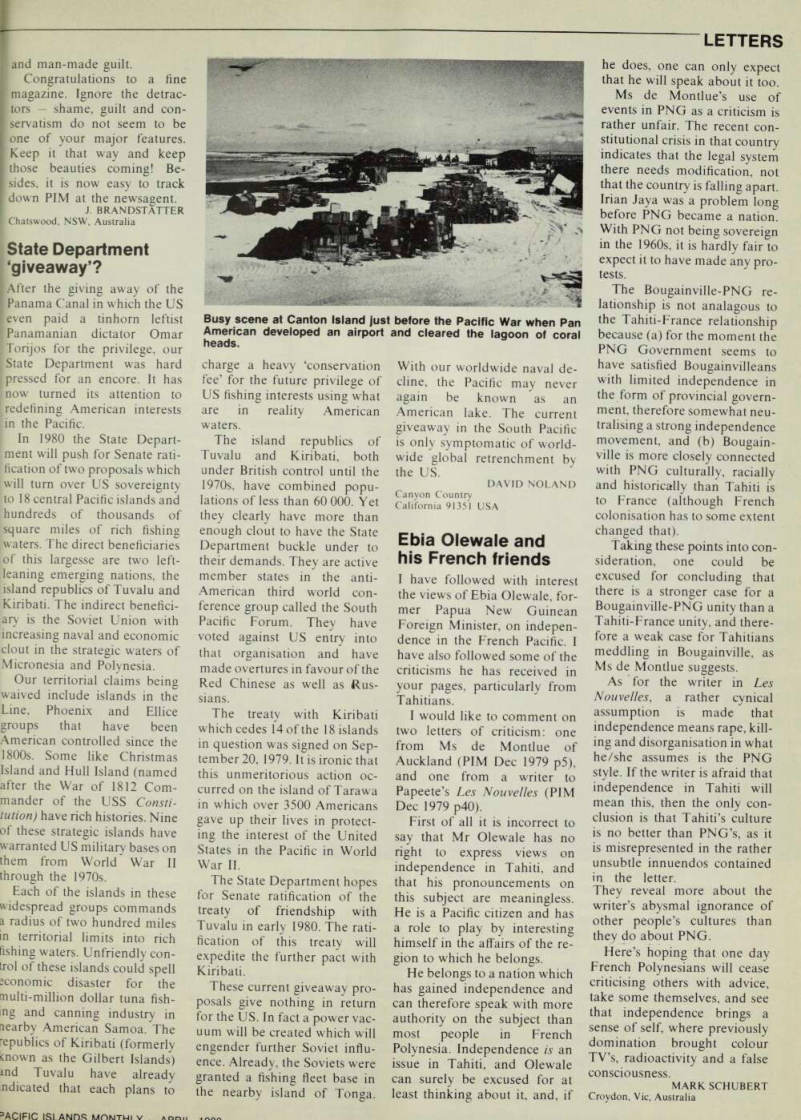
Busy scene at Canton Island just before the Pacific War when Pan American developed an airport and cleared the lagoon of coral heads.