Festschrift coming
p. 55 · Read in the full issue
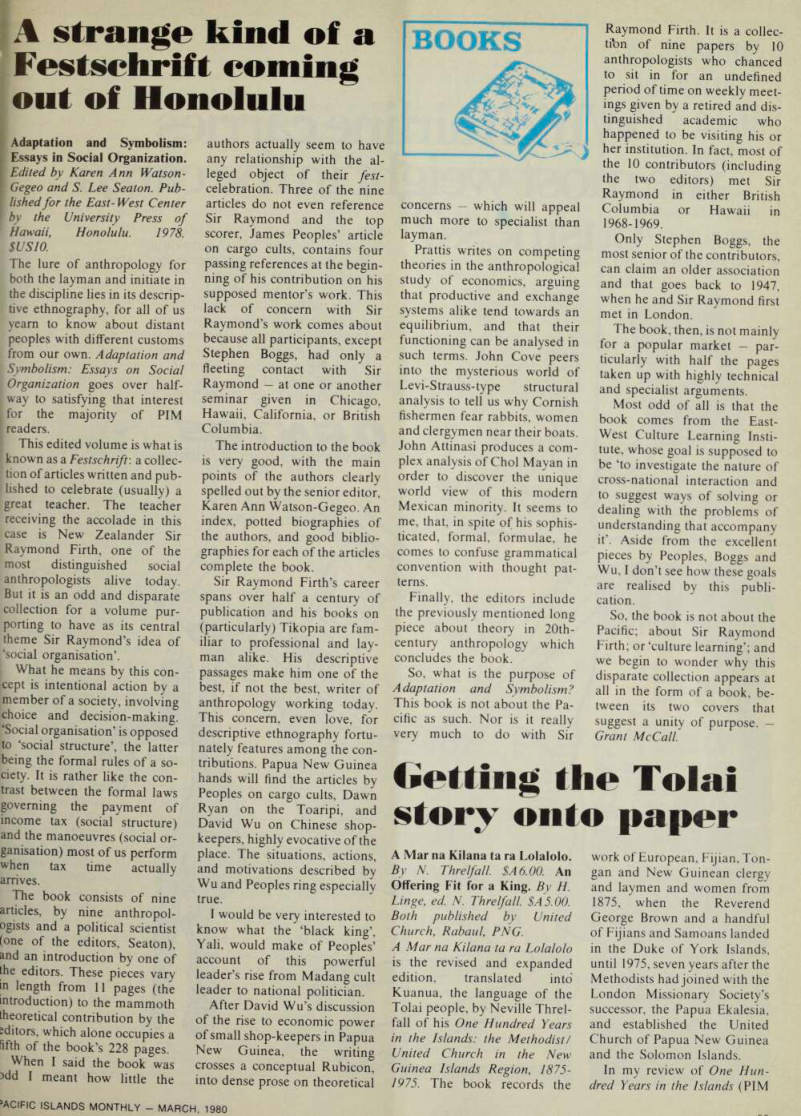
A strange kind of a Festschrift coming out of Honolulu
Books
Adaptation and Symbolism: Essays in Social Organization.
Edited by Karen Ann Watson- Gegeo and S. Lee Seaton. Pub lished for the East- West Center by the University Press of Hawaii, Honolulu. 1978.
Susio.
The lure of anthropology for both the layman and initiate in the discipline lies in its descrip tive ethnography, for all of us yearn to know about distant peoples with different customs from our own. Adaptation and Symbolism: Essays on Social Organization goes over half way to satisfying that interest for the majority of PIM readers.
This edited volume is what is known as a Festschrift ', a collec tion of articles written and pub lished to celebrate (usually) a great teacher. The teacher receiving the accolade in this case is New Zealander Sir Raymond Firth, one of the most distinguished social
anthropologists alive today.
But it is an odd and disparate collection for a volume pur porting to have as its central theme Sir Raymond’s idea of ‘social organisation’.
What he means by this con cept is intentional action by a member of a society, involving choice and decision-making. ‘Social organisation’ is opposed to ‘social structure’, the latter being the formal rules of a so ciety. It is rather like the con trast between the formal laws governing the payment of income tax (social structure) and the manoeuvres (social or ganisation) most of us perform when tax time actually arrives.
The book consists of nine
articles, by nine anthropol
ogists and a political scientist (one of the editors, Seaton), and an introduction by one of the editors. These pieces vary in length from 11 pages (the introduction) to the mammoth
theoretical contribution by the
editors, which alone occupies a fifth of the book’s 228 pages.
When I said the book was xld I meant how little the
authors actually seem to have any relationship with the al leged object of their fest celebration. Three of the nine articles do not even reference Sir Raymond and the top scorer, James Peoples’ article on cargo cults, contains four passing references at the begin ning of his contribution on his supposed mentor’s work. This lack of concern with Sir Raymond’s work comes about because all participants, except Stephen Boggs, had only a fleeting contact with Sir Raymond at one or another seminar given in Chicago, Hawaii, California, or British Columbia.
The introduction to the book is very good, with the main points of the authors clearly spelled out by the senior editor, Karen Ann Watson-Gegeo. An index, potted biographies of the authors, and good biblio graphies for each of the articles complete the book.
Sir Raymond Firth’s career spans over half a century of publication and his books on
(particularly) Tikopia are fam
iliar to professional and lay man alike. His descriptive passages make him one of the best, if not the best, writer of
anthropology working today.
This concern, even love, for
descriptive ethnography fortu
nately features among the con tributions. Papua New Guinea hands will find the articles by Peoples on cargo cults, Dawn Ryan on the Toaripi, and David Wu on Chinese shop keepers, highly evocative of the place. The situations, actions, and motivations described by
Wu and Peoples ring especially
true.
I would be very interested to know what the ‘black king’, Yali, would make of Peoples’ account of this powerful leader’s rise from Madang cult leader to national politician.
After David Wu’s discussion of the rise to economic power of small shop-keepers in Papua New Guinea, the writing crosses a conceptual Rubicon, into dense prose on theoretical
concerns which will appeal much more to specialist than
layman.
Prattis writes on competing theories in the anthropological study of economics, arguing that productive and exchange systems alike tend towards an equilibrium, and that their functioning can be analysed in such terms. John Cove peers into the mysterious world of
Levi-Strauss-type structural
analysis to tell us why Cornish fishermen fear rabbits, women and clergymen near their boats.
John Attinasi produces a com plex analysis of Choi Mayan in order to discover the unique world view of this modern Mexican minority. It seems to me, that, in spite of his sophis ticated, formal, formulae, he comes to confuse grammatical convention with thought pat terns.
Finally, the editors include
the previously mentioned long
piece about theory in 20th century anthropology which concludes the book.
So, what is the purpose of Adaptation and Symbolism?
This book is not about the Pa cific as such. Nor is it really very much to do with Sir
Raymond Firth. It is a collec tibn of nine papers by 10 anthropologists who chanced to sit in for an undefined period of time on weekly meet ings given by a retired and dis tinguished academic who happened to be visiting his or her institution. In fact, most of the 10 contributors (including the two editors) met Sir Raymond in either British Columbia or Hawaii in 1968-1969.
Only Stephen Boggs, the
most senior of the contributors, can claim an older association and that goes back to 1947, when he and Sir Raymond first met in London.
The book, then, is not mainly for a popular market par ticularly with half the pages taken up with highly technical and specialist arguments.
Most odd of all is that the book comes from the East- West Culture Learning Insti tute, whose goal is supposed to be ‘to investigate the nature of cross-national interaction and to suggest ways of solving or dealing with the problems of understanding that accompany it’. Aside from the excellent pieces by Peoples, Boggs and Wu, I don’t see how these goals are realised by this publi cation.
So, the book is not about the Pacific; about Sir Raymond Firth; or ‘culture learning’; and we begin to wonder why this disparate collection appears at all in the form of a book, be tween its two covers that suggest a unity of purpose. - Grant McCall.