See the US Trust
pp. 47-51 · Read in the full issue

Territory while it’s still there!
Travellers wanting to combine a Pacific Islands holiday with a chance to observe a fascinat ing period of political and social transition, the like of which will not be seen again in the Pacific, should this year head for the Trust Territory of the Pacific Islands.
Next year the territory won’t exist.
Already it is becoming hard to identify as it camouflages itself under a collection of sep arate identities such as The Marshalls, the Federated States of Micronesia, the Re public of Palau, the Common wealth of the Northern Marianas.
But don’t be bamboozled by the nomenclature. They cur rently all add up to that group of north Pacific islands administered by Japan be tween the two world wars, and by the United States since 1947 on behalf of the United Nations; in the same way as Australia administered Nauru and New Guinea, and New Zealand administered Western Samoa.
These latter groups have
long since become indepen
dent, and next year it will be come the turn of the islands of the US Trust Territory, which is the UN’s last trusteeship and the year when the US has decided to front up to the UN and say, ‘There you are. We are handing power back to these islands on the following terms.
Do you approve?’
All the politicking which has gone on in that area of the Pacific for at least the last 10
years, and which occasionally
has made confused reading for
regular PIM readers (especially
those trying to follow what has been happening in Palau), has been aimed at getting the UN to say yes next year on terms that are mutually advan tageous for the islanders and the United States.
The major task of getting agreement appears to have
been achieved. The Trust Ter ritory has decided to divide itself up and make various sep arate arrangements with the US. What is happening now is an attempt by all involved to get the various separate parts working well enough for the arrangements to be acceptable
to the Trusteeship Council.
They are at various stages of this process. This is what is so
interesting to the discerning
traveller, keen to observe the people around him and the effect on them of the important constitutional changes that they themselves have engineered.
Because of the pressures on the Trust Territory (the US is anxious to wrap everything up before the forthcoming Presidential elections delay the
Congressional approvals
needed for the various arrange ments that have been ham mered out) the islands today are in an unusual state of flux.
Systems of government are
being established throughout
the group which are in fact transitional, because tech nically the various islands still comprise the United Nations Trust Territory. There is still a Trust Territory Government, based on Saipan and with a sort of watching brief over the affairs of the entire group of more than 2000 islands in three major archipelagoes, with a combined population of more than 125 000.
In fact the TT government is quickly being run down as the various groups are encouraged to take over the reins of the kind of government they’ve chosen.
Things have been happening so speedily that the US never did get the opportunity to move its TT headquarters from Saipan to Ponape, which it planned to do, and now the central government is ending its days with a whimper at its
old Saipan headquarters, itself
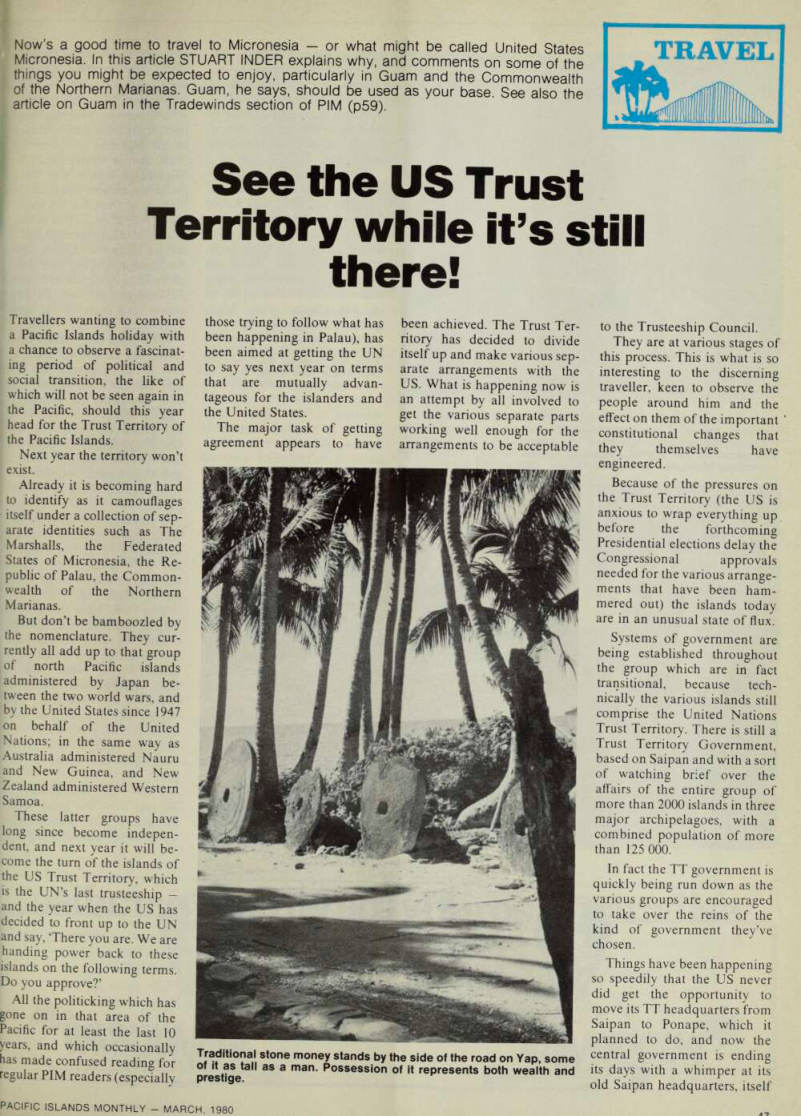
Traditional stone money stands by the side of the road on Yap, some of it as tall as a man. Possession of it represents both wealth and prestige.
worth a visit as a piece of his tory about to disappear.
Saipan is the main island of the new Commonwealth of the Northern Marianas, a group of small islands running north of Guam and which include Rota and Tinian.
South-west of Guam are the islands of what is to be the new Republic of Palau, with Koror the headquarters temporarily.
South-east of Guam are the island groups of Yap, Truk, Ponape and the island of Kosrae, which between them make up the Federated States of Micronesia, with head quarters on Ponape.
Far to the east of Guam are the Marshall Islands, with
headquarters on Majuro.
So Guam is clearly the place to use as a base for anybody wanting to visit Micronesia.
Guam is an American pos session, accessible by air from every direction and with its
own fascination apart from its handy position on the map (see
story, p 59).
You can fly from Guam to all main centres, or at least con nect, sometimes with a choice of air services, although the main one is Continental Air Micronesia which will drop you down at most places on the flight to or from the US main land. ‘Air Mike’, as it is called, is also planning to establish a service between Guam and Australia, but in any case trav ellers from Australia and New Zealand can get fast jets into Guam and parts of the new Micronesia with Air Nauru.
Air Nauru flights are worth taking for their own sake, as they touch on places that are different and both service and fare schedules are excellent.
The 727 and 737 aircraft have the added advantage of not being crowded. Air Nauru can take you to Majuro, Ponape and Guam, and connect also with Manila, Hong Kong and
Japan.
If you arrive by air from the US it makes sense to drop off at Majuro, Ponape or Truk on the way through to Guam, keeping perhaps one of them for the return trip.
You will have to get to Saipan, Yap and Palau through Guam. There’s a first-class sea trip from the US aboard the comfortable Nauru Pacific Lines vessel Enna G, sailing be tween San Francisco and
Saipan throughout the year
and calling at Honolulu,
Majuro, Ponape and Truk.
Passengers can board at any port.
With the exception of Kosrae, there are good hotels throughout the islands, with Continental hotels being the
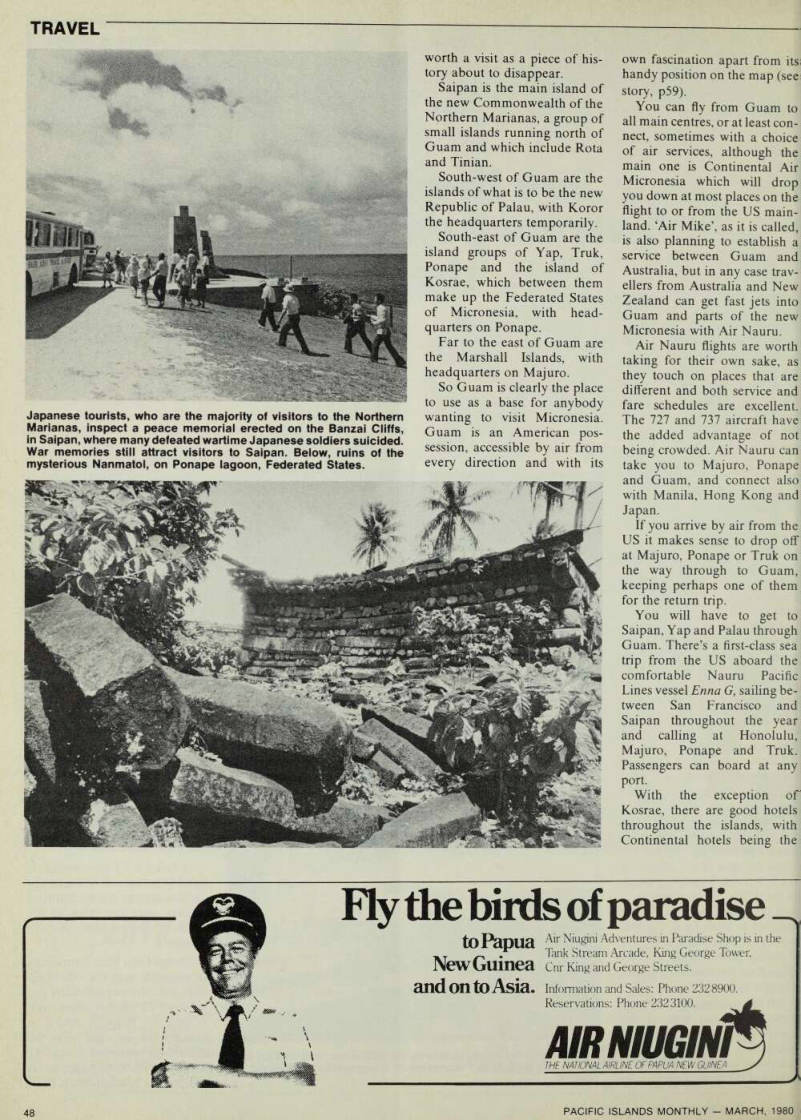
Japanese tourists, who are the majority of visitors to the Northern Marianas, inspect a peace memorial erected on the Banzai Cliffs, in Saipan, where many defeated wartime Japanese soldiers suicided.
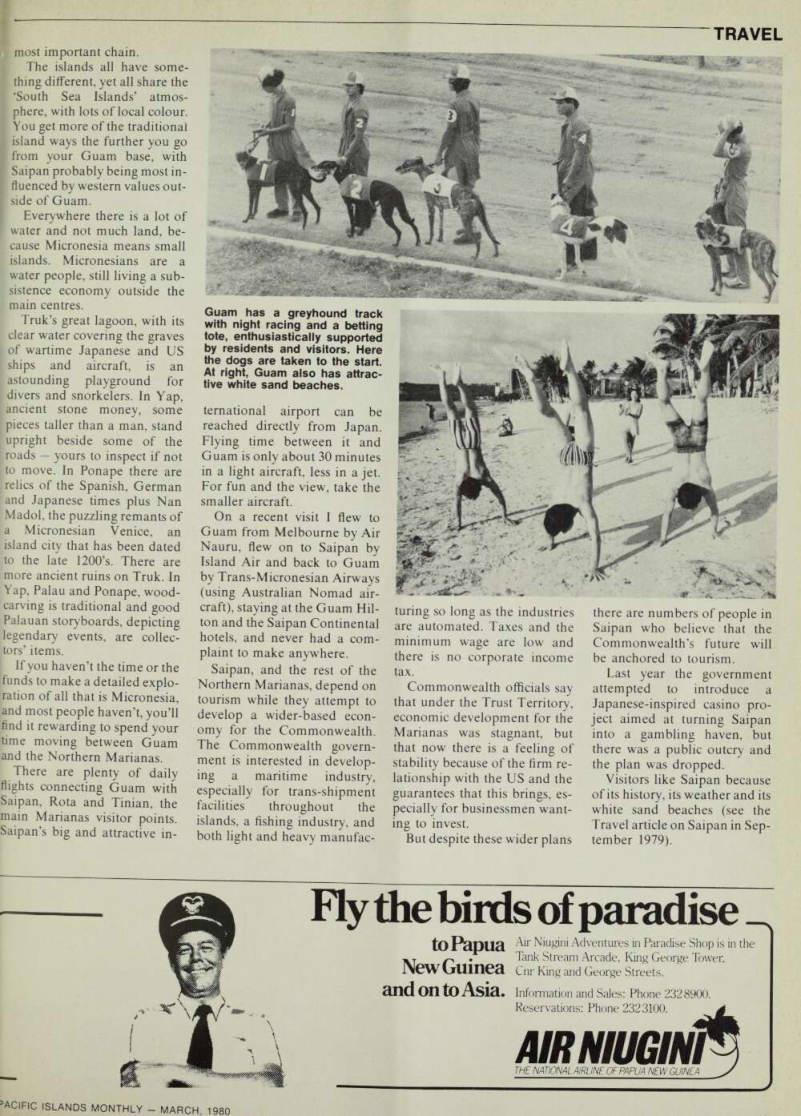
War memories still attract visitors to Saipan. Below, ruins of the mysterious Nanmatol, on Ponape lagoon, Federated States.
most important chain.
The islands all have some thing different, yet all share the ; ‘South Sea Islands’ atmos phere, with lots of local colour.
You get more of the traditional island ways the further you go from your Guam base, with
Saipan probably being most in
fluenced by western values out side of Guam.
Everywhere there is a lot of f water and not much land, be cause Micronesia means small islands. Micronesians are a water people, still living a sub sistence economy outside the main centres.
Truk’s great lagoon, with its clear water covering the graves of wartime Japanese and US j ships and aircraft, is an
I astounding playground for
divers and snorkelers. In Yap, ancient stone money, some pieces taller than a man, stand upright beside some of the i roads yours to inspect if not to move. In Ponape there are relics of the Spanish, German and Japanese times plus Nan Madol, the puzzling remants of a Micronesian Venice, an island city that has been dated to the late 1200’s. There are more ancient ruins on Truk. In Yap, Palau and Ponape, wood carving is traditional and good
Palauan storyboards, depicting
legendary events, are collec tors’ items.
If you haven’t the time or the funds to make a detailed explo ration of all that is Micronesia, and most people haven’t, you’ll find it rewarding to spend your time moving between Guam and the Northern Marianas.
There are plenty of daily
flights connecting Guam with
Saipan, Rota and Tinian, the main Marianas visitor points.
Saipan’s big and attractive in-
ternational airport can be reached directly from Japan, Flying time between it and Guam is only about 30 minutes in a light aircraft, less in a jet.
For fun and the view, take the smaller aircraft.
On a recent visit I flew to Guam from Melbourne by Air Nauru, flew on to Saipan by Island Air and back to Guam
by Trans-Micronesian Airways
(using Australian Nomad air craft), staying at the Guam Hil ton and the Saipan Continental hotels, and never had a corn plaint to make anywhere.
Saipan, and the rest of the Northern Marianas, depend on tourism while they attempt to develop a wider-based econ omy for the Commonwealth, The Commonwealth govern ment is interested in develop
ing a maritime industry,
especially for trans-shipment
facilities throughout the islands, a fishing industry, and both light and heavy manufac
turing so long as the industries are automated. Taxes and the minimum wage are low and there is no corporate income tax - Commonwealth officials say that under the Trust Territory, economic development for the Marianas was stagnant, but that now there is a feeling of stability because of the firm relationship with the US and the guarantees that this brings, especially for businessmen wanting to invest.
But despite these wider plans
there are numbers of people in Saipan who believe that the Commonwealth’s future will be anchored to tourism.
Last year the government attempted to introduce a Japanese-inspired casino pro
ject aimed at turning Saipan
into a gambling haven, but there was a public outcry and
the plan was dropped,
Visitors like Saipan because of its history, its weather and its white sand beaches (see the Travel article on Saipan in Sep tember 1979).
Guam has a greyhound track with night racing and a betting tote, enthusiastically supported by residents and visitors. Here the dogs are taken to the start.
At right, Guam also has attrac tive white sand beaches.
Stepped-up marketing activities by the Marianas Visi f tors Bureau, directed by its hard-working and dedicated I boss, J M Guerrero, brought in I a record in foreign exchange I earnings in the 1978 calendar I year and a 60% increase in the I number of visitors, which I totalled more than 91,000 for the year. They spent between f them more than $27.5 million.
The greater part of visitors come from Japan, most on
organised package deals.
The Northern Marianas re cently embarked on a promo tional campaign to educate local residents on the import ance of the tourist industry for the Commonwealth, with leaf f lets and television spots explaining how the dollars brought to the islands by ‘Mr and Mrs Sato’ permeate through the entire com
munity.
The islands of Tinian and Rota are quickly developing as tourist attractions. In Japanese times, Rota had a big sugar industry. Tinian has on its northern end the remains of the vast runways from where the aircraft took off which dropped the first A-bombs on Hiroshima and Nagasaki.
Through most of the islands there are relics of war, but these
days they are being consciously
I used as tourist bait.
The Trust Territory official enclave on ‘Mount Olympus’, or Capitol Hill, Saipan, is diminishing by the month. The area began as a highly secret
training complex for guerillas,
run by the CIA. When last I visited it, it was a thriving, well maintained Trust Territory headquarters of attractive
homes and buildings. Today
many are derelict and probably 100 are empty. The buildings are not being maintained as the Trust Territory staff leave for new and lesser jobs in the US,
or perhaps for early
retirement.
Many of these dedicated officials have spent as long as 20 years with the Trust Terri tory Government, and if they had been working for other colonial governments in the Pacific they would have ended their days with ‘golden hand shakes’ as compensation for
the premature termination of their careers, but the US Government doesn’t recognise that it ever had a colonial ser vice. Trust Territory staff are made one job offer by the Department of the Interior, and if it’s not suitable that’s it.
The buildings will be handed back to the new Common wealth.
Guam, too, has sun and beaches and good comfortable hotels. But Guam is a fascinat ing combination of the “US of A” and the Pacific Islands, with additional overtones of Spain, who once owned it.
As a first-time visitor wrote not long ago, ‘Guam is a para dox, a puzzle, a clutter of con tradictions. Such a small island should be easy to get to know, but once you start paddling around, the complexities begin to surface’.
Guam is sophisticated. It has first-rate shopping and enter tainment, plenty of eating houses of all styles and prices, a wide choice of television channels, and an Americanism which will remind many visi tors of life at the movies. For shoppers there is a great variety of American goods, European luxuries and cheap booze.
Entertainment includes a
greyhound racing track, with
an on-the-course totalisator,
owned by a Hong Kong based
firm, and established by an Australian, Norm Smith, and the locals have taken to it with enthusiasm, training their own dogs. But the new sport exists
side-by-side with cock fighting
in cock pits around the island.
In one area of Agana visitors are encouraged to take a stroll of less than one mile to view the remnants of many cultures.
The tour starts at the Agana Catholic Cathedral, Guam’s largest church, and moves on to a statue donated by the
Filipino community of Guam,
then an historic Spanish bridge, then the Plaza de Espana, which for 230 years was the seat of government for Guam and the other Mariana islands, then to the nearby re mains of the original Spanish Governor’s palace, including the ‘chocolate house’, dating
back to 1736, where wives of the Spanish governors would serve cups of chocolate to guests. The walk includes Guam’s Latte Stone Park, with ancient latte stones dating from prehistoric times. The stones, which have become a symbol for Guam, are believed to have been used as foundations for homes. Finally the visitor in spects the remains of the Spanish-built Fort Apugan.
One of the many attractive fea tures of Guam’s entertainment round is Tahitian dancer Rosalie Cao (below), a member of a Polynesian dance group of four men and four women who pro vide nightly shows in the season. All are from Papeete and
their dancing is deservedly
regarded highly for its authen ticity. But Rosalie is also re nowned in Guam’s sporting life as a star tennis player. She’s taken out the Guam open cham pionships for the last three years. Photo at right, by Manny Crisotomo, shows her at the
1979 championship.