Here Yet’
p. 29 · Read in the full issue
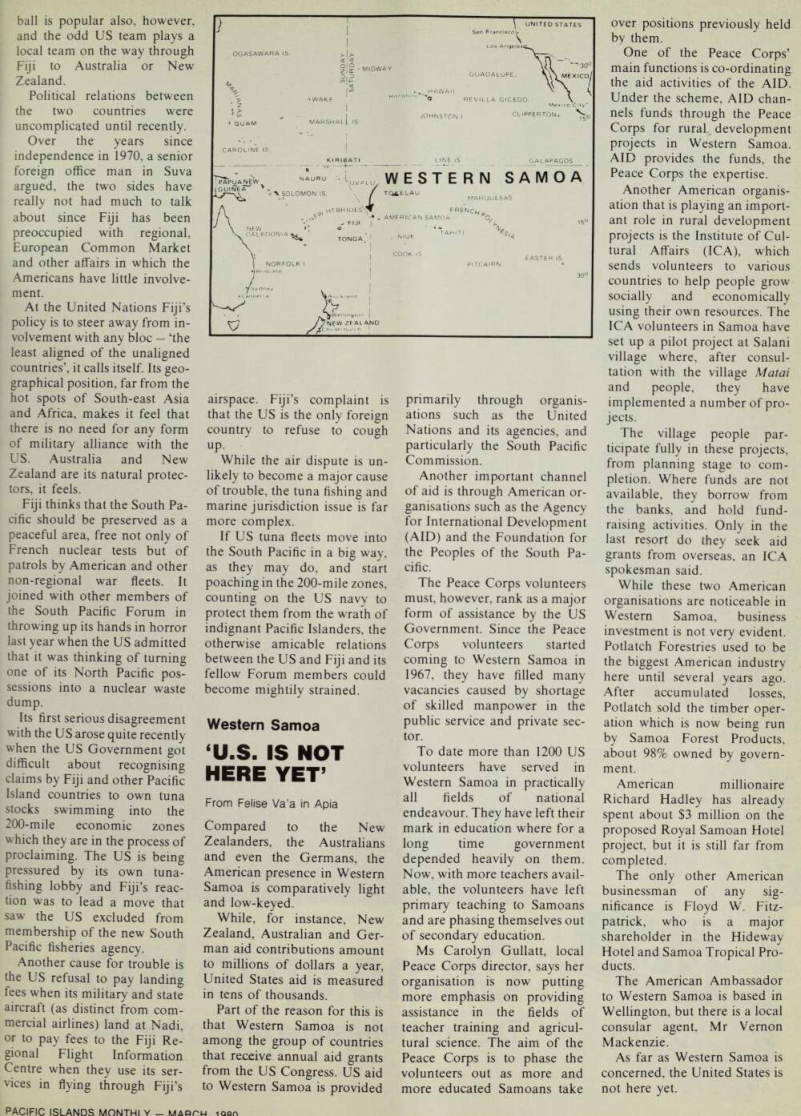
Western Samoa
‘U.S. Is Not
primarily through organis
ations such as the United Nations and its agencies, and particularly the South Pacific Commission.
Another important channel of aid is through American or ganisations such as the Agency for International Development (AID) and the Foundation for the Peoples of the South Pa cific.
The Peace Corps volunteers must, however, rank as a major form of assistance by the US Government. Since the Peace Corps volunteers started coming to Western Samoa in 1967, they have filled many vacancies caused by shortage of skilled manpower in the public service and private sec tor.
To date more than 1200 US volunteers have served in Western Samoa in practically all fields of national endeavour. They have left their mark in education where for a long time government
depended heavily on them.
Now, with more teachers avail able, the volunteers have left
primary teaching to Samoans
and are phasing themselves out of secondary education.
Ms Carolyn Gullatt, local Peace Corps director, says her
organisation is now putting
more emphasis on providing
assistance in the fields of teacher training and agricul tural science. The aim of the Peace Corps is to phase the volunteers out as more and more educated Samoans take
From Fslise Va’a in Apia Compared to the New Zealanders, the Australians and even the Germans, the American presence in Western
Samoa is comparatively light
and low-keyed.
While, for instance, New Zealand, Australian and Ger man aid contributions amount to millions of dollars a year, United States aid is measured in tens of thousands.
Part of the reason for this is that Western Samoa is not among the group of countries that receive annual aid grants from the US Congress. US aid to Western Samoa is provided
over positions previously held
by them.
One of the Peace Corps’ main functions is co-ordinating the aid activities of the AID.
Under the scheme, AID chan nels funds through the Peace Corps for rural., development projects in Western Samoa.
AID provides the funds, the Peace Corps the expertise.
Another American organis ation that is playing an import ant role in rural development projects is the Institute of Cul tural Affairs (ICA), which sends volunteers to various countries to help people grow
socially and economically
using their own resources. The ICA volunteers in Samoa have set up a pilot project at Salani village where, after consul tation with the village Matai
and people, they have
implemented a number of pro
jects.
The village people par
ticipate fully in these projects,
from planning stage to com pletion. Where funds are not available, they borrow from the banks, and hold fund raising activities. Only in the last resort do they seek aid grants from overseas, an ICA
spokesman said.
While these two American organisations are noticeable in Western Samoa, business investment is not very evident.
Potlatch Forestries used to be
the biggest American industry
here until several years ago.
After accumulated losses, Potlatch sold the timber oper ation which is now being run by Samoa Forest Products, about 98% owned by govern ment.
American millionaire
Richard Hadley has already
spent about $3 million on the proposed Royal Samoan Hotel project, but it is still far from
completed.
The only other American businessman of any sig nificance is Floyd W. Fitz patrick, who is a major shareholder in the Hideway Hotel and Samoa Tropical Pro ducts.
The American Ambassador to Western Samoa is based in Wellington, but there is a local consular agent, Mr Vemon Mackenzie.
As far as Western Samoa is concerned, the United States is not here yet.