Two Forming
pp. 25-26 · Read in the full issue
Fiji
A Cloud Or
From Robert Keith-Reid in Suva American actor Raymond Burr was one of the first to do it.
New York publisher and multi millionaire Malcolm Forbes did it too. So did two wealthy Californians, Jay Johnson and Richard Evanson, as well as a company called the University Place Corporation, of Califor nia.
What did they all do? They each bought one of Fiji’s few freehold islands.
At least 50 other American buyers have a stake in Fiji’s limited area of freehold land, which adds up to less than 10% of the total.
But apart from the flam boyancy of characters like Forbes, the glamour attached to Burr’s name, and the com paratively recent investment some American businessmen have made in a few hotels, the American presence in Fiji is not all that obvious.
In fact, inquiries into the extent of US involvement show that apart from land holdings there’s not really all that much compared to what Australians and New Zealanders have tied up in the country.
As tourists Americans are
not especially evident only
30 000 a year for a country that handles about 200 000 a year.
Pan Am operate two return flights a week through Nadi on flights between Honolulu and Sydney, and last May Con tinental Airlines started the same frequency of service via Honolulu.
Apart from outboard engines and bulldozers, American products are not much in evidence either. Last year the US had only about 5%
of Fiji’s $4OO 000 000 a year import market. With the excep tion of land, direct US invest ment is confined to several hotels, a timber mill, a helicop ter company, and in mineral and oil prospecting.
The Peace Corps has been around for 15 years but that is a low-key outfit also.
One of America’s biggest banks. Citibank, tried to make a go of it in Fiji, but after five years, and after incurring sev eral million dollars in losses, it
pulled out.
US aid has hardly touched Fiji, since there is little of it and, apart from the influence of American films and jargon, US ideas have little foothold either.
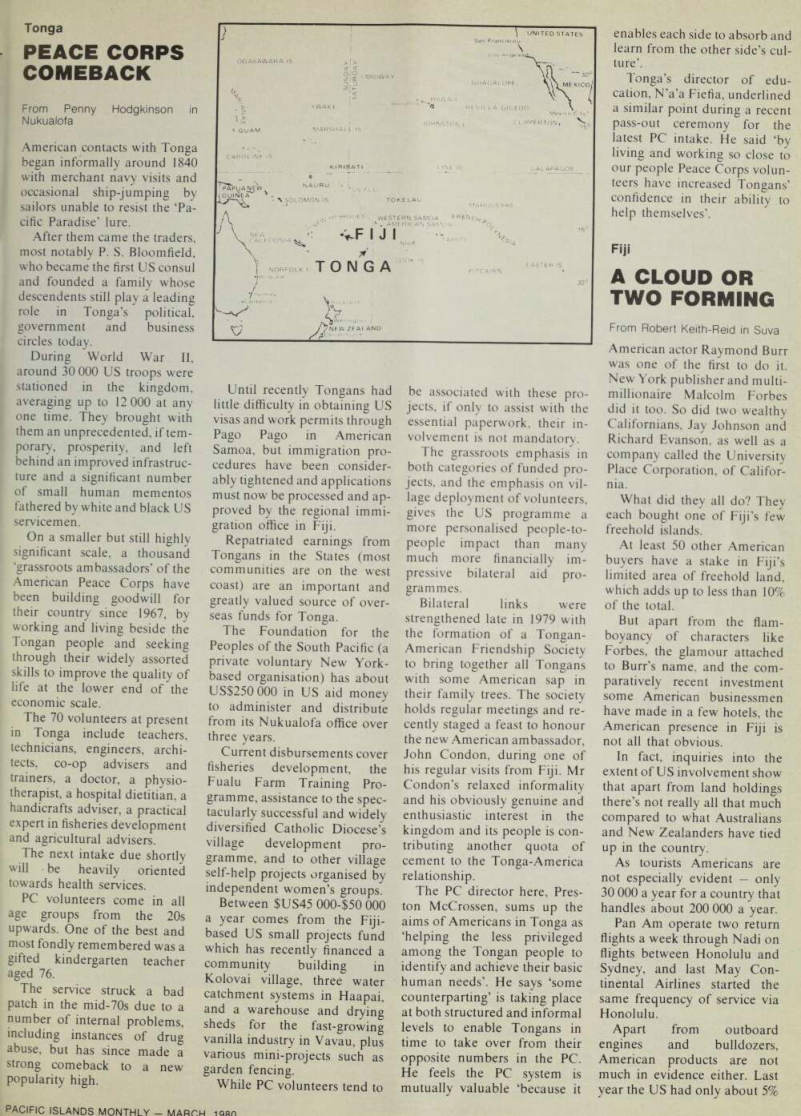
But as the South Pacific’s crossroads, Fiji is beginning to attract more US political and economic attention. A five
floor embassy building, leased
for 10 years with an option to
buy, stands conveniently close
to Government Buildings and contains the office of a fully fledged American Ambassa dor, Mr John Condon, who took over from the charge d’af faires who had previously headed the post.
Apparently uneasy about increasing Russian and Chinese overtures to the newly independent countries of the region, and itself interested in marine .resources such as tuna and seabed minerals, the US
has begun forging stronger pol
itical links with a region it had not previously bothered about too much.
Now Suva is shaping up as the centre for US political activity in the South Pacific.
After a mid-19th century row with Fijian chiefs over some land claims in Fiji by American adventurers, the US didn’t bother about Fiji again until World War 11, when it became a forward base for operations against the Japanese. After World War II about the only link with the US was Pan Am.
Then ip the late 1960 s
Americans began buying up
land in Fiji in a wave of specu lation that lasted until about 1974, when Fiji enacted anti
speculation legislation and a
world recession arrived.
Several scores of freehold
properties, ranging from min
ute islets to copra plantations
of 2000 acres and more, passed into American ownership and mostly remain there. But with a few exceptions the new owners have done little with
their land, being apparently
ready to wait until conditions
are ripe enough to bring them
a hefty profit, despite a 30%
speculation gains tax.
Burr has made other invest ments in Fiji, being a share holder in one of Fiji’s two daily newspapers, the Fiji Sun.
Forbes bought Laucala island, one of the biggest free hold islands available, for about $1 million. He has put in a lot of money turning it into a model plantation, with high class accommodation for his workers and a new school and
community centre.
Los Angeles businessman Jay Johnson owns Kaibu island. He’s also a substantial shareholder in the busy local service airline. Fiji Air.
In the Yasawa Islands Richard Evanson has turned Nanuyalevu into an exclusive resort. He owns Turtle Air ways, which runs non scheduled services with floatplanes about Fiji, and he has a big interest in the large Fiji Regent Hotel at Denarau Island, near Nadi.
In Vanua Levu the Courtesy Bench Corporation has 4000 ha of land. It is planting 2400 ha with pine and is think
ing about planting cocoa.
American involvement in the tourism scene started in the mid-1960s when a group of Pan
Am pilots pooled their savings
and started a company that led to the building of the Mocambo Hotel at Nadi air port, and later the 300-room Fijian resort hotel at Cuvu.
Majority control of these two hotels has since passed into Singapore hands, but the American initiative gave Fiji its first world-class resort (the
Fijian).
In the late 1960 s a California company. Commercial Invest
ment Properties Ltd, acquired
the lease of Denarau island. Its initiative has led to another big resort, the Fiji Regent, which at $2O million is the biggest single US investment in Fiji. The
Bishop Corporation of Hono
lulu has a 67% interest in the resort.
At Korolevu a Los Angeles business group took over the half-built shell of a big hotel that was started by an Aus tralian company that went bankrupt, and in December 1979, at a completed cost of $l2 million, opened it as the Hyatt Regency. Next door, Califor nian businessman Gordon Oliver has recently taken over the lease of the famous Korolevu Beach Hotel, with an option to buy it, and is talking of a $7 million re
development.
At Deuba, Honolulu busi nessman Larry Bortles has the Tropic Sands Motel, and is talking of a major resort on an
adjacent site.
Mr Bill Daly’s American Investments Ltd runs a modern sawmill at Deuba, and he and former US associates carried out a large and profitable residential and commercial sub-division at Laucala Bay, in Suva.
Seattle businessman Ed Chopot owns Pacific Crown
Aviation, Fiji’s only helicopter
company, which runs five ma chines on a wide variety of work. Another American business group recently
acquired a logging concession
near Sigatoka and is said to be planning to put up a sawmill to handle logs and later veneers.
In January 1980 the Fiji Government was disappointed when America’s giant Amax group and its Australian. Ger man and British partners de cided to shelve further exploration at Namosi indefinitely as low copper prices and low ore grades mean they are not worth mining yet.
But by the end of March another US giant. Standard Oil of California, through a sub sidiary company. Chevron, is due to start drilling Fiji’s first exploratory oil well. And the big US oil explorer. Mapco, is active in Fiji. Standard and Mapco were attracted to Fiji by the work of a small prospector.
Pacific Energy and Minerals
Ltd, of Colorado, which be sides oil has now begun a hunt
for gold.
There’s virtually no US in volvement in the local com merce and industry scene otherwise, and in 1979 US exports to Fiji were worth only $22 366 000 - only 5.7% of the total.
In Suva the embassy’s re cently established commercial office hopes to get this pro portion increased and will hold its first trade fair, with 20 US companies likely to be in volved, in July.
The embassy’s commercial secretary, Mrs Dinny Laufen bak, says: ‘US businessmen, who used to fly through Nadi to Australia without stopping, are now beginning to stop off.
They have been asking for population and trade figures and are surprised by the size of the market.’
US direct aid to Fiji is not so far significant, apart from emergency supplies and equip ment delivered after hurricane disasters, and the supply, at a nominal figure, of the three small minesweepers which make up the Fiji navy.
US universities and foun dations are another source of occasional help, and the University of the South Pacific and the University of Hawaii signed an agreement in January for a five-year co
operative programme.
Apart from the hotels, prob ably the most significant US presence in Fiji is the Peace Corps. This started work in the late 1960 s and maintains an av erage of 150 to 200 volunteers who worked in areas specified by the government. These are mainly in school teaching, in
agriculture, with co-operatives,
rural development in agencies
of the ministry of finance and planning or other technical fields.
The government prefers
older, qualified and experi
enced volunteers, and these are mainly what it gets after ex
periences with some freshly
graduated volunteers who caused some problems in the
early days.
Fiji’s British connections gave it soccer, cricket and Rugby Union, and in con sequence not much inclination for meeting Americans in sport outside of these games. Basket