Love Affair
p. 15 · Read in the full issue
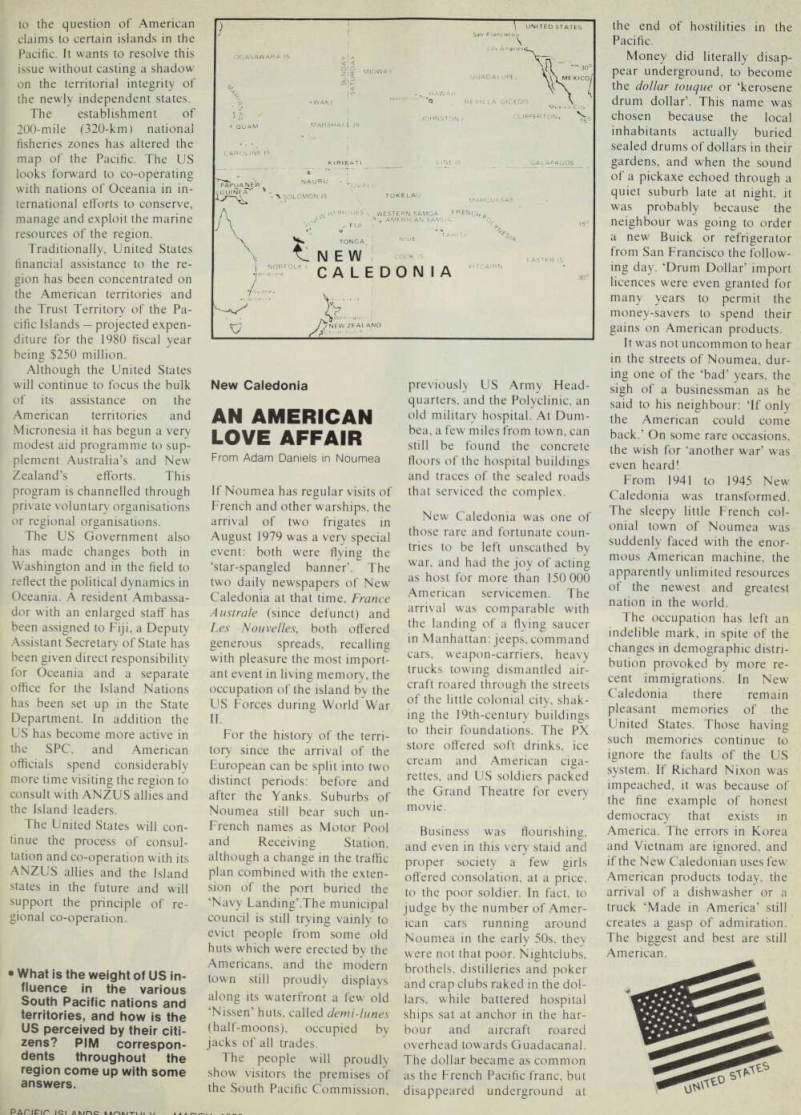
New Caledonia
An American
previously US Army Head quarters, and the Polyclinic, an old military hospital. At Dum bea, a few miles from town, can still be found the concrete floors of the hospital buildings and traces of the sealed roads that serviced the complex.
New Caledonia was one of those rare and fortunate coun tries to be left unscathed by war, and had the joy of acting as host for more than 150 000 American servicemen. The arrival was comparable with the landing of a flying saucer in Manhattan: jeeps, command
cars, weapon-carriers, heavy
trucks towing dismantled air craft roared through the streets of the little colonial city, shak
ing the 19th-century buildings
to their foundations. The PX store offered soft drinks, ice cream and American ciga rettes, and US soldiers packed the Grand Theatre for every movie.
Business was flourishing, and even in this very staid and proper society a few girls offered consolation, at a price, to the poor soldier. In fact, to judge by the number of Amer ican cars running around Noumea in the early 50s. they were not that poor. Nightclubs, brothels, distilleries and poker and crap clubs raked in the dol lars, while battered hospital ships sat at anchor in the har bour and aircraft roared overhead towards Guadacanal.
The dollar became as common as the French Pacific franc, but
disappeared underground at
From Adam Daniels in Noumea If Noumea has regular visits of French and other warships, the arrival of two frigates in August 1979 was a very special event; both were flying the ‘star-spangled banner’. The two daily newspapers of New Caledonia at that time, France Australe (since defunct) and Les Nouvelles, both offered generous spreads, recalling with pleasure the most import ant event in living memory, the occupation of the island by the US Forces during World War 11.
For the history of the terri tory since the arrival of the European can be split into two distinct periods; before and after the Yanks. Suburbs of Noumea still bear such un- French names as Motor Pool and Receiving Station, although a change in the traffic plan combined with the exten sion of the port buried the
‘Navy Landing’.The municipal
council is still trying vainly to evict people from some old huts which were erected by the Americans, and the modern
town still proudly displays
along its waterfront a few old ‘Nissen’ huts, called demi-lunes
(half-moons), occupied by
jacks of all trades.
The people will proudly
show visitors the premises of the South Pacific Commission,
the end of hostilities in the Pacific.
Money did literally disap
pear underground, to become the dollar touque or ‘kerosene drum dollar’. This name was chosen because the local inhabitants actually buried sealed drums of dollars in their gardens, and when the sound of a pickaxe echoed through a quiet suburb late at night, it was probably because the neighbour was going to order a new Buick or refrigerator from San Francisco the follow
ing day. ‘Drum Dollar’ import
licences were even granted for many years to permit the money-savers to spend their gains on American products.
It was not uncommon to hear in the streets of Noumea, dur ing one of the ‘bad’ years, the sigh of a businessman as he said to his neighbour: ‘lf only the American could come back.’ On some rare occasions, the wish for ‘another war’ was even heard!
From 1941 to 1945 New Caledonia was transformed.
The sleepy little French col onial town of Noumea was suddenly faced with the enor mous American machine, the apparently unlimited resources of the newest and greatest nation in the world.
The occupation has left an indelible mark, in spite of the
changes in demographic distri
bution provoked by more re cent immigrations. In New Caledonia there remain pleasant memories of the United States. Those having such memories continue to ignore the faults of the US system. If Richard Nixon was impeached, it was because of the fine example of honest democracy that exists in America. The errors in Korea and Vietnam are ignored, and if the New Caledonian uses few
American products today, the
arrival of a dishwasher or a truck ‘Made in America’ still creates a gasp of admiration.
The biggest and best are still American.