Can the U.S. steer
pp. 11-14 · Read in the full issue
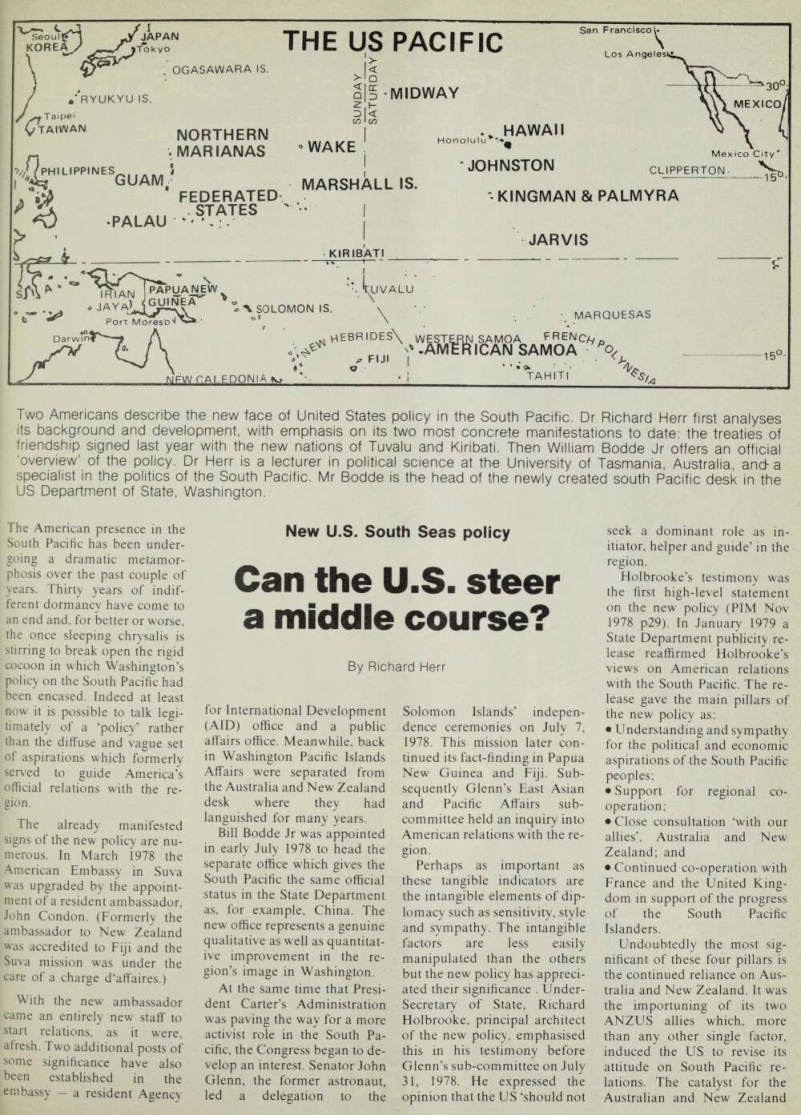

New U.S. South Seas policy Can the U.S. steer a middle course?
By Richard Herr
The American presence in the South Pacific has been under going a dramatic metamor phosis over the past couple of years. Thirty years of indif ferent dormancy have come to an end and, for better or worse, the once sleeping chrysalis is stirring to break open the rigid cocoon in which Washington’s policy on the South Pacific had been encased. Indeed at least now it is possible to talk legi timately of a ‘policy’ rather than the diffuse and vague set
of aspirations which formerly
served to guide America’s official relations with the re
gion.
The already manifested signs of the new policy are nu merous. In March 1978 the American Embassy in Suva
was upgraded by the appoint
ment of a resident ambassador, John Condon. (Formerly the ambassador to New Zealand was accredited to Fiji and the Suva mission was under the care of a charge d‘affaires.) With the new ambassador came an entirely new staff to start relations, as it were, afresh. Two additional posts of some significance have also been established in the
embassy a resident Agency
for International Development (AID) office and a public affairs office. Meanwhile, back in Washington Pacific Islands Affairs were separated from the Australia and New Zealand desk where they had languished for many years.
Bill Bodde Jr was appointed in early July 1978 to head the separate office which gives the South Pacific the same official status in the State Department as, for example, China. The new office represents a genuine qualitative as well as quantitat ive improvement in the re
gion’s image in Washington.
At the same time that Presi dent Carter’s Administration was paving the way for a more activist role in the South Pa cific, the Congress began to de velop an interest. Senator John Glenn, the former astronaut, led a delegation to the
Solomon Islands’ indepen dence ceremonies on July 7, 1978. This mission later con tinued its fact-finding in Papua New Guinea and Fiji. Sub sequently Glenn’s East Asian and Pacific Affairs sub committee held an inquiry into American relations with the re
gion.
Perhaps as important as
these tangible indicators are the intangible elements of dip
lomacy such as sensitivity, style
and sympathy. The intangible
factors are less easily manipulated than the others but the new policy has appreci ated their significance . Under secretary of State, Richard Holbrooke, principal architect of the new policy, emphasised this in his testimony before Glenn’s sub-committee on July 31, 1978. He expressed the opinion that the US ‘should not
seek a dominant role as in itiator, helper and guide’ in the
region.
Holbrooke’s testimony was the first high-level statement on the new policy (PIM Nov 1978 p 29). In January 1979 a
State Department publicity re
lease reaffirmed Holbrooke’s views on American relations with the South Pacific. The re lease gave the main pillars of the new policy as:
• Understanding and sympathy
for the political and economic aspirations of the South Pacific peoples; • Support for regional co
operation;
• Close consultation ‘with our allies’, Australia and New Zealand; and • Continued co-operation with France and the United King dom in support of the progress of the South Pacific Islanders.
Undoubtedly the most sig
nificant of these four pillars is the continued reliance on Aus tralia and New Zealand. It was the importuning of its two ANZUS allies which, more than any other single factor, induced the US to revise its attitude on South Pacific re lations. The catalyst for the Australian and New Zealand
overtures was of course the row stemming from Russian con ■ tacts with Tonga in 1976.
Although the US places a premium on the advice of its two ANZUS partners, it is not willing to adopt their perspec tives unquestioningly. The new regime of almost weekly liaison meetings between the State Department and Aus tralia and New Zealand
embassy staffs in Washington
do not always produce perfect
agreement.
New Zealand perhaps more than Australia has had occasion to pause and reflect on the previous period when it did not have to accord the US full collegiality in South Pacific affairs.
Whether or not the new pol
t icy is altogether what New
* Zealand had in mind at the [ 1976 and 1977 meetings of the ANZUS council of ministers, t the January statement indi ‘ cated that the emergent policy has yet to fully extend its wings.
The release nominates three particular areas of ‘special attention’ for the future: • The establishment of a larger and more effective US pres ence in the area; • Participation in regional or
ganisations; and
• Termination of the Micronesian trusteeship by 1981.
What the State Department
ultimately intends by ‘a larger
and more effective US pres ence’ is still under consider ation. However, Senator Glenn’s trip report for his Solomon Islands visit pub lished in late 1978 suggests sev eral possible lines of action
including reopening the con
sulate in French Polynesia,
posting a State Department
official in Pago Pago, and more frequent visits by US officials and naval vessels to the region.
The aspirations of the Island states are expected to be a key influence on American de cisions regarding a larger re gional presence if and when the Carter budget squeeze permits new initiatives to be taken.
Indicative of both the motiv ations and directions of the new US foreign policy towards the South Pacific are the treat ies of friendship with Tuvalu and Kiribati. The Tuvalu treaty was signed in February 1979 and the one with Kiribati in
September. Both treaties were felt by Washington to be necessary to allow the US to re linquish its claims to islands in each country. Despite some op position in Hawaii and American Samoa, the Carter Administration has insisted on
demonstrating its good neigh
bourliness towards the South
Pacific by surrendering its
disputed claims to a score of islands and atolls in the Central Pacific. The treaty avenue was selected since it involves only one chamber of the Congress’s two houses the Senate and thus is presumed to ensure an easier passage of the act of re nunciation.
Nonetheless, the generosity of the US has not been extended without a quid pro quo. In the case of Tuvalu there is a clause obliging Tuvalu to consult with the US before third parties are allowed to use
Tuvaluan territory for military
purposes. Another clause seeks to facilitate a fisheries connec tion between Tuvalu and American Samoa. (Tuvalu’s waters are vital to the two large canneries at Pago Pago.) Simi lar clauses were written into the treaty with Kiribati. Undoubt edly both clauses could secure mutual advantages for all par ties in the long run, but the immediate advantages appear to favour the US. Still, official sources maintain, the revo cation of American claims to the islands is final, while the other clauses only provide for a process of consultation which can be terminated after 10 years.
The Kiribati treaty contains special provisions concerning the islands of Canton and Enderbury in the Phoenix group. While the US renounces its claim to them, the treaty provides that facilities built by the US on the islands (and on the atoll of Hull) will not be used by third parties for mili tary purposes without US agreement.
Regional organisation is seen both as a ‘pillar’ of policy and an area for ’special atten tion’ by the US. The US is anxious that regionalism should succeed in the South Pacific, but at the same time it would like to ensure its own entree into the regional
decision-making process.
Through its membership in the South Pacific Commission (SPC) the US does have some access.
Since the South Pacific Forum, however, handles all the politically sensitive issues including the vital fisheries issue this access is not always sufficient. The apparently suc cessful attempt by some states at the Niue Forum (September 1978) to hold the US at arm’s
length by keeping the
Americans out of the regional fisheries organisation is the current case in point. There appear to be few easy solutions to the dilemma of Washing ton’s desire for a larger re gional role as long as countries like Fiji, Papua New Guinea and the Solomons oppose a greater American involvement in Forum-sponsored projects.
Thus far the US has been seeking to maintain a low pro file in the controversy over South Pacific regional organis ations a low profile, that is, by its own estimation. Some critics have suggested nonetheless that the US has exacerbated some regional dis putes by pursuing its own aims
bilaterally especially in the
area of fisheries. A grain of truth in this complaint cer tainly exists in the case of the treaties of friendship with Tuvalu and Kiribati, although
virtually all the Washington
sources insist that any regional ramifications from America’s bilateral arrangements are unintentional. In the case of the Pacific Islands Develop ment Corporation’s meeting in Pago Pago in January 1979 to discuss regional fisheries issues, the charge of mischief making is less plausible. The initiative here seems to have originated almost wholly in Pago rather than Washington.
In contrast with the in creased Australian interest in the South Pacific from 1976, the American involvement has not relied heavily on develop ment assistance. Figures re
leased by the AID office in Suva show that from 1977 to September 30, 1979, the sum of $4 667 319 had been allocated to various aid-funded projects in the South Pacific. Prior to 1977 the US gave almost no aid to the South Pacific.
But the US aid programme in the South Pacific is growing.
An ultimate ceiling has not yet been established but, if and when Carter’s budget pause is lifted, something close to the European Economic Com munity figure of $5 million an
nually might be expected by
the mid-1980s. In line with US aid policy elsewhere, large pro jects are discouraged. The old ‘trickle down from the top’ view of aid has been replaced by a ‘basic human needs’ ap proach which tends to favour
appropriate technology and
small grassroots development projects. Partly as a con sequence of this outlook on aid, the US Government plans to rely heavily on non governmental aid agencies.
More than half the US aid budget in the South Pacific appears destined to be dis bursed by such private bodies as the Foundation for the Peoples of the South Pacific and the YMCA.
American military aid has been rare in the South Pacific
and developments regarding
the fisheries issue have tended to complicate the matter in re cent times, especially since the need to patrol the 200-mile led_to more interest in this form of assistance.
Conflicting reports on why
some recent requests from the Islands for military assistance (mainly patrol and surveillance
equipment and training) have
been refused only add to the confusion.
Some in the State Depart ment have suggested that it would be impolitic for American military aid to be used to capture American vessels which could be excluded from vast areas of the region if the US were not al lowed to join the regional fisheries agency. Other sources intimate that the problem is
essentially procedural there
being little expertise in the South Pacific in applying in due and proper form for mili tary assistance.
An underlying basis for the
American involvement in South Pacific affairs arises from its territorial possessions in the region. They have been both a source of strength and weakness in official US re lations with the South Pacific.
American Samoa, Guam and the Trust Territory of the Pa cific Islands contribute a
special legitimacy to the
American presence in the area.
The US is intimately in volved with the people of the region in a way that Canada, Japan and the Soviet Union are not. On the other hand, the American relationship with its possessions has caused some
disquiet among the indepen
dent states. Absorption rather than independence has charac terised the political develop ment of American territories.
The difference with other metropoles (except France) is marked. ‘Had Hawaii been retained by Britain, it would be an independent state today,’ is the view adopted by critics of America’s territorial policy in the Pacific.
The Micronesian nego tiations may help to change this colonial image. Recent developments mean that the TTPI will emerge from its trus teeship in four parts (at a mini mum). The Northern Marianas
are following precedent and
will draw closer to the US by virtue of their commonwealth status, The other three areas Palau, the central districts (known now as the Federated States of Micronesia) and the Marshalls appear destined for an enhanced version of self government referred to in the US as Tree association’. Each country is to have control of its own foreign policy and indeed each is expected to maintain separate overseas missions.
There is, however, to be a
qualification on this foreign
policy power the treaties ter minating the trust are expected to give the US a veto on matters relating to security and de fence.
On the surface, the free as sociation status would appear to be closer to full indepen dence than that enjoyed by either the Cooks or Niue where both foreign affairs and de fence are formally vested in New Zealand. Whether or not this view is adopted by the
Forum countries in ruling on the eligibility of the three future Micronesian states for
membership will depend in
part on other conditions in the termination agreement. A suc cessful result on termination could restore some of America’s tarnished image as a colonial power.
The new American foreign policy in the South Pacific is still emergent. While its shape and direction are no longer simply inchoate expectations subsumed under the perceived Australasian stance, the new policy is not fully settled. It is
uncomfortably dependent on
the personalities and interests of a few people in Washington and the Pacific.
Opposite the Charybdis of
indifference is the Scylla of domination. The US insists that its new policy does not seek to impose any form of he gemony in the South Pacific.
Nonetheless the mere presence of the US in the region could attract great-power rivalry if the US is not circumspect in its demands of the region.
The treaties of friendship with Tuvalu and Kiribati demonstrate the depth of con cern the US feels for its stra tegic and economic interests in a South Pacific which increasingly identifies with the Third World. By the same token the treaties could be said to illustrate the new sensitivity felt in Washington for Islands opinion and. indeed, even genuine attempts at accom
modating this opinion where
possible.
Somewhere along the line a balance will be struck between
the fishing lobby in Congress
and the military strategists of the Pentagon on the one hand, and those favouring a policy
which gives a high priority to
Islands aspirations on the other.
Critics continue to doubt that the US can steer a middle course between apathy and over-involvement in the long term. Those presently respon sible for American policy in the South Pacific maintain that their actions will prove other wise. What cannot be doubted is that the chrysalis is opening as the new policy stirs within.
Only time will tell whether it is to become either butterfly or moth.