project
pp. 5-10 · Read in the full issue

Letters
Politicians to the
rear please
I would like to say how pleased I am to see that a Polynesian maiden is once again gracing your front cover (PIM, Nov).
Please take no notice of the correspondent who wrote advising that such illustrations should be beneath the dignity of PIM.
The appropriate place for
pictures of South Pacific poli ticians should be the rear pages.
Hugh Norwood
Geography Dept.
Massey University Palmerston North, NZ
Reply from
Miriama Chambault
We generally don’t read Pacific Islands Monthly. There is a long time view (in New Caledonia) that the aim of your publication is more subversion than information.
But concerning your October report of the South Pacific Games, we were surprised to read that ‘Miriama Chambault hated to win her two golds 100 m. and long-jump for the territory in which she now lives’.
You really have been gone too far! How can you write such nonsense? About a woman who came here seven years ago by her own decision after many years in New Zealand? Now married to a Frenchman, she is a mother of a child, Christopher. Do you mean that somebody FORCED her to stay in New Caledonia? But moreover, how can you say that about a woman who placed SPORTS over everything? When she thinks about sports and compe tition, she forgets the meaning
of ‘country’, ‘people’, ‘colour’
or origin. She works hard to win. That’s all!
And don’t say that this kind of thinking is due to the ‘fanatic Paris desire to convince Pacific neighbours that French is the best’. There are no ‘fanatics’ in Paris regarding New Cale donia, and we should dare to say, unfortunately for us!
Miriama Chambault would be as proud of her two gold medals whether she was living in Australia, Fiji, or New
Zealand. As a sportswoman she has had the most beautiful life that a woman can dream of: travelling around the world from Europe to USA for her
unique passion: SPORT. She
was not French, yet now she is.
And she is not so ‘rich’.
She simply discovered one day that all her philosophy was expressed in this short sentence from the Frenchman Pierre De Coubertin that you probably
know: L’important c’est depar
ticiper . . .
This could be enough for her to be proud of being a French woman. But there are also a lot of other reasons. This letter was published in La France Aus trale on November 8.
Alain & Miriama Chambault
Noumea New Caledonia • PI M's coverage of the Games was from former editor Bob Hawkins, who comments briefly
from abroad: ‘Perhaps my use of
the word “hate” was, unfortuna tely, too strong for the occasion.
What I intended to convey was the message that Miriama Chambault, whatever course her life has now taken, was first and foremost a Fijian and proud to be so. As to who finances what, it was clear at the Games that everyone, wherever they came from, had had to stretch themselves to the limit to raise enough money to get their teams to Suva. What was obvious, however, was the relative afflu ence of athletes from French col onies against that of athletes
from independent nations.'PlM
apologises to the Chambaults for any hurt they felt over the comment, which was not intended. Editor
Facts needed
on Donald McLeod
I am the great-niece of an early
Pacific pioneer. Captain
Donald McLeod, whose story I am trying to write. I’m sure it would contain much of interest from his birth at Cape Bre ton Island, Nova Scotia in 1845, to his arrival in New Zealand on the Breadalbane in 1858 at the age of 13, and his life in the New Hebrides from 1868 until his death in Noumea in 1894.
My father was Graham Kerr, of Kerr Bros, and these days, sadly, we have no connec tion with the group. I myself was born in Vila in 1917 and I’m trying to reconstruct my family’s history in the New Hebrides before it is too late.
I would be pleased to hear from any reader with infor mation about Captain McLeod.
Katherine Cawsey (Mrs)
122 Cowper Street Dickson ACT 2602
Lateiki reminds
him of Vulcan
Many thanks for the most in formative article by E. A.
Crane, on Tonga’s new island, Lateiki. (PIM, Nov.). I found
the article, pictures, diagram
and map all the more interest ing for having seen Rabaul’s Vulcan Island four or five days after it had erupted, causing such damage and hardship to that beautiful area. I well re-
member seeing coconut palms that had been snapped off like matchwood six feet or so above
ground by the accompanying
earthquake, and, as in the vicinity of Lateiki, a sea of pumice some distance from the harbour.
As all that happened over 42 years ago, there may not be too many around who were there when it actually happened, es pecially as World War II inter vened. If there is someone whose memory of it is good (es
pecially from the vulcanology
angle), I’d be delighted to hear from him/her. I am beginning to feel like the last dodo on Mauritius: I have even been told that it didn’t happen!
Again, thanks for all the good things in PIM
Kit Hetherington
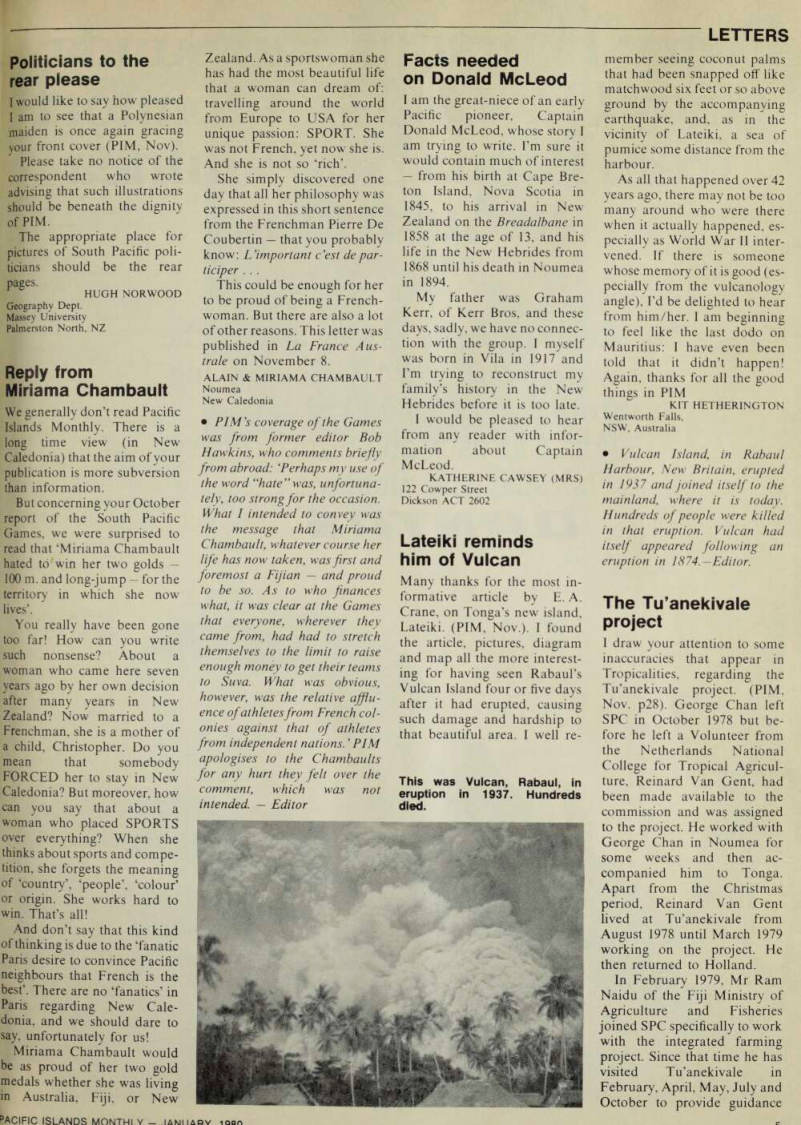
Wentworth Falls, NSW, Australia • Vulcan Island, in Rabaul Harbour, New Britain, erupted in 1937 and joined itself to the mainland, where it is today.
Hundreds of people were killed in that eruption. Vulcan had
itself appeared following an
eruption in 1874.—Editor.
The Tu’anekivale
project
I draw your attention to some inaccuracies that appear in
Tropicalities, regarding the
Tu’anekivale project. (PIM, Nov. p2B). George Chan left SPC in October 1978 but be fore he left a Volunteer from the Netherlands National
College for Tropical Agricul
ture, Reinard Van Gent, had been made available to the commission and was assigned to the project. He worked with George Chan in Noumea for some weeks and then ac
companied him to Tonga.
Apart from the Christmas period, Reinard Van Gent lived at Tu’anekivale from August 1978 until March 1979 working on the project. He then returned to Holland.
In February 1979, Mr Ram Naidu of the Fiji Ministry of Agriculture and Fisheries joined SPC specifically to work
with the integrated farming
project. Since that time he has visited Tu’anekivale in
February, April, May, July and
October to provide guidance
This was Vulcan, Rabaul, In eruption in 1937. Hundreds died.
and technical advice and to ensure liaison was maintained with the Department of
Agriculture.
A second Volunteer took up post in July 1979 Mr Arjen Hettema. He proceeded im mediately to the project and like Van Gent before him, is living in the village and is employed full time on the pro ject, with regular visits from Mr Ram Naidu providing the back-up.
The Foundation for the Peoples of the South Pacific, who were the partners in the operation with the late Dr. Alo Eva, have also continued their interest and support and as late as October 31, they advised ‘as a result of recent meetings be tween Mrs Elizabeth Silver stein, president of FSP and Mr Stanley Hosie, executive direc tor of FSP and Robert Craig,
Regional Development Offi
cer, USAID. ... we are able to
provide additional funding for
the Tu’anekivale Piggery to complete Stage I and II . . .'
W. T. Brown
Director of Programmes South Pacific Commission Noumea The future of
Islands airlines
Having read articles on airlines in the Pacific (PIM, July and Oct.) with great interest. I feel that the whole issue has come to a point where something should be done. The Pacific airline industry has come to a
point where efficiency doesn’t
seem to matter, but re
equipping fleets and expansion
does. The result is that a lot of carriers are running at a loss because they are trying to grow
too quickly and picture bright
futures that are far off.
Another major problem is
that the four major carriers: Air Niugini, Air Pacific, Air Nauru and Polynesian are try ing to become “The Regional Carrier for the Pacific.” All have a monopoly on most of their routes, in particularly Air Nauru. Because of this mon opoly high fares come into the business as the carriers know that the travelling public don’t have much of a choice.
It’s a sad thing that the re nowned “charm” of the islands
is spoilt by the politics involved
in air travel between the nations of the area.
Frequency is another prob lem. This is caused by lack of aircraft. The way things are shaping up, with Air Pacific
wanting bigger aircraft, places
like Tarawa and Funafuti are going to be lucky if they see a flight to Fiji once a month!
So, which direction will the carriers take? They have an entire ocean to serve. Each of them is government owned and to a great extent government subsidised because of heavy
operating costs.
If carriers continue the path they are on now; what with rising fuel costs etc. we’re going to have a very poor airline net
work. Full of big planes going
to small places, and, in some cases, so irregularly that they might as well not bother going at all!
Suggestions to solve their problems are thrown at the air lines all the time. I know this happens in Air Niugini’s case.
However nothing seems to
happen.
Obviously with airlines like Pan Am, who’ve already pulled out and U.T.A. and Qantas that are rapidly dropping the num ber of the flights to the region,
and Air New Zealand trying to take on the whole Pacific and treating Air Pacific and
Polynesian as competitors; the
Pacific airlines are getting a hard time, and the demand to “spread their wings,” is ever
increasing. They must surely
have to join forces.
I’m not saying that there should be one airline, but I am
saying co-operation between
carriers is essential. Wouldn’t it be nice to be able to island-hop from Tahiti to Japan without
overnighting anywhere, and by
doing so making it cheaper
than going via Auckland or Syd ney! If all the airlines made a point of having the same type of aircraft and connecting con veniently with one another we’d have a wonderful airline network in the region. Pool ser vices is another healthy way of operating, because then an air line can operate a service at a loss and have the cost balanced out by its partner, while the opposite could occur on another route.
The Pacific has great poten tial and it’s a pity that it’s being kept indoors because of a lack of co-operation. Many of the peoples of the Pacific are tra ditionally related, so why can’t
their airlines stop trying to be better than one another, and get on with the job their people want them to do serve the Pacific. Not rip it off through petty competitive behaviour.
(Master) Richard Hawkins
(aged 15) Port Moresby, Papua New Ginea
John Kciia replies
to his critics In my last letter as Acting/ Director of the Institute of Papua New Guinea Studies. I wish to make known several facts through the columns of three publications in which slurs have been cast against me; of which publications yours is one.
The institute is obliged to publish creative literature vet ted by critics competent to do so. I have set up a publications board as a further form of con trol.
My contract with the National Cultural Council obliged me to deliver for publi cation by the institute a list of named fictional and non fictional works and this was done before I took over as Acting/Director. I have refused to accept the royalties I am entitled to under that con tract.
During my period as Acting/
Director, I presented to the institute no works of mine.
Indeed, I have hardly had time to write any, but the one slim volume of the period is being published outside the institute.
During that time, however, I did have the works of others published by the institute.
The institute has published a very large number of titles, a minority of which are mine and some only are works of fiction.
Work by indigenous authors
gets preference at all times.
At no time did I seek the Directorship of the Institute but acted at the request of the Minister for Culture, Edu cation and Science.
It is not my habit to debate publicly with my critics, ama teur or otherwise, but for once, and not again, I wish to make the above facts known.
Dr. J. Kolia
Institute of Papua New Guinea Studies.
Port Moresby • More letters on p.lO.
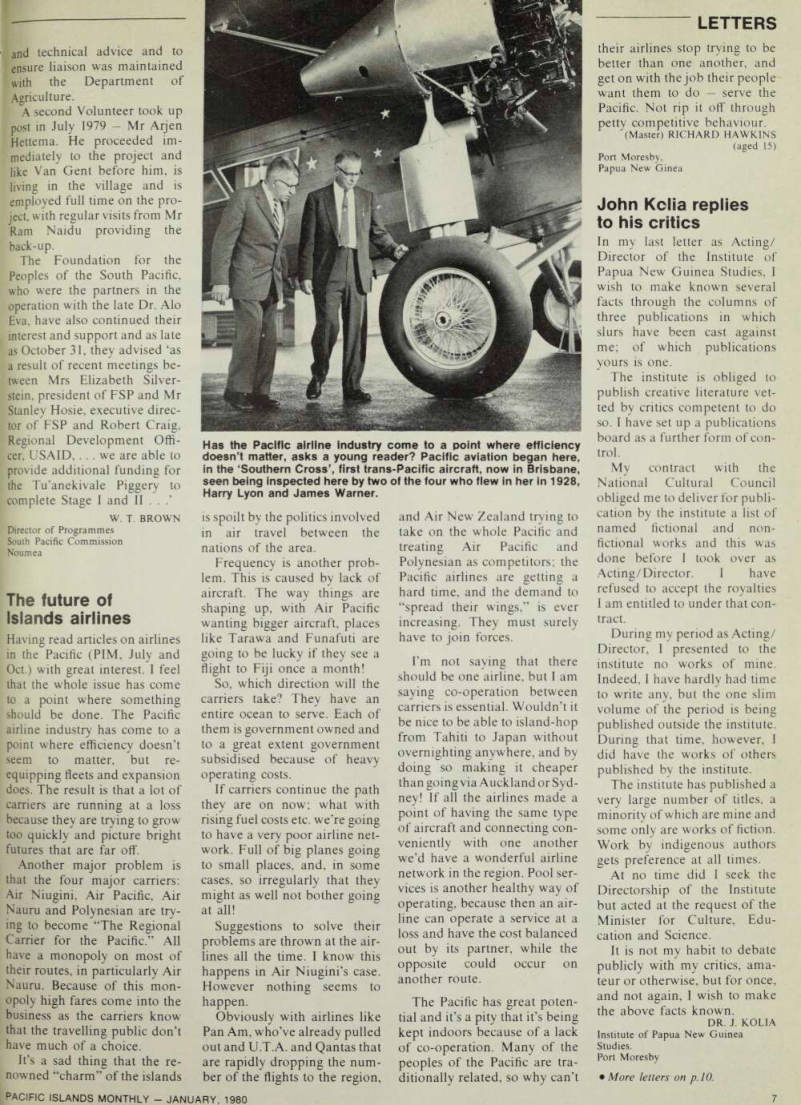
Has the Pacific airline industry come to a point where efficiency doesn’t matter, asks a young reader? Pacific aviation began here, in the ‘Southern Cross', first trans-Pacific aircraft, now in Brisbane, seen being inspected here by two of the four who flew in her in 1928, Harry Lyon and James Warner.
In defence of
cruising yachts
In reply to the criticism in the December letters columns con cerning my article on Vava’u charter (PIM Aug. 79, p. 71), which raised the subject of local attitudes to visiting yachts. I feel that the writers failed to read the article care fully and jumped to rash con clusions. Firstly, both writers used the expression ‘dumb friendly native’ as if these were my own words. They are words I would never use and consider them an insult to my many friends throughout the Pa cific.
My article does not propose that yachtsmen should receive preferential treatment and not be subject to the normal immi
gration, customs, agriculture
and health procedures. Once they have satisfied all entry re
quirements however, foreign
yachts should have the same freedom of movement as any foreign visitor who arrives by other means of transport. The point I was trying to make is that there is no reason why
people travelling on yachts
should be suspected of being criminals, just because a very small minority have broken the law.
Along with all responsible
law-abiding yachtsmen, I am
strongly in favour of any
yachtsmen caught infringing
the laws of the country in ques tion being prosecuted in the normal manner. Heavy fines, imprisonment or seizure of the offending yacht would act as a deterrent to any crews who have criminal intentions be hind their travelling.
Although accused of not having done my homework properly, I did ask Inspector Lavaki of the Vava’u police for details of any misbehaving yachts, which was quoted in the article. As to the removal of black coral, it should be pointed out that this grows at great depth, where it can only be reached with scuba diving equipment, which most yachts do not carry. In a recent survey for a yachting magazine carried out in Suva, I found that out of 50 boats, only one carried a compressor for filling tanks.
In Vava’u it was local men who were offering black coral
for sale to the visiting yachts men and when I pointed this out to Inspector Lavaki, I was told that Tongans had the right to harvest it. More to the point, the local carver Leonasi re quested a visiting yacht with diving equipment on board to supply him with black coral for his artwork. If this is an endan gered species, then it should be
protected by appropriate laws.
Visiting yachts should be in formed clearly on arrival of any such laws.
Your two letter writers, who write from Australia, dismiss
the foreign exchange brought
in by visiting yachts as unim
portant, giving the impression
that the sale of handicrafts to visitors is demeaning to the
local people. Selling souvenirs
to tourists is an accepted com mercial venture throughout the world, from the streets of Rio de Janiero to the Tower of London.
The tone of Tevita Sioka tame’s letter is typical of the attitude I’m complaining about. At least he is straight
enough to identify the problem
as one of colour and race. He would like to see the ‘palangi’
yachtsmen, among whom he queries that there are any good ones at all, pay the price for all past ‘palangi’ misdemeanours.
Yet many of these undesirable yachtsmen, especially the re spectable retired couples, have paid or are still paying taxes in their country of origin. These are the taxes which have paid for new hospitals in Vava’u and Ha’apai (NZ aid), water catch ment facilities in Ha’apai (US aid) and a sewerage system for Nukualofa (UK aid), to men tion just a few examples of the ‘selfish attitude of the palangis, who have exploited our shores for centuries’, to quote Mr Siokatame in full.
Or how about the selfish palangi yachtie who rescued a girl from drowning in the Gil berts (PIM, July 79), the count less yachties who have repaired outboard motors, generators, etc. in outlying islands, or the doctors on yachts who have given emergency treatment where no medical facilities were available.
The long distance cruising
yachts that pass through the Pacific form a community that doesn’t differ all that much from communities found ashore. They are young and old, families with children, singlehanders and retired couples, some rich, some poor.
The vast majority of these are decent, responsible, law
abiding people and the only
thing that sets them apart is their love of the sea and sailing.
This is something one would expect the peoples of the Pa cific to understand.
Jimmy Cornell.
C/- S. Y. Aventura, Honiara, Solomon Islands
When left-wing
is a dirty word
You state (PIM Nov, p 11) that the Pacific People’s Action Front is a Suva-based left-wing group. I should point out; (1) PPAF is a regional organis ation, with its sister group, the Micronesia Support Com mittee, which was formed at the Nuclear Free Pacific re gional conference in 1975.
Among other things PPAF sup ports independence move ments and the creation of a
nuclear free zone in the Pacific ocean; and opposes the passage of nuclear powered vessels anc submarines in the region, the dumping of nuclear wastes in the Pacific, the mining ol uranium for nuclear tech nology, and all nuclear test
ing.
(2) The term ‘left-wing’ indi cates biased value laden reporting which is not usual ol PIM, nor worthy of you. I have recently taken issue with other groups on this matter; it is irri tating and intended to turn readers or hearers against the group or person concerned. It is used as a dirty word.
My understanding is that the terms ‘radical’ and ‘left-wing’ represent positions that are dif ferent from that held by the majority, or the rulers, the government, or whoever. This is clearly not so, as almost all Pacific governments have a stated policy against nuclear testing in the region. Whether individuals agree with these positions or not, they are official policy of many of our governments - ergo! those of us who promote them cannot then by definition be left-wing or radical.
I personally do not regard either as a dirty word, and at times they are a compliment.
My Oxford dictionary had
them as ‘the more advanced or innovating section of a philo
sophical school, a religious
sect, a political party etc’, and ‘one who holds the most ad vanced views of political re form on democratic lines’.
But I object to their use as value laden or do I misjudge
your usage? The point being
that I cannot understand why you had to use the adjective when describing the incident it was not straight reporting. I have recently had a similar dis cussion overseas regarding my own so called ‘radical stance’ it happens that my understand ing of the gospel and my own Christian commitment take me in certain ways that the ‘world’ may well regard as radical then the commitment is ines
capable, but not political,
humanitarian rather, and therefore should not be used as a dirty word ... I am getting tired of it.
Ruth E. Lechte
Nadi, Fiji
Jim Cornell, wife Gwenda, and children Doina and Ivan (above) are experienced cruising yach ties. Jimmy defends yachties as being decent, responsible, law abiding, despite some critics.