Yachts
pp. 63-67 · Read in the full issue

entered the Pacific by round ing the notorious Cape Horn in March 1978, being the first catamaran to do this from east to west. Burghard Pieske, Luggi Bayreuther and Helga Seebeck then sailed through the Magellan Straits to Chile, from where they crossed to Tahiti. Samoa, Tonga and Fiji were visited next before head ing for Australia for the cyc lone season. Plans for 1980 include a crossing of the Indian Ocean and a return to Europe via the Red Sea. • BUMMLER (Tramp’): A 12.2 m catamaran in the Apache 40 class from Tutzig, a resort on the Stumberger Lake in Bavaria, left on the present round-the-world cruise from Vila Moura in Por tugal in June 1978. After call ing at the Azores and Canaries, the cat crossed the Atlantic to the Caribbean and Panama. Entering the Pacific in February this year, Bummler called at the Galapagos, Marquesas, Tuamotu and So ciety Islands before carrying on to Suwarrow, Western Samoa and Fiji. Bummler's crew, Ernst and Erika Bullmer, plan to spend the summer in New Zealand and in 1980 sail to the New Hebrides, Torres Straits, Bali and back to Europe via the Cape of Good Hope. • MERO: A 9 m fibreglass sloop skippered by single hander Claus Lubbert from Hamburg. Claus left home in August 1978 bound for Spain, Madeira and the Canaries. On the western side of the Atlantic he visited various islands in the Caribbean before transiting the Panama Canal in March ’79. In the Pacific Mero made stops at the Galapagos, Cocos Island, Marquesas, Tuamotus, Tahiti and the Society Islands, Suwarrow, the two Samoas and Fiji. After Sydney, where Mero plans to spend the cyc lone season, skipper Claus has no fixed plans. • FRAM; 13.85 m ketch from Berlin skippered by another German single-hander, Axel Pilz. The 46-year-old wooden double-ender has the lines of a classic Baltic yacht. She left on the present cruise from Berlin itself, sailing down the Havel and Elbe rivers to Ham
le number of cruising yachts assing through Suva during ctober 1979 was greater lan ever before, writes Jimmy ornell. After the horrors of Meli, which sank two achts near Kandavu, hardly iy skipper was planning to )end the summer in Fiji and 1 crews seemed in a hurry to at to safer places New aaland, Australia or Papua ew Guinea, before the onset the cyclone season.
The usual North American edominance was chal nged this year by an increas g number of European ichts, with German yachts in e majority. Nine yachts flying e German flag were ichored off the Royal Suva acht Club at the beginning of ctober, causing endless kes among fellow yachties )Out a new wave of German cpansionism in the South Pa fic. Details of the nine fol w.
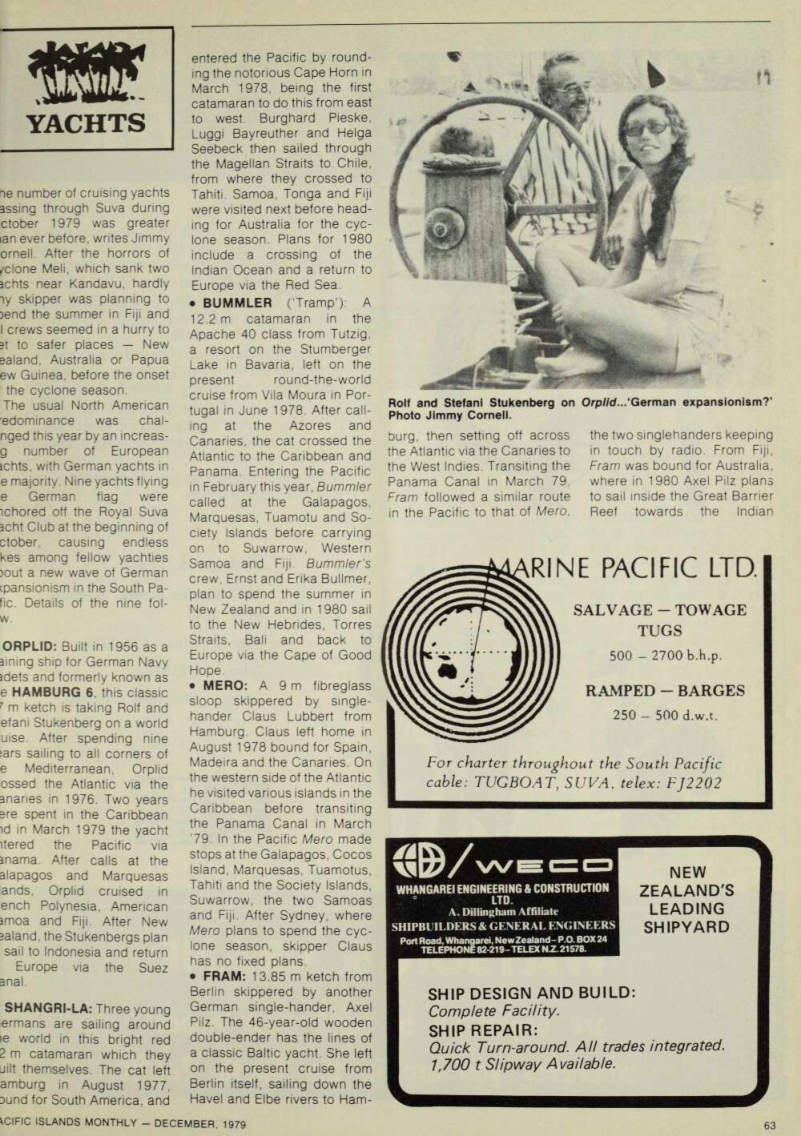
ORPLID: Built in 1956 as a lining ship for German Navy idets and formerly known as e HAMBURG 6, this classic 7 m ketch is taking Rolf and efani Stukenberg on a world uise. After spending nine sars sailing to all corners of e Mediterranean, Orplid ossed the Atlantic via the anaries in 1976. Two years are spent in the Caribbean id in March 1979 the yacht itered the Pacific via mama. After calls at the alapagos and Marquesas ands, Orplid cruised in ench Polynesia, American amoa and Fiji. After New
aaland, the Stukenbergs plan
sail to Indonesia and return Europe via the Suez anal.
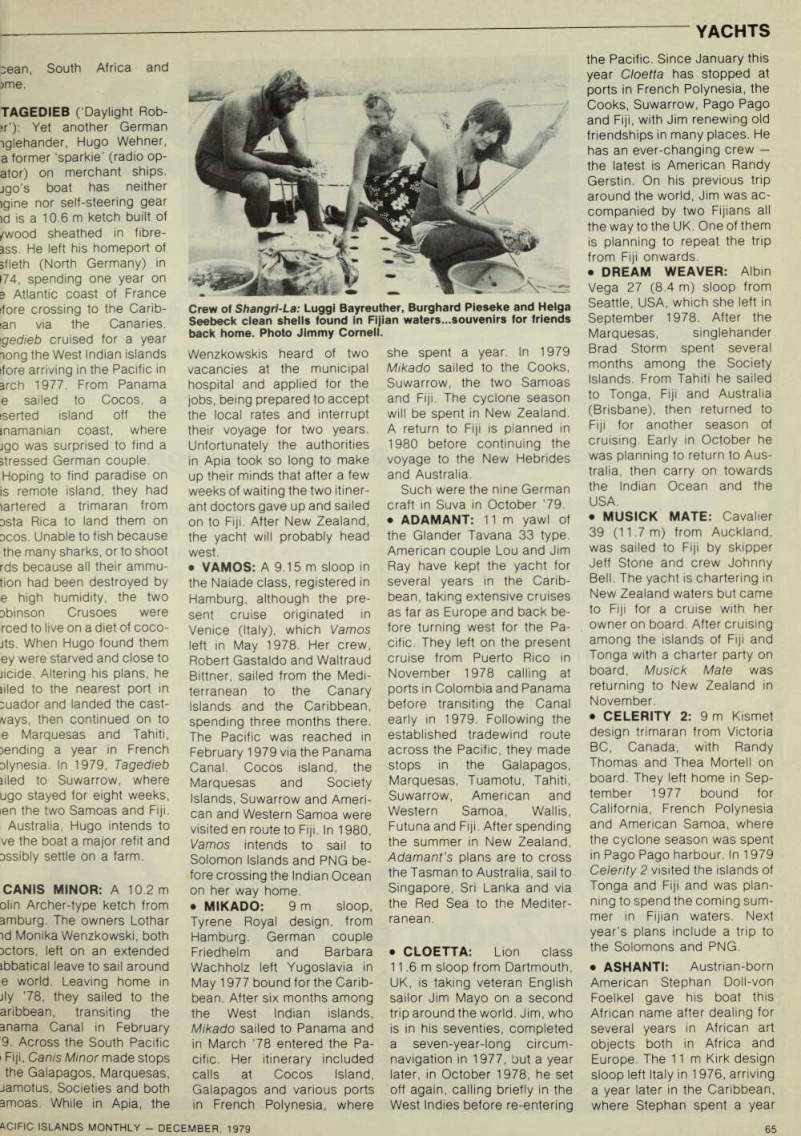
SHANGRI-LA: Three young ermans are sailing around te world in this bright red 2 m catamaran which they uilt themselves. The cat left amburg in August 1977, aund for South America, and
burg, then setting off across the Atlantic via the Canaries to the West Indies. Transiting the Panama Canal in March 79, Fram followed a similar route in the Pacific to that of Mero,
the two singlehanders keeping in touch by radio. From Fiji, Fram was bound for Australia, where in 1980 Axel Pilz plans to sail inside the Great Barrier Reef towards the Indian
Rolf and Stefani Stukenberg on Orplid... ‘German expansionism?’
Photo Jimmy Cornell.
cean, South Africa and )me.
TAGEDIEB (‘Daylight Rob ?r’): Yet another German iglehander, Hugo Wehner, a former ‘sparkie’ (radio op ator) on merchant ships, jgo’s boat has neither igine nor self-steering gear id is a 10.6 m ketch built of /wood sheathed in fibre ass. He left his homeport of sfleth (North Germany) in 174, spending one year on a Atlantic coast of France ifore crossing to the Garib ian via the Canaries. gedieb cruised for a year long the West Indian islands ifore arriving in the Pacific in arch 1977. From Panama e sailed to Cocos, a iserted island off the mamanian coast, where jgo was surprised to find a stressed German couple.
Hoping to find paradise on is remote island, they had lartered a trimaran from DSta Rica to land them on dcos. Unable to fish because the many sharks, or to shoot rds because all their ammu tion had been destroyed by e high humidity, the two Dbinson Crusoes were reed to live on a diet of coco jfs. When Hugo found them ey were starved and close to jicide. Altering his plans, he liled to the nearest port in suador and landed the cast vays, then continued on to e Marquesas and Tahiti, lending a year in French clynesia. In 1979, Tagedieb liled to Suwarrow, where ugo stayed for eight weeks, ien the two Samoas and Fiji.
Australia, Hugo intends to ve the boat a major refit and Dssibly settle on a farm.
Canis Minor: A 10.2 M
olin Archer-type ketch from amburg. The owners Lothar id Monika Wenzkowski, both ictors, left on an extended ibbatical leave to sail around e world. Leaving home in jly ’7B, they sailed to the aribbean, transiting the anama Canal in February 9. Across the South Pacific i Fiji, Canis Minor made stops the Galapagos, Marquesas, jamotus, Societies and both amoas. While in Apia, the
Wenzkowskis heard of two vacancies at the municipal hospital and applied for the jobs, being prepared to accept the local rates and interrupt their voyage for two years.
Unfortunately the authorities in Apia took so long to make up their minds that after a few weeks of waiting the two itiner ant doctors gave up and sailed on to Fiji. After New Zealand, the yacht will probably head west. • VAMOS: A 9.15 m sloop in the Naiade class, registered in Hamburg, although the pre sent cruise originated in Venice (Italy), which Vamos left in May 1978. Her crew, Robert Gastaldo and Waltraud Bittner, sailed from the Medi terranean to the Canary Islands and the Caribbean, spending three months there.
The Pacific was reached in February 1979 via the Panama Canal. Cocos island, the Marquesas and Society Islands, Suwarrow and Ameri can and Western Samoa were visited en route to Fiji. In 1980, Vamos intends to sail to Solomon Islands and PNG be fore crossing the Indian Ocean on her way home. • MIKADO: 9 m sloop, Tyrene Royal design, from Hamburg. German couple Friedhelm and Barbara Wachholz left Yugoslavia in May 1977 bound for the Carib bean. After six months among the West Indian islands, Mikado sailed to Panama and in March ’7B entered the Pa cific. Her itinerary included calls at Cocos Island, Galapagos and various ports in French Polynesia, where
she spent a year. In 1979 Mikado sailed to the Cooks, Suwarrow, the two Samoas and Fiji. The cyclone season will be spent in New Zealand.
A return to Fiji is planned in 1980 before continuing the voyage to the New Hebrides and Australia.
Such were the nine German craft in Suva in October ’79. • ADAMANT: 11 m yawl of the Glander Tavana 33 type.
American couple Lou and Jim Ray have kept the yacht for several years in the Carib bean, taking extensive cruises as far as Europe and back be fore turning west for the Pa cific. They left on the present cruise from Puerto Rico in November 1978 calling at ports in Colombia and Panama before transiting the Canal early in 1979. Following the established tradewind route across the Pacific, they made stops in the Galapagos, Marquesas, Tuamotu, Tahiti, Suwarrow, American and Western Samoa, Wallis, Futuna and Fiji. After spending the summer in New Zealand, Adamant's plans are to cross the Tasman to Australia, sail to Singapore, Sri Lanka and via the Red Sea to the Mediter ranean. • CLOETTA: Lion class 11.6 m sloop from Dartmouth, UK, is taking veteran English sailor Jim Mayo on a second trip around the world. Jim, who is in his seventies, completed a seven-year-long circum navigation in 1977, but a year later, in October 1978, he set off again, calling briefly in the West Indies before re-entering
the Pacific. Since January this year Cloetta has stopped at ports in French Polynesia, the Cooks, Suwarrow, Pago Pago and Fiji, with Jim renewing old friendships in many places. He has an ever-changing crew the latest is American Randy Gerstin. On his previous trip around the world, Jim was ac companied by two Fijians all the way to the UK. One of them is planning to repeat the trip from Fiji onwards.
• Dream Weaver: Albin
Vega 27 (8.4 m) sloop from Seattle, USA, which she left in September 1978. After the Marquesas, singlehander Brad Storm spent several months among the Society Islands. From Tahiti he sailed to Tonga, Fiji and Australia (Brisbane), then returned to Fiji for another season of cruising. Early in October he was planning to return to Aus tralia, then carry on towards the Indian Ocean and the
Usa.
• MUSICK MATE: Cavalier 39 (11.7 m) from Auckland, was sailed to Fiji by skipper Jeff Stone and crew Johnny Bell. The yacht is chartering in New Zealand waters but came to Fiji for a cruise with her owner on board. After cruising among the islands of Fiji and Tonga with a charter party on board, Musick Mate was returning to New Zealand in November. • CELERITY 2: 9 m Kismet design trimaran from Victoria BC, Canada, with Randy Thomas and Thea Mortell on board. They left home in Sep tember 1977 bound for California, French Polynesia and American Samoa, where the cyclone season was spent in Pago Pago harbour. In 1979 Celerity 2 visited the islands of Tonga and Fiji and was plan ning to spend the coming sum mer in Fijian waters. Next year’s plans include a trip to the Solomons and PNG. • ASHANTI: Austrian-born American Stephan Doll-von Foelkel gave his boat this African name after dealing for several years in African art objects both in Africa and Europe. The 11 m Kirk design sloop left Italy in 1976, arriving a year later in the Caribbean, where Stephan spent a year
Crew of Shangri-La: Luggi Bayreuther, Burghard Pieseke and Helga Seebeck clean shells found In Fijian waters...souvenirs for friends back home. Photo Jimmy Cornell.
j a half doing odd jobs to re lish the kitty. Arriving in the pific early in 1979, he glehanded to Ecuador, ling the yacht up the river ayas. Galapagos was visi- I next, then French lynesia, the two Samoas, illis and Fiji. No plans for the ure. tERESI: 12.2 m steel ketch im Auckland bearing the me of the skipper’s wife ace, spelt in Fijian. Jack and ace Ross have fallen in love :h Fiji and have come there ery year for the last six, this \e in their own yacht. After ending the summer at their me in Te Awamutu, they m to return again to Fiji in 80.
Ioonlighter I: 14 6 M
•op from Nanaimo, BC. The pper family, with Jim, Dona, luglas, Alex and Barry on ard, left Canada in June 78 sailing first to California d Mexico. Crossing in 22 ys to the Marquesas, they ntinued to the Tuamotu and ciety Islands, Rarotonga, vau and Fiji. The summer I be spent in New Zealand, er which a second visit to vau is planned and a grad- I return home via Hawaii. lAINMAKER: Self-built rocement ketch (13 m) from irban. South African couple ter and Michelle Bjbrseth t Capetown in February 77, sailing to St Helena and ihia, spending seven months Brazil. Later they visited rinam and cruised for 18 )nths in the Caribbean be e reaching the Pacific :ean via the Panama Canal March 1979. Galapagos, snch Polynesia, Rarotonga, ue and Vavau were visited route to Fiji, where the cht arrived early in October 9. The crew planned to stop New Caledonia en route to istralia, and a return home is scheduled for 1980.
VRANGLER: 13 m ter cement ketch from Durban taking South African couple >bert and Lorraine Millar on trip around the world. After ree years of preparations, lilding the boat in their back rd, the Millars left home in jcember 1977, crossing the lantic via St Helena and >cension to Barbados. One
season was spent cruising in the Caribbean before transit ing the Panama Canal in February 1979. Galapagos, Marquesas, the Tuamotu, So ciety and Cook Islands, Tonga and Fiji were visited before heading for New Caledonia and Australia. The Millars plan to cross the Indian Ocean dur ing 1980 and return home. • HIKAROA: Misha Sperka, an American from Hawaii, left home in 1968 as crew on a sailing boat bound for Europe.
In Italy he bought Hikaroa a 15 m yawl of Italian design.
After a cruise to the Middle East, he sailed to Iceland and Greenland, then back to the Mediterranean via the Azores.
Following a route different from the majority of cruising yachts, Hikaroa transited the Suez Canal in 1977, sailing to Sudan, North Yemen, Ethiopia, Djibouti, the Mal dives and Sri Lanka, Indonesia, Malaysia, Sin gapore, the Philippines, Taiwan and Japan. Crossing the Pacific to Tahiti, Misha met and married an Austrian girl, Brigitte, in Papeete early in 1979. As expected, Hikaroa’s plans after Fiji are very vague. • HAWK: Famous 50-year-old staysail schooner better known under its previous name SEVEN SEAS. Presi dent Franklin D. Roosevelt used to sail in this elegant yacht while in office. In the late '4os, its owner was actor Errol Flynn. The present owner, Dud Dewey, a retired general con tractor, who has flown as a pilot for the US Navy in three wars (WWII, Korea and Viet nam), found the 16 m schooner in a neglected state, and practically rebuilt it, bring ing it back to its former beauty.
Accompanied by wife Barbara and two 11-year-old terriers, Dud Dewey left Florida in April 1978, cruising in the Lesser Antilles, the ABC Islands off Venezuela, Colombia and Panama, transiting the Canal in January 1979. Galapagos, French Polynesia, the two Samoas, Vavau and Fiji were visited en route to New Zealand, where Hawk will spend the cyclone season. In 1980 the Deweys plan to head for the Indian Ocean.
• GAMBOL: 11.4 m sloop from Tauranga arrived in Suva from Vavau in September, completing her six-year and 72 000 km long circumnaviga tion. Gambol's owner, New Zealander Stuart Clay, a farmer from Tipuki, left home in 1973 in the Auckland to Suva Race. After the race he decided to carry on cruising rather than go back to farming. • FORTUNA: Another Kiwi cir cumnavigator who has chased GAMBOL all round the world, catching up with her only in Tonga. Mike Morrish, ac companied by wife Anne, daughter Tina (11) and son Paul (13), also left home with out the intention of sailing right round the world. Early in 1976, they left Auckland in their 11.5 m cutter, a boat which already had seven Hobart Races and one previous round-the-world trip to her credit. • THIRD SEA: Outward bound from Christmas island in Sep tember was the 21 m auxiliary schooner Third Sea, owned and skippered by Harold Stephens, first mate Don Perkins, navigator David Wills and with a crew of four, re ports Robin J. Dannhorn. This ferrocement wishbone
schooner rigged vessel is becoming increasingly well known during its extensive travels in the Pacific after its initial three years of sailing in the seas of Asia, having been built in Singapore. Its tra ditional lines and rig attract attention wherever it goes.
This most recent cruise, last ing five months, was from its home base of Honolulu, via the Marquesas to Tahiti, where it arrived in time for the fete cel ebrations in July. Homeward bound it cruised the Society Islands and the Cooks, with a stop at Christmas Island be fore arriving back in Hawaii in early October.
Above: Circumnavigating family aboard Fortune: Anne, Paul, Tina and skipper Mike Morrish.
Below: Robert and Lorraine Millar of the South African yacht Wrangler ... far from home.
Photos Jimmy Cornell.