A modern Bounty mutiny
p. 61 · Read in the full issue
troubles NZ export link
A modem “mutiny” over the
Bounty jeopardised a new
;xport prospect for New Zealand barely before the ven ;ure had got underway,’ writes David Robie in a report to PIM from Auckland.
Robie goes on: ‘Hardly had he cocktail glasses stopped inkling to celebrate the inaug jral voyage of the 3800-tonne
~rench Polynesian freighter
Bounty from Auckland to Papeete laden with New Zea and exports than the New Zea and Seamen’s Union slapped i week-long picket on the ship o prevent it leaving port. ‘The union claimed the ihip’s owners Compagnie Tahi ienne Maritime (the Tahiti Line as it will be known here), vere cross-trading by taking :argo to Tonga and Western Samoa on the journey to Papeete. ‘But the fact is that the Bounty was carrying only 1400 onnes of cargo to Nukualofa md Apia on behalf of the Ton *an line Warner Pacific on a ;pace charter agreement be muse its own ship wasn’t im nediately available.’
The Tahitian Seamen’s Union appealed twice to the Mew Zealand seamen to call
iff the picket. But, despite
lints that the Tahitians might retaliate, the appeals were
ignored.
It is believed that French Polynesian government coun cil Vice-President, Francis Sanford, unofficial premier of
French Polynesia, cabled New
Zealand Prime Minister Rob Muldoon protesting against the boycott and expressing full support for his country’s ship ping line.
Finally, the deadlock was broken when Warner Pacific cancelled its contract, and transferred its cargo to its own ship. At the same time, the Tahiti Line assured the union it would not carry freight to Nukualofa and Apia.
Robie quotes Tahiti Line
president director-general
Enrique Braun-Ortega as say
ing: ‘This was a bitter blow to
us for our first voyage.’ ‘Setting up a new service like this, we would have been
helped considerably by the
Tongan contract which was only a oncer. Now we are going to have to wait a lot longer to recoup our initial costs of set ting up the service.’
Estimates were that the epi sode could lose the Tahiti Line up to about $BO 000. ‘But’, Robie writes, ‘in spite of this initial setback the new service augurs well for New Zealand exports to French
Polynesia provided exporters
take up the cue. ‘The Bounty, the former
Swedish-built ship Capitaine
La Perouse owned by the Sofrana Uniline of New Cale donia, will provide a monthly service between New Zealand and French Polynesia.
‘Although in competition
with the New Zealand Ship
ping Corporation’s service, this
will mean in practice a fort nightly run between Auckland
and Papeete.’
He says that Braun-Ortega is
‘highly optimistic’ about the
prospects of increased trade between New Zealand and Tahiti. ‘lt is significant that New Zealand’s exports to French
Polynesia last year dropped by
15% while Australian exports
continue to grow,’ he says.
This is partly because of Australia’s better shipping ser vices three lines operate which the Tahiti Line hopes to offset. But it is also because Australian exporters are mak ing better use of their oppor tunities.
French Polynesia imports
about 24 000 cubic metres of timber a year but New Zealand’s share of this is only 0.5%.
Most of the Tahitian timber imports come from the United States but, Robie says, there is no reason why New Zealand couldn’t increase its share, es pecially when metrics are in common use.
He adds that two large food stock plants are being built in Tahiti and that about 8000 tonnes of maize a year will be needed to supply them. ‘New Zealand could gain a share in this, provided prices are right, but there will be stiff competition from Australia and the United States,’ he says.
‘Telephone poles, steel pro
ducts, aluminium window frames, roofing tiles and other building materials are also pro ducts that could benefit through increased exports to French Polynesia,’ Robie con cludes.
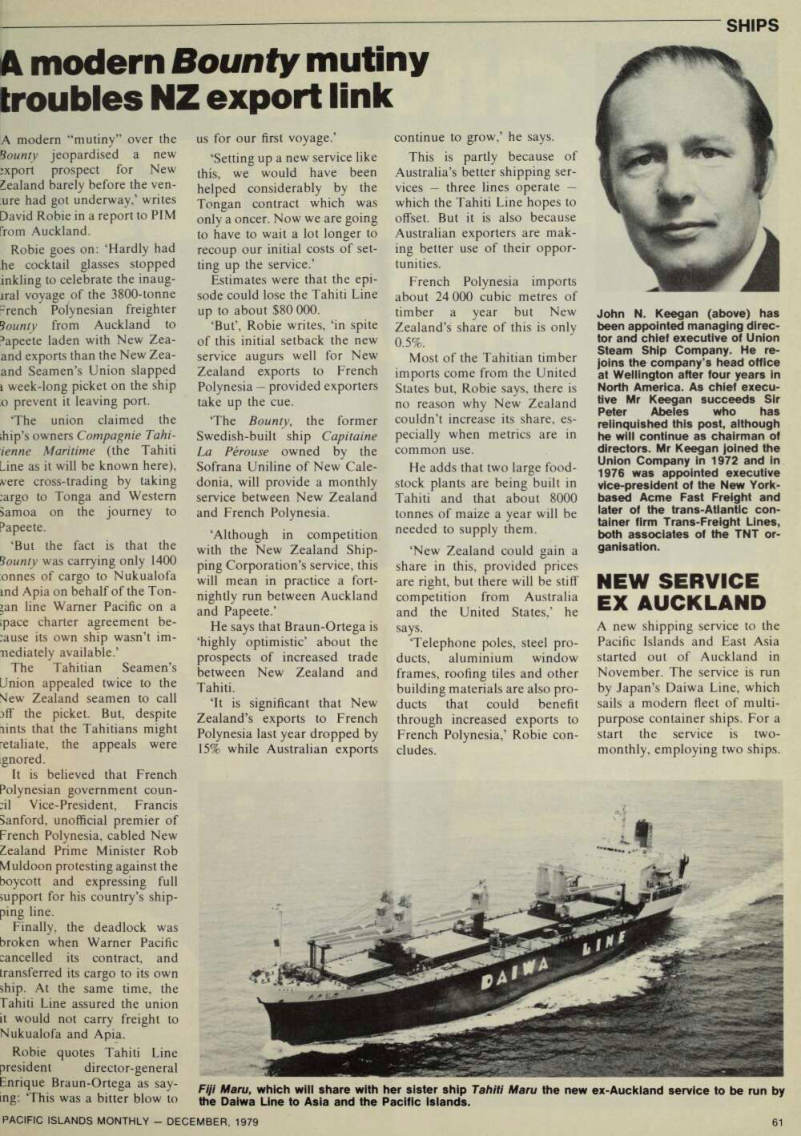
Fiji Maru, which will share with her sister ship Tahiti Maru the new ex-Auckland service to be run by the Daiwa Line to Asia and the Pacific Islands.