It’s the little people who
pp. 11-19 · Read in the full issue

call the Islands tune
The South Pacific Commission does have a future, and its annual South Pacific Conference, this year attended by more than 150 people in Papeete, will continue to be suc cessful because it is the forum in which the small Island territories can have their say. That’s the way STUART INDER sees it in presenting this report on what he thinks went on at the big conference.
The most successful speech made at the 19th South Pacific Conference held in Papeete was from David Buffett, sole representative of the Aus tralian Pacific territory of Nor folk Island (population 1800).
It was informative, relevant and witty, as most successful speeches are. But, more im portantly, it was a speech
whose delivery was significant
to the future of the South Pa cific Commission because it was further proof of the SPC’s need to continue.
Little Norfolk Island is the home of the descendants of the Bounty mutineers. The entire population of Pitcairn moved there in 1856 because Pitcairn was becoming overcrowded. A few homesick families later re turned to Pitcairn (the basis of the tiny Pitcairn population of today) but most remained and
prospered.
Although they consider
themselves as part of the Pa cific Islands community, as they are, Norfolk Islanders have not taken part in the SPC because they have not been permitted to by Australia. But in August, Norfolk Island got a measure of self-government with the establishment of an elected nine-man legislative as
sembly, and Australia has promised progress to self government within five years.
So in September Norfolk Island sent its first team to the South Pacific Games (and won a commendable number of four medals), and in October David Buffett, who is Norfolk’s chief minister and a great great-great grandson of one of the mutineers, appeared in Tahiti as Norfolk’s first rep resentative at any South Pacific Conference.
He was there as an ‘adviser’ to the Australian delegation, which is a traditional way of introducing new boys to the commission. So well did Mr Buffett use his opportunity and so well was he received by the conference that there should be no further doubt about Nor folk Island’s right to be there on its own behalf, with higher status than adviser.
David Buffett served to re mind the conference of its own value in the Pacific. It was, he said, a forum at which Island
people could express them selves and co-operate in the concept of regionalism; it was a means of fostering and developing the flow of local products and technical knowl edge of use to all of them; it was a means of islands gaining access to all kinds of assistance.
But, finally and importantly, it was a means of extending
friendships and goodwill, and
Norfolk Islanders, who were ‘intensely proud of their his tory’, were clearly within the Pacific community and thus very pleased to have at least a more direct representation at the conference. He was warmly applauded by the full con ference, which is unusual.
This was a successful con ference, and its continuing suc cess depends on the presence of the Norfolk Islanders of the Pacific the involvement of Niue, Tokelau, Tuvalu, Kiribati, Wallis and Futuna and others, for it is these small islands which understand the problems of the Pacific and the
need to continue the close sense of family if the islands are to survive and prosper as a
regional identity.
It is the small islands who now have the task of reminding the big Islands states of their grass roots, and the big islands which forget this do so at peril for all.
The advent of the South Pa cific Forum, to which only
independent or fully self
governing islands may belong,
must not be allowed to pose a threat to these annual con ferences. But it could if the big Forum members become insensitive to the needs of islands that have neither the land nor the resources for
development.
In my week at Tahiti I found it instructive to watch the inter action develop between the Forum powers and the small territories. The larger Forum powers are being hoisted to the
exposed position on the
coconut-shy once reserved for the metropolitan powers. Some will learn that to the little fel low, big and black is no more beautiful than big and white.
The question is not black and white, but big and little.
The Solomons, Papua New Guinea and Fiji cut no special
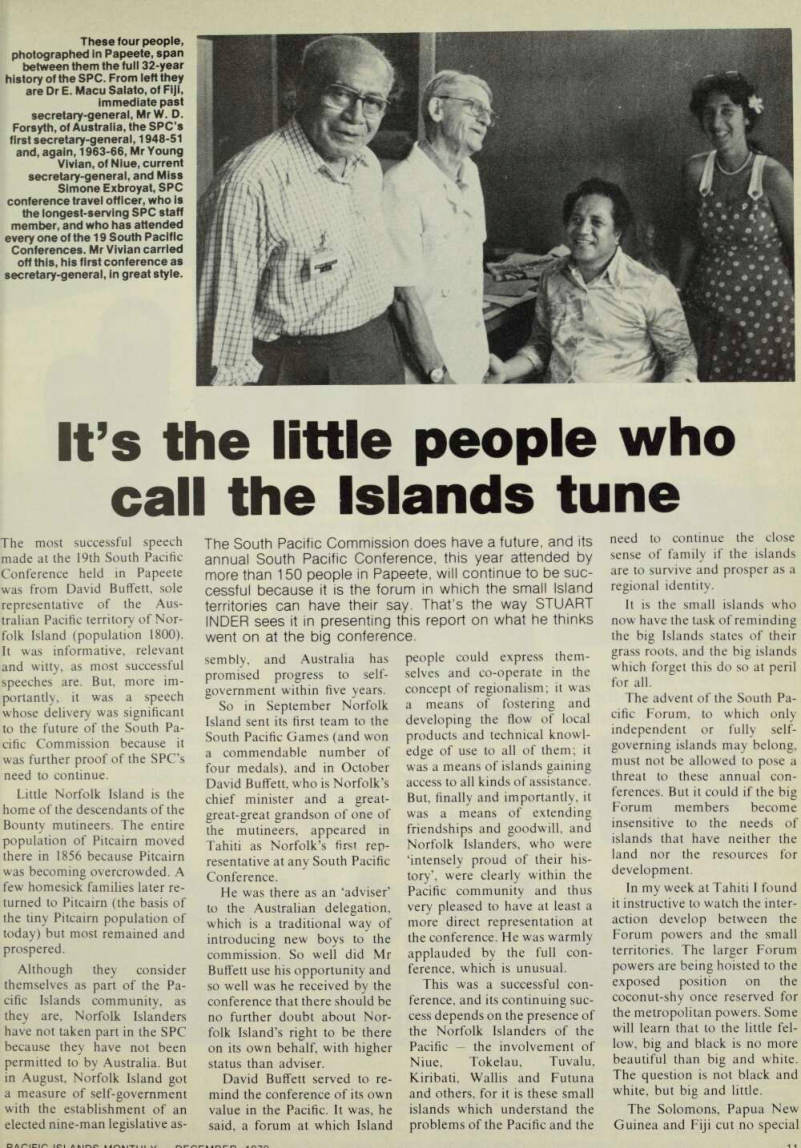
These four people, photographed In Papeete, span between them the full 32-year history of the SPC. From left they are Dr E. Macu Salato, of Fiji, immediate past secretary-general, Mr W. D.
Forsyth, of Australia, the SPC’s first secretary-general, 1948-51 and, again, 1963-66, Mr Young Vivian, of Niue, current secretary-general, and Miss Simone Exbroyat, SPC conference travel officer, who is the longest-serving SPC staff member, and who has attended every one of the 19 South Pacific Conferences. Mr Vivian carried off this, his first conference as secretary-general, in great style.
•ce at the conference simply be cause they have large popu .ations, and I noted resentment Dy some of the smaller terri :ories at the sheer volume of noise made by the bigger states, which is sometimes mistaken for arrogance.
This is unfortunate, because there are needs on both sides.
Ebia Olewale, PNG’s deputy prime minister and minister for foreign affairs, a genuine SPC supporter who works (and plays) with drive and energy for the Pacific family, cannot be accused of personal arro gance. He’s a great Pacific per sonality. But he talked at times, in his usual direct fashion, as if be were at the Forum making
a point bluntly to Australia or
New Zealand.
One of the difficulties is that if men of Olewale’s stature are to come to the conference, and it is vital that they should, then they are going to do their own thing in their own way.
It would be fatal to the SPC T conferences were to be
manned by professional
:onference-goers, of whom there is a small number developing, or by senior, unim aginative functionaries sent along as some kind of reward for loyal service.
Nor would it be good for top men to make a practice of
merely blowing in, making a
speech, and blowing out again.
If they can’t arrange to be pre sent at least for the major part of the conference it’s probably best that they don’t come at all, and thus avoid accusations of
being patronising.
Conference organisers could help resolve this last problem
by recognising that the people
who are most valuable at such
a meeting are busy people, and
reduce the number of days for the conference. This con ference ran from a Saturday to
the following Friday. The
actual meeting time could have been reduced to three-and-a half days of solid work, with periods of relaxation tacked to both ends for people to make use of according to pressures on their time elsewhere.
Apart from the invaluable influence of top men on the de liberations in the conference room, people who can speak for their country with authority are also necessary because of
the growing number of import ant observers now attending the South Pacific Conference.
They were at Papeete in larger numbers than ever.
An observer spends his most useful time outside the con ference session, at the lunch breaks, or at the inevitable eve ning social functions. Here, a diplomat from one of the rim countries not associated with the SPC can sniff the political air of the Islands, informally
discussing matters of possible
mutual interest with Islands’ ministers or foreign affairs staff, without either side being in any way committed. The contacts are invaluable for everybody. The South Pacific Forum can never offer such an informal role.
One of the larger countries which attracted some resent ment at the conference, but for a different reason, was Tonga.
The resentment was not openly expressed on the conference floor, but clearly Tonga needs to review its position in the
SPC. Although independent,
and a Forum member, it is not a participating government of the SPC which means its contributions to the SPC budget are voluntary and not
set as a percentage of the total budget. In the 1980 budget its contribution is CFP2SBO, which compares with CFP27126 each from the governments of Western Samoa, the Solomons, PNG, Nauru and even little Tuvalu.
And this figure is low in the scale compared with the volun tary contributions from other territories and countries.
Yet Tonga benefits from SPC expenditure out of pro portion to its contributions, it has a surprisingly vocal and influential participation in the Planning and Evaluation Com mittee, which virtually establishes the year’s pro gramme, and not for years has there been anything to prevent
Tonga becoming a Participat
ing Government,
That Tonga gets more than it contributes is not necessarily fair criticism; this charge can be levelled against some other countries, particularly PNG, but in any case needs vary from year to year and from country to country.
But unfortunately Tonga
takes a backseat at the con ference itself, adding little or nothing to debate. Many dele continued next page)
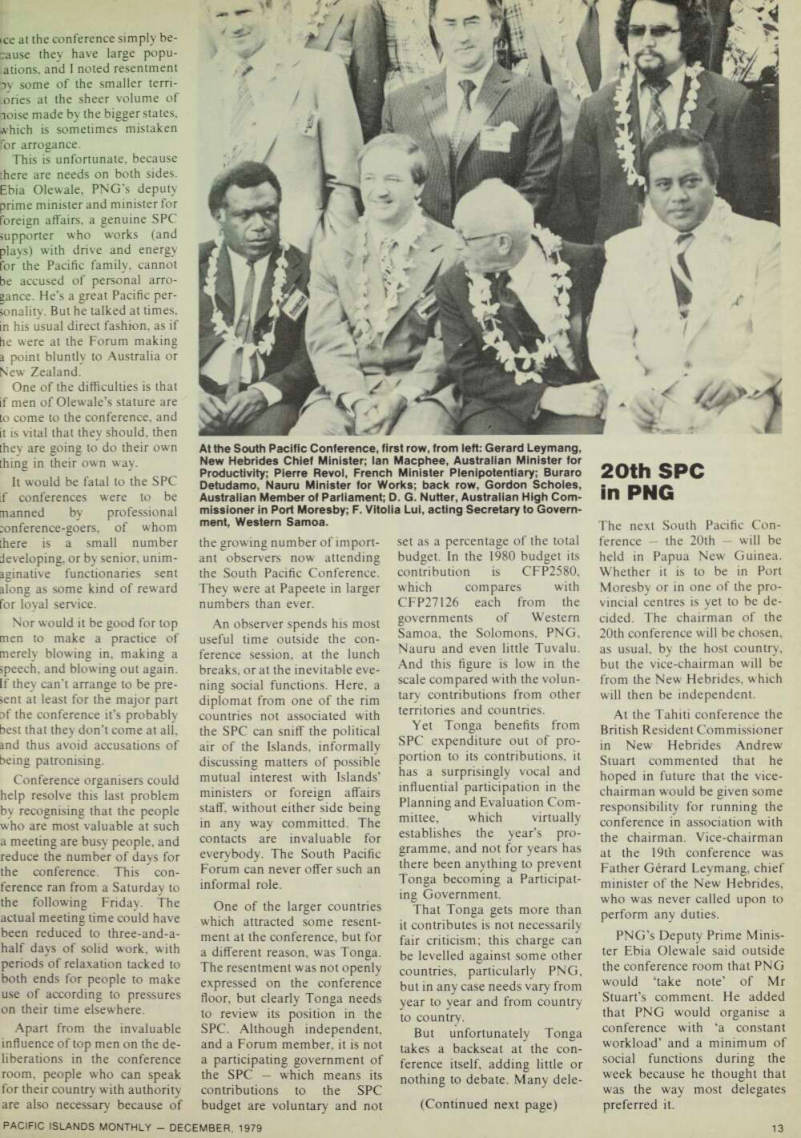
At the South Pacific Conference, first row, from left: Gerard Leymang, New Hebrides Chief Minister; lan Macphee, Australian Minister for Productivity; Pierre Revol, French Minister Plenipotentiary; Buraro Detudamo, Nauru Minister for Works; back row, Gordon Scholes, Australian Member of Parliament; D. G. Nutter, Australian High Com missioner in Port Moresby; F. Vitolia Lui, acting Secretary to Govern ment, Western Samoa.
gates consider that it is import ant that Tonga should be seen to take an active part on the floor of the conference, enter ing into the cut and thrust of
debate. Tonga apparently be
lieves it should not take active participation, and be rep resented by somebody of the calibre of say Crown Prince Tupouto’a while it isn’t a Par ticipating Government. This.is
shortsighted.
Prince Tupouto’a could do a good job for Tonga, and at the same time gain information that Tonga needs if it is to keep abreast of Islands opinion.
Meanwhile, what did every body do at the conference?
In brief, they looked at last year’s budget and works pro gramme and approved next year’s; paying lip service to the Year of the Child, they dis cussed the needs of Islands children, types of stabilisation schemes suitable for South Seas economies (and agreed to do a feasibility study in time for next year’s conference); they directed the secretariat to plan for a second meeting of
Island development planners
to discuss the problems and means of achieving balanced
rural development; they heard
and were satisfied with the planning details for the South Pacific Festival of Arts to be held in Port Moresby in July; they were critical of the atti tude of big airlines to Islands services; they involved them selves in a debate about the re lationship between the South Pacific Commission and the South Pacific Bureau for Econ
omic Co-operation; they got
sidetracked during what should have been a mere formality about the accession of the Cook Islands and Niue to the Canberra Agreement, which is the charter of the South Pacific Commission; and they heard various reports from observers on a wide-range of subjects, from the European Economic Community to the Social Com mission for Asia and Honolulu’s East-West Center.
There was little real contro versy on the floor of the con ference during the entire session.
The days when the atmos phere could have been sliced in half with a cane-knife may well have gone for good. Chairman Maco Tevane’s handling of the
conference deserved some of the credit: his pressure on the reins was light enough for the horse to feel it was free, and firm enough to keep it in the
nght direction.
He was unperturbed on those occasions when delegates involved themselves in politi-
cal grandstanding against the
terms of the SPC charter, and it never got out of hand. He seemed to take the commonsense view that a conferenceroom full of Islanders can hardly expect to discuss their everyday problems for the best part of a week without oc-
casionally talking politics.
The only signs of smoke and sometimes a little flame were to be observed during (a) the debate on Pacific aviation policies (b) as a result of some questions of the position of the French territories in the SPC
and (c) the discussion on the re spective roles of the SPC and
Spec.
• On aviation. Cooks Prem ier Dr Tom Davis, who was able to spend only a day at the conference sitting, threw in a time bomb before he departed.
He attacked the big airlines, and Air New Zealand in par ticular, for Pacific aviation policies which restricted the smaller airlines and, in turn, tourism in the Islands.
He drew attention to a resol ution of last year’s conference protesting at the inadequate air services provided the Islands as a result of high fares, in
frequent flights, and flight
times determined by the larger market at each end of the route, and said none of the governments had done any thing about the situation.
Warming to a stinging
attack, he pointed out that in adequate air services restrictec all sorts of commerce in th< Islands as well as tourism; it af fected exports, employment the availability of skilled man power; it was responsible foi adding to inflation.
In the Cooks, he said, im proved air transport was a cata lyst for economic development A large part of the Cooks tour ist plant was locally owned anc operated, yet the hotels were showing an average occupanc) rate of only 51 per cent. Recem attempts by a regional airline
(Polynesian) to develop links
between Tahiti and Rarotonga had not been successful, due ‘tc an unrealistic attitude by cer tain airline interests’.
A couple of days later, when Dr Davis had gone home, and the conference decided to examine the problem, the Premier turned out to have befriended many like-minded people. Western Samoa, which, with Niue, is also one of the links of Polynesian’s new service, made rude comments about regional co-operation
sometimes being merely lip
service. Nauru’s Kinza Clodumar, who is involved with the operations of Air Nauru and who is currently arguing with New Zealand about fare structures in an effort to make a new Air Nauru service into Auckland oper ational, said pointedly that ‘the rules of the aviation game weigh heavily against the small man’. Restrictive policies of the aviation giants squeezed out the small airlines, he said.
The New Zealand dele gation leader, Tourism Minis ter Warren Cooper, making no specific mention of Polynesian Airlines, argued that aviation
generally was passing through
a difficult period, and said that the introduction of cheap inter national air fares hadn’t brought the Pacific, meaning New Zealand, the benefits expected.
He got no sympathy, but the
debate ended inconclusively, I
with the conference expressing 1 disappointment that the Pacific j governments controlling the airlines had done nothing since ’ last year to meet the aviation I needs of the Islands. • The embarrassing question J about the French Pacific came up unexpectedly while the con
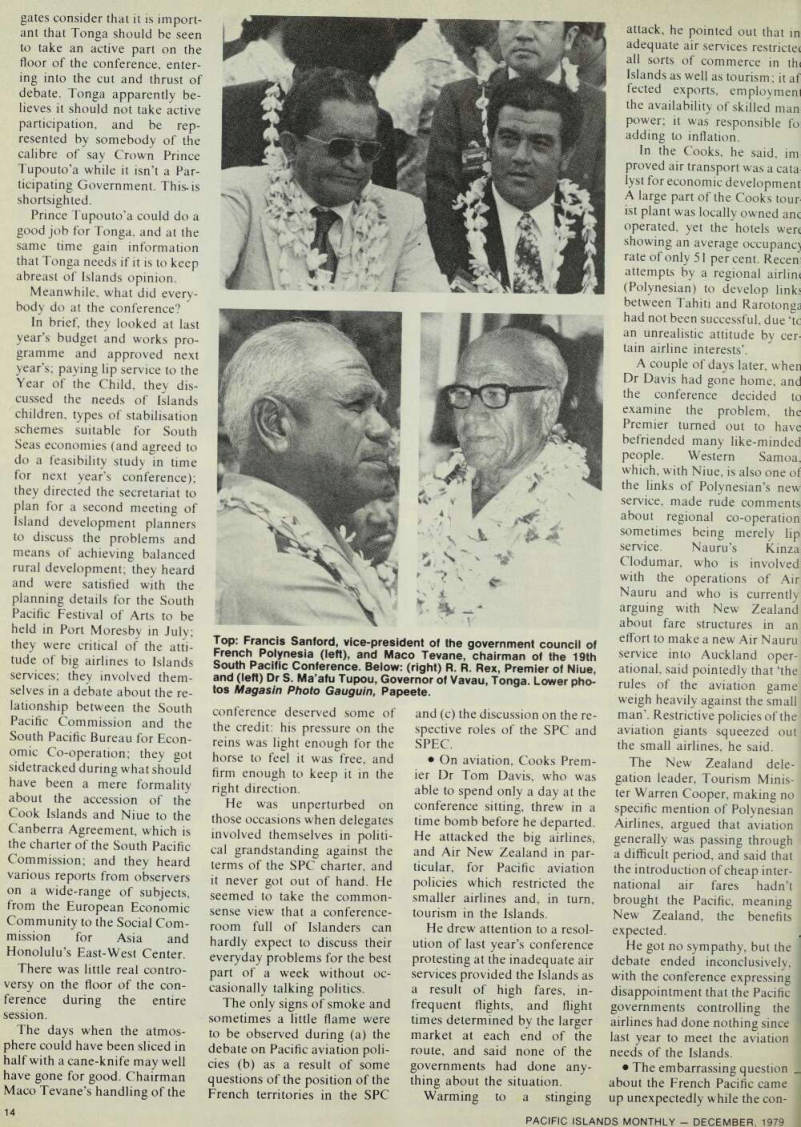
Top: Francis Sanford, vice-president of the government council of French Polynesia (left), and Maco Tevane, chairman of the 19th South Pacific Conference. Below: (right) R. R. Rex, Premier of Niue, and (left) Dr S. Ma’afu Tupou, Governor of Vavau, Tonga. Lower pho tos Magasin Photo Gauguin, Papeete.
t'erence was being told that the look Islands and Niue had not vet formally acceded to the Canberra Agreement because Ihe instruments had not been .igned, but they were to be egarded by the conference as ull members anyway.
New Hebrides Chief Minis er Father Gerard Leymang isked, almost idly, whether Polynesia and New Caledonia could accede to the Canberra Agreement. ‘What’, he asked, ‘is France’s position an this?’
French delegation leader 3 ierre Revol was so annoyed at oeing taken unawares that he
ilmost spluttered, but keeping
limself under admirable con rol, he replied evenly that he
was grateful for the question’,
md explained that it was not )ossible to divide sovereignty vithin the French republic as t was a unitary state. However, here was a door open as a re ult of the new Canberra for nula, and one would have to
;ee how things evolved.
The new formula, or amend nent to the Canberra Agree nent to which Mr Revol was
eferring, reads: ‘Any govern
nent, the territory of which is vithin the territorial scope of he Commission as defined in Article II and which is either idly independent or in free as
sociation with a fully indepen
lent government, may accede o this Agreement, if it is in cited to do so by all participat
ng governments, by depositing
in instrument of accession with he Government of Aus ralia.’
Just what Mr Revol’s reply neant was not at all clear, as he French territories are leither independent nor in free issociation, so one or two of us ook the opportunity at the norning teabreak to ask Mr levol what it was all about.
Mr Revol was still fuming out gave us a fuller interpret ition of what he had said. This vas, ‘The wording which was idopted for the amendments to he Canberra Agreement was
iebated at considerable length
;o the amendments were in ac cordance with constitutional irrangements. While this vording makes it possible to establish distinctions, we must lot forget that the structure of
(Continued next page)
ie French constitution is a nitary construction and that 11 French citizens overseas are tizens on exactly the same >oting as citizens who live in ictropolitan France. You can- Dt divide France’s sover gnty. The wording that was Jopted for the amendment :aves the door open to future langes for the territories of
ie region.’
What, I asked Mr Revol, ould be the conditions under hich the French territories >uld accede?
Replied Mr Revol; ‘Nothing
i the Canberra Agreement >uld make it possible for New aledonia and French □lynesia to accede unless irough a vote they wished to
s independent.’
• On the third controversial latter, the case of the associ tion between the SPC and the outh Pacific Bureau for Econ mic Co-operation, which is ie economic arm of the South acific Forum, has been a fes jring sore for the last year or vo. The SPC was established i 1947. The Forum was set up i 1971 to give the leaders of le independent nations in the outh Pacific the opportunity ) talk to each other about any
abject they chose, including
olitical matters not then ossible in the SPC, although
:s prohibition on political dis
ussions is now honoured more i the breach than the observ nce.
The Forum soon established PEC, designed as a secretariat 3 carry out the Forum’s aims nd supply it with facts and fig res. It was inevitable that as tie Forum became stronger, PEC would too, and that it /ould be moving at times in tie same areas as the SPC.
The latest Forum meeting, eld in Honiara in July, pro iosed that the Forum and SPC stablish a joint committee of ix to examine the relationship if SPEC and SPC with a view
o minimising these overlaps.
Tie Papeete conference agreed
o this, and elected as its epresentatives on the commit ee the New Hebrides, American Samoa and French
’olynesia, with an independent
hairman yet to be chosen.
To kick off the debate the >PC secretariat submitted a artly brief report outlining the
various areas of co-operation
already existing between SPC
and SPEC. The main message in it appeared to be that while the SPC invites SPEC to every meeting the SPC thinks might be useful to that organisation, SPEC does not invite SPC to any of its meetings, nor to Forum meetings. This was, in fact, a good point and the Forum should remedy it.
The ensuing debate covered
opinions so varying in intensity
that it served to underline the genuine need for a joint com mittee to hammer out some kind of direction.
The debate also boiled over into discussion of the relation ship of the Islands to the SPC, with American Samoa’s
conference-experienced P.
Tuiasosopo (‘Brownie’), taking
the opportunity to remind those members of the con ference who were also mem bers of the exclusive Forum, that the conference, not the Forum, alone gave the oppor tunity for all islands to express opinions about matters rel evant to everybody. He was
only momentarily upset by
some baiting from Ebia Olewale who said pointedly it was not possible for terri tories of metropolitan powers to be equal partners with Forum members because they were unable to speak their mind. Brownie retorted crisply that his instructions at the con ference came from the Govern ment of American Samoa, not the Government of the United States.
But the most biting comment came the next day from the inaugurating director of SPEC,
Mahe Tupouniua, of Tonga,
who relinquishes the post at the end of the year for Dr Gabriel Gris, of PNG. Addressing the conference by invitation, Mahe said that despite some ‘immoderate and fairly strong
language’ in the previous day’s
debate, he could say with a clear conscience that SPEC had always endeavoured to co operate closely with SPC.
Informal discussions had helped resolve unforeseen problems before they devel oped; and his own view was that relations were on a most
cordial plane.
He added: ‘By the very nature of development in the region, as issues become more complex and involvements grow and expand, there has in evitably been a certain amount of overlap, and thus the need has arisen to avoid dupli cation... That the SPEC has been misunderstood in its atti tude and the way it had gone about tackling this problem, I have no doubt, as was demon strated I thought in yesterday’s discussion. For the mistakes that we have made, I can but apologise. This is a cross one has to bear when taking up an appointment of this nature. ‘But reports or rumours of “takeovers” are without foun dation as far as SPEC is con cerned. This is a great pity and something ought to be done to correct it. Otherwise it only serves to distort the South Pa
cific regional co-operation pro
cedures in such a way that we run the risk of frittering away our resources, dealing with ap pearances when we should be grappling with the substance, the real issue, the total issue.
‘Words like “competition”,
“rivalry” and “jealousy” have
no place in the Pacific way of dealing with delicate and sensi tive issues. In such a context, words have meanings which are most un-Pacific. And I can only urge the conference that the sinister development of an “under siege” mentality that I have detected in recent utter ances from responsible quar ters who should know better is undermining the health of the South Pacific regional co operation endeavours, and the sooner it is corrected the bet ter. ‘SPEC is no more than a sec retariat which serves the independent South Pacific nations in the body of the South Pacific Forum, and acts as the Forum’s executive. It is not for us to formulate a policy, but to follow the directions given to us. This we do without embellishment.’
Mahe Tupounia has been a highly competent and dedi cated director of SPEC, a man of integrity who believes sin cerely in what he says. It’s probable though that he fails to recognise his own drive and in itiative when he says it is not for the SPEC secretariat to for mulate policy, but to follow directions. Anybody who has seen Mahe on the job in the Islands could be left in little doubt that Forum policies must sometimes be shaped and sharpened, and at times initi ated, by him.
Given the fact that the Forum leaders have heavy re sponsibilities in their own islands and don’t have the time to involve themselves to any real extent outside the few days a year devoted to Forum meet ings, even a dull executive offi cer is going to find himself
closely involved in policy.
A man of Mahe’s stature can’t really expect to do his job as he sees it without inevitably
stirring up charges of
‘takeover’! The fact is that SPEC and the SPC do at times cross each other’s bows, and will continue to do so while or
ganisations are run by people
and not computers.
The SPEC-SPC debate did slot up an important win in an unexpected quarter for French Polynesia. When the conference suggested that French Polynesia should be on
Delegates out of conference were entertained with numbers of dancing spectacles like this on the opening day. Photo Magasin Photo Gauguin, Papeete.
Miss Efi Rex, and Mrs Caroline Malo. Miss Rex is daughter of Niue’s Premier.
he review committee, the |uestion that was in every body’s mind was whether Tance would allow her terri ory to represent herself, or
vhether metropolitan France
vould want that seat. The French delegation asked for ime for discussion. The result:
-rench Polynesia got the
eat.
This was one further ixample of the changing re
ationship between metropoli
an France and French ’olynesia. The new atmos )here was an important facet >f the success of the Tahiti con erence, the first to be held here. The conference was
>rganised not by France but by
elf-governing French
’olynesia and its assembly
ind very well organised, with
;reat goodwill. The French
’olynesians showed by
xample that the weight of aetropolitan bureaucracy was
lot these days heavy, and that
fieir Pacific neighbours could
»est help Polynesia by recog
dsing that they had the re
ponsibility of running their
iwn affairs and needed the
ame sort of help and sympathy
s anybody else.
This relaxed attitude was ssisted by Mr Pierre Revol,
Tance’s representative at the
onference, who made no /aves, even managing to beam hat there were no difficulties t all about Ebia Olewale’s inexpected excursion into
acal politics (see separate
tory); that Ebia was a ‘good riend of his’.
A rumour that the organisers iad cancelled the usual end-of onference concert because of nnoyance over something 4ew Zealand Minister Warren "ooper was supposed to have aid about ‘too much feasting’, /as only a rumour. The concert /as cancelled, but because of
easons of complicated dom
stic politics not connected
/ith delegates. Mr Cooper
icvertheless later wrote from Vellington to Francis Sanford, aying he was ‘indeed sorry hat this unfortunate and ntirely incorrect report should lave appeared’, and that he
lad nothing ‘but the deepest
latitude for Tahiti’s welcome, md the warmth of its hospi
ality’.
Everyone would agree to hat.