Letters
pp. 5-7 · Read in the full issue

Tahitian takes
n Mr Olewale im a Tahitian student study g in Auckland and I am greatly sturbed with the statements ade by the Minister of ireign Affairs for Papua New uinea, Mr Ebia Olewale, con
rning French Polynesia’s re
tionship vis-a-vis France. As r as I am aware, Mr Oleware not Tahitian which renders s pronouncements on the bject meaningless as he has ither a right nor interest to »so.
The Prime Minister of ench Polynesia, Mr Francis
inford, has categorically
ited that French Polynesia
>es not seek full indepen ;nce but rather internal itonomy, not unlike the re tionship which the Cook
lands enjoys with New
jaland, and that of American imoa with the U.S.A. Pro
dependence parties have put
rward candidates in the elec ins for the Territorial As mbly and their lack of
ccess has conclusively proved
at the majority prefer
temal autonomy rather than
dependence.
Complete independence
auld mean the standard of
dng in French Polynesia,
hich is the highest in the >uth Pacific Islands after merican Samoa, would fall, nlike Papua New Guinea,
rench Polynesia does not
ive vast mineral resources to :port (although this fact has it raised the standard of liv g of the ordinary people in ipua New Guinea).
I submit to Mr Olewale that is a fundamental principle of temational law that the dom tic affairs of a country are be md the bounds of terference by another. Of mrse in the context of his atement it must be realised at the rule of law in Papua ew Guinea does not seem to £ observed at all. A PIM cor-
respondent reports in the October 1979 issue, page 66, that ‘there has been a massive upsurge of lawlessness in the urban areas, particularly in
Port Moresby’ and ‘peaceful
and law-abiding citizens are afraid to walk around at night, or for that matter even by day, for fear of being beaten up, robbed or raped’.
Also the abuse of law by the Papua New Guinea Govern ment in pardoning one of their ministers after being imprisoned, indicates the de gree to which the rule of law is not observed in Papua New Guinea. Unlike Port Moresby, Papeete is a safe town to live in and our people do not have to build ‘six foot high security fences’ (p 66) for fear of their lives and property. Tahitians do have respect and faith in the
judiciary and our politicians
are not above the law.
It would be interesting to hear the answers of Mr Olewale to a number of per tinent questions I would like to ask. Why hasn’t the Papua New Guinea Government protested about the invasion by Indonesia of Papua New Guinea’s close neighbours Irian Jaya and East Timor? These invasions have effectively
clogged these peoples’ rights to
self-determination. Would the Papua New Guinea Govern ment consider it a gross inter ference in their own domestic affairs? Should Tahitians help the Bougainville Island se cessionist movement in its push
for independence from Papua New Guinea?
In conclusion it seems ob vious that Mr Olewale ought to ensure the domestic affairs of his own country are in order before he ventures on to the in ternational scene, and the future of French Polynesia is to be decided by French Polynesians on our own terms, not those of Mr Olewale.
Titaua De Montlue (Ms)
Auckland, New Zealand Mr Olewale’s performance at the South Pacific Forum (and later the Conference), and his so much expressed concern for the freedom and independence of others, appear to be in con tradiction with the historical facts. They do not eliminate the reality that Mr Olewale and his government not long ago vir tually betrayed and sold their own brothers and sisters into
slavery and exploitation.
Hiding behind the incom petence of the United Nations to settle the disputes of racial and national minorities, and
depending constantly on the
advice of Australia’s Mr Pea cock, offers little hope for
freedom-seeking Pacific
Islanders, as it is hardly a pro motion of Papua New
Guinea’s ‘independence’.
Under the circumstances, perhaps Mr Olewale should be the last one to advise and talk in terms of‘decolonisation’ and ‘independence’ of others, as
frustrated freedom-seeking
Islanders could be driven towards the end of the scale, throwing the so much pro
moted ‘regional stability’ off
balance.
Fred Eiserman
Caims, Qld, Australia PS: The trouble is to find an unbiased, fact-accepting Aus
tralian publisher.
Percy Chatterton
and PNG students
After reading in ‘After thoughts’ (PIM Aug p4O) some stirring comments on the strikes at the University of Papua New Guinea, I too have been stirred into reflection.
Perhaps Dr Chatterton isn’t the old grey stallion he used to be!
Could he at his age and with
his maturity of experience be a little more wise, tolerant and humane?
Initially his airy-fairy jour
nalism is little more than irri tating! I quote: ‘lt seems beyond reasonable doubt that these periods of student unrest were accompanied by acts of intimidation, violence and van dalism; by wild ultimata and threats of national disruption; and by an arrogant assump tion that the laws of the land and the authority of the courts do not extend to the university
campus.’ It is definitely beyond
reasonable doubt that these ac cusations are but the personal view of a critic who has neither the interests of one party nor the other at heart such idle thoughts are liable to aggravate
an already irritating problem,
especially coming from some
one whom the utmost respect is held for in Papua New Guinea.
It is also a pity that the writer doesn’t try to analyse the prob lem and offer some fatherly advice, rather than give us a lecture on the misuse of lan gauge. The reason for the action taken is far more im portant than any matter of
language.
It is wonderful to see the
university developing into a
body of questioners. Surely it
is a purpose of the educated to ever be critical criticism can be constructive. The change in student attitudes is to be wel comed and encouraged. Out side encouragement is just as
important and ideas gleaned
from visiting academic staff can indeed be as educative as a set syllabus. A ‘strike’ by students in PNG is as appro-
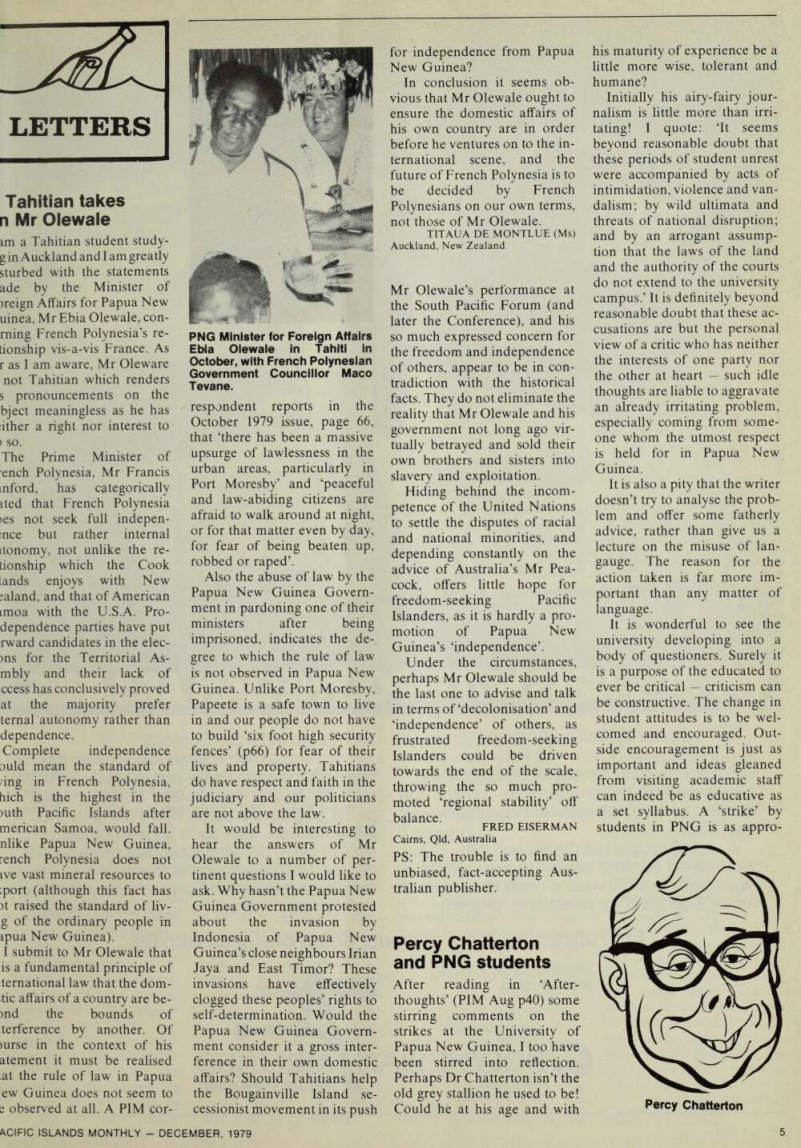
PNG Minister for Foreign Affairs Ebia Olewale in Tahiti in October, with French Polynesian Government Councillor Maco Tevane.
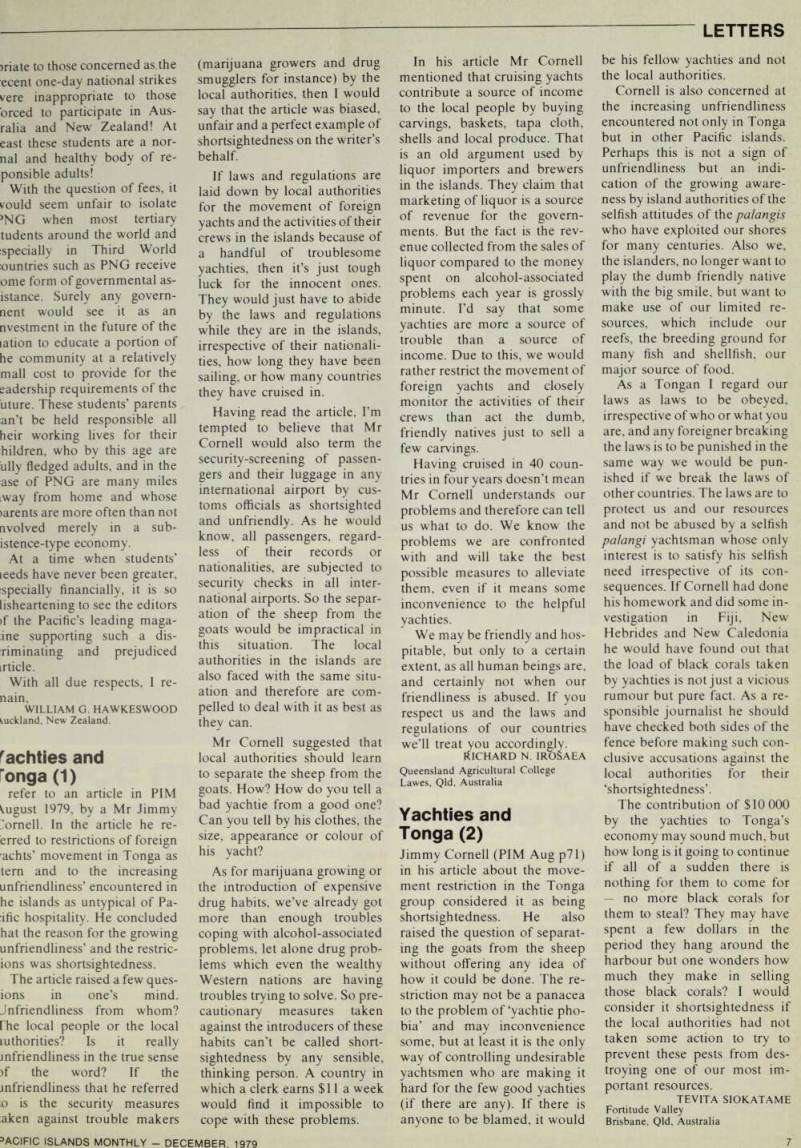
Percy Chatterton
mate to those concerned as.the ecent one-day national strikes
vere inappropriate to those
breed to participate in Aus ralia and New Zealand! At east these students are a nor
nal and healthy body of re
ponsible adults!
With the question of fees, it vould seem unfair to isolate
>NG when most tertiary
tudents around the world and specially in Third World ountries such as PNG receive ome form of governmental as istance. Surely any govern nent would see it as an nvestment in the future of the lation to educate a portion of
he community at a relatively
mall cost to provide for the
eadership requirements of the
uture. These students’ parents an’t be held responsible all heir working lives for their hildren, who by this age are ully fledged adults, and in the ase of PNG are many miles iway from home and whose >arents are more often than not avolved merely in a sub
istence-type economy.
At a time when students’ iceds have never been greater, specially financially, it is so lisheartening to see the editors »f the Pacific’s leading maga ine supporting such a dis
riminating and prejudiced
irticle.
With all due respects, I re nain,
William G. Hawkeswood
Auckland, New Zealand.
r achties and
’onga (1)
refer to an article in PIM
August 1979, by a Mr Jimmy
Cornell. In the article he re erred to restrictions of foreign achts’ movement in Tonga as tem and to the increasing unfriendliness’ encountered in he islands as untypical of Pa
ific hospitality. He concluded
hat the reason for the growing unfriendliness’ and the restric ions was shortsightedness.
The article raised a few ques ions in one’s mind.
Jnfriendliness from whom? fhe local people or the local
mthorities? Is it really
mfriendliness in the true sense )f the word? If the mfriendliness that he referred o is the security measures aken against trouble makers
(marijuana growers and drug
smugglers for instance) by the local authorities, then I would say that the article was biased, unfair and a perfect example of shortsightedness on the writer’s behalf.
If laws and regulations are laid down by local authorities for the movement of foreign yachts and the activities of their crews in the islands because of a handful of troublesome
yachties, then it’s just tough
luck for the innocent ones.
They would just have to abide by the laws and regulations while they are in the islands, irrespective of their nationali ties, how long they have been sailing, or how many countries they have cruised in.
Having read the article. I’m tempted to believe that Mr Cornell would also term the security-screening of passen gers and their luggage in any
international airport by cus
toms officials as shortsighted and unfriendly. As he would know, all passengers, regard less of their records or nationalities, are subjected to security checks in all inter national airports. So the separ ation of the sheep from the goats would be impractical in this situation. The local authorities in the islands are also faced with the same situ ation and therefore are com pelled to deal with it as best as
they can.
Mr Cornell suggested that local authorities should learn to separate the sheep from the goats. How? How do you tell a bad yachtie from a good one?
Can you tell by his clothes, the size, appearance or colour of
his yacht?
As for marijuana growing or the introduction of expensive drug habits, we’ve already got more than enough troubles coping with alcohol-associated
problems, let alone drug prob
lems which even the wealthy Western nations are having troubles trying to solve. So pre cautionary measures taken against the introducers of these habits can’t be called short
sightedness by any sensible,
thinking person. A country in which a clerk earns $ll a week would find it impossible to cope with these problems.
In his article Mr Cornell
mentioned that cruising yachts
contribute a source of income
to the local people by buying
carvings, baskets, tapa cloth, shells and local produce. That is an old argument used by
liquor importers and brewers
in the islands. They claim that marketing of liquor is a source of revenue for the govern ments. But the fact is the rev enue collected from the sales of liquor compared to the money spent on alcohol-associated problems each year is grossly minute. I’d say that some yachties are more a source of trouble than a source of income. Due to this, we would rather restrict the movement of
foreign yachts and closely
monitor the activities of their crews than act the dumb, friendly natives just to sell a
few carvings.
Having cruised in 40 coun tries in four years doesn’t mean Mr Cornell understands our problems and therefore can tell us what to do. We know the problems we are confronted with and will take the best possible measures to alleviate them, even if it means some inconvenience to the helpful
yachties.
We may be friendly and hos pitable, but only to a certain extent, as all human beings are, and certainly not when our friendliness is abused. If you respect us and the laws and regulations of our countries we’ll treat you accordingly.
Richard N. Irosaea
Queensland Agricultural College Lawes, Qld, Australia
Yachties and
Tonga (2)
Jimmy Cornell (PIM Aug p7l)
in his article about the move ment restriction in the Tonga group considered it as being shortsightedness. He also raised the question of separat ing the goats from the sheep without offering any idea of how it could be done. The re striction may not be a panacea
to the problem of‘yachtie pho
bia’ and may inconvenience some, but at least it is the only way of controlling undesirable yachtsmen who are making it hard for the few good yachties (if there are any). If there is anyone to be blamed, it would
be his fellow yachties and not the local authorities.
Cornell is also concerned at the increasing unfriendliness encountered not only in Tonga but in other Pacific islands.
Perhaps this is not a sign of unfriendliness but an indi cation of the growing aware ness by island authorities of the selfish attitudes of the palangis who have exploited our shores for many centuries. Also we, the islanders, no longer want to play the dumb friendly native with the big smile, but want to make use of our limited re sources, which include our reefs, the breeding ground for many fish and shellfish, our major source of food.
As a Tongan I regard our laws as laws to be obeyed, irrespective of who or what you are, and any foreigner breaking the laws is to be punished in the same way we would be pun ished if we break the laws of other countries. The laws are to protect us and our resources and not be abused by a selfish
palangi yachtsman whose only
interest is to satisfy his selfish need irrespective of its con sequences. If Cornell had done his homework and did some in
vestigation in Fiji, New
Hebrides and New Caledonia he would have found out that the load of black corals taken by yachties is not just a vicious rumour but pure fact. As a re
sponsible journalist he should
have checked both sides of the fence before making such con clusive accusations against the local authorities for their
‘shortsightedness’.
The contribution of $lO 000
by the yachties to Tonga’s
economy may sound much, but how long is it going to continue if all of a sudden there is nothing for them to come for no more black corals for them to steal? They may have spent a few dollars in the
period they hang around the
harbour but one wonders how much they make in selling those black corals? I would consider it shortsightedness if the local authorities had not taken some action to try to prevent these pests from des troying one of our most im portant resources.
Tevita Siokatame
Fortitude Valley Brisbane, Qld, Australia