Albert Steel - a
pp. 93-98 · Read in the full issue

Yachts
Albert Steel - a man of antiques, art and the sea
Many a palagi sailor has fallen in love with Tonga’s islands since that most famous palagi of them all, James Cook, named them the Friendly Isles some 200 years ago, writes Jimmy Cornell from Nukua lofa. At first glance one would not even notice Peregrine squeezed in among the local boats in Nukualofa’s small boat harbour. Battered and stained, with paint peeling off in places, the 40 year old cut ter looks like a boat that has covered plenty of ocean be fore getting here.
So does its white haired, blue eyed owner, Albert Steele, who wears his 63 years lightly, always with a smile on his furrowed face. He has been captivated by these isles and has swallowed the hook after a lifetime of seafaring :rammed with adventure, danger and stories to make ane’s hair stand on end.
In Tonga he has found the Polynesian atmosphere he bought had disappeared for ever, the Polynesia he had mown in the early thirties in Hawaii and when he sailed the Jne Islands with the sampan slander, converted to a fishing )oat after its famous ethno ogical trip around the South 3 acific.
Albert also met in Tonga his )eautiful wife with the lovely lame of Malia Sosefo Satae. >he is probably the main eason why Peregrine’s world 'oyage came to an abrupt end n Tonga.
Down below in Peregrine’s buttered cabin - as Albert aughingly relates the (scapades of his wild youth mother facet of his surprising haracter slowly comes to ght. A candle in an antique •rass stand throws long hadows over shelves rammed with books on period Jrniture and art history, cas ettes of music by Grieg, leethoven and Mozart. The
bulkheads are hung with old Dutch prints and ancient chronometers. The sea, art and antiques are his life, His love affair with the sea began as a child when he used to watch the occasional square-rigger sail up the Delaware River. He ran away from home at 12 and started working on an assortment of
sailing boats, ending up as the skipper of a fishing schooner in Florida.
Vividly Albert recalls the time in Cuba when Batista overthrew Machado: ‘We were forbidden to leave the ship, but of course we did, found a bar and got steadily drunk on monkey rum while the guns of the civil war boomed over the harbour.’
Hawaii was the place he liked best in those pre-war
days. He spent three years there until the place got too ‘touristy’ for his taste and he returned to Florida.
World War II saw him in North Africa and Italy as a rig ger in a tank recovery unit.
Later he was a salvage diver with the airforce. On dis charge he joined the sponge divers of Florida, earning fabu lous money at a time when first grade sponges sold at $35 a pound. When the bottom fell out of the sponge market he moved to California, took a re fresher course in modern navi
gation and signed on as first mate and later as skipper on a tuna fishing boat out of San Diego. For years he followed the tuna up and down the coast of Central America, to the Galapagos Islands and Ecuador.
One day, deciding there must be an easier way of earn ing a living, he turned his back on the sea and dedicated him self to something which had always fascinated him antiques. He became a specialist in antique furniture and built up a considerable art collection. But, eventually, the call of the sea proved stronger so one day he signed on as deckhand on a tugboat, progressing rapidly to skipper.
For several years he success fully mixed the activities of art collector and antique furniture buyer with those of a part-time tugmaster. ‘I guess I must be the only guy in history who has given a lecture on seventeenth century English art, then run backstage, put on overalls and, within the hour, docked a ship in San Diego harbour,’ he says. Not bad for someone who never made it past eighth grade, but, as Albert smilingly explains: ‘Although I never had much education, I always had a taste for champagne.’
It was a nice life, with plenty of money and all that he wanted. But, on the eve of his sixtieth birthday, Albert looked at himself and felt life was run ning like sand through his fingers. The saltwater in his veins gave him the only logical answer. He sold a painting and started looking for a yacht. He found Peregrine, a little ship like those he was used to in his youth. He threw out the engine because he hates engines with a ‘purple passion’, loaded it with the most valued of his possessions, seriously de pleted after two divorces, and set off from California with the idea of sailing around Cape Horn to the faraway Aegean from where some of his fellow
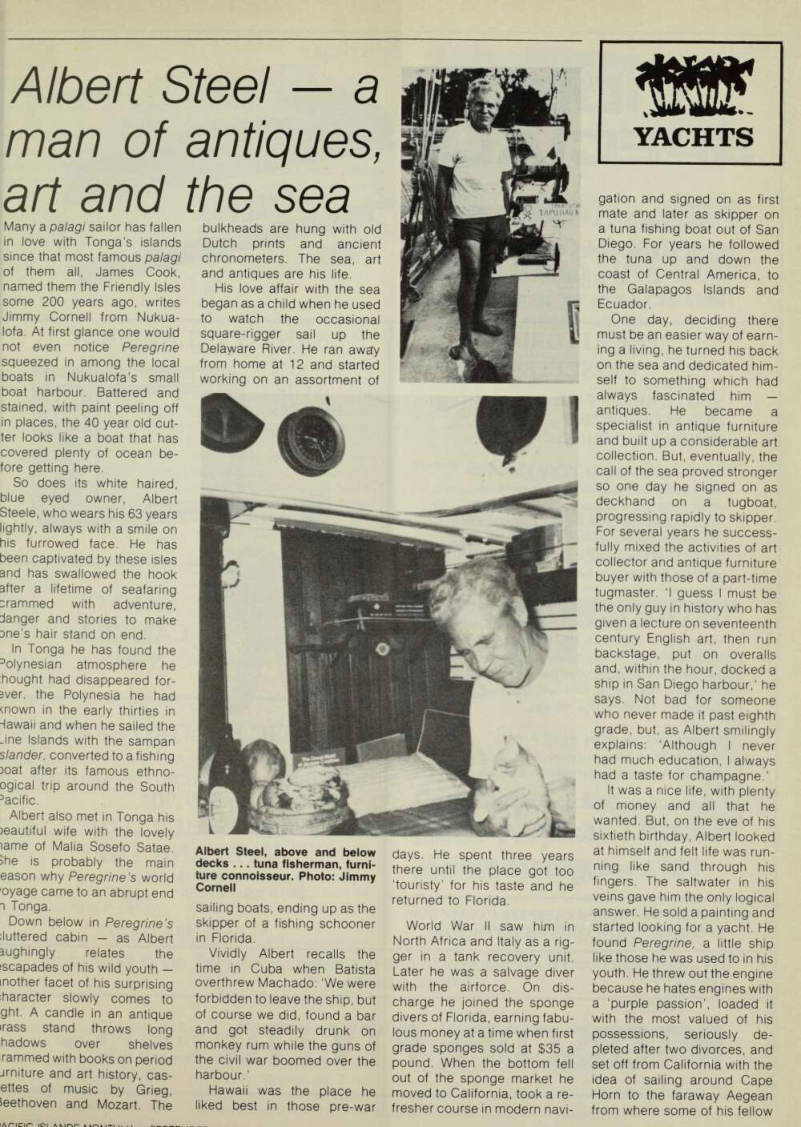
Albert Steel, above and below decks ... tuna fisherman, furni ture connoisseur. Photo: Jimmy Cornell
tponge divers came. But a trip iround the Horn for a man on lis own became less appeal ng so Albert turned Per egrine's bows west, hoping to ind in the Pacific a trace of the itmosphere he had known lore than four decades ago. i 1976 he visited the Marquesas and Society >lands but life in French ’olynesia was not what he had oped to find. So, the following ear, he sailed to the Cooks nd finally Tonga.
As a ticketed captain he is ow much in demand and has Iready taken the Tofua, a 220 )nne Tongan ship, to New ealand for a refit. This is not le kind of life he has been »oking for though, so he plans ) refit Peregrine, sail a little nd possibly accept the offer > become the skipper of a ical fishing boat. And if this cesn’t work out, Peregrine is ill there to take Albert over ie horizons in pursuit of Dmething that perhaps does Dt even exist.
SILVERHEELS, 8 m sloop Yankee 26 type, arrived in pia at the end of May. merican couple David and at Mancini left San Diego, alifornia, in May 1978 bound r the Marquesas. They spent e cyclone season cruising e islands of French alynesia before heading west r Pago Pago. It took them 22 iys as winds were light and Iverheels has no engine, avid would like to continue liling around the world but s first mate (who has to man long oar when manoeuvring e boat in port) insists on an igine before carrying on. axt port of call: Suva.
MIKADO, 9 m Tirena de gn, registered in West Ger any, called in to Rarotonga Dm Bora Bora with vner/skipper Friedhelm achholz and wife Barbara, ans include American imoa, Tonga, Fiji and New jaland.
GAMBIT, 11 m sloop, from in Diego, California, arrived Rarotonga in early June >und for the Samoas, New jaland and Australia before lading on around the world.
Owner/skipper Buzz Hath away and wife Maureen left home early last year. • MANUITI II (‘little bird’ in Maori), 8 m sloop, arrived in Apia. The small yacht from Opua, NZ, a Laurent Giles designed version of the famous yacht TREKKA, is usually sailed singlehanded by Celia Reed, known in this part of the Pacific as ‘the lady with the funny dinghy’, the con traption in which she com mutes between ship and shore. It has the shape of an inverted Roman litter or a four poster baby coffin of classic design. Her uncle, the Rever end Rodney Murphy, joined Manuiti II in Rarotonga. Celia’s voyage started in April 1978 with a 28-day passage from New Zealand to Tahiti in the company of her brother Will Reed. After cruising for sev eral months in the Tuamotu and Society Islands, she sailed on to the Cooks. Future plans include Tonga and Fiji before returning home in November. • L’ORION, a Westsail 32 cutter from San Francisco, is taking the Lewis family on a scientific tour of the Pacific.
Nancy Lewis, a geographer specialising in medical ge ography, is studying ciguatera fish poisoning and its effects on Island populations. Nan cy’s research work is funded by a grant from the Fulbright Foundation. Don, a Vietnam veteran, worked for six years preparing the boat for the voy age, which started in Califor nia in December 1977. The Marquesas, Tuamotu and So ciety Islands were cruised for a year before sailing to the Cooks and the Samoas. The Lewises, who are ac companied by their eight year-old son Daren, plan to sail on to Fiji and New Zealand. • CALAO, 12.2 m yawl in the Finisterre class, registered in Toulon, France, sailed into Vavau for a Pacific rendez vous with AVENTURA, skip pered by PlM’s roving correspondent, Jimmy Cor nell. Calao left Le Havre in July 1976 with the Bouteleux family on board, 35-year-old Erick having given up his job as an insurance agent to sail around
before visiting the Marshalls and Gilberts. En route to Tonga, White Cloud also visi ted Tuvalu and Fiji. After Vavau, the crew of White Cloud plan to sail to Tahiti.
Skipper is Jeff Hooper with Pat Gipson and Dar Mooney as crew. • SEA SHELL, a Yankee 30, singlehanded by owner John Welch, arrived in Papeete from Hawaii. Until his retirement, John Welch was chief of com munications for the US Trust Territories. After scuba diving in the Societies, his plans were to head for Tonga and the Samoas and then to the Marshalls and Caroline Islands in Micronesia to look up old friends. • RENATA, 12 m Ed Horst man design trimaran, regis tered in California, arrived in Rarotonga, with skip per/owner Henry Lisowski and wife Renata. They came in from Bora Bora and planned to head on to Niue, Fiji, New Zealand and points west.
• Black Magic, 11 M
sloop, with owner/skipper Peggy Larkin and Paul Quinlisk, arrived in Rarotonga from Tahiti. Paul, who spent 25 years in the navy, is finding life a lot different aboard a yacht.
Plans were to sail on to Aitu taki, Suwarrow, the Samoas, Tonga, Fiji and New Zealand. • SEIKA, 13 m Sparkman and Stevens, registered in Tauranga, NZ, arrived in Raro tonga. On board were owner/skipper Ted Peacock with wife Denise, children Chris, Stephanie, James and Alistair, and two crew—Sue Peacock and Paul Kirkman.
They then headed on to Tahiti
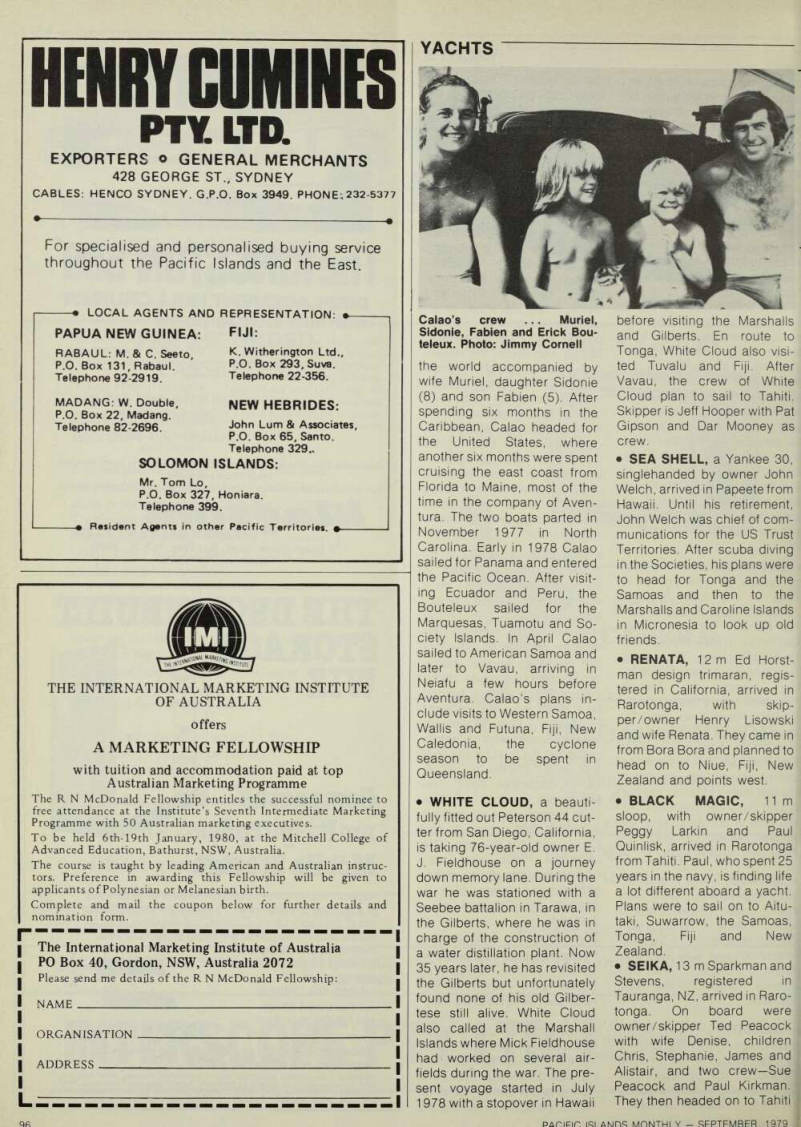
the world accompanied by wife Muriel, daughter Sidonie (8) and son Fabien (5). After spending six months in the Caribbean, Calao headed for the United States, where another six months were spent cruising the east coast from Florida to Maine, most of the time in the company of Aven tura. The two boats parted in November 1977 in North Carolina. Early in 1978 Calao sailed for Panama and entered the Pacific Ocean. After visit ing Ecuador and Peru, the Bouteleux sailed for the Marquesas, Tuamotu and So ciety Islands. In April Calao sailed to American Samoa and later to Vavau, arriving in Neiafu a few hours before Aventura. Calao’s plans in clude visits to Western Samoa, Wallis and Futuna, Fiji, New Caledonia, the cyclone season to be spent in Queensland. • WHITE CLOUD, a beauti fully fitted out Peterson 44 cut ter from San Diego, California, is taking 76-year-old owner E.
J. Fieldhouse on a journey down memory lane. During the war he was stationed with a Seebee battalion in Tarawa, in the Gilberts, where he was in charge of the construction of a water distillation plant. Now 35 years later, he has revisited the Gilberts but unfortunately found none of his old Gilber tese still alive. White Cloud also called at the Marshall Islands where Mick Fieldhouse had worked on several air fields during the war. The pre sent voyage started in July 1978 with a stopover in Hawaii
Calao’s crew ... Muriel, Sidonie, Fabien and Erick Bou teleux. Photo: Jimmy Cornell
and the Marquesas. All new at oftshore sailing, they reported fair winds for their 19-day passage from Tauranga. • S’ECHAPPER (Escape), 12 m O’Kell design home-built ferro-cement hull, registered at the Royal Geelong Yacht Club, Victoria, Australia, arrived in Rarotonga with Roger French, Peter Jones and Alex Roper on board.
They planned to spend ‘sev eral weeks’ in Rarotonga be fore sailing on to Tahiti and other Islands. • ISLE OF FLIGHT, a 7 m Okomoto yawl, with owner/skipper Jon Powers and Constance Nypen as crew, arrived in Rarotonga from Bora Bora, bound for Aitutaki, Western Samoa, Tonga, Fiji and, finally, New Zealand. • JANDIRA, 11 m cutter, arrived at Tubuai in the Aus trals from Tahiti in May, with French couple Fabien and Michotte Poncet. Fabien has taken up a teaching position in
the secondary school which serves all of the Austral Islands. Jandira was built in France of balsa-core fibreglass construction with double centreboards, one fore and one aft. They left France in 1975 for French Guyana where they taught for two years, their two young chil dren joining them there. Then they all sailed to French Polynesia. The children have now returned temporarily to France to stay with their grandparents.
Fabien Poncett ... teaching in the Australs. Photo: Don Travers