The Forum ‘Interferes’
pp. 10-15 · Read in the full issue
South Pacific Forum
French Territories
No one invited them to come officially. But there was no way Solomon Islands was going to prevent them. And almost everybody made them welcome, even if New Zealand Prime Minister Robert Mul doon said he didn’t think the South Pacific Forum was the place for it.
Early in the piece, as Pacific heads were arriving in Honiara for the Forum gathering, Yann Celene Uregei, Nidoishe Nais seline, Franqois Otonari and Jean-Marie Tjibaou, repre
senting the five parties
comprising New Caledonia’s Kanak ‘lndependence Front’, were on deck at the Point Cruz Mendana Hotel, ready to talk to anyone willing to give an ear to their cause.
With them they had brought a letter from the Prime Minis ter’s Department in Western Samoa which, they said, had promised support for them at the Forum. They had also been assured, they said, of Papua New Guinea’s backing which, as it turned out, they got wholeheartedly, but only to limited avail.
Forum delegations all 12 of them - had earlier received
a petition, signed by leaders of
South Pacific Forum discussion of the French presence in the Islands has been muted since Paris decided in 1975 to go underground with its nuclear testing programme on Mururoa Atoll in French Polynesia. But the presence of four New Caledonian Melanesian independence campaigners in Honiara for July's heads of government meeting changed all that, writes PIM Editor Bob Hawkins.
the five parties making up the Independence Front Union Caledonienne (UC), Parti de Liberation Kanak (Palika), Parti Socialiste Caledonien (PSC), Front Uni de Liberation Kanak (FULK) and Union Progressiste Melanesienne
(UPM). Basically, the petition
wanted the Forum to ask the United Nations Committee of 24 on decolonisation to have New Caledonia listed as a
‘non-autonomous’ territory
and, therefore, eligible ulti mately to be ‘decolonised’. (See petition extracts in box page 13.) ‘Champion’ of the moment of the Melanesians’ self determination campaign was Papua New Guinea’s Deputy Prime Minister and Foreign Minister Ebia Olewale who still shows some of the grit and fire which earned him the tag ‘rebel’ in pre-self-government
Png.
Mr Olewale arrived on
Saturday night, July 7, two
days before the heads of government deliberations were
to begin. The following morn ing he had a short but obviously amicable session with his four Melanesian friends from New Caledonia at the water’s edge in the grounds of the hotel. No furtive hotel room lobbying here. (As days went by, Mr Uregei and company were to be seen talk ing freely with most, but not all, heads of delegations.) In quick succession followed press conferences with the four
independence campaigners
and Mr Olewale.
Francois Otonari of Union Caledonienne was interpreter for his group, the other three having some understanding of English but little or no spoken command. Because an interpreter was necessary, the New Caledonian Melanesian case came out a little ragged: ‘We represent the Front for Independence. We represent five parties in New Caledonia ... On the agenda of the Forum there is the question of the French territories of the Pa cific so we want a question to be put forward at the Com mittee of 24 at the United Nations. That’s why we came . . . We contacted Mr Olewale this morning to push our
motion . . . We got a letter from Western Samoa and assurance from PNG that they would give us full support at the Forum 9 Asked what they thought of Mr Muldoon’s indication that he would not support the PNG motion, Mr Otonari continued: ‘Our motion is to inform every
body, including New Zealand,
about the internal problems in New Caledonia . . . Two other countries .. . they said we would get their support but they did not write . . . This was February .. . Cooks and Tuvalu gave us verbal support this morning .. . Australia does not want to be in front of this problem of French territories but they are in favour of de colonisation. They are sym pathetic. The men who saw us today from Australia said they feel the same as Papua New Guinea ... but I think Aus tralia’s position is different.
They would rather see the small countries of the Pa cific . . .’
Tell them the percentages,’
New Hebridean journalist Hilda Uni suggested. Mr Otonari continued: The 14 seats (won by the Indepen dence Front in the recent New
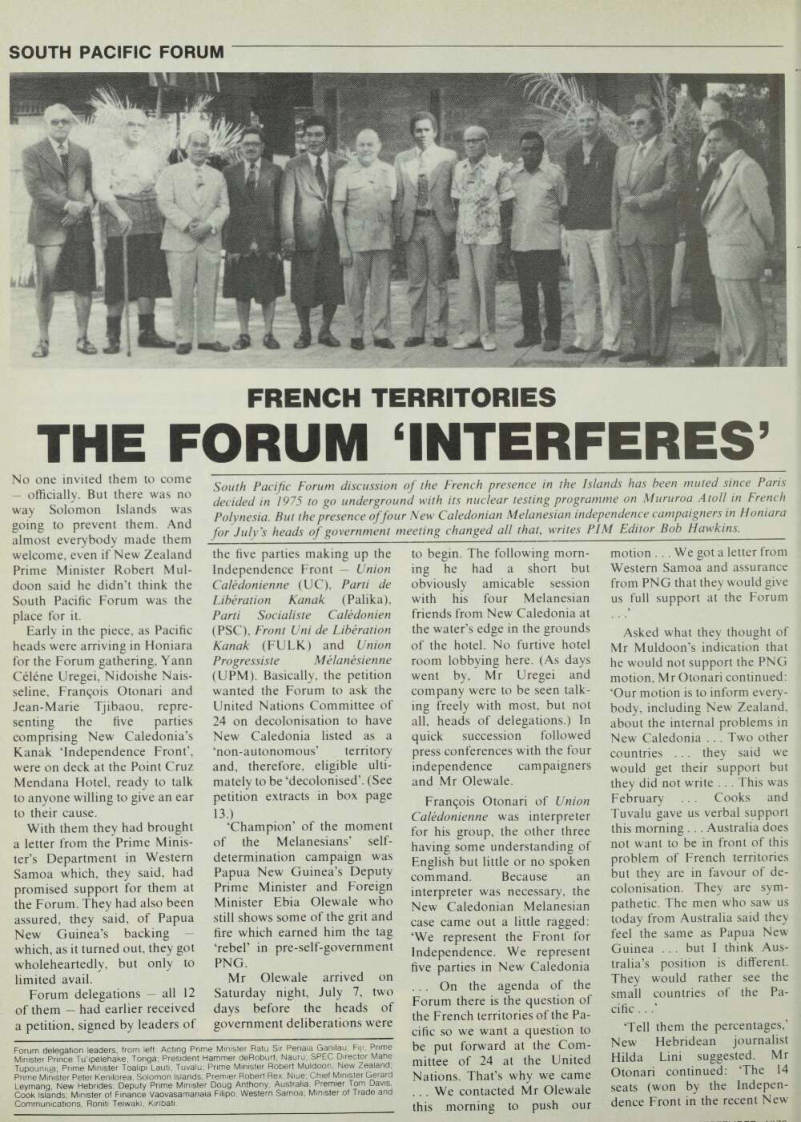
Forum delegation leaders, from left. Acting Prime Minister Ratu Sir Penaia Ganilau, Fiji, Prime Minister Prince Tu[?]pelehake, Tonga; President Hammer deRoburt, Nauru; SPEC Director Mahe Tupouniua; Prime Minister Toalipi Lauti, Tuvalu; Prime Minister Robert Muldoon, New Zealand; Prime Minister Peter Kenilorea, Solomon Islands; Premier Robert Rex, Niue; Chief Minister Gerard Leymang, New Hebrides; Deputy Prime Minister Doug Anthony, Australia; Premier Tom Davis, Cook Islands; Minister of Finance Vaovasamanaia Filipo, Western Samoa; Minister of Trade and Communications, Roniti Teiwaki, Kiribati.
Caledonia elections see box page 15) represent the Melan esians. We know now where everyone stands. From 1969 to 1976 there have been 15 000 newcomers, more than 11 000 Europeans, principally from France. There are 135 000 people in New Caledonia and 55 000 Melanesians .. . You have heard about Mr Dijoud. • He has got a plan. That ma jority [in the recent election] is in favour of that plan. He says that in 10 years from now there will be 400 000 people in New Caledonia .. . And in 10 years from now Melanesians will be only 30% of the total popu
lation ... [The projected
400 000 figure for New Caledonia’s population within 10 years seemed to have be come something of an ob session with the Independent Front representative even though, in all printed accounts PIM has read of the ‘Dijoud Plan’ there is nothing to sup port it. However it is under standable that, if Melanesians of New Caledonia have got this idea into their heads, they are even more anxious than before to rally help from around the Pacific. Even without the Dijoud Plan their position is already precarious.] Melan esians who voted for indepen dence? 82.5% of all Melanesians voted for
independence.’
Question: How did you ac
quire that figure?
Answer: ‘Because we know all of these people, or groups of people, who work with us, who are either European or Melanesian. We have been in politics for 25 years.’
End of press conference. On to another with Mr Olewale: Q: A French official has said a
discussion of independence for
'he French territories at the Forum meeting would be ' egarded by France as an un-
Yiendly act.
Dlewale: I think all human beings are entitled to self
ietermination ... and if they
lave friends who want to help hem I think the act by those
fiends towards helping them
hould not be regarded as an
mfriendly act.
f. New Zealand's position is hat the matter doesn I belong at he Forum level.
O: I believe the Forum has every right to discuss the matter because the Forum happens to be the organisation of sover eign independent states in the Pacific and if there are other Pacific people who want decolonisation, rightly it should be the concern of the Forum.
Q: How many other members of
the Forum would support your attitude on that?
O: I know for a fact that West ern Samoa would support this idea. There are others I have
heard through the grapevine
that would also support us Q: Have you had any formal French Government approach ... to try to persuade you to drop this issue?
O: When was it? Friday. Some junior officer from the French Government went to Port
Moresby and he wanted to see either the prime minister or myself but we thought he was such a.. .just a civil servant. . . that it was not proper for civil servants to see heads of govern ments so we referred him to our Department of Foreign Affairs. He presented a written message from the president of France which in fact said the same sort of thing which Olivier Stirn has preached lately in his travels to the Pa cific ...
Q: Did Mr Stirn at any stage suggest he should go to Port
Moresby himself?
O: Yes. He made a request but his time did not fit in with our prime minister’s time table or my time table. I was away in Southeast Asia and the prime minister was attending the provincial premiers’ con ference ... and I think he had such a short time to stay in the Pacific that he decided not to come to Port Moresby.
Q: Had it fitted in with your time table would you have been prepared to meet him?
O: Oh yes. Sure.
Q: What would you like the Forum to do on this question?
Would you like it to come up with a formal resolution to refer it to the Committee of 24?
O: That is what Papua New Guinea would like to see hap pen. A general resolution on decolonisation in the Pacific, and finally for it to find its way to the UN Committee of 24.
Q: How do you see your motion to raise the issue of French terri tories as a contrast to your foreign policy ... Do you see it as antagonising France?
O: I don’t think it is antagonis ing France. I think I am sure it is very clear to you that there are countries in the South Pacific like a . . . Where are you from? ... Yes, like Solomons, and you are happy that you are independent now. Like me. I am happy Papua New Guinea is now an independent country.
And how would you feel about other Pacific Islanders being ruled from Europe? Europe is very far away from the Pacific.
Q: You say you cannot do any thing about Irian Jaya because it is part of Indonesia. The French claim New Caledonia is part of France. So how is it that
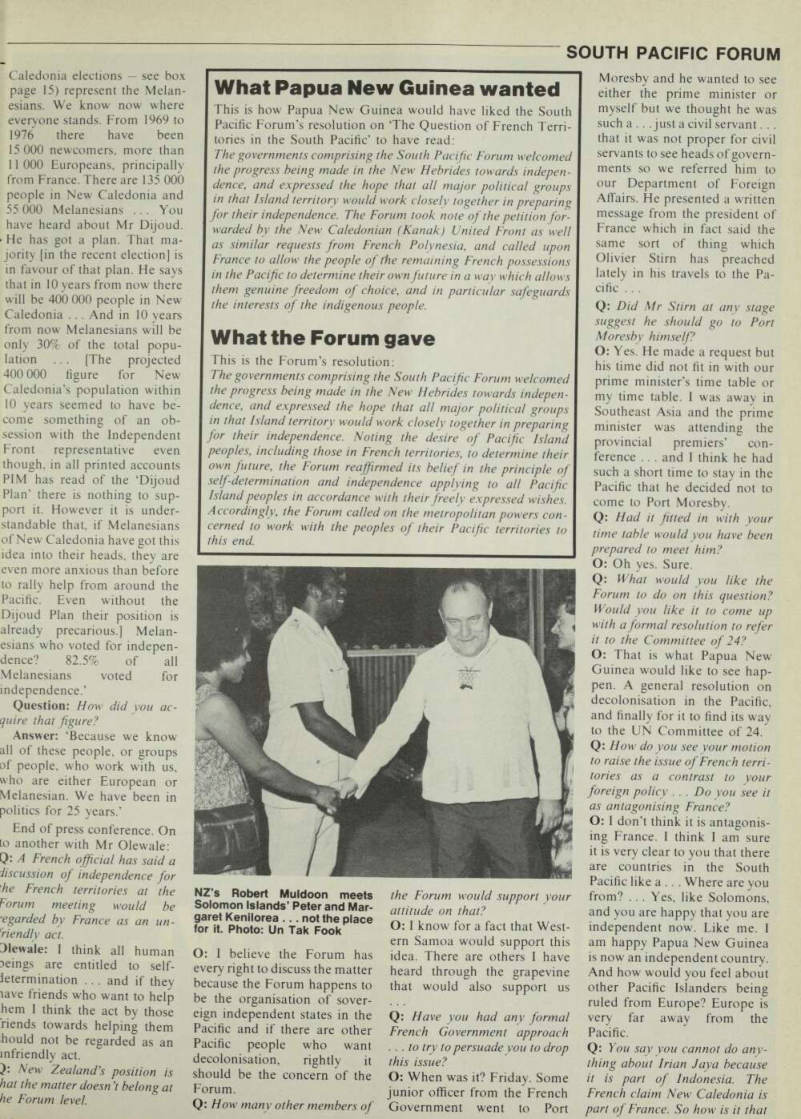
NZ’s Robert Muldoon meets Solomon Islands’ Peter and Mar garet Kenilorea ... not the place for It. Photo: Un Tak Fook
you come to support the New Caledonia issue but not West Papua?
O: The difference is that in West Papua the United Nations, the world organis ation, carried out a plebiscite.
No such thing has happened in New Caledonia yet.
So, with Papua New Gui nea’s cards on the table, New Caledonia’s Melanesians got on with their lobbying until heads of delegation headed off to Tambea, up the coast of Guadalcanal, for their now tra ditional ‘informal’ talks about the Forum agenda. When they returned in the evening word was, according to one delegate, that they had had ‘the best informal session ever’.
But, next day, it was clear that the New Caledonia issue was not one which had gone well at Tambea. By lunchtime almost all other agenda busi ness, in formal session, had been disposed of and national leaders and deputies were ‘five minutes’ into the French terri tories debate.
At the afternoon teabreak it seemed some progress had been achieved and a drafting
committee comprising
Papua New Guinea, Australia and Fiji - was working on a watered-down form of the PNG resolution. Australian
Foreign Minister Andrew Peakcock seemed confident that an acceptable formula was imminent but he obviously still felt it necessary to put an arm around his old friend, Ebia Olewale, and guide him away to a waterside seat where earn est discussion followed.
Though out of earshot, it cer tainly didn’t look as if Mr Pea cock was finding the going easy in his attempts to persuade Mr Olewale to accept anything less than PNG’s original proposal.
Back into session and a
long one. Finally delegates re
emerged to an eager press
corps. Dr Tom Davis, premier of the Cook Islands, elected spokesman for the Forum, did a smooth job of rationalising what at first appeared to be almost an act of appeasement of the French.
In Dr Davis’ lunchtime briefing on the morning session there had been an interesting
exchange:
Question: Will you discuss the matter of the French territories
this afternoon?
Davis: It could be held over.
Q: Until tomorrow?
D: Until later.
It seems at that stage that there was some doubt as to whether the French territories would appear in the final com munique, even as an agenda
item which delegations had chosen not to discuss.
But the Papua New Guinea delegation had no intention of
letting the issue disappear.
While not doubting the ability of both Melanesian and Polynesian to put up a good
fight when they really decide to
dig their heels in, of the nations which have emerged in a decolonising Pacific, none can match Papua New Guinea in the way it casts caution and economic considerations to the wind in pursuit of what it considers ‘moral’ goals. (Irian Jaya, of course, is more than a simple economic risk for
Png.)
Dr Davis recorded later, when asked if PNG had accepted the will of the Forum:
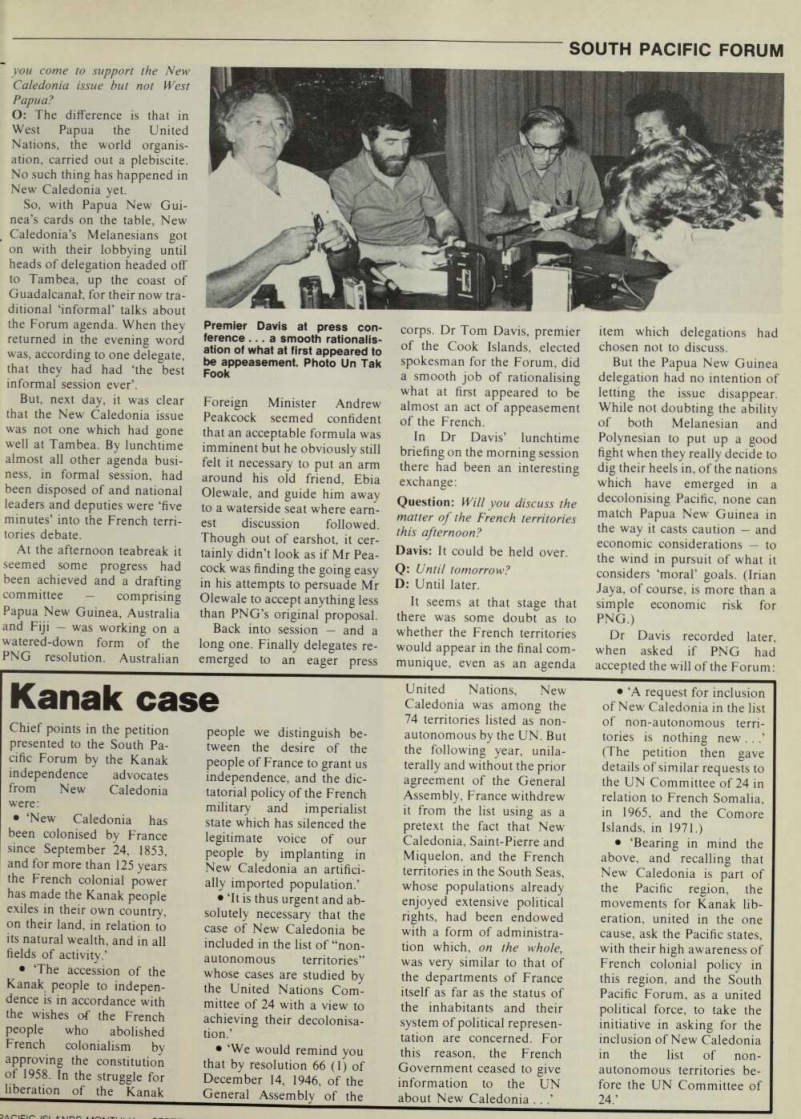
Premier Davis at press con ference ... a smooth rationalis ation of what at first appeared to be appeasement. Photo Un Tak Fook
‘They have eventually, but I must give them credit for fight ing very hard on behalf of the
indigenous peoples of New
Caledonia.’
The Cooks premier in several ways made the Forum’s final resolution look so much more reasonable. He ex plained; ‘The first resolution was considered by the majority ... to be too specific towards the French which could be con sidered interference in internal affairs. In other words, France is not the only nation in the Pacific which has colonial rights *Over Pacific peoples. I think ... all of us feel very strongly for the self determination of Pacific peoples .. . Those of us who have been associated with New Zealand or Australia have a feeling of ... a strong feeling,
perhaps carrying a bit of pain
to it, that there are still peoples who are not free. Australia and New Zealand have bent over backwards to create the
independence of peoples orig
inally colonially under their
guidance. But nevertheless there is a degree of responsi bility that has to be taken. Even with the help of the bending backwards of Australia and New Zealand (it) still took con siderable time to work out the
independence of the peoples
associated with them.’
Dr Davis agreed that the final resolution was far short of what the New Caledonian Independence Four had wanted but the ‘Forum has to act responsibly in not becom
ing a platform for a political
party’.
Question: This (the resolution) does not preclude individual members of the forum taking the matter to the Committee of 242 Davis: That is exactly right.
Q: Was that discussed?
D: Yes. These individuals,
these particular political enti
ties, can speak with each of the members of the Forum pri vately. There is little doubt that they will be given support in their aims.
Dr Davis said he accepted the assurances from Olivier Stirn that France would grant independence if a majority of people voted that way but added that the limitations on
that acceptance were the ‘con stituents of a population. Are
they Frenchmen? Are they
soldiers? Are they in the army?
Are they imported to work in nickel mines? Or whatever.
And have a vote. In other words, the issue is indigenous
people’.
Question: It has been suggested Cook Islands would support moves to have this question put before the Committee of 24.
Davis: I don’t think we can do any less.
Q: Then you support them.
D:Yes.
Q: Therefore you are personally disappointed at the resolution which has come out of the Forum.
D: I am not disappointed in terms of the Forum. As an individual I feel disappointed that there wasn’t much more that we can do.
Q: What essentially was the dif ficulty that the Forum had in accepting the proposal put for ward by Papua New Guinea?
D: The difficulty was the fact that this constituted (the view point of) a party and prob ably a minority party. It did not constitute a national wish.
Q: Do vou at any stage see the
Pacific being wholly indepen
dent?
D: Oh! I do. It could be half a decade. These things are
moving along faster than you think. That is some reason why one should take a fairly responsible attitude rather than supporting, say, the Toto tupuna in Tahiti which is a strong group, vociferous and doing what they can politically ... but a relalively small minority in terms of the total population. (Once again I had the feeling that certain Pacific leaders, including Australian and New Zealand, know something on this matter that they are not willing to impart to the press.
A year ago I met a highly respected authority on the Islands who didn’t drop hints, like Dr Davis seemed to be
doing. He bluntly suggested
that France would be out of New Caledonia in about three years. In fact we wagered a car ton of beer on the point, with me assuming that I would be able to drink it in a still-French New Caledonia sometime in 1982. On several other occasions in the past year I have met the ‘wink wink,
nudge nudge’ approach in
people who ought to know what they are talking about. If they’re right, there was more to the Forum’s easy approach in Honiara than immediately met the eye. It is possible that the ‘wink and nudge’ experts have a weather eye on political
Above: Melanesian Indepen dence Front reps, from left Nais seline, Uregei, Tjlbau and Otonari ... talking to most everybody; right: PNG’s Olewale ... a determined stand.
Photos Bob Hawkins
developments in France, where combined Leftist forces such as the Socialist and Communist parties are usually only a few percentage points off achieving power in Presidential and national elections. If they suc ceed in bridging this gap at any time, French policy in the Pa cific could undergo dramatic changes in favour of indepen dence for the indigenous peoples of the Pacific terri tories.) Talking around delegation members afterwards it was ap parent that though the Forum had acted in ‘statesmanlike’ manner, sympathies generally lay with New Caledonia’s min ority Melanesian community.
Most important, even
though some delegates seemed
unaware of the breakdown of New Caledonia’s population (and the implications of the Melanesians’ now precarious position within their home land), their major concern was the protection of the rights of the ‘indigenous’ peoples.
One delegate’s eyes opened in surprise (only the cynical would have said mock surprise) when the various components of the New Caledonian popu lation (and their percentages) were detailed to him. ‘Why didn’t the Forum know these facts?’ he asked.
The two New Hebridean ob servers, Chief Minister Father
Gerard Leymang, and Minister
for Public Administration George Kalkoa (of the Vanu
aaku Part y)’ were sported to ave been biting their lips as the y listened ’ unable to con tribute to the French territories debate in the formal Forum sessions, Afterwards, Father Ley mang told me: did not understand the Australian and New Zealand reas °ning in the Forum. It ™ ust have *? een economic con- Sld w atl £ n ?i Ka koa told me New Caledonia would be a priority foreign affairs matter after New Hebrides gains its dependence next year. He adm *“ ed «■»« his party had been helping the Kanak move ment ‘" New Caledon.a for <• , , . quite a while and it was a , continuing process. r .
On the question of whites in x Ta „, n i a .
New Caledonia, he com t , tI r . mented; I am afraid it is very hard to give any clear intention as to how the New Caledonians can * sort this out. If New Caledonia achieves mdepen dence they (the whites) will be given the option of choosing whether they want to stay and become citizens.’ He was quite cynical about many of the Europeans who stood in the re cent New Caledonian elec tions: ‘They could only stand because someone is dishing out money somewhere.’ He be
lieved that only in electorates where Melanesians were out numbered had anti-independ ence candidates been elected.
One source suggested the Forum breakdown on the French territories question was roughly as follows: For the PNG resolution PNG, West ern Samoa, Fiji and Tuvalu; highly sympathetic Cook Islands, Kiribati, Tonga, Niue; against the PNG resolution Australia, New Zealand and Nauru, the latter, as one voice put it, being ‘caught in an econ omic vice’ (President Hammer de Roburt recently visited Paris); would have preferred no record at all in the final com munique Australia and New Zealand.
Fiji is understood to have indicated some preference for the Banaba (Ocean) Island issue to have been included in the resolution, but this was settled separately with a mild resolution congratulating the Banabans and Kiribatians on their willingness to keep talk ing about the Banabans’ desire to get out of the Republic of Kiribati, and Tarawa’s deter mination to keep them in.
The final resolution was drafted by a committee
comprising Australia, Papua
New Guinea and Fiji. One wonders how long Andrew
Peacock’s ‘special’ relationship
with certain of PNG’s leaders will survive.
Post-Forum, it was revealed that New Zealand’s Prime Minister Muldoon had tried to compare a New Zealand South Island secessionist movement with the New Caledonian situ ation. He was not the only red herring specialist. It was also suggested that Mr Peacock had expressed the view that Papua New Guinea’s own Bougain ville and Papua Besena prob lems were analogous.
Obviously, both Australia and NZ were desperate for par allels. In the Pacific there is no analogy to the position of the Melanesians in New Caledonia
an indigenous population in
the minority. Unless one looks to Australia and New Zealand.
God forbid that should happen
again in this ‘enlightened’
age.
New Hebrides Kalkoa and Leymang ... puzzled at the Aus tralasian attitude. Photo: Bob Hawkins