Letters
pp. 5-6 · Read in the full issue
A word to Ms James I offer some comments on Ms Lois James’ letter published in the May edition of PIM, and the role of the United States in Pacific affairs.
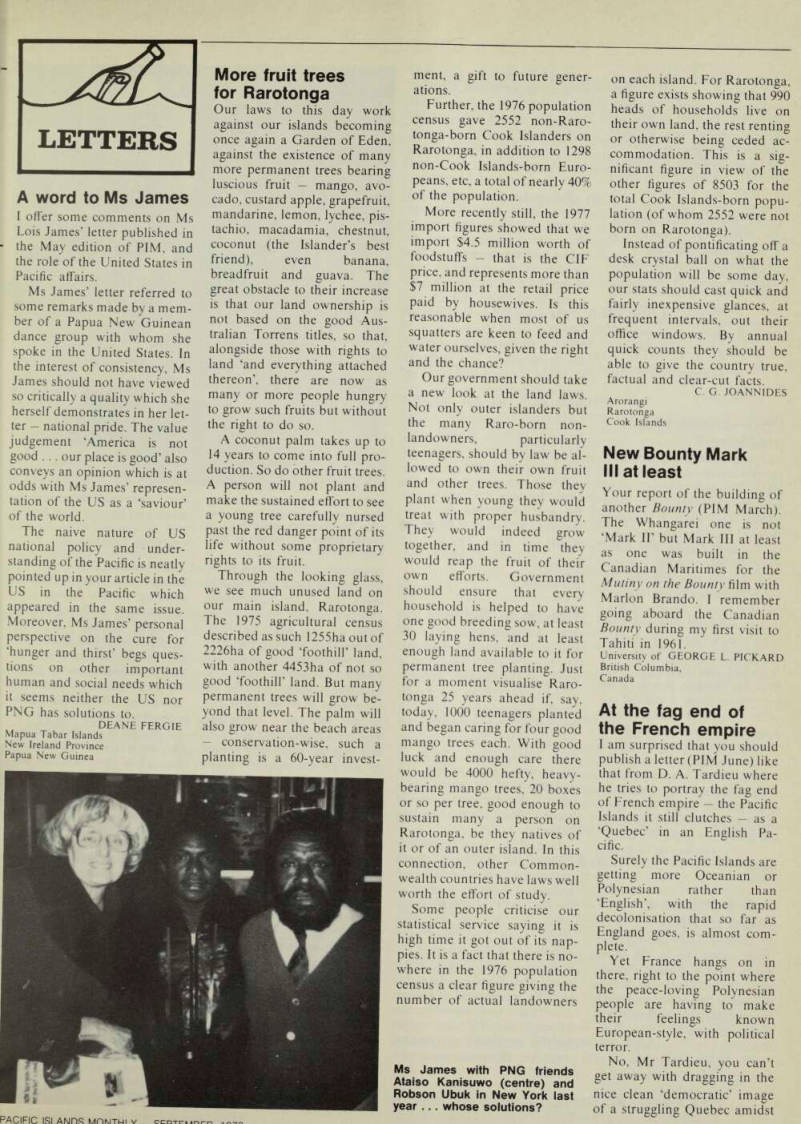
Ms James’ letter referred to some remarks made by a mem ber of a Papua New Guinean dance group with whom she spoke in the United States. In the interest of consistency, Ms James should not have viewed so critically a quality which she herself demonstrates in her let ter national pride. The value judgement ‘America is not good ... our place is good’ also conveys an opinion which is at odds with Ms James’ represen tation of the US as a ‘saviour’ of the world.
The naive nature of US national policy and under standing of the Pacific is neatly pointed up in your article in the US in the Pacific which appeared in the same issue.
Moreover, Ms James’ personal perspective on the cure for ‘hunger and thirst’ begs ques tions on other important human and social needs which it seems neither the US nor PNG has solutions to.
Deane Fergie
Mapua Tabar Islands New Ireland Province Papua New Guinea
More fruit trees
for Rarotonga
Our laws to this day work against our islands becoming once again a Garden of Eden, against the existence of many more permanent trees bearing luscious fruit mango, avo cado, custard apple, grapefruit, mandarine, lemon, lychee, pis tachio, macadamia, chestnut, coconut (the Islander’s best friend), even banana, breadfruit and guava. The great obstacle to their increase is that our land ownership is not based on the good Aus tralian Torrens titles, so that, alongside those with rights to land ‘and everything attached thereon’, there are now as many or more people hungry to grow such fruits but without the right to do so.
A coconut palm takes up to 14 years to come into full pro duction. So do other fruit trees.
A person will not plant and make the sustained effort to see a young tree carefully nursed past the red danger point of its life without some proprietary rights to its fruit.
Through the looking glass,
we see much unused land on our main island, Rarotonga.
The 1975 agricultural census described as such 1255 ha out of 2226 ha of good ‘foothill’ land, with another 4453 ha of not so good ‘foothill’ land. But many permanent trees will grow be yond that level. The palm will also grow near the beach areas - conservation-wise, such a planting is a 60-year invest
ment, a gift to future gener ations.
Further, the 1976 population census gave 2552 non-Raro tonga-born Cook Islanders on Rarotonga, in addition to 1298 non-Cook Islands-born Euro peans, etc, a total of nearly 40% of the population.
More recently still, the 1977 import figures showed that we import $4.5 million worth of foodstuffs - that is the CIF price, and represents more than $7 million at the retail price paid by housewives. Is this reasonable when most of us squatters are keen to feed and water ourselves, given the right and the chance?
Our government should take a new look at the land laws.
Not only outer islanders but the many Raro-born non
landowners, particularly
teenagers, should by law be al lowed to own their own fruit and other trees. Those they plant when young they would treat with proper husbandry.
They would indeed grow together, and in time they would reap the fruit of their own efforts. Government should ensure that every household is helped to have one good breeding sow, at least 30 laying hens, and at least enough land available to it for permanent tree planting. Just for a moment visualise Raro tonga 25 years ahead if, say,
today, 1000 teenagers planted
and began caring for four good mango trees each. With good luck and enough care there would be 4000 hefty, heavy bearing mango trees, 20 boxes or so per tree, good enough to sustain many a person on Rarotonga, be they natives of it or of an outer island. In this connection, other Common wealth countries have laws well worth the effort of study.
Some people criticise our statistical service saying it is high time it got out of its nap pies. It is a fact that there is no where in the 1976 population census a clear figure giving the number of actual landowners
on each island. For Rarotonga, a figure exists showing that 990 heads of households live on their own land, the rest renting or otherwise being ceded ac commodation. This is a sig nificant figure in view of the other figures of 8503 for the total Cook Islands-born popu lation (of whom 2552 were not born on Rarotonga).
Instead of pontificating off a desk crystal ball on what the population will be some day, our stats should cast quick and
fairly inexpensive glances, at
frequent intervals, out their office windows. By annual quick counts they should be able to give the country true, factual and clear-cut facts.
C. G. Joannides
Arorangi Rarotonga Cook Islands
New Bounty Mark
111 at least
Your report of the building of another Bounty (PIM March).
The Whangarei one is not ‘Mark IT but Mark 111 at least as one was built in the Canadian Maritimes for the Mutiny on the Bounty film with Marlon Brando. I remember going aboard the Canadian Bounty during my first visit to Tahiti in 1961.
University of GEORGE L. PICKARD British Columbia, Canada
At the fag end of
the French empire
I am surprised that you should publish a letter (PIM June) like that from D. A. Tardieu where he tries to portray the fag end of French empire the Pacific Islands it still clutches - as a ‘Quebec’ in an English Pa cific.
Surely the Pacific Islands are getting more Oceanian or Polynesian rather than
‘English’, with the rapid
decolonisation that so far as England goes, is almost com
plete.
Yet France hangs on in there, right to the point where
the peace-loving Polynesian
people are having to make their feelings known
European-style, with political
terror.
No, Mr Tardieu, you can’t get away with dragging in the nice clean ‘democratic’ image of a struggling Quebec amidst
Ms James with PNG friends Ataiso Kanisuwo (centre) and Robson Ubuk in New York last year ... whose solutions?
hostile ‘English’ Canadians.
Why not take a look in your very own country, France, where the Breton people are intensifying their own struggle in a sea of uncaring F rench?
As a well-known Brezhoneg (Breton) separatist remarked not long ago; ‘Between the retreats from Moscow and
Algiers nothing has changed,
apart from the capacity, in
French empire-building.’
Presumably the denial of democratic liberty to a far, small, easily-exploited Pacific Islands people will be the very last instalment in that story, and echo the truth of my Bre ton nationalist colleague’s re mark.
Andrew Mackillop
Konedobu Papua New Guinea
PNG—conservation
problems?
Recently I had the opportunity to view a film made in Papua New Guinea. There were beautiful flowers, birds, but terflies, and some traditional dances. The film showed also the cutting of trees. The com mentator said that local people were unable to cut down the larger and more beautiful trees, but that outside firms with ma chinery now can. The commen tator tried to find out whether anything was done about replacing the trees and said that the lumber people were very vague about it and did not seem to care. He said that if this goes on unchecked the PNG people will some day have little left but sawdust.
The film also pictured mountaineers with feathered head-dresses going into little stores to purchase things which are really not good for them.
Andre Gschaedler
Salem, W.Va
Usa
Cell 4 strikes a
chord in PNG
As a New Hebridean I was really interested in the letter ‘From Cell 4, French Prison, Vila’ (PIM June). At last a French citizen is brave enough to admit facts about the French administration in the New Hebrides.
Mr Tarii’s illustrations of how the French administration in the New Hebrides is trying to monopolise both air trans
port and the press are facts that in many respects even govern ment ministers in the New Hebrides cannot deny. This sort of policy can be found in all walks of life, ranging from schools to shipping lines and even the House of Assembly.
Nabanga is also a one-sided paper. Many news items are printed in it either to promote the colonial masters or to give a bad face to opponents of the French in the group. It is a mouthpiece of French propa ganda in the New Hebrides.
The experiences related by
Mr Tarii could happen to any body at all who tried to spread the truth about the political situation, and other matters of major importance in the New
Hebrides. Many people,
including Americans, Aus tralians, French, English and Africans have been treated in this way in the past.
That’s the way it is in the New Hebrides. If it hadn’t been for the British and the Aus tralians, things would be worse still.
C. M. Lawrence
University of Papua New Guinea Port Moresby
Tribute to Salato
The commendable offer in People (PIM June) to publish Dr Macu Salato’s memoirs if he will but use some of his time in retirement from the South Pacific Commission (SPC) to write them deserves underscor ing. Dr Salato has had a long and distinguished career in Fijian and Pacific affairs. His assessment of the region’s pol itical development would
make fascinating reading
indeed.
One of the most interesting chapters in this book would have to be Dr Salato’s 3*/2-year tenure as secretary-general of the SPC. As PIM will no doubt recall, the SPC was at a crisis point when Dr Salato was appointed at the Nauru Con ference in 1975. Stuart Inder made the comment then that the SPC was in need of a ‘heart transplant’ and therefore the appointment of a doctor might be just the medicine the SPC required. His words were pro
phetic.
Dr Salato’s ability, energy and personality have helped to
resuscitate the organisation. He took charge from the outset to make use of the opportunity afforded him by the major re view of the SPC in 1976.
Rather than waiting passively
to receive whatever result the review committee chose to give, Dr Salato encouraged the secretariat to review itself and to put forward a secretariat position on needed changes. In this way he materially helped to design the ship at whose helm he stood.
Having secured from the 1976 review an organisation which he felt had a genuine role to play. Dr Salato began a daunting schedule of intra- and extra-regional visits to cement these gains. He was undoubt
edly the most widely-travelled
secretary-general in the organ isation’s history. To further the communication function of the SPC, Dr Salato visited virtually every one of its 20 member countries, including the isola ted Tokelaus. He also per sonally represented the SPC at numerous international and national meetings concerned with matters of interest to the SPC. These visits have helped both to achieve a more effec
live liaison with these govern ments and international bodies and to restore some of the SPC’s tarnished image.
In Noumea, Dr Salato’s dip lomacy was instrumental in
securing French co-operation
in repairing and modernising
the aging ‘Pentagon’ and other
headquarter buildings. His
firm hand and keen eye for detail enabled him to ensure his staff functioned effectively as a team. The ‘old man’, as he was affectionately known, had the respect of his staff and with this he was able to make the best of a very difficult time financially for the SPC.
Perhaps the greatest disap pointment for Dr Salato over the past 3 Vi years must be that he had to spend so much of his time dealing with criticism of the SPC. His term of office will certainly serve to dispel some of the more exaggerated com plaints and this may be suf ficient recompense for him.
Young Vivian, Dr Salato’s suc cessor at the SPC helm, must be personally grateful to have had such an able predecessor.
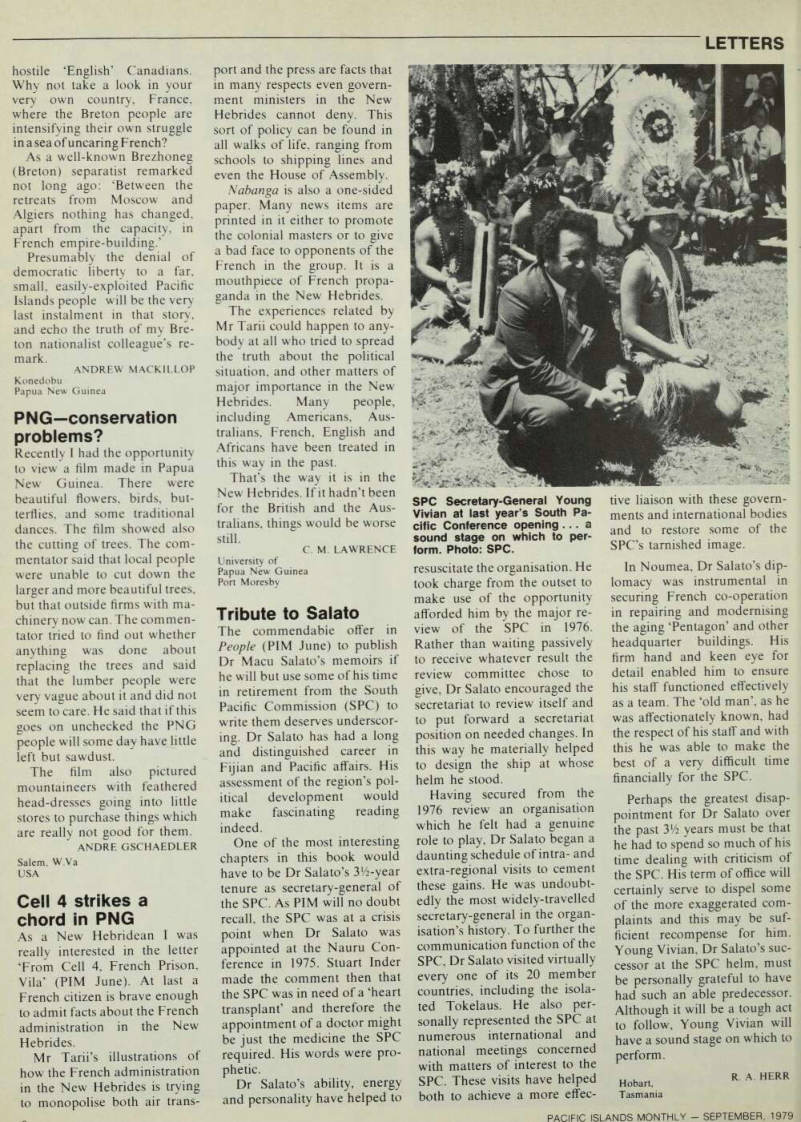
Although it will be a tough act to follow, Young Vivian will have a sound stage on which to
perform.
R. A. Herr
Hobart, Tasmania
SPC Secretary-General Young Vivian at last year’s South Pacific Conference opening ... a sound stage on which to perform. Photo: SPC.