Barriers
pp. 85-87 · Read in the full issue

McNamara hits OUT
At Trade
Criticism of protectionism in the industrialised countries made by Pacific Island and other Third World spokesmen at the United Nations (PIM February) received ringing endorsement from World Bank President Robert S. McNamara at the United Nations Conference on Trade and Development (UNCTAD) in Manila in May.
Fiji’s UN representative Ber
enado Vunibobo had told the 1978 meeting of the UN Gen eral Assembly that the trend towards protectionism was not only ‘unhealthy’, but ‘makes us wonder as to the sincerity of those who have been loud in their assurances and commit ment to a more equitable dis tribution of the world’s wealth’.
Papua New Guinea’s Foreign
Minister Ebia Olewale told the
same meeting: if meaningful
progress is to be achieved, de veloped industrial nations must address themselves to the question of improved access to their markets for the goods of developing countries. It is a
recognised fact that developing
countries are an important market for the exports of in dustrialised countries. If these markets are to remain open, greater efforts must be made to enable Third World countries to increase their export earn
ings.’
Taking up the theme in Manila, Mr McNamara warned that unless the gather ing momentum of trade protec tionism is resisted and rolled back, the progress made in economic development and in ternational co-operation dur ing the past 25 years could be undermined.
He reminded the meeting of the ‘shocking conclusion’ of the World Bank’s World Develop ment Report 1978 that unless the developing countries achieved the projected, and optimistic, growth rates envisaged by the report some 600 million people would re main trapped in absolute pov erty at the end of the century.
Mr McNamara said that pro tectionism in the industrialised nations harmed the developing
countries directly by reducing
their opportunity to earn
foreign exchange, by increas
ing their unemployment, and by diminishing the rate of growth of their income. It hurt
them indirectly by inhibiting
them from adopting invest ment, production and trade policies which would improve the allocation of their resources and their overall development performance.
The very threat of future im position of protectionist measures often discouraged developing countries from adopting trade-orientated poli cies. ‘The result is that they settle for inferior trade and
development strategies, and
end by strengthening the vested interests in the societies that benefit most from produc ing at high cost for highly pro tected domestic markets.’
Mr McNamara told the con ference that protectionism in
the developed countries sought
to save specific industries, sec tors or regions from incurring detrimental economic and human costs. But this did not
protect society from incurring
equally real and even larger long-term costs.
The case for protection at least for protection against exports from developing coun tries was usually made on the basis of the burden that fell on the low-skilled labour that was
displaced.
‘But what the advocates of protection neglect to say is that the present jobs of these workers may not be saved even
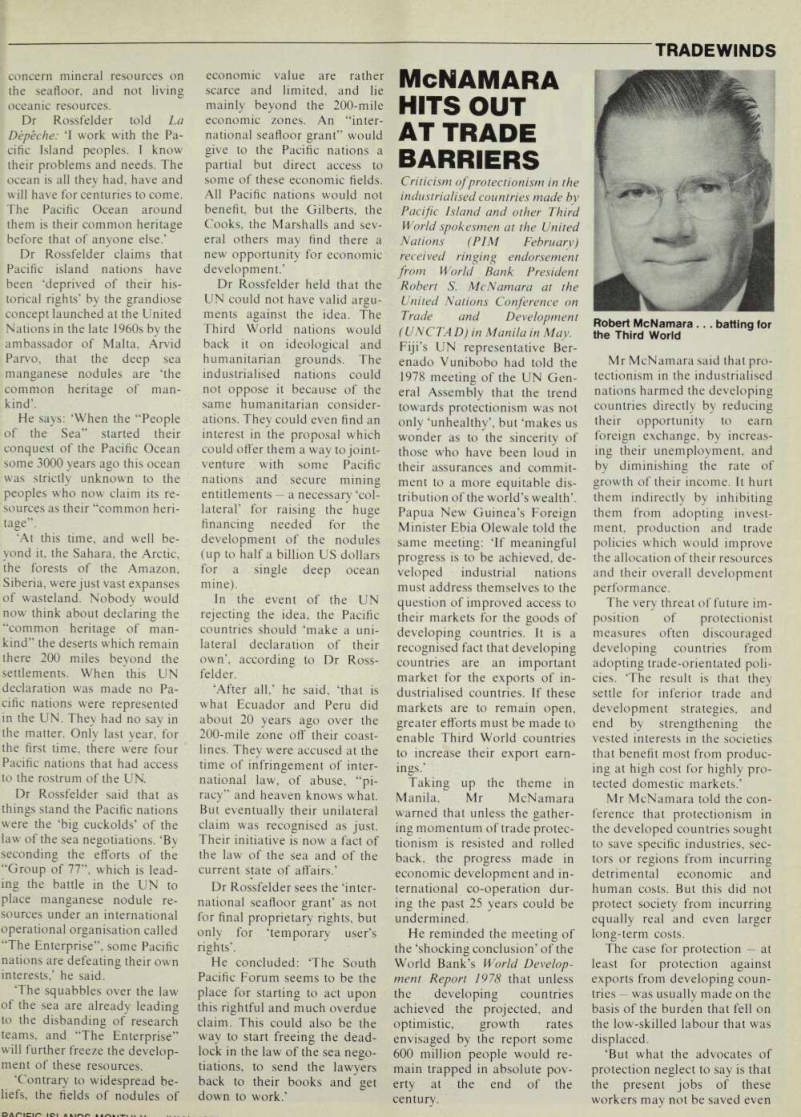
Robert McNamara ... batting for the Third World
under protection. Protection is often utilised — to the ultimate disappointment of trade unions that ask for it — as a means of allowing an industry to “adjust” by automating low skilled jobs out of existence, using the assured higher prices to pay for labour-displacing
machinery.’
‘The truth is that protec tionism is inefficient, counter
productive and ultimately
self-defeating,’ Mr McNamara said. It was inefficient because it prevented the restructuring of inefficient traditional indus tries into modern. high technology industries for which the advanced countries were best suited. As a result, indus trial nations, which were
dependent on foreign trade,
might suffer slower growth and
falling living standards.
Protectionism was counter
productive because it provoked
retaliation by other countries,
and eroded incomes and better jobs in export-orientated industries, a large share of whose production went to the
developing countries.
By walling off-low-cost.
imports in the developed coun tries, protectionism fuelled in flation and often put the heaviest burden on those in so ciety least able to bear it. It had been estimated in a recent study that the effects of protec tionist measures imposed by the United States between 1975 and 1977 resulted in a cost to consumers of $660 million in sugar, $1250 million in carbon steel, $400 to $800 million in meat, and $1200 million in footwear.
In terms of short-term gain in jobs, the consumer cost per job-protected was more than $50 000 per year. Protectionism also undermined the inter national system of capital and trade flows on which the suc cesses of the past 25 years had been built. Mr McNamara added.
He concluded: Trade prob lems of course are not the only economic issues that trouble our planet. . . But I remain convinced that a liberal world trade environment is critical to the success of international
development.
‘If we fail to save that -
environment from the repeated threats of trade protectionism, then the pace of development itself and the quality of life of hundreds of millions of less advantaged individuals who deserve so much more than the little they have will remain
in jeopardy.’