for everybody
p. 83 · Read in the full issue
Trade
Winds
Fisheries: one for the forum-one for everybody
Three years of research, talking and politicking culminated in May with a meeting in Honiara at which a draft convention was adopted for the newly-established South Pacific Fisheries Agency.
From the statement issued after the May 7-9 meeting, it seems there’s a long way to go before the agency, or any or ganisation which may stem from it (which now seems likely), will become an effec tive means of using and
managing the highly migratory
tuna which abound in the waters of Forum members.
Without the privilege of lis tening in to the exchanges of Forum member country officials (all present at Honiara except Niue and Tuvalu), it is difficult as it always is in finding out what goes on inside the mind of the Forum body corporate - to understand what motivated them to come up with the idea of the agency
spawning yet another organis
ation.
The press release tempts the reader to jump to the con clusion that the age-old prac
tice of avoiding taking any real
action by ordering another
‘feasibility study’, or simply by
deciding to ‘consider the mat ter further at a future date’, was □nee again at work in Honiara.
Officials recommended that their leaders, when they meet in Honiara this month, should ‘convene a meeting ... at an early date to consider the prin ciples’ on which a further or
ganisation - ‘more broadly
based’ with ‘separate functions from the Forum Fisheries Agency, to provide a means of co-operation between all coastal states of the region and all states whose nationals fish
for highly migratory species in
the region’ should be established.
However, the key to the reasoning behind this latest development in the fisheries agency saga may lie in the views of a United States diplo mat who specialises in Pacific affairs, John Dorrance, who talked to journalists at the American Centre in Sydney in
late May.
Mr Dorrance felt that the most likely solution to the pre sent impasse, which began last September in Niue when the US was excluded from the then proposed agency, was the for mation of two separate organ isations, one comprising Forum members only, the other all
interested parties including
particularly the ‘distant water fishing nations’ which means the likes of the US, Japan, South Korea and Taiwan in
particular.
That the May 7-9 Honiara meeting of Forum officials would move in this direction was indicated earlier in the month by Papua New Guinea’s Foreign Minister Ebia Olewale in a statement directed at US
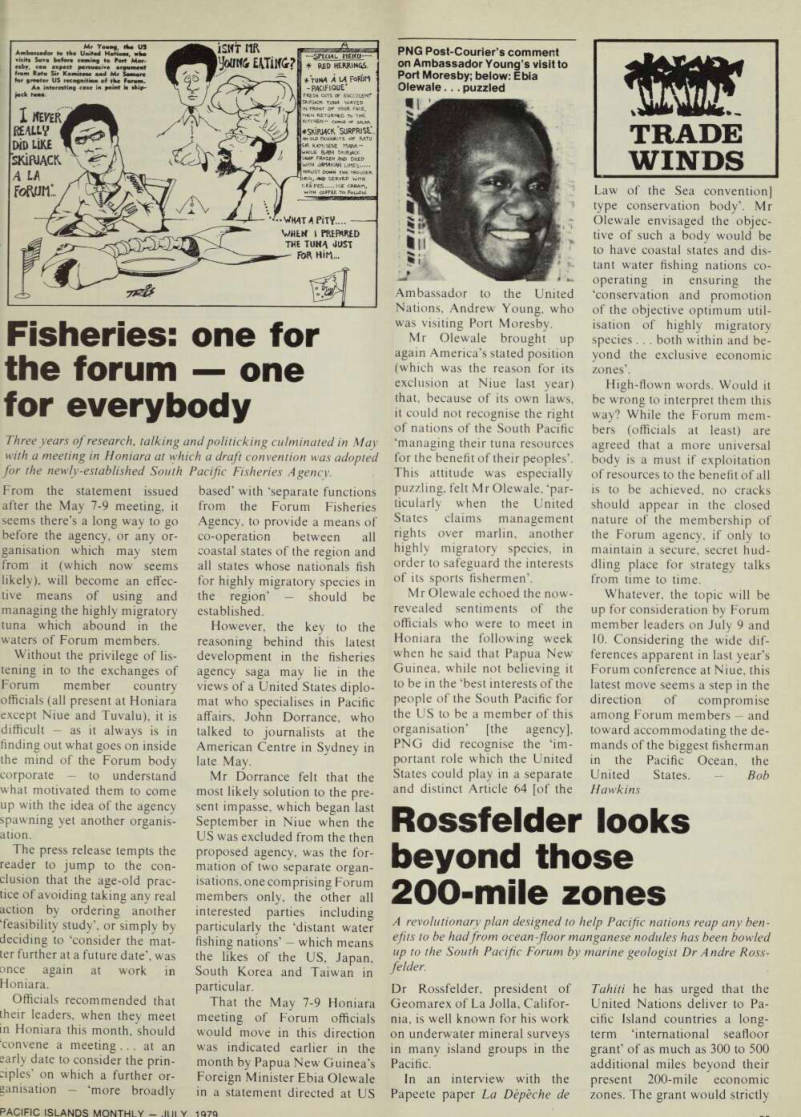
Ambassador to the United Nations, Andrew Young, who
was visiting Port Moresby.
Mr Olewale brought up again America’s stated position (which was the reason for its exclusion at Niue last year) that, because of its own laws, it could not recognise the right of nations of the South Pacific ‘managing their tuna resources for the benefit of their peoples’.
This attitude was especially puzzling, felt Mr Olewale, ‘par ticularly when the United States claims management rights over marlin, another
highly migratory species, in
order to safeguard the interests of its sports fishermen’.
Mr Olewale echoed the now revealed sentiments of the officials who were to meet in Honiara the following week when he said that Papua New Guinea, while not believing it to be in the ‘best interests of the people of the South Pacific for the US to be a member of this organisation’ [the agency], PNG did recognise the ‘im portant role which the United States could play in a separate and distinct Article 64 [of the
Law of the Sea convention] type conservation body’. Mr Olewale envisaged the objec tive of such a body would be to have coastal states and dis tant water fishing nations co
operating in ensuring the
‘conservation and promotion of the objective optimum util
isation of highly migratory
species . . . both within and be yond the exclusive economic zones’.
High-flown words. Would it be wrong to interpret them this way? While the Forum mem bers (officials at least) are agreed that a more universal body is a must if exploitation of resources to the benefit of all is to be achieved, no cracks should appear in the closed nature of the membership of the Forum agency, if only to maintain a secure, secret hud dling place for strategy talks from time to time.
Whatever, the topic will be up for consideration by Forum member leaders on July 9 and 10. Considering the wide dif ferences apparent in last year’s Forum conference at Niue, this latest move seems a step in the direction of compromise among Forum members and toward accommodating the de mands of the biggest fisherman in the Pacific Ocean, the United States. Bob Hawkins
PNG Post-Courier’s comment on Ambassador Young’s visit to Port Moresby; below: Ebia Olewale ... puzzled