Long Ago When
pp. 77-79 · Read in the full issue
Books
Hope Was Far
Too Modest
Long Ago is Far A way by Penelope Hope. Published by ANU Press, Canberra.
Penelope Hope’s Long Ago is Far A way is really two books in one. The first half is a chronicle
of early exploration, pacifi
cation and settlement by Europeans of that western part of the Papuan Gulf country which, between the wars, was appropriately known as the Delta Division, with its admin istrative headquarters at Kikori.
The story has been pain stakingly researched and com piled from contemporary
records, particularly patrol re
ports, and gains vividness from the frequent and lengthy quo tations from these sources, and also from the fact that the author spent a part of her child hood in the area she writes about. For me it has the added interest of being in its latter part a record of the activities of people government officers, missionaries and others whom I knew in my early years in Papua. Here we have a story which is of interest in itself and which will be a valuable source book for those who haven’t the time or the opportunity to con sult the original records.
The second half of the book is an equally painstaking re cord of the life, on Ogamobu Plantation, near Kikori, of Percy Robinson, his wife Irene, and their two daughters, be tween 1914, when the plan tation was established, and 1929, when the family returned to Australia.
Once again the story is com piled from contemporary re cords, this time the personal letters from and to various members of the Robinson fam ily. There are extensive quo tations from these letters; perhaps a bit too extensive and in some places a bit banal. The author keeping herself well in the backround, has given us a detached record of events in which she was involved as a girl. It might have been better if she had allowed her own per
sonality and personal memor ies to show through a bit more.
That being said, this story re mains a vivid and fascinating record of what life was like on a plantation in Papua in an era which boasted neither air travel nor refrigerators. A whole way of life is summed up in little Di Robinson’s boast: ‘Look, I have helped myself to butter and I haven’t spilt a drop.’ I had almost forgotten this once-shared lifestyle till
Penelope Hope brought it back
so vividly to memory.
The author is modest in her hopes for the reception of her book. She writes: ‘This book is an attempt to present the activities and motivations of a
generation whose writings are
fossilised in the archives. I hoped, because I was influ enced by that generation, that I could interpret their efforts in such a way that people here and now would at least sym pathise with their strivings even though they believe them to be misguided.’
I sympathise; but I find my self wondering why on earth they did it at all; why they toiled so strenuously under conditions varying from mod erate to extreme discomfort for little material reward. The government officers felt they were shouldering the white man’s burden. The mis sionaries too had a sense of vo cation. But why did people like the Robinsons do it? Perhaps they just liked that kind of life.
Again, I sympathise.
Certainly they did not make a fortune by ‘exploiting’ the local Papuans, as the current nationalist myth would have us believe. Irene Robinson sums it up by saying that moneywise they finished up just about where they would have been if Percy had stuck it out, quietly and uneventfully, in the South Australian public service, till retirement and superannuation came.
But, as Penelope Hope says:
‘She may have believed that she could have been satisfied tending her garden in Broken Hill, but Percy had at least lived the life he felt impelled to live, and though financial success would have proved his point it was not the only re ward.’ This is a very worth while book. My only regret is that the author didn’t let her self show through more. - Percy Chatterton.
A Journey
in flie
Solomons
A Solomons Sojourn: J. E.
Philp's Log of the Makira 1912-1913. - Edited by R. A.
Herr and E. A. Rood. Published by the Tasmanian Historical Research Association 1978.
Limited to 550 copies. Cat & Fiddle Press, sole trade distribu tor, Hobart, Tasmania. $A 17.50.
This attractive volume of 208
pages, including a 10-page
introduction by the editors, three pages of footnotes and a fairly good index, and five pages of photographs, is intended as a reference book for future historians of the Solomons.
Written as a brief journal or diary, our interest is captured by the versatility of the writer and the work of a trading and recruiting vessel in the early period of the development of the copra plantations in the still savage Solomons.
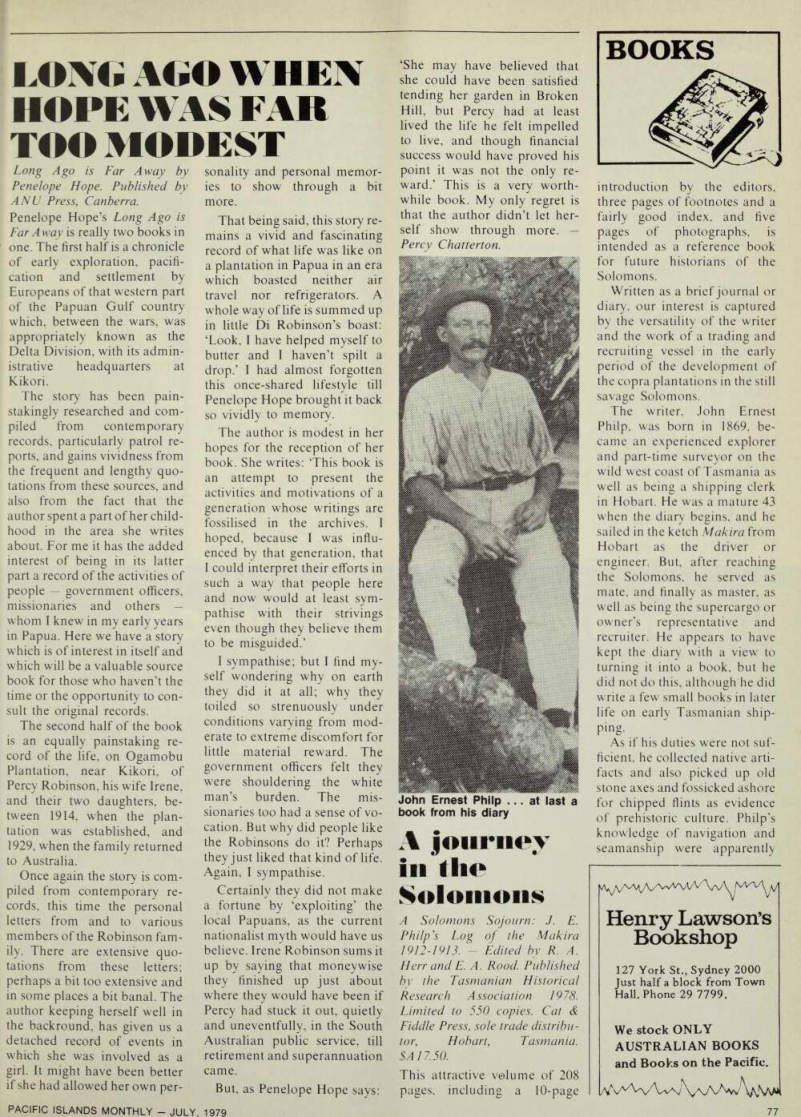
The writer, John Ernest Philp, was born in 1869, be
came an experienced explorer
and part-time surveyor on the wild west coast of Tasmania as well as being a shipping clerk in Hobart. He was a mature 43 when the diary begins, and he sailed in the ketch Makira from Hobart as the driver or
engineer. But, after reaching
the Solomons, he served as mate, and finally as master, as well as being the supercargo or owner’s representative and recruiter. He appears to have kept the diary with a view to turning it into a book, but he did not do this, although he did write a few small books in later life on early Tasmanian ship
ping.
As if his duties were not suf ficient, he collected native arti facts and also picked up old stone axes and fossicked ashore for chipped flints as evidence
of prehistoric culture. Philp’s
knowledge of navigation and
seamanship were apparently
John Ernest Philp ... at last a book from his diary
sufficient to save the ship from mishaps in the badly charted waters of the islands, and he appears to have got along well with the native crew-members and recruits, as well as the chiefs and native traders.
The purpose of the ketch was to engage in both trading and
recruiting, and carrying cargo
for the owner. F. B. Kirby, who was establishing a plantation at Boroni on San Cristobal or Makira island. The book con tains very clear little charts of the islands of the southern Solomons where the ketch made all its voyages, with the names of the anchorages or ‘passages’ visited. Native traders were agents for the owner, and the produce col lected in return for trade goods included copra in half shells, ivory nuts, trochus and green snail shell, and a little coconut oil. which was the early pro duct before the universal use of copra.
The recruits were signed on for the Kirby plantation or for
working the ketch, generally
for one year at a wage of six
pounds, which remained the standard figure for many years.
The recruiting system was of course well known to the natives, many of whom had worked in Queensland or in Fiji, but both these trades had ceased by 1910, and only local work was available.
The log gives names of traders, planters and recruiters, government officials, mis sionaries and natives, some of whom were important then or since. Names of the schooners and other vessels which worked in the group are given, though no overall picture is painted of the lines of sea-communi cation.
The Burns, Philp steamer Mindini is often mentioned as it was the main connection with Australian ports. Some of the more famous characters men tioned are C. M. Woodford, the first resident commissioner: Harold Markham of the Lily, famous as ‘Marko’, who died about 1950; C. E. Fox of the Melanesian Mission, who died recently in New Zealand, aged 99; Captain Hamilton of the
Manila (was this ‘Squeaker’
Hamilton of Manning Strait?); Charlie Cooper, a trader (one of the ex-German family of
Kuper?); Captain Svensen of
the Mission schooner Se/wyn, and Cliff of Bugota (one of the Clift brothers of Aruligo plan tation?).
One of the photographs shows a memo from the inspec tor of labour, signed W. R. Bell, who was presumably the man who was killed on Malaita as district officer in 1927.
Philp mentions the use of a small cannon to notify the natives of a recruiter’s arrival at a ‘passage’. This was generally fired on the vessel’s arrival at dusk, so that recruiting could start next morning. The pre vious practice had been to fire sticks of dynamite, but the im portation and use of this ex
plosive had been prohibited
after many accidents through careless use.
One rare visit by the Makira was to Gower Island, better known now as Ndai, which had been resettled after the pre vious inhabitants had died out.
It is a tiny island, and Philp de scribes the large lagoon full of crocodiles and the absence of
dogs, pigs and fowls. Perhaps
due to the crocodiles? The log is often rather boring but there are little items of interest of many kinds for future his
torians.
Brett Hilder.
.\«VV It’s
Aimho -
pastor
Aimbe the Pastor, a novel by Paulias Matane. Published by Exposition Press, Hicksville,
Ny, Us. Pp. 328. $Us 12.50.
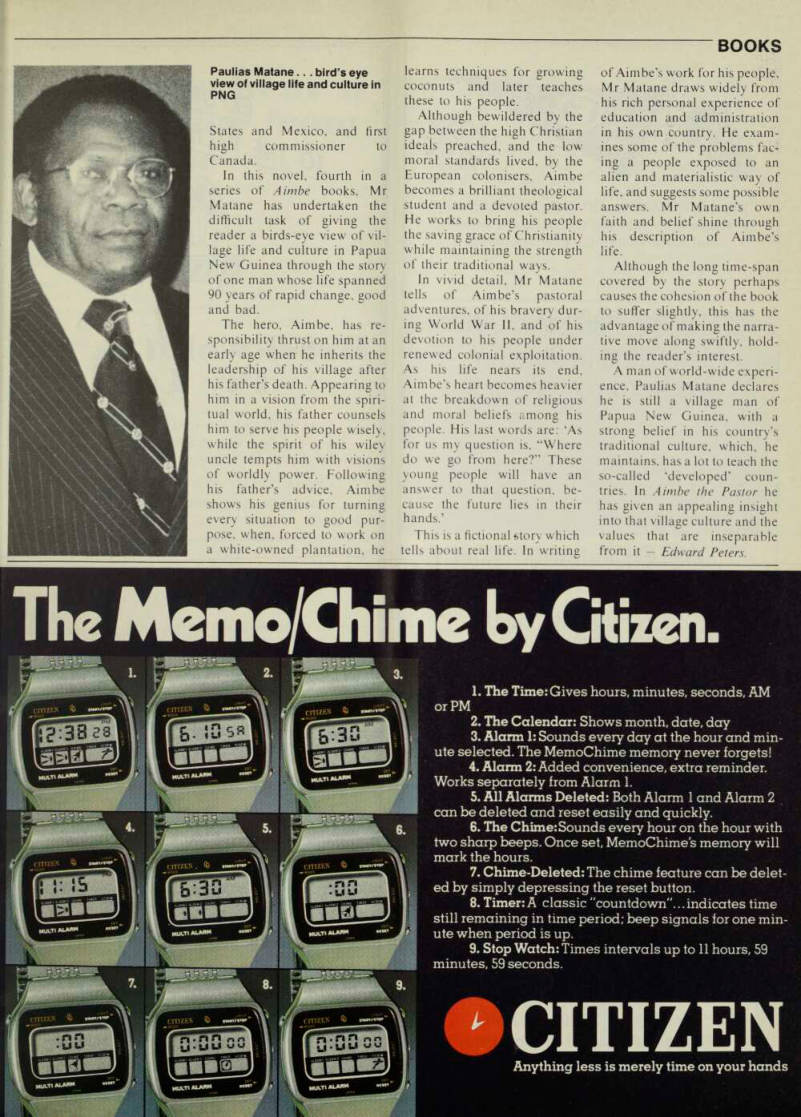
Papua New Guinea’s ambassa dor to the United Nations, Paulias Matane, is a man of great energy. His latest book.
Aimbe the Pastor, published in America early in 1979, has been written in the midst of re sponsibilities that would fully occupy most people - as well as representing Papua New Guinea at the United Nations, Mr Matane is his country’s first ambassador to the United
States and Mexico, and first high commissioner to Canada.
In this novel, fourth in a series of Aimbe books, Mr Matane has undertaken the difficult task of giving the reader a birds-eye view of vil lage life and culture in Papua New Guinea through the story of one man whose life spanned
90 years of rapid change, good
and bad.
The hero, Aimbe, has re sponsibility thrust on him at an early age when he inherits the leadership of his village after his father’s death. Appearing to him in a vision from the spiri tual world, his father counsels him to serve his people wisely, while the spirit of his wiley uncle tempts him with visions
of worldly power. Following
his father’s advice, Aimbe shows his genius for turning every situation to good pur pose, when, forced to work on a white-owned plantation, he
learns techniques for growing
coconuts and later teaches these to his people.
Although bewildered by the gap between the high Christian ideals preached, and the low moral standards lived, by the European colonisers, Aimbe becomes a brilliant theological student and a devoted pastor.
He works to bring his people the saving grace of Christianity
while maintaining the strength
of their traditional ways.
In vivid detail, Mr Matane tells of Aimbe’s pastoral adventures, of his bravery dur ing World War 11, and of his devotion to his people under renewed colonial exploitation.
As his life nears its end, Aimbe’s heart becomes heavier at the breakdown of religious and moral beliefs among his people. His last words are: ‘As for us my question is, “Where do we go from here?” These young people will have an answer to that question, be cause the future lies in their hands.’
This is a fictional story which tells about real life. In writing
of Aimbe’s work for his people, Mr Matane draws widely from his rich personal experience of education and administration in his own country. He exam ines some of the problems ing a people exposed to an alien and materialistic way of life, and suggests some possible answers. Mr Matane’s own faith and belief shine through his description of Aimbe’s life.
Although the long time-span
covered by the story perhaps causes the cohesion of the book to suffer slightly, this has the advantage of making the narra tive move along swiftly, hold ing the reader’s interest.
A man of world-wide experi ence, Paulias Matane declares he is still a village man of Papua New Guinea, with a strong belief in his country’s traditional culture, which, he maintains, has a lot to teach the so-called ‘developed’ coun tries. In Aimhe the Pastor he
has given an appealing insight
into that village culture and the values that are inseparable from it Edward Peters.
Paulias Matane ... bird’s eye view of village life and culture in