Galapagos-a place
pp. 69-72 · Read in the full issue

where you can look but not touch
The Galapagos Islands, isolated from the world for aeons, still form a lonely, unique area on the globe. It was there, in the 1830 s, that Charles Darwin found strong reinforcement for his theories on evol ution. Australian student Frances Simons went to the Galapagos last year. Her story will make many more want to visit these islands but it seems their fascination can only last as long as the Ecuadorian authorities keep a tight rein on tourist traffic.
Until recently, the Galapagos Islands have been almost completely isolated from tourists and others, and are relatively unspoiled. The many plants and animals on the islands which have evolved in special ways because of their geographical isolation were noted with interest by Charles Darwin when he visited the islands in 1835, aboard the Beagle.
There are two commercial ways to get to the Galapagos.
You can fly from Guayacil, Ecuador, on a TAME flight (the internal Ecuadorian air
line operated by the military),
which takes two hours and costs about SUS9O single; or you can join five or six day cruises which also leave from Guayacil and cost from around $450. Of course, you can sail your own vessel to the
Galapagos but skippers should
be aware that it is not permit ted to sail among the islands at random because of their national park status. On arrival it is easy to hire a small con verted fishing boat to explore the islands at leisure.
I flew to the Galapagos on TAME after discovering it is essential to book well ahead and to reconfirm flight sched ules several times because of
the rather erratic service. All flights (once or twice a week) land on the island of Baltra, using an old airstrip built by the Americans in the Pacific war.
From the windswept tarmac my first impression as I sur
veyed the barren landscape
was of having landed in a wasteland just red, dry earth, sparse ground cover and a few weird cactus trees against the sky. Baltra, like most of the islands, is uninhabited.
We boarded an ancient bus for the first stage of the journey to the township of Puerto Ayora on the neighbouring island of Santa Cruz. Then came a ferry crossing of only a few minutes to Santa Cruz fol lowed by a one-hour bus ride across the island to the settle ment. The whole trip costs 90 sucres. (There are about 25 sucres to the US dollar and it is wise to have changed foreign money to Ecuadorian sucres on the mainland, as rates in the Galapagos are very low.) It is best to choose your vehicle carefully (sometimes you have a choice) and go for the one that seems most roadworthy.
The small bus I was in took 4Vi hours to do the last stage owing to many breakdown and repair stops, during which the driver
and his assistant displayed sheer mechanical genius in keeping the old bus alive with
pieces of chewing-gum and
shoelace.
While crossing the island of Santa Cruz the vegetation changes from dry ground cover on the low coastal region to extremely dense greenery on the higher plateau in the middle of the island. The change from one to the other is as sudden as if a border had been intentionally marked be tween the two. On one side of the line it rarely if ever rains, while, on the other, rainfall is so good it supports a sizeable
farming community that
supplies the island with vege tables, fruit and dairy needs.
The bus finally limped into Puerto Ayora well after dark with the town all but closed for the night. I found accommo dation at ‘Pensione Gus’, which offered a straw mat and shower facilities for $l. There are two other ‘hotels’, slightly more expensive but not much more luxurious, and two very expensive hotels of a much higher standard which are mainly for the benefit of pack age deal tourists. It is important to go to the Galapagos well armed with mosquito repellant. Without it, the marauding hordes in the humid months of December,
January and February make
eating and sleeping virtually
impossible.
Puerto Ayora has about 1000 people, maybe a quarter of the islands’ total population. (Other settlements are on the islands of Floreana, San Cris tobal and Isabella.) It has a post office, bakery, two general stores, a souvenir shop, a few modest restaurants and an assortment of hotels of varying quality. There is also a shop
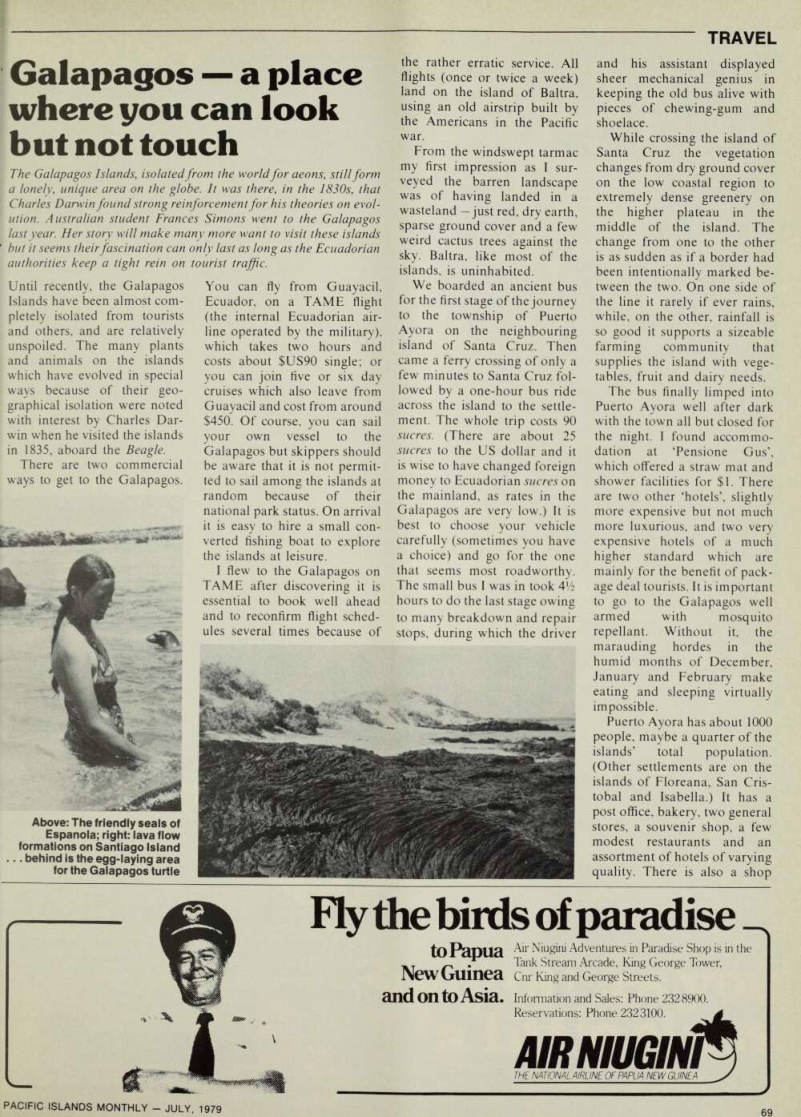
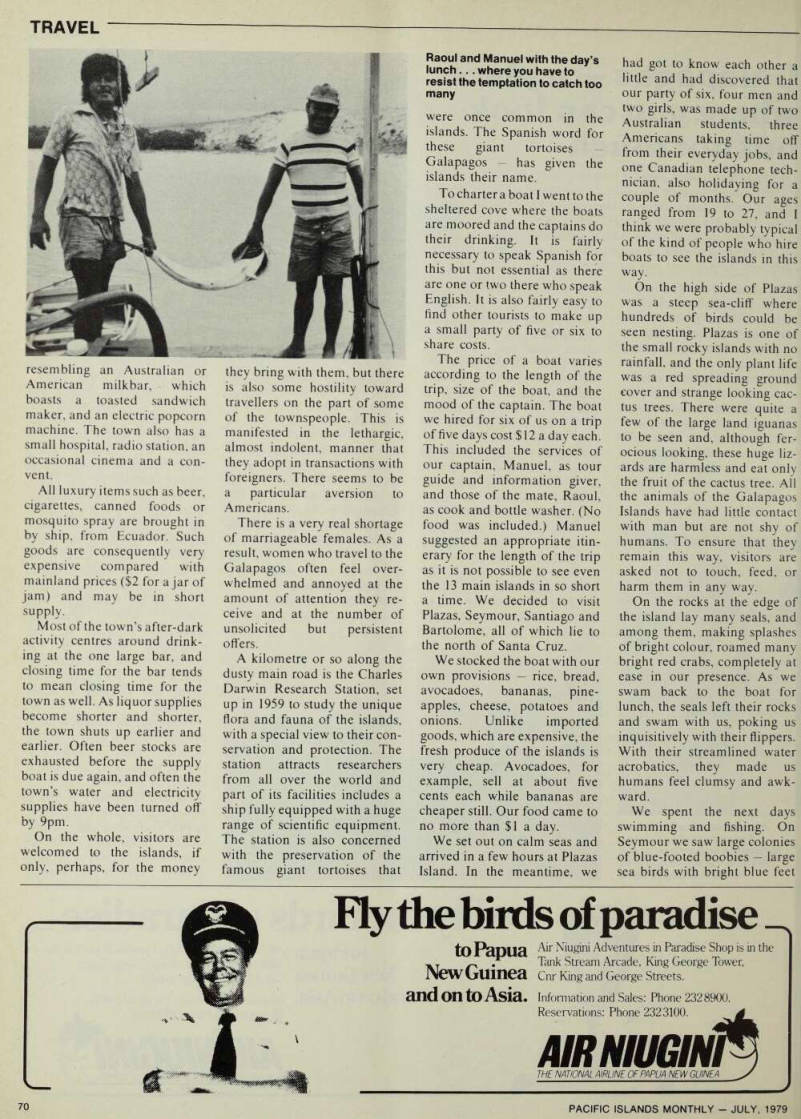
Above: The friendly seals of Espanola; right: lava flow formations on Santiago Island ...behind is the egg-laying area for the Galapagos turtle
resembling an Australian or American milkbar, which boasts a toasted sandwich maker, and an electric popcorn machine. The town also has a small hospital, radio station, an occasional cinema and a con vent.
All luxury items such as beer, cigarettes, canned foods or mosquito spray are brought in by ship, from Ecuador. Such goods are consequently very expensive compared with mainland prices ($2 for a Jar of jam) and may be in short
supply.
Most of the town’s after-dark activity centres around drink ing at the one large bar, and closing time for the bar tends to mean closing time for the town as well. As liquor supplies become shorter and shorter, the town shuts up earlier and earlier. Often beer stocks are exhausted before the supply boat is due again, and often the town’s water and electricity supplies have been turned off
by 9pm.
On the whole, visitors are welcomed to the islands, if only, perhaps, for the money
they bring with them, but there is also some hostility toward travellers on the part of some of the townspeople. This is manifested in the lethargic, almost indolent, manner that they adopt in transactions with foreigners. There seems to be a particular aversion to Americans.
There is a very real shortage of marriageable females. As a result, women who travel to the Galapagos often feel over whelmed and annoyed at the amount of attention they re ceive and at the number of unsolicited but persistent offers.
A kilometre or so along the dusty main road is the Charles Darwin Research Station, set up in 1959 to study the unique flora and fauna of the islands, with a special view to their con servation and protection. The station attracts researchers from all over the world and part of its facilities includes a
ship fully equipped with a huge
range of scientific equipment.
The station is also concerned with the preservation of the famous giant tortoises that
were once common in the islands. The Spanish word for these giant tortoises
Galapagos has given the
islands their name.
To charter a boat I went to the sheltered cove where the boats are moored and the captains do their drinking. It is fairly necessary to speak Spanish for this but not essential as there are one or two there who speak English. It is also fairly easy to find other tourists to make up a small party of five or six to share costs.
The price of a boat varies according to the length of the trip, size of the boat, and the mood of the captain. The boat we hired for six of us on a trip of five days cost $ 12 a day each.
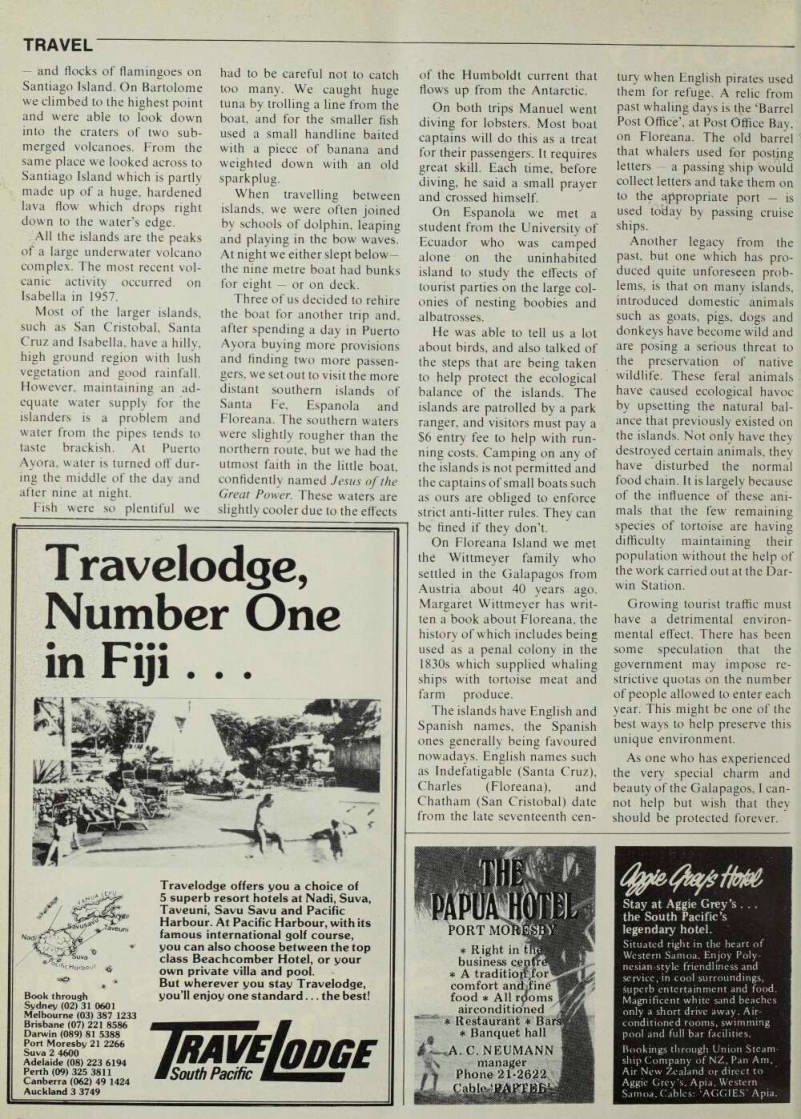
This included the services of our captain, Manuel, as tour
guide and information giver,
and those of the mate, Raoul, as cook and bottle washer. (No food was included.) Manuel
suggested an appropriate itin
erary for the length of the trip as it is not possible to see even the 13 main islands in so short a time. We decided to visit
Plazas, Seymour, Santiago and
Bartolome, all of which lie to the north of Santa Cruz.
We stocked the boat with our own provisions rice, bread, avocadoes, bananas, pine apples, cheese, potatoes and onions. Unlike imported goods, which are expensive, the fresh produce of the islands is very cheap. Avocadoes, for example, sell at about five cents each while bananas are cheaper still. Our food came to no more than $1 a day.
We set out on calm seas and arrived in a few hours at Plazas Island. In the meantime, we
had got to know each other a little and had discovered that our party of six, four men and two girls, was made up of two Australian students, three Americans taking time off from their everyday jobs, and one Canadian telephone tech nician, also holidaying for a couple of months. Our ages ranged from 19 to 27, and I think we were probably typical of the kind of people who hire boats to see the islands in this way.
On the high side of Plazas was a steep sea-cliff where hundreds of birds could be seen nesting. Plazas is one of the small rocky islands with no rainfall, and the only plant life was a red spreading ground cover and strange looking cac tus trees. There were quite a few of the large land iguanas to be seen and, although fer ocious looking, these huge liz ards are harmless and eat only the fruit of the cactus tree. All the animals of the Galapagos Islands have had little contact with man but are not shy of humans. To ensure that they remain this way, visitors are asked not to touch, feed, or harm them in any way.
On the rocks at the edge of the island lay many seals, and
among them, making splashes
of bright colour, roamed many bright red crabs, completely at ease in our presence. As we swam back to the boat for lunch, the seals left their rocks and swam with us, poking us
inquisitively with their flippers.
With their streamlined water acrobatics, they made us humans feel clumsy and awk ward.
We spent the next days
swimming and fishing. On
Seymour we saw large colonies of blue-footed boobies large sea birds with bright blue feet
Raoul and Manuel with the day’s lunch...where you have to resist the temptation to catch 100 many
and flocks of flamingoes on Santiago Island. On Bartolome we climbed to the highest point and were able to look down into the craters of two sub merged volcanoes. From the same place we looked across to Santiago Island which is partly made up of a huge, hardened lava flow which drops right down to the water’s edge.
All the islands are the peaks of a large underwater volcano complex. The most recent vol canic activity occurred on Isabella in 1957.
Most of the larger islands, such as San Cristobal, Santa Cruz and Isabella, have a hilly, high ground region with lush vegetation and good rainfall.
However, maintaining an ad equate water supply for the islanders is a problem and water from the pipes tends to taste brackish. At Puerto Ayora, water is turned off dur ing the middle of the day and after nine at night.
Fish were so plentiful we
had to be careful not to catch too many. We caught huge tuna by trolling a line from the boat, and for the smaller fish used a small handline baited with a piece of banana and weighted down with an old
sparkplug.
When travelling between islands, we were often joined by schools of dolphin, leaping and playing in the bow waves.
At night we either slept below— the nine metre boat had bunks for eight or on deck.
Three of us decided to rehire the boat for another trip and, after spending a day in Puerto Ayora buying more provisions and finding two more passen gers, we set out to visit the more distant southern islands of Santa Fe, Espanola and Floreana. The southern waters were slightly rougher than the northern route, but we had the utmost faith in the little boat, confidently named Jesus of the Great Power. These waters are slightly cooler due to the effects
of the Humboldt current that flows up from the Antarctic.
On both trips Manuel went diving for lobsters. Most boat captains will do this as a treat for their passengers. It requires great skill. Each time, before diving, he said a small prayer and crossed himself.
On Espanola we met a student from the University of Ecuador who was camped alone on the uninhabited island to study the effects of tourist parties on the large col onies of nesting boobies and albatrosses.
He was able to tell us a lot about birds, and also talked of the steps that are being taken to help protect the ecological balance of the islands. The islands are patrolled by a park ranger, and visitors must pay a $6 entry fee to help with run ning costs. Camping on any of the islands is not permitted and the captains of small boats such as ours are obliged to enforce strict anti-litter rules. They can be fined if they don’t.
On Floreana Island we met
the Wittmeyer family who
settled in the Galapagos from Austria about 40 years ago.
Margaret Wittmeyer has writ ten a book about Floreana, the history of which includes being used as a penal colony in the
1830 s which supplied whaling
ships with tortoise meat and
farm produce.
The islands have English and Spanish names, the Spanish
ones generally being favoured
nowadays. English names such
as Indefatigable (Santa Cruz), Charles (Floreana), and Chatham (San Cristobal) date from the late seventeenth cen
tury when English pirates used them for refuge. A relic from past whaling days is tjie ‘Barrel Post Office’, at Post Office Bay, on Floreana. The old barrel that whalers used for posting letters a passing ship would collect letters and take them on to the appropriate port - is
used to'day by passing cruise
ships.
Another legacy from the past, but one which has pro duced quite unforeseen prob lems, is that on many islands, introduced domestic animals such as goats, pigs, dogs and donkeys have become wild and are posing a serious threat to the preservation of native wildlife. These feral animals have caused ecological havoc by upsetting the natural bal ance that previously existed on the islands. Not only have they
destroyed certain animals, they
have disturbed the normal food chain. It is largely because of the influence of these ani mals that the few remaining species of tortoise are having
difficulty maintaining their
population without the help of the work carried out at the Dar win Station.
Growing tourist traffic must have a detrimental environ mental effect. There has been some speculation that the government may impose re strictive quotas on the number of people allowed to enter each year. This might be one of the best ways to help preserve this
unique environment.
As one who has experienced the very special charm and beauty of the Galapagos, I can not help but wish that they should be protected forever.