Png’S Register-233
p. 65 · Read in the full issue
From 707 To Moth
The PNG aircraft register, with the international prefix P 2, lists a total of 233 aircraft.
Many of the listed aircraft were originally on the Aus tralian VH register which ceased to extend to PNG after
political independence in
1975.
The licence classes, num bers of aircraft and operators in each are: Airline 13 (one operator); Charter 161 (29); Aerial work 13 (11); Private 43 (40); Total 233.
Air Niugini is the only op erator with an airline licensed fleet. Its 13 aircraft, to be increased to 15 later in the year, are: one Boeing 707 338-C (USA manufacture), with a second for delivery later this year; three F2B Fokker Fellowship jets (Netherlands), with a fourth for delivery later this year; eight series-200 F 27 Fokker
Friendship turbine-powered
airliners; and one series-400 F 27 Fokker Friendship
turbine-powered cargo
airliner.
Air Niugini’s present Boe ing is owned outright and the
second will be obtained on a leasing basis. Air Niugini still has several DC3 aircraft from its original fleet of 10. Some are still officially on the regis ter but they are no longer in service and are being sold.
Among charter fleets there are eight helicopter operators with 21 units (all US) of vari ous types. Many of the heli copters on the register are on permanent allocation by their charter operators to specific projects, including mineral exploration. The government is a major charterer for rural services, search and rescue operations and patrol supply.
There are 19 single-engine utility aircraft operators with 61 units. Of this total, 54 air craft are Cessna (US) types, including 37 units of the Cessna 206 in several vari ants. The 206 is used in a six seater or pilot-plus-cargo configuration with an all-up
weight approaching 1800 kg,
and is increasingly being
chartered by village com munities taking produce to market.
There are nine short-field feeder and utility twins oper ators with 47 units between them. The backbone of the short-field utility twin fleet is the highly-successful Britten- Norman Islander (UK), of which 35 units are flown by eight operators. It is used as a cargo or nine-passenger air craft, operates well from rough unsealed strips and has proved simple to maintain.
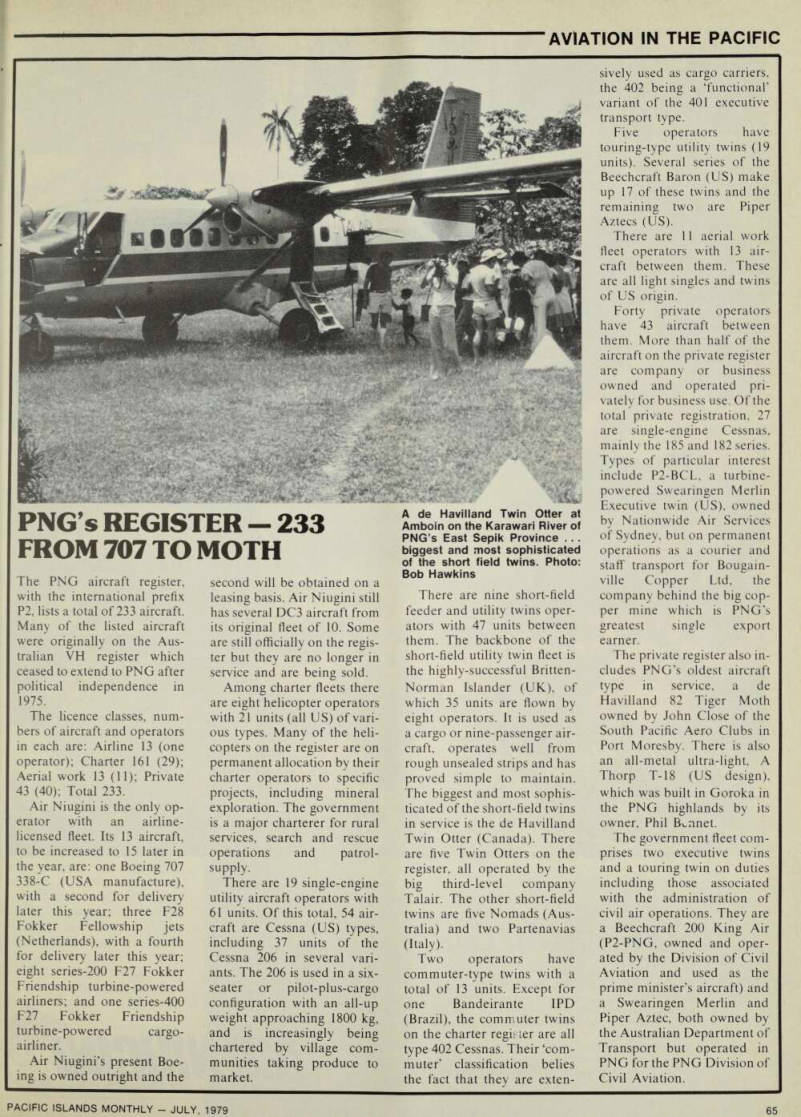
The biggest and most sophis ticated of the short-field twins in service is the de Havilland Twin Otter (Canada). There are five Twin Otters on the register, all operated by the big third-level company Talair. The other short-field twins are five Nomads (Aus tralia) and two Partenavias
(Italy).
Two operators have commuter-type twins with a total of 13 units. Except for one Bandeirante IPD (Brazil), the commuter twins on the charter regit ter are all type 402 Cessnas. Their ‘com muter’ classification belies the fact that they are exten
sively used as cargo carriers, the 402 being a ‘functional’ variant of the 401 executive transport type.
Five operators have touring-type utility twins (19 units). Several series of the Beechcraft Baron (US) make up 17 of these twins and the remaining two are Piper Aztecs (US).
There are 11 aerial work fleet operators with 13 air craft between them. These are all light singles and twins of US origin.
Forty private operators have 43 aircraft between them. More than half of the aircraft on the private register are company or business
owned and operated pri
vately for business use. Of the
total private registration, 27
are single-engine Cessnas, mainly the 185 and 182 series.
Types of particular interest
include P2-BCL, a turbine
powered Swearingen Merlin
Executive twin (US), owned by Nationwide Air Services of Sydney, but on permanent operations as a courier and staff transport for Bougain ville Copper Ltd, the company behind the big cop per mine which is PNG’s greatest single export earner.
The private register also in cludes PNG’s oldest aircraft type in service, a de Havilland 82 Tiger Moth owned by John Close of the South Pacific Aero Clubs in Port Moresby. There is also an all-metal ultra-light, A
Thorp T-18 (US design),
which was built in Goroka in the PNG highlands by its owner, Phil Bonnet.
The government fleet com prises two executive twins and a touring twin on duties including those associated with the administration of civil air operations. They are a Beechcraft 200 King Air (P2-PNG, owned and oper ated by the Division of Civil Aviation and used as the prime minister’s aircraft) and a Swearingen Merlin and Piper Aztec, both owned by the Australian Department of
Transport but operated in
PNG for the PNG Division of Civil Aviation.
A de Havilland Twin Otter at Amboin on the Karawari River of PNG’s East Sepik Province ... biggest and most sophisticated of the short field twins. Photo: Bob Hawkins