The Spirit Of Kiribati
p. 10 · Read in the full issue
Gilbert Islands
It was just another day on
Abaiang. At about eight
o’clock Teng Kuri of Tabon tebike village, on the southern
extremity of Abaiang, decided
to go net fishing. With him went his three children Bureka, her brother Tonga (both teenagers), and Biaua.
The tide, which had been full some 3½ hours earlier, was now more than half way out.
They decided to try their luck on a large reef to the south of the village. They left Biaua in the canoe, anchored to the reef, while they went off net ting. After a while, probably
becoming bored from waiting
all alone, Biaua tried to swim ashore. However, in the pass age between reef and shore, the
falling lagoon tidewater was
rushing out to sea. Biaua was no match for it and. becoming tired, she was swept out to sea.
When the family returned and saw that Biaua was not on the canoe they assumed some one must have given her a lift back to the village. When they discovered she was not ashore, three teams went out again in canoes to search the area.
Unsuccessful, they returned with the sad news.
On the afternoon of the same day John Thurston, aboard his 14 metre catamaran Erena Roe, was bound for Marakei island via Abaiang. where he intended to drop off some cargo at Kuria
village.
Originally from Laguna Beach, California. John, being a keen surfer, had moved to Hawaii some 20 years ago.
Then after joining the Baha’i World faith, he had volun teered to work in the Gilberts.
Now. seven years later, his visa having expired, he had decided to go to the Marshall islands in the Erena Roe which he had built almost singlehanded on a beach at Betio Tarawa. He should have left the Gilberts the previous day but a last min ute charter job delayed his departure to take care of this work.
At one in the afternoon, when they were about 2½ km from Abaiang’s main entrance.
KIRIBATI the Gilbert Islands barring last minute hitches will become independent on July 12. There’s a little girl on Abaiang Island, about 50 km north of Tarawa, the capital, who really should not be alive to join in the cel ebrations. But, miraculously, she is and if her composure, good sense and resilience are indicative of the spirit of Kiribati, the future augurs well for this far flung atoll nation.
Philip Wilder, in Tarawa, tells the story of seven-year-old Nei Biaua.
Bingham Passage, a crew member, Beiatake, shouted that he had spotted something on the port side ahead which looked like a human body. Bin oculars seemed to confirm it
was the body of a young girl.
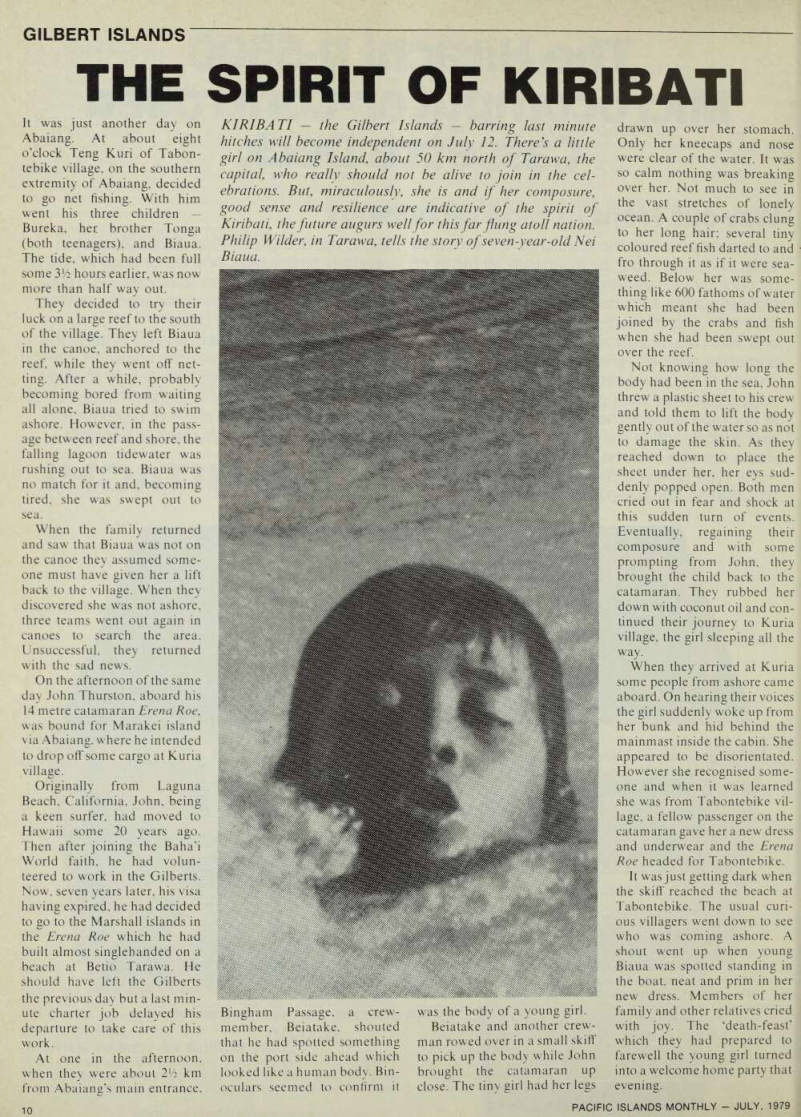
Beiatake and another crew man rowed over in a small skiff to pick up the body while John brought the catamaran up close. The tiny girl had her legs
drawn up over her stomach.
Only her kneecaps and nose were clear of the water. It was so calm nothing was breaking over her. Not much to see in the vast stretches of lonely ocean. A couple of crabs clung to her long hair; several tiny coloured reef fish darted to and fro through it as if it were sea weed. Below her was some thing like 600 fathoms of water which meant she had been joined by the crabs and fish when she had been swept out over the reef.
Not knowing how long the body had been in the sea, John threw a plastic sheet to his crew and told them to lift the body gently out of the water so as not to damage the skin. As they reached down to place the sheet under her, her eys sud denly popped open. Both men cried out in fear and shock at this sudden turn of events.
Eventually, regaining their
composure and with some prompting from John, they brought the child back to the catamaran. They rubbed her down with coconut oil and con tinued their journey to Kuria
village, the girl sleeping all the
way.
When they arrived at Kuria some people from ashore came aboard. On hearing their voices the girl suddenly woke up from her bunk and hid behind the mainmast inside the cabin. She appeared to be disorientated.
However she recognised some one and when it was learned she was from Tabontebike vil lage, a fellow passenger on the catamaran gave her a new dress and underwear and the Erena Roe headed for Tabontebike.
It was just getting dark when the skiff reached the beach at Tabontebike. The usual curi ous villagers went down to see who was coming ashore. A shout went up when young Biaua was spotted standing in the boat, neat and prim in her new dress. Members of her family and other relatives cried with joy. The ‘death-feast’ which they had prepared to farewell the young girl turned into a welcome home party that evening.