Letters
pp. 4-6 · Read in the full issue
Tuvalu: PM puts
the record straight
I wish to comment on the article ‘Tuvalu puts all its eggs in one basket’ (PIM May) and correct any misconceptions that may have arisen as a result of it.
The title of the article itself suggests that all of Tuvalu’s ready cash has been put into one investment. This is not so and sufficient cash is held else where to enable us to continue with the normal functioning of government and also the
development programme.
In the introduction to the article there is a suggestion that we have ‘fallen out of love’ but with whom is not clear. To the best of my knowledge all our friendships have remained intact over the years.
I must also point out that the main reason for my trip to the United States was to try to find sources of money to establish a fishing industry on a commer cial basis, an industry which, we hope, will after a few years become economically viable.
As minister of finance I also wished to explore the possi bility of investing cash which was a present during Indepen dence Day and which has a special meaning to us. It was also cash surplus to our immediate requirements. I consider that the opportunity arose which is both secure and offers a fair return at 15% per annum. From the outset my purpose has been well known to both the Tuvalu Parliament and people and both have been
kept fully in the picture since
the beginning. Like any invest ment only time will tell but as the person responsible for it I have every confidence.
My aim is to create a finan
cially independent nation and
to do so it is necessary to use our fishery resource which to date, apart from domestic use, has been exploited only by others with no return to
Tuvalu. As you correctly point out, surveys have indicated that there is every reason for opti mism although, of course, we are equally aware of the high costs of developing this re source and other difficulties surrounding such a venture.
My government is currently exploring several avenues for the development of the fishing industry and not with Mr Gross alone. All proposals will be studied before final decisions are made.
I might also point out that Mr Bula O’Brien (or Tokatasi) was born in Fiji of a full Tuvaluan mother and a full Gilbertese father.
Finally, on page 3, under my
photograph, the caption reads
‘. . . big spending in the United States’. I would like to point out that nothing was spent in the United States but was
invested.
Funafuti Tuvalu
T. Lauti
Prime Minister
Another angle on
‘another dominion’
As a Papuan New Guinean, I wish to say that L. F. James (PIM Letters April) omitted citing the fact that, like herself, many other ‘expat’ mis sionaries, most of whom came from Europe and America,
brought with them capitalism.
That America freed us from ‘another dominion’ (implying Japan) was simply to perpetu ate its predominance in world affairs.
The three Mekeo men, I be lieve, regarded ‘America as a bad place’ because of its vast ness. Naturally it would have been pretty difficult for the three rural Papua New Guineans to have been left in the heart of New York without wantoks to show the way.
Edmund Reynolds Kaba
Goroka Papua New Guinea
‘Fantastic’ welcome
for SPFFA boss Your ‘People’ section (PIM May) contains references to the South Pacific Fisheries Agency. While it is always pleasing to see one’s name in print, it is always distressing to see the article surrounding it contain errors which may mis lead the reader.
To start with, a personal
problem. My family has a
rather unusual custom: although my name is Bill and my father’s name is Bill our Christian names are actually Wilfred, not William as indi cated in your article.
Of more serious note are the following errors: the correct name of the agency is South Pacific Forum Fisheries Agency; New Caledonia is most definitely not a member of the agency, nor of the Forum; Nauru is a member of the agency and of the Forum.
Finally, although I have
been able to express my ap preciation to officials for their courteous reception in each of the 12 Forum countries whose capitals I have been able to visit since the beginning of February, I have no easy way of expressing my gratitude to the hundreds of individuals I met in my travels in the South Pacific Forum region and whose willingness to teach me in short order about the major features of the culture in each of the countries has been most
rewarding.
Not only rewarding, posi
tively heart-warming; never in
my experience in North or Central America, in the various countries of Western Europe, nor even in Japan have I been received and taken in to share the lives of so many people pre
viously complete strangers. It
has been a fantastic experience already; and I very much look forward to understanding every country in more detail as my work carries me again throughout the region.
Honiara Solomon Islands
W. E. Razzell
Director
‘Brainwashed’ says
a union man An article in PIM April had the startling headline ‘Petrol Bombs on Banaba’. We should probably thank the World Fed eration of Trade Unions, based in Czechoslovakia, for not supplying Russian-made nu clear weapons to the Banabans’ supreme commander, the Rev Kaitangare Kaburoro, and his general. Teem Takoto, when they staged their invasion of Banaba in February.
With their petrol bombs they
damaged mining machinery
and installations, and without doubt their actions were detri
mental to the peace and good order of the country at large.
Their actions, to my mind, showed that they had been
brainwashed by their lawyers
in Fiji.
My views are not associated with any government policies, but arise from my own under
standing of Gilbertese history,
of which the history of Banaba is an integral part.
Ocean Island (or Banaba as it is now called), according to our tradition and culture, is an island whose people for hun dreds of years have been Gil bertese in language, blood, flesh and bone. Before the arrival of I-Matang (white men) in the Gilberts, our people used to travel in their baurua, or big canoes, from island to island within the Gil berts, then known as Tungaru.
This brought intermarriage, in
which the Banabans were involved as much as anybody else. Sometimes there was fighting between inhabitants of the different islands, but for the most part the journeyings were to visit relatives who may have left their home islands to settle permanently on others.
Then came Great Britain with her Union Jack. The Bri tish visited all the islands of the Gilberts and the then Ellice Islands and, having obtained the consent of all concerned, made the the Gilbert and Ellice Islands Protectorate. Banaba was not affected in this colonial move for reasons I will men tion below. Only later, in 1916, was Banaba included in the protectorate.
In my view the British made two mistakes at the outset; they should not have included the Ellice Islands in the protec torate, and they should have in cluded Banaba.
The Ellice Islands were in cluded for administrative pur poses only. Their people had no cultural or traditional ties with the Gilbertese. Britain eventually realised this, as the Gilbertese and Ellice people had done all along. So when
the Ellice requested complee
separation from the Gilberts to form the new nation of Tuvalu there were no objections either from the Gilbertese or the Bri tish. The only people who shed any tears were those who had
formed close married and other relationships across the barriers, or who had worked for many years in one or the other island group.
Ten Tabaita Tawaka or Ten Taomati Teai would probably say ‘Banaba was not included in the protectorate because it is not an integral part of the Gil berts’. Mr Ramrakha, legal adviser to the Banabans in whom they have every con fidence, would say: ‘ln accord ance with my own statute law, enacted by me with Fred Caine, Banaba was incorpor ated later because of the phos phate and not because of any cultural or traditional ties with the Gilbertese.’
The most likely explanation is that the great power of the day. Great Britain, and Her Majesty Queen Victoria, knew not the first thing about the Banabans, or their culture and traditions. They had not the least idea that Banaba, before Captain Davies landed in the Gilberts in HMS Royalist, had been an integral part of the Gilbert Islands. Our unimane (old men), who accepted the annexation of our islands by Britain, had no understanding of modern administrative prac tices, and failed to inform Cap tain Davies of the existence of the Banabans, their brothers and sisters living on another island in the Gilberts.
Later, when phosphate was discovered on Banaba, and in view of the Banabans’ linguis tic, cultural and traditional ties with the Gilbertese, Britain realised that they belonged to the Gilbertese nation, and Banaba was accordingly brought into the protectorate.
From that time on the Banabans were no longer con stitutionally separate from the Gilberts. When this news reached the other islands all unimane thanked Nareau, the god of our ancestors, for the re union with our Banaban brothers and sisters.
A large number of the people now living on Rabi, and a number who recently trav elled to Banaba from Rabi, were born in the Gilberts on islands other than Banaba.
When Banabans visit Tarawa
they nearly always stay with
relatives, and are most wel
come to do so. Many of them also hold land on other islands in the Gilberts, and some land cases have actually been held up in the courts until the Rabian member of the family was consulted.
As to the part played by Apisai Tora, together with the World Federation of Trade Unions, I can only say, as one of the union leaders in this country, that they are appar ently being led by the nose by somebody, and that their actions cannot succeed. I would
be grateful if they would keep
out of the Banaba dispute from now on. It is an internal politi cal matter for the Gilbertese.
Any intervention by foreign
union experts in the issue is a pure waste of time and of the dues and resources of the mem bers of the unions concerned.
In conclusion I wish to thank men like James Raman and James V. Smith for keeping right out of this Gilbertese pol itical issue.
Ngutu T. Awira
Secretary/Organiser Line Island Workers’ Union Christmas Island Gilbert Islands
Challenge to
Kiribati leaders In the dispute between the government of the Gilbert Islands (Kiribati after indepen dence in July) and the Banabans, I wonder whether Tabai’s government or Tawaka’s administration de serves congratulation or sym pathy. 1 personally feel they have fallen victims of the so called ‘spoon-fed’ and ‘a piece of chocolate’ wavelength
thinking. Instead of looking
inwardly to basic compassion ate needs, they have adopted the coloniser’s image, the face of an oppressor whose blind selfishness is predictable and whose behaviour is unchang
ing.
The two parties have never realised the true value of Kiribati’s wise sayings and ways which would help them along the path to compromise.
Unnecessary side issues are hiding the main issue. The blindness caused by political games is as bad as using theor etical slogans. Be practical when dealing with the issue.
This cannot be done by relying
solely on foreign ideas. You must also use Kiribati and Banaban ideas. Outsiders’ views can be good but they have limi tations because they don’t take into consideration the customs and cultures of the people involved. For example, a wise man from Kiribati advised his young people that they could only get good solutions and answers from their boti in the maneaba.
Most forms of government which have viewed everything from a political standpoint
have always brought injustice
and unfair treatment to their
people.
I, therefore, challenge the two wise and capable Kiribati leaders to try and come to a better compromise rather than
just accusing one another.
Good terms cannot be achieved unless one voluntarily renounces exercising neo colonialist powers. I entreat them to freely, consciously and
humbly give up their legal right
to impose decisions on their people. I challenge them to
recognise their inability,
powerlessness and incapacity to decide what is ‘good’. May I remind them of three moving Kiribati words: Te Mauri, Te Raoi and Te Tabemoa.
Rev Dominico T. Tareka
Bishop Patteson Theological Centre Honiara Solomon Islands
‘The one day
of the year’
Anzac Day, April 25, is the day of the year when veterans of the 2nd Australian Mountain Battery reassemble at the For tune of War Hotel in The
Rocks, Sydney.
The unit was formed in Sep tember 1943. The Ist Aus tralian Mountain Battery had been formed earlier for service in New Guinea and it was de cided to convert A Field Bat tery into the 2nd Mountain Battery to serve in the same theatre. A Field Battery was the oldest artillery unit in the Australian Army, having seen service in the Boer War and World War I. The men of A Field Battery stationed at Hols worthy, NSW, were the nucleus of the 2nd Mountain Battery.
Where A Field Battery had used a great variety of artillery
pieces in its long history, the
2nd Mountain Battery was al lotted exclusively the US 75 mm pack howitzer, designed to be broken up and carried by mules in rugged terrain.
The 2nd Mountain Battery, of six officers and 140 men, fired its first shots in anger dur ing the assault on Satelberg in the Morobe district of New Guinea in late 1943. In the absence of mules, the howitzers were carried through the jungle by the troops and their New Guinean helpers. After Satel berg was taken by the Aus tralians, the battery saw further service on the Bogadjim road to Madang in the Finisterre
Ranges.
After six weeks break in Townsville, the battery headed north again, this time to Bougainville. At one stage, all the Australian forces were sur rounded by the Japanese but managed to fight their way clear.
The 2nd Mountain Battery supported the infantry in its advance up the west coast of Bougainville to drive the Japanese out of the north western part of the island.
Then it was back to Torokina and on to Pearl Ridge in the centre of the island where the battery took up a fixed position until the war ended.
During the New Guinea campaign the 2nd Mountain
Battery was commanded by
Major Bob Stevenson. Follow ing the cessation of hostilities the unit was posted to Japan with the British Common wealth Occupation Force, after which it became A Field Bat tery once again and served in Malaysia and Vietnam. It is still in service.
The Fortune of War Hotel was suggested as a reunion venue by the late Ray Har
dingham, a battery veteran,
who was employed by the Maritime Services Board, opposite the hotel. The first re union took place in 1948 and veterans still meet at the hotel after the ANZAC Day march.
Widows of men who served with the unit pop in during the afternoon. Last year about 40 veterans took part in the re union, coming from all walks
of life. Generally speaking.
their paths cross only on ‘the one day of the year’.
Fortune of War Hotel The Rocks
Sydney
John Hook
Licensee
Dead but they
won’t lie down
It is indeed a very sad thing to notice the ‘won’t have anything to do with it’ attitude of the Papua New Guinea Govern ment in matters relating to those wartime hangings (PIM July 1978). This attitude was clearly revealed in that issue where it was said: ‘PNG has decided not to make any official comment. . and ‘PNG sees the issue ... as a purely Australian domestic matter. . .’
The Australian daily, news paper The Australian in May 1978 claimed that the PNG Government had castigated Barry Jones, Federal Labor Party MP from Victoria, for attempting to embarrass Australia-PNG relations or for
trying to gain personal glory.
This is a typical example of a government which opted out of protecting the interest of its people in favour of protecting its relations with foreign powers and benefactors.
But the question is: Why should an Australian parliamentarian, who wants to uncover the injustices in the darkest-kept secret of the Aus tralian military tribunal, be accused by PNG people’s rep resentatives of trying to gain personal glory? There is a cer tain amount of fear involved in this. Here we have a group of PNG parliamentarians who, for sheer personal reasons or for the sake of party and government status quo, would sell PNG to foreigners, even Indonesia for that matter.
The executions are said to be historically documented. But where are they? What has hap pened to them? Even if the documents are available, it cannot be true that all those 30 or more of our relatives were hanged for raping and murder ing the missionaries. No one will persuade us to believe that.
We believe most of them were executed for collaborating with the Japanese. However, whether the executions were for rape and murder or for
treason by collaborating with invading forces, we still de mand answers to the basic questions asked by Barry Jones in PIM; • Were the trials military or civil and under what law were the Papua New Guineans
charged?
• Who defended them or were
they undefended?
• Did they understand the nature of the offences with
which they were charged?
• Who received the sen tences? • Was there right of appeal? • Why were the sentences not referred to Canberra? • Was the Australian law of
treason regarded as appropri
ate for unsophisticated
indigenes?
• Why have virtually all the re
cords disappeared?
• Why has the incident gone unrecorded by historians and other writers of that period?
We do not regard this darkest-kept secret as dead and lost. It took us time to be born, bred and educated. Now the time is ripe for us to demand
explanations to that injustice.
When we hear of those war time happenings they seem to be unbearable legend. It is premature for us to say what we want to do or for what reason but this decision will be taken in the not very distant
future.
Walter Ataembo
(For Northern Province people) Port Moresby Papua New Guinea
One man’s view
is another man’s ...
It is unfortunate that so many authors rush into print without getting their ‘facts’ straight. Bill Coppell (PIM Travel May) gets ‘off the beaten track’ on Aitu taki, Cook Islands (he would no doubt call Caloundra ‘off the beaten track’). Aitutaki (where I recently lived for 2Vi years) has piped water. 240 volt power and a daily air service (he gets that one right).
I presume that ‘a beautiful lagoon’ would have crystal clear water, masses of spec tacular coral, and numerous
brilliantly-coloured tropical
fish. Aitutaki’s lagoon has none of these things. It is very shal low, turbid (average visibility two metres), contains almost
no living coral, and the fish are very few, very small and very
frightened, having been hunted
for 3000 years. The lagoon at Lord Howe Island (only 650 km from Sydney) is infinitely more beautiful. Underwater photography is just a waste of film at Aitutaki.
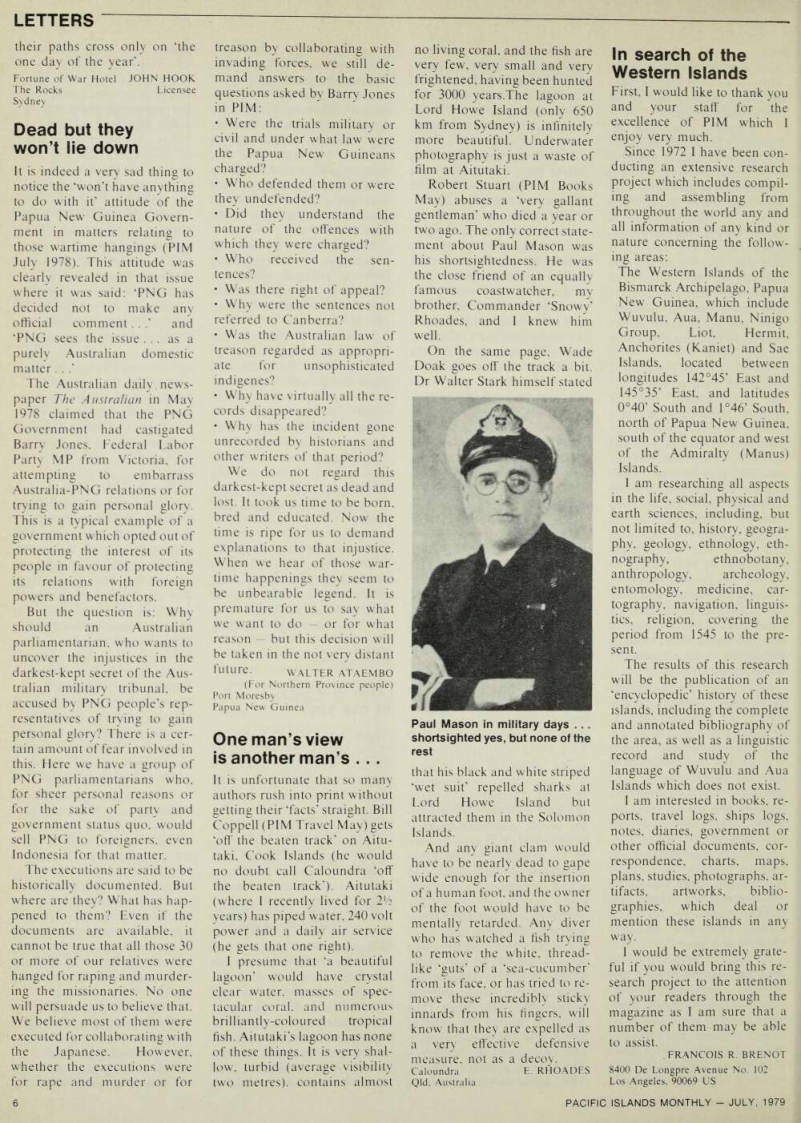
Robert Stuart (PIM Books May) abuses a ‘very gallant gentleman’ who died a year or two ago. The only correct state ment about Paul Mason was his shortsightedness. He was the close friend of an equally famous coastwatcher, my brother. Commander ‘Snowy’
Rhoades, and I knew him well.
On the same page, Wade Doak goes off the track a bit.
Dr Walter Stark himself stated
that his black and white striped ‘wet suit’ repelled sharks at Lord Howe Island but attracted them in the Solomon Islands.
And any giant clam would have to be nearly dead to gape wide enough for the insertion of a human foot, and the owner of the foot would have to be mentally retarded. Any diver who has watched a fish trying to remove the white, thread like ‘guts’ of a ‘sea-cucumber’ from its face, or has tried to re move these incredibly sticky innards from his fingers, will know that they are expelled as a very effective defensive measure, not as a decoy.
Caloundra Qld. Australia
E. Rhoades
In search of the
Western Islands
First, I would like to thank you and your staff for the excellence of PIM which I enjoy very much.
Since 1972 I have been con ducting an extensive research
project which includes compil
ing and assembling from
throughout the world any and all information of any kind or nature concerning the follow
ing areas:
The Western Islands of the
Bismarck Archipelago, Papua
New Guinea, which include Wuvulu, Aua, Manu, Ninigo Group, Liot, Hermit, Anchorites (Kaniet) and Sae Islands, located between longitudes 142°45’ East and 145°35’ East, and latitudes o°4o’ South and I°46’ South, north of Papua New Guinea, south of the equator and west of the Admiralty (Manus) Islands.
I am researching all aspects in the life, social, physical and earth sciences, including, but not limited to, history, geogra
phy, geology, ethnology, eth
nography, ethnobotany,
anthropology, archeology,
entomology, medicine, car
tography. navigation, linguis
tics, religion, covering the
period from 1545 to the pre sent.
The results of this research will be the publication of an
‘encyclopedic’ history of these
islands, including the complete
and annotated bibliography of the area, as well as a linguistic record and study of the language of Wuvulu and Aua Islands which does not exist.
I am interested in books, re
ports, travel logs, ships logs,
notes, diaries, government or other official documents, cor respondence, charts, maps,
plans, studies, photographs, ar
tifacts, artworks, biblio graphies, which deal or mention these islands in any way.
I would be extremely grate ful if you would bring this re search project to the attention of your readers through the magazine as I am sure that a number of them may be able to assist.
Francois R Brenot
8400 De Longpre Avenue No. 102 Los Angeles, 90069 US
Paul Mason in military days ... shortsighted yes, but none of the rest