Currents
pp. 33-41 · Read in the full issue


Political
A Nukualofa
Tripoli Axis
Ancient Scotland’s King Robert the Bruce, with his reputation for perseverance, surely has a modern counter part in Tonga’s King Taufa’ahau Tupou IV, whose unflagging efforts to promote his country’s economic development have become a
byword in today’s Pacific.
Now the Tongan monarch, who has in the past looked to Japan, the Soviet Union and to a variety of more or less stable banking institutions for help, has come up with a prospect of aid from what is probably the unlikeliest and at the same time the most promising source of all: the oil-rich Arab republic of Libya.
In an official statement on his return from a March visit to the Libyan capital of Tripoli, the king announced that, after his talks with the country’s leader Colonel Muammar Gaddafi, Libya was likely to offer Tonga a soft loan of SUS 3 million. The money would be used to carry out the project nearest of all to the king’s heart: the upgrading of Tonga’s Fua’a’motu airport to take jumbo jets. Libya had also asked were there other projects in which it could be of help. A Libyan delegation was ex pected to make an early visit to
Tonga to make on-the-spot
studies.
As a result of the king’s visit, Libya and Tonga decided to establish diplomatic relations with the Tongan high com missioner in London being accredited to Tripoli, and the Libyan ambassador in Aus tralia accredited to Nukualofa.
Looking for the mainspring
of what seems such an improb able relationship, a writer in an Australian magazine specu lates; ‘The Libyan leader and
the Tongan king, if they share
nothing else, probably have a
common feeling that their neighbours do not accord them the status that is their rightful
heritage.’
Noting that ‘the extension of Gaddafi’s pan-Arabism into Pacific politics has so far been viewed in relaxed fashion by
Tonga’s neighbours’, the writer
adds a quite gratuitous scare note, saying that such neigh bours ‘may become a good deal more nervous if Libyan financed guns start appearing in the Pacific’.
While such weaponry prob-
ably exists only in the writer’s fertile imagination, what is im portant to Tonga in its Libyan connection is that the dollars are there. Unlike such insti tutions as John Meier’s Bank of the South Pacific, there is no doubt about Colonel Gaddafi’s ability to put his money where his mouth is.
Famous American news paper columnist Jack Ander son, who has spent years heaping abuse of all kinds on Colonel Gaddafi, was recently surprised to receive an in vitation to visit Libya and in terview the colonel.
Accepting the invitation with some apprehension (the CIA had warned him that not all who enter Gaddafi’s door come back through) Anderson left Libya with his ideas sub stantially changed. He wrote in a newspaper account of his interview: ‘Colonel Gaddafi conveyed a truculent deter mination to lift up the down trodden, the laughed-at, the pushed-around. Indeed, I saw impressive evidence that his millions in annual oil revenues
are going not into the palaces of sheikhs nor the coffers of oil executives, but into free med ical clinics, free housing and nourishment, free schooling for those who until yesterday were the poorest of the poor.’
One can only nurse the hope that Tonga’s king has at last found a benefactor ready and able to give his country some genuine and disinterested
help.
Oscar Temaru
Lays A Wreath
On the day in March chosen by the Pacific Conference of Churches to popularise the idea of a denuclearised Pacific, 150 young Tahitians resorted to the very un-Polynesian protest
method of parading through
the streets of Papeete, write PIM correspondents Marie- Therese and Bengt Danielsson.
The huge banners they carried, held high over their heads, an nounced in strong terms their opposition to the continued underwater tests at Mururoa (which last year reached a total of eight and over the next 10 years will greatly increase in number), and their worries over the health hazards from residual radioactive fallout from the earlier 41 atmospheric tests.
Considering that local politi
cal parties campaigning
actively against the tests (and for independence) in the 1978 elections polled 6593 votes, or 14% of the total, the turnout was modest. But the number of silent sympathisers with the anti-tests movement is cer tainly much greater even than those who cast these ballots. A recent series of interviews pub lished in the local newspaper, Les Nouvelles, reflected what seems to be a very wide feeling of disapproval and fear on the issue. Without exception all those interviewed ascribed to the bomb tests not only specific cases of cancer, skin rashes and other ills, but also insect
plagues, dry spells and crop
failures.
An original twist was given to the orderly protest march by the main organiser, Oscar Temaru, leader of the legally constituted political party Front de Liberation de la
Polynesie. Stopping in the
heart of Papeete at the monu ment to Polynesian soldiers who died for the ‘mother country’ during the two world wars, he deposited a beautiful wreath with the inscription : ‘To Those Killed by the Bomb’.
The following morning,
startled Tahitian newspaper readers found alongside a pic ture of Oscar and his peace offering, a statement released by the non-political association la orate natura. This active ecological association which so far has concerned itself mostly with what is happening to the trees, fishes and birds in the course of the ruthless pro cess of modernisation now
being endured by French
Polynesia had now adopted
a much bolder stand: first, it deplored the constant refusal of the French authorities to furnish any reliable infor mation about the radioactive pollution of the environment; second, it condemned all kinds of nuclear testing; and third, it stated its agreement with the demand that the whole Pacific should be declared a denuclearised zone.
Coleman Tells
It Like It Is
American Samoa’s active role in seeking to influence
Washington’s policy over US
claims to disputed Pacific islands was revealed by Gover nor Peter Tali Coleman in a re cent speech to the Hawaii Senate (see also Tradewinds).
Governor Coleman told the Hawaii senators: ‘lncreasingly your attention and ours is being directed to the ocean that sur rounds us. When we start exer cising that attention we are
automatically projected into an
international political arena law of the sea conferences, re
gional fishing compacts, etc.
‘We in American Samoa have learned, the hard way, that we can’t sit back and expect the federal government to act in our best interest auto
matically. Certainly we can’t
assume they will. We must ex press our views to them. ‘A case in point is the ques tion of the disputed South Cen tral Pacific islands, islands over which the US, the UK and New Zealand have had conflicting
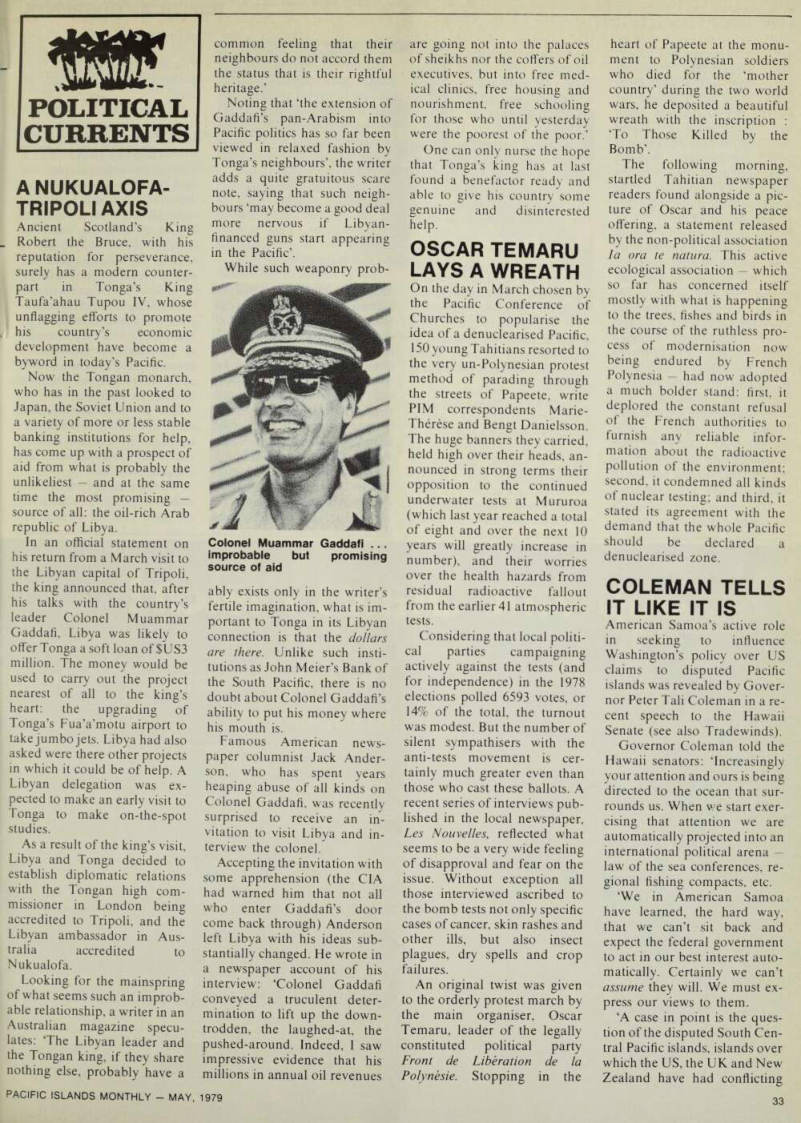
Colonel Muammar Gaddafi .. . improbable but promising source of aid
claims for more than 100 years.
Just last Thursday and Friday State Department represen tatives met with a joint dele gation from the UK and the
soon-to-be-independent Gil
bert Islands. Some 14 disputed islands of the Line and Phoenix group are involved. Without going into great detail, the US based most of its claims on the guano mining of the 1800 s (the Guano Act of 1856). ‘But in the case of islands like Canton and Enderbury we have had a settled presence since the islands became im portant for civil aviation and defence activities. Little weight was given (strangely) to the fact that Polynesians had occupied these islands for centuries while travelling to and from Hawaii and the south. To us the islands are important. For every island there is a 200-mile fishing economic radius around it. As I said earlier, we in Samoa are dependent for our survival on the continued health of our fish canneries. ‘When we learned, through a published statement in the Pa
cific Islands Monthly (the governor is referring to PIM December 1977 Ed), of the
State Department’s alleged
willingness to give up all US claims we went to “battle stations”. ‘We made a strong represen tation of our case in Washing ton to the State Department.
You in Hawaii are also deeply affected by these events since you are also trying to develop your long-range fishing fleet. It is a “natural” for that fleet to operate up north out of Mid way during summer months and off the Line Islands to the south during winter months. ‘lf the Gilberts assert their 200-mile economic zone and li cense another nation’s boats exclusively we both have a real
problem.
‘I am happy to say that your state administration joined American Samoa’s rejection of any outright give-away as of last Wednesday, and as of
today, through our involve
ment, we have achieved a posi
tive working relationship with
the Gilbertese. So again we see
how our interests are interlinked.’
Governor Coleman made an oblique plea for Hawaiians to become more involved in Pa
cific regional affairs, saying:
‘Neither Hawaii nor American Samoa can escape the fact that we are oceanic states, unique in the American Constellation. ‘While science has produced new technologies, governments are notoriously snail-like in their reactions. This is par ticularly so in the field of
oceanic technology.
‘The problems of new indus tries that might be based in Hawaii and/or American Samoa cannot be handled except at the international level, or at least the regional in ternational level. This is why we in American Samoa empha sise our participation in all South Pacific and Pacific-wide institutions, such as the Pacific Islands Development Com mission (PIDC) and the South Pacific Commission, and send observers to South Pacific Forum meetings. ‘Hawaii, as such, I might
add, has been largely absent from these forums, though Hawaiian residents have rep resented the US from time to time.’
He also had a word for Hawaii’s senators about the delicate question, especially for Hawaiians. of preserving a
Polynesian cultural identity.
Said he: ‘We have one other important common politico social element, our mutual de sire to preserve as much as possible of our unique Island cultures. As with Hawaii in the past 20 years since statehood, we in Samoa are faced with the inevitability of our greater inte gration into the world at large.
We welcome the opportunity
to participate actively in
improving the lives of our own
and other peoples through
modern technologies.
‘But we in Samoa are also deepy committed to the preser vation of the true and abiding values of fa’a Samoa, the Samoan culture. ‘To some we may seem slow in building hotels or adapting our land policies to develop
ment but we do so for a reason. If it’s good, it will ultimately have broad public support. Until then, we won’t be giving the store away!’
Nh Right To
Try Uniting
Yet another new political party has made its appearance in the New Hebrides as the count down to the elections, due later this year, gets under way. But at least the New Hebrides Fed eral Party simplifies the local political map rather than
complicating it.
The NHFP is an amalgam of the half-dozen or so ‘moderate’
(conservative) groupings
whose varied titles and policies have in the past given many a headache to outsiders trying to grasp the main lines of political development in the New Hebrides.
The main reason for the new party’s formation is clearly the desire to present a united oppo sition to the Vanuaaku Party in the elections. Another factor would certainly have been the desire to choke off any spread
of the process of fragmentation of moderate forces signalled by the formation earlier this year of the ‘third force’ Nakamal movement by Vincent Boulekone and Maxime Carlot
(PIM April).
The NHFP newpaper Tru Toktok editorialised in its first issue: it is more important to make preparations for the future than for men of the same mind to be fighting each other.’
Fighting each other is exactly what the moderate parties have been doing for a long time now, but the acceleration of the
movement toward indepen dence has at last forced them to sink their differences.
Tru Toktok is for the moment appearing fortnightly, but as the tempo of election campaigning mounts it plans to move to weekly, and then in the immediate run-up to the
election, daily production.
As its ‘federal’ title suggests, the new party will go in heavily on the principle of decentralis
ation. The French/Bislama newspaper Nabanga wrote: ‘The moderates hope that, apart from major decisions taken by the central bodies, maximum responsibility will be assumed by members on the spot in four centres; Santo, Malekula, Vila and Tanna.
Members in each of these centres will have the job of
establishing the party locally.
Officials of the party will be designated for each island’.
President of the new party is Jean-Marie Leye, formerly of the Tan Union, and vice president Jack Kalotiti, formerly of Natatok Efate.
Honorary president is Jimmy
Stevens of the Santo-based Na- Griamel movement.
As the moderates carried out their big regrouping, the VP was holding a meeting of its 70 or so political commissars on the island of Aoba, and the process of census-taking - an essential prerequisite to the elections was nearing
completion.
Barring hitches, a draft con stitution, prepared by the rep
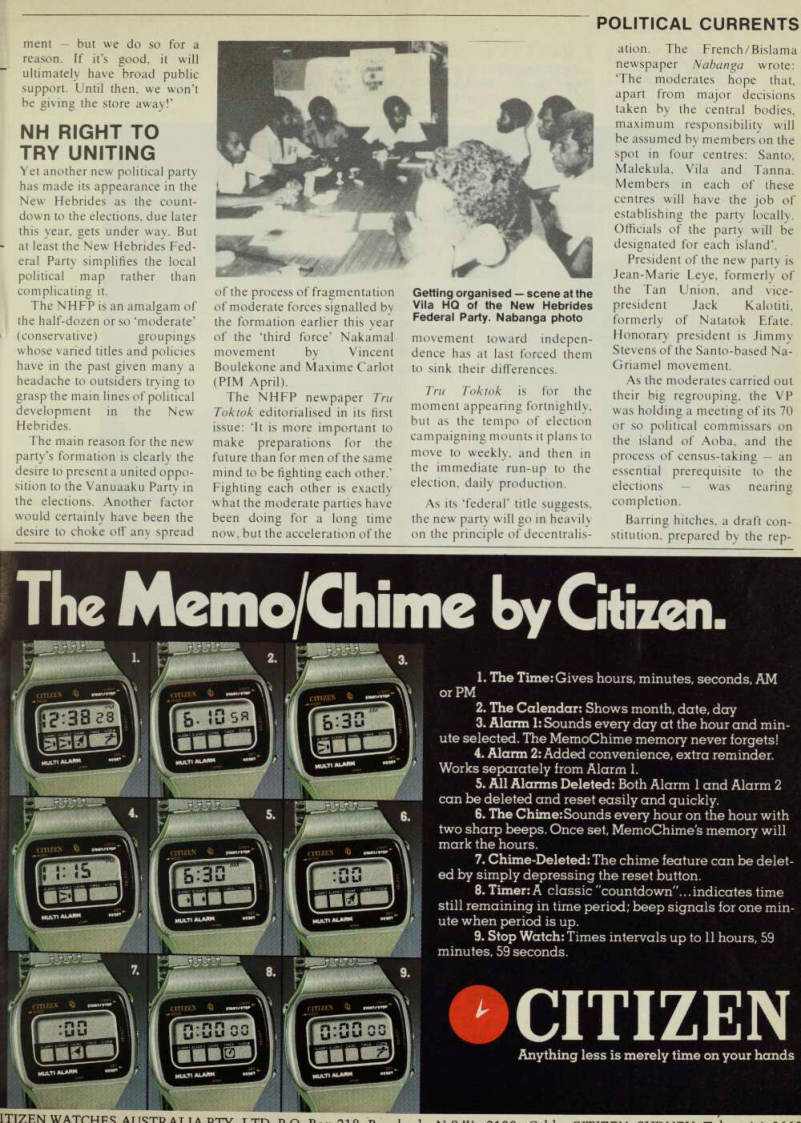
Getting organised scene at the Vila HQ of the New Hebrides
Federal Party. Nabanga photo
resentative assembly with the . help of British and French con stitutional lawyers, will be presented this month. The population will then be asked to vote on the constitution and independence. Elections will then be held for a new assembly which will in turn elect a leader who will have the
responsibility of forming a
government. This government will have charge of the New
Hebrides following indepen
dence, which is expected either late this year or early next year.
Recent New Hebrides his tory, however, shows that hitches are by no means to be ruled out. Writing in the Papua New Guinea Post-Courier in March, journalist Hilda Lini, sister of Vanuaaku Party presi dent and Deputy Chief Minis ter Walter Lini, said: ‘Vanuaaku Party members still talk about delaying tactics by the British and French to slow the elections. They warn that if there are too many of these tricks, too many broken prom ises, they will leave the tran sitional government and again work outside the system.
‘This might well delay
independence. But the end re sult true independence, rather than a deal handed to us from London and Paris is worth a few delays.’
Fiji’S Elusive
Coalition
The mainly Fijian-backed
Alliance Party controls 36 of the 52 seats in Fiji’s House of Representatives, writes Robert Keith-Reid in Suva. There are V/2 years to go to the next elec tion, which the Alliance Party is reasonably sure of winning.
Why then is the Alliance’s leader. Prime Minister Ratu Sir Kamisese Mara, talking of
sharing power (PIM April)
with the strife-torn India dominated National Feder
ation Party (NFP) by forming
a coalition government?
Because, he complains, the Indian arm of his own party, the Indian Alliance, is also torn by rivalries, so much so that he’s lost contact with the Indian people who form half of Fiji’s 600 000 population.
Ratu Mara exaggerates
when he says he has no contact with the Indians. There are many situations when the Fijian leader is obviously in close contact with them. But he has ground for serious concern about a corrosive battle going on inside the Indian Alliance, a separate party in its own right, but one of three which, with the Fijian Association and the General Electors’ Associ ation (the ‘Generals’ are neither Fijians or Indians), form what is already a coalition, the Al liance Party itself, which has run Fiji since 1968.
Ratu Mara has mentioned coalition several times in recent
years, without really going into the nitty-gritty of what kind of co-operative government he envisaged. He floated it again in a radio interview last year.
His attitude is generally interpreted as: If Fiji is to pre serve political stability it must have an evenly balanced multi racial government backed and trusted by a majority that represents a fair cross-section of its multi-racial society. If this can’t be done with the help of the Indian Alliance, can it be done by forming a national government with the NFP?
Response has so far been cool in almost all quarters.
Cabinet ministers say privately that they see no reason what soever to share power with the NFP. After all. hadn’t the Al liance crushed the NFP in the last election, and wasn’t the NFP split into two apparently irreconcilable factions?
The dominant NFP faction is led by the new leader of the
opposition, Jai Ram Reddy, a
cool, highly intelligent, elegant
and moderate lawyer who shows every sign of greatly
enchancing Fiji’s political
scene. But while some senior members of his faction have shown interest in being coalition cabinet ministers, Reddy has refused to say pub licly what he thinks one way or the other and has not, he says, even discussed the proposition privately with Ratu Mara. A possible reason for this attitude is that he is still consolidating his place as opposition leader, and fears that any sign of a deal with the Alliance could be
interpreted by his NFP
enemies as weakness they call him ‘Mara’s stooge’
already and exploited as
such.
The fight in the Indian Al liance shows no signs of end ing. It is primarily between its president. James Shankar Singh, and a faction he claims is led by his nephew and a former Indian Alliance presi dent, Attorney-General Sir
Vijay Singh. In January Mr J.
S. Singh resigned from cabinet, alleging he had been forced to do so because of false stories whispered in Ratu Mara’s ear by his opponents.
Veteran Alliance leader Doug Brown, a retired MP and former cabinet minister, seemed to sum up things when he told a February meeting of the national council of the Al liance Party: “I wonder whether we non-Indians in the
Alliance really and truly
understand the people with whom we work. I am at a loss to understand this personal animosity which crops up at almost every meeting we have.’
Ratu Mara is promising that he will keep plugging at the coalition idea, hoping that it will take root and then burst into flower in the Alliance and on Mr Reddy’s side of the
Nfp.
Mara, aged 59, wants to retire. ‘lf I can see the possi bility of a coalition at least a government that succeeds me that will be more represen tative of the people of Fiji than 1 have been able to achieve - I'll walk out tomorrow,’ he says.
Caledonia:
Hicom Rules
The French Government in March dismissed New Caledonia’s government coun cil and placed the territory under the direct authority of High Commissioner Claude Charbonniaud. Under existing
legislation the high com
missioner may act as adminis trator for up to two months.
Any new elections for the 35member territorial assembly called by the high com missioner after that period would be under new rules which, on the recommendation of France’s Minister for Over seas Departments and Terri tories Paul Dijoud, came into force in March.
A feature of the new rules is that for the first time parties must obtain at least 10% of the total vote before they can have a member elected. This effec tively disfranchises voters for the minor parties in the New Caledonian context, primarily
Melanesian-supported and
advocating independence. (It is
noteworthy that in the New Hebrides Mr Dijoud is
advocating an exactly opposite
electoral practice - a form of
proportional representation
‘which does not exclude min
ority parties from political life’
Le Monde , March 1. But in the New Hebrides the minority
parties are those supporting
close and continuing links with France.) Andre Chaville, writing from Noumea, backgrounds the crisis: Mr Dijoud came back to Noumea in February for a reply to his proposal for a 10-year contract between France and the territory.
The Union Caledonienne, led by Maurice Lenormand, which at the time controlled the government council, after many meetings with the minis ter, still could not agree to vote in favour of the plan because it failed to acknowledge the possibility of New Caledonian
independence in the long
term. ‘ln view of the UC control of the government council, Mr
Dijoud suggested that the
council should be dissolved.
But vice-president Lenormand (the high commissioner is
Jamus Shankar Singh ... eye of the storm
president) refused, insisting
that the councillors had been
democratically elected.’
In a statement in early
March, clearly foreshadowing
dismissal of the government council, Mr Dijoud said on the Noumea television station, FR3; ‘For the moment, the situation is blocked. Is it pos sible to have any real collabor ation between on the one hand a government council, a majority of whom have chosen the path of independence and a split with the mother country, and on the other, a territorial assembly with a majority in favour of progress together with France? ‘We are going to find a way to make the wishes of the terri torial assembly coincide with the objectives of the govern ment of New Caledonia . ..’
To this end, ‘. . . the terri torial councillors will, from now on. have to be elected more scrupulously and in
better organised conditions ...
Thus only representatives of
major parties may be elected ... This implies that small political factions will have to
be grafted on to the larger ones.’
Sanford Hits
At Wcc
The March conference in Noumea sponsored by the South Pacific Commission on the subject ‘An Oceanian Ap
proach to Rural Development’
saw stiff resistance by New Caledonian representatives to a motion calling for ‘suitable training’ of church ministers working in rural areas. They succeeded in having the motion amended.
Explaining the New Caledonian stand, the Noumea newspaper France Australe said the ‘original motion almost opened the door to the financing of churches by the
Spc.
The conference adopted a number of resolutions, stress ing the importance of work among young people and proposing a plan of action to benefit young folk working on
rural development projects.
Differences between spokes men of French territories and the predominantly Protestant
churches active in the Pacific also surfaced in French Polynesia, where Vice- President Francis Sanford delivered himself of a sharp criticism of the World Council of Churches. He was comment ing on a WCC decision
adopted in January in Jamaica on independence and self determination of Pacific
peoples.
Mr Sanford said: ‘The World Council of Churches should explain what it means
by “supporting the Pacific
peoples in their struggle for independence and self determination”. Is it a matter of supporting the majority in each country concerned, or rather does it mean supporting minorities in order to help them to become majorities, indeed, to impose their pro grammes on the majority?
There’s much more than a shade of difference between the two ideas. For my part, I think the idea of the World Council is a democratic one only if it is directed to helping
majorities achieve what they
desire. Any other attitude would unquestionably repre sent interference, the exercise of unjustified pressure in the affairs of peoples who alone have the right to choose their future.’
On the question of the denuclearisation of the Pacific, another demand raised at the Jamaica meeting, Mr Sanford found more common ground with the WCC, saying: ‘Given the undeniably harmful character of radioactive pol lution, the gravest of all forms
Francis Sanford ... demanding an explanation
of pollution, the denuclearisa * tion of the Pacific is fully justi fied. It is a matter of putting an end to a physical aggression whose consequences will affect many generations to come. It is quite simply a matter of pro tecting the life or our region
against all polluters, whatever
their nationality.’
World Junket
For A Mod
A notable visitor to Australia in March was Moli Jimmy Tubou Putuntun Stevens, chief presi dent of Na-Griamel. the cus tom political movement based on the island of Santo in the New Hebrides.
Variously regarded as
brazen opportunist or Melanesian-style saint, Mr Stevens was on a double mission: to push his idea of having some 3000 Vietnamese refugees settle in the New Hebrides, and to stake claims for land he maintains has been illegally taken from his people
by various foreign elements.
On the issue of Vietnamese refugees he wants them partly because in the past earlier Vietnamese residents had taught New Hebrideans valuable techniques such as basket-making, and how to smoke fish to ensure a food
supply during cyclone periods
he seemed to be getting no where; Australian Foreign Minister Andrew Peacock refused to see him on the ground that the New Hebrides Government is strongly opposed to the scheme.
On the land question. Mr Stevens had some of his most important business in Washington and Paris, the two capitals he was headed for after his Australian visit. In Washington he hoped to dis cuss land title matters arising from the US naval presence on Santo during World War Two.
In Paris, he would be meeting old friends (he’s been there be fore) and trying to untangle land matters left over from French planter operations in the New Hebrides.
Who was paying the fares of Mr Stevens and Susan, one of his nine wives, who was accom-
panying him on the worldwide junket? The people,’ was the reply from Mr Stevens’ Aus
tralian companion in Sydney,
Richard King. But some knowledgeable residents of the New Hebrides who happened to be in Sydney at the same time did not hesitate to drop the name of the Phoenix Cor poration in this connection.
The US-based Phoenix group was implicated in some of the most bizarre ‘development’ schemes known to the recent history of the New Hebrides,
including the so-called Minerva Reef Scheme. (Mr
King, incidentally, was closely
involved in Minerva.) When PIM talked to him in
Sydney, Mr Stevens apparently
did not wish to discuss the overall political scene in his country. But that his influence there remains considerable is shown by the fact that he has
been named honorary presi
dent of the newly formed New Hebrides Federal Party, set up by the various ‘moderate’ groupings to present a united front against the Vanuaaku
Party in the forthcoming
elections.
Jimmy Stevens in Melbourne park ... a long road ahead.
Photo Geoff Ampt, The Age