Letters
pp. 4-5 · Read in the full issue
A kind call from
Captain Withers
Would you please note that I no longer reside at Dick’s Place, on Malolo Lailai Island, (via Nadi Airport), Fiji . . . and that my new, current and prob ably final address is Trevor Withers, MBE, KCMC, The Defence Club, Suva, Fiji.
Thank you very much.
And, while on the subject of requests, would you please be good enough to forward to your founder the rightly revered Mr R.W. Robson my
respectful but quite affection
ate regards? Dear old Robbie!
I’m getting a little old myself .. . but my memories of that human dynamo and brilliant
journalist known far beyond
Australia as ‘Robbie’ remain, thank God, undimmed by the passing of the years.
I chuckled myself to sleep
last night when having happily
waded through many volumes of PIM during the past week, I came across and read for the umpteenth time ‘Lautoka’s Case of the Shrouded Corpse’ in PIM of July 1966.
What a man! That quite
intriguing story factually
true in every detail had its
birth when, on the day follow ing the event. I’d had the privi lege of buying Robbie an evening drink in Lautoka’s Northern Club. He was politely interested but only in a cursory' way. As I was subsequently to discover from PIM, he had a
photographic memory!
Stuart Inder and John Carter may well say, ‘Hell! When did Trevor Withers receive a knighthood? Since when has he been KCMC?’ A fair enough
question! It’s a long
story ... but KCMC - not to be confused with KCMG merely means ‘Kindly Call Me
Captain’. My quite miniature
award of the MBE is a more re cent, realistic and genuine one.
But I’ve had so much fun and games out of my KCMC. ‘nighthood’ that I refuse to sur render this!
Suva Fiji
Trevor S. Withers
Aborted take-off
from Papeete
I read with great interest in your January issue that Con tinental Airlines is shortly to be given permission to fly to New Zealand and Australia. It should be a great boon to trav ellers. I have flown many miles, in the USA and overseas, on Continental and have found their service efficient, comfort able and friendly. The same cannot be said of some of the present monopoly air carriers.
My wife and I recently bought full fare tickets we hoped would take us on a leisurely trip to Tahiti, the Cook Islands, Western Samoa, Tonga, New Zealand, New Caledonia, Fiji, Honolulu, and back to California.
After a week in Tahiti, where the weather was bad and the French unfriendly, we decided to continue our journey, per haps returning to Tahiti when the weather improved (our ex pensive tickets would have per mitted that). But neither UTA nor Air New Zealand would honour our onward tickets.
UTA said they might be able to take us at the end of March.
An Air New Zealand official suggested we stay in Tahiti and that he would sell us a building lot so that we could do so.
I don’t suppose that this kind
of airline arrogance will seriously hurt the economy of the South Pacific. We had
budgeted only SUS6OOO (with
American Express back-up) for
our trip. In any case, we were forced to return to California and will probably spend our money later in Hawaii. Or, if Continental gets permission to fly where we want to go, we might try again. In sorrow.
Frederic C. Coonradt
Pasadena California An unsigned copy of Mr Coonradt's letter was sent to both Air New Zealand and UTA for comment. Air New
Zealand's public affairs man
ager, Gordon Stepto, replied as follows: ‘You will apprec iate . . . that it is difficult for us to comment on a letter. . . which has been sent to a third party and not to us directly... we would expect that he would have dealt with us directly had he wished to take issue over any as pect of Air New Zealand's ser vice or operation ... I find it impossible to answer criticism levied by your reader. We have no idea of his identity or the dates and flights on which he travelled. With this information at hand, I can assure you that we would, as a matter of course, have investigated the incident fully and whatever action necessary would have been taken... Air New Zealand takes seriously any cri ticism . . . be it in standard of service or conduct of ground per sonnel and the airline is well able to investigate the veracity of such complaints ... Air New Zealand's reputation is well known in the South Pacific and we will go to whatever length necessary to protect that PIM had not heard from UTA at press time.
1878 Revolt: Latham
answers Guiart
I refer to Jean Guiart’s com ments on my thesis The 1878 Revolt on New Caledonia (PIM
Yesterday April).
I think much of the bitter ness of Professor Guiart’s re view comes from my having pointed out that his calcu lations of how many rebels were killed in 1878 use the 1954 census as an approximation of
pre-1878 population figures.
This leaves one of the leading tribes of the revolt with 17 men, women and children.
Professor Guiart raises the
age-old fear of anthropologists
that historians believe every thing they see on paper. Far from doing this, I showed in the book that our present picture of the revolt is the result of
wholesale manipulation by the
French administration in 1878.
The report of the official in quiry into the revolt has been
accepted completely as an
impartial examination of the revolt’s causes, but the inquiry included officials whose actions largely caused the re bellion and who were accused of gross cowardice during the outbreak. More than this, orders were given at the begin ning of the revolt which sent 80 Europeans, New Hebrideans and Indians to their death. The administration used its enor mous powers of censorship and coercion to make its version of why the revolt broke out and what happened on the first two days the only one transmitted to Paris, and so, ultimately, to us.
The official story was that most tribes on New Caledonia had been plotting a gigantic re volt for months when unim portant events touched it off prematurely in June 1878. This version, which ironically appeals to modern New Caledonian nationalists, obviously diverts attention from the circumstances of the first outbreaks.
Professor Guiart accuses me of crying over European deaths and ignoring the army’s shoot ing of innocent Melanesians.
The book’s purpose in the sec tions on the revolt was not to detail atrocities by either side but to explain what the admin istration had to cover up.
More generally, the book attempts to shift the French ad ministration and settlers from the central position they be lieved they occupied to a more realistic spot on the stage. This involves showing the adminis tration as. at times, for instance on the land issue, a fairly tooth less organisation which may have wanted to oppress but was
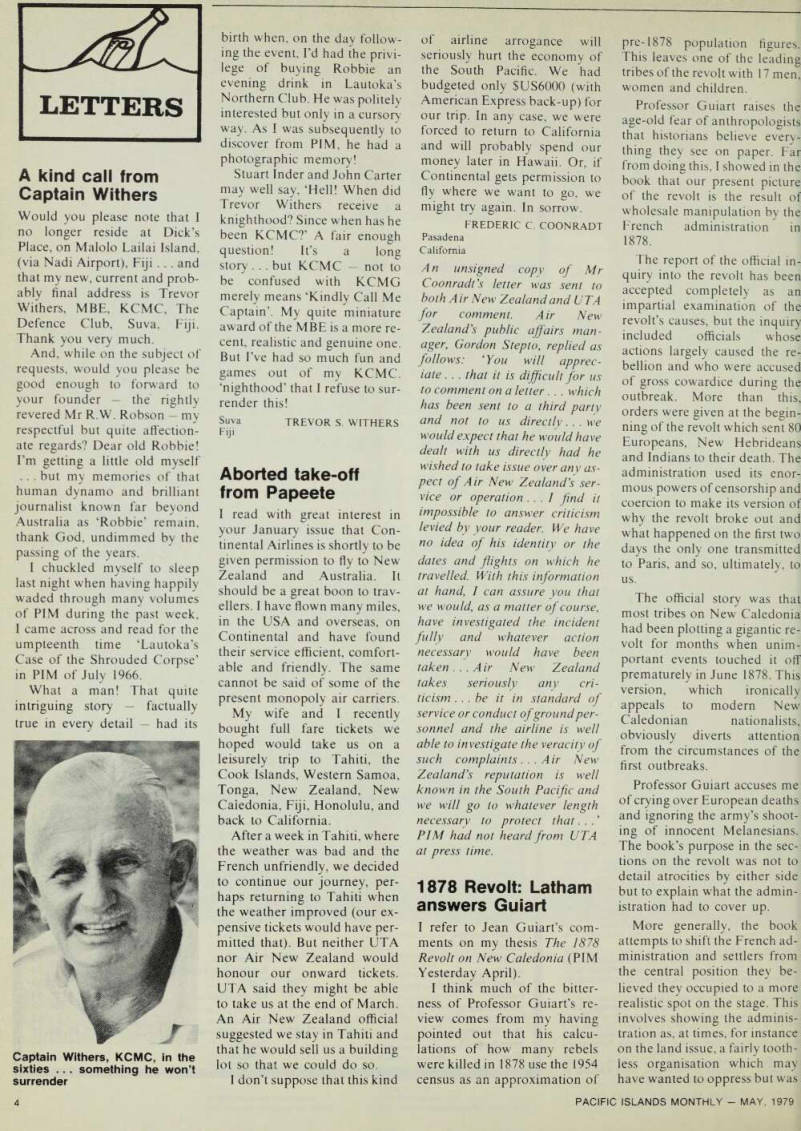
Captain Withers, KCMC, in the sixties... something he won’t surrender
I not always in a position to do
I so.
The book’s theme is that Melanesian tribes were nor
mally preoccupied by their re
lations with one another and relations with Europeans were
secondary. This approach
moves away from the usual I oppressor/oppressed writing
|on New Caledonian history
from which the island emerges I as a little piece of Algeria set ■ in the Coral Sea inhabited by ““settlers and tribes quite unlike those encountered elsewhere in the Pacific.
Frankly I doubt whether the book has had any political impact in New Caledonia be ’cause neither side can draw much comfort from its con clusions. To raise the issue, as Professor Guiart does, appears 'to me perilously close to cen
sorship.
Canberra Australia
Linda Latham
Burning questions
from the Cooks
Could you kindly advise me where and how an Islander may express any strong feelings he has on some public matter, or how he may get an answer to a question he may have burning inside him on such a matter, in circumstances where he has no hope of access to local media? Here in the Cook Islands we have a government daily and two party weeklies.
The latter two at present have their pet subjects, six pages against 12. The first is gradu ally appearing to get off poli tics but is still largely engaged in the cult of the individual, in the style of the Official Gazette of Louis XIV, at times going so far as to print items nostal gically bringing to memory ‘Le chat de Mme de Maintenon a ce matin recu un clystere’. (‘Mme de Maintenon’s cat was given an enema this morning.’) In 1974 for the first time for many a year all the northern group teachers in the Cooks came to Rarotonga on a re fresher course. At a long meet ing they all agreed on a certain number of coconuts per house hold not being sold for copra but left to them for food, drink and feed for domestic live stock, as they were the only sig
nificant fresh vegetable nutrient on the total 23.7 sq km of their atolls lying in some 2 125 000 mostly cubic sq km of South Pacific, brimming as it is with fish.
The southern group islands, including Rarotonga, where 90% of the population lives (1976 census) paid in 1977, according to official statistics, $4.5 million for imported food stuffs, and they are starving for fresh fish. The north can easily supply all needs, fresh or dried fish. Their skills if encouraged will survive to become their most important and valuable economic asset and our total Cl exports are just $% million net per annum!
To date no one has been pre pared to publish the considered view of these schoolteachers, the most educated and respon sible natives in the northern group. Meanwhile the less
knowledgeable northerners,
without any suggestion to the contrary from a central source, feverishly burn all nuts into copra, starving their families to cash in as much as they can on the world’s present very high
copra price.
Since self-government the
population birth-rate (not just
our total births per annum) dropped to about half. The 1976 census commentary gives no satisfactory reasons for it.
Was it some pill universally taken by all for a specific trop ical ailment, but with birth con trol side-effects of which the ordinary Islander has been told
nothing?
That is another public ques tion about which nothing has
been published locally, though
the results of the 1976 census were.
There are many other burn
ing public questions still not
being aired.
Arorangi Rarotonga Cook Islands
C. G. Joannides
(Retired public servant)
In defence of
French N-tests
PlM’s February People fea tured statements attributed to Oscar Temaru of Tahiti according to which 35 people were secretly hospitalised at Mururoa for ‘radiation sick ness’.
This story is pure fantasy.
Here are the facts: A few of the 3200 residents of the Mururoa nuclear test base were hit by a mild form of viral hepatitis.
This highly contagious disease
gives the patient’s skin a yel
lowish tint and in these cases was probably caused by sea food poisoning. Patients are isolated in the first days of treatment. This incident had nothing to do with nuclear test
ing.
If the claims of Messrs Temaru and Danielsson
regarding nuclear pollution
were true, one should conclude that these 3200 permanent atoll residents are Kamikaze types,
wilfully exposing themselves to
lethal radiation! Furthermore,
despite the strident opposition
to the tests by some well financed quarters, the fact remains that no proof what soever has ever been produced to substantiate these charges of pollution. It is a devious way to attack the French presence in the Pacific by portraying our country as colonialist, heartless and power-mad. That the French Pacific territories enjoy by far the highest standard of living in the area is con
veniently ignored by these
crackpot correspondents.
May I also direct your atten tion to the following: The New Zealand Radiation Labora
tory, Christchurch, a scientific body which can hardly be branded an agent of colonialism, states in its April 1978 report: ‘French under ground nuclear tests in the South Pacific commenced in mid-1975. Since, continuous monitoring has also been con ducted at five Pacific islands stations. No fresh fission pro
ducts, from possible venting
during underground tests, have
been detected since the pro gramme started. The levels recorded during 1977 were very small fractions of the reference levels and thus do not consti tute a public health hazard.
Moreover, the radiation dose
to the general population
resulting from the long-term
average levels, summarised herein, is small compared not only with the dose from the natural background but also with that from common vari ations in the natural back
ground.’
In the interest of truth and balanced reporting, I trust you will favour your readers with the above observations. The test site was visited by many of your confreres last June and re ports with photographs were published in the two Tahiti dailies Les Nouvelles and La
Depeche.
Bernard Malandain
French Embassy Charge d’Affaires Fiji
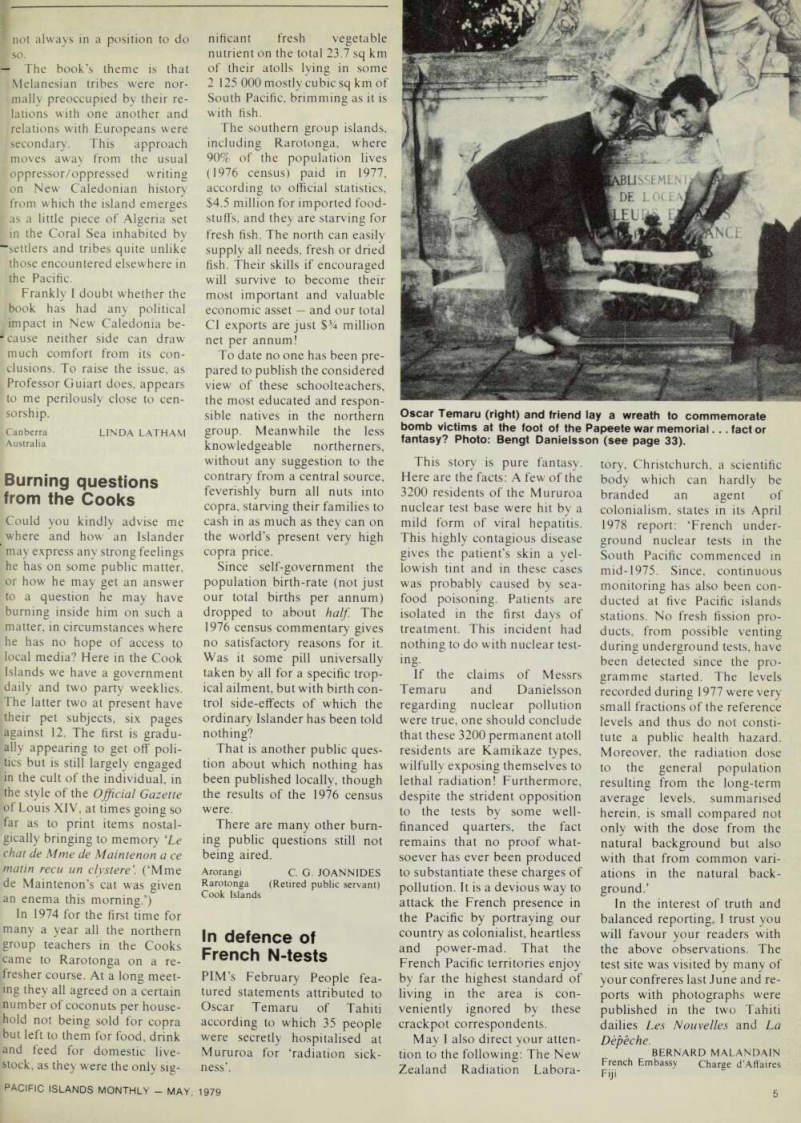
Oscar Temaru (right) and friend lay a wreath to commemorate bomb victims at the foot of the Papeete war memorial...factor fantasy? Photo: Bengt Danielsson (see page 33).