Niugini’s grand plans
pp. 88-89 · Read in the full issue
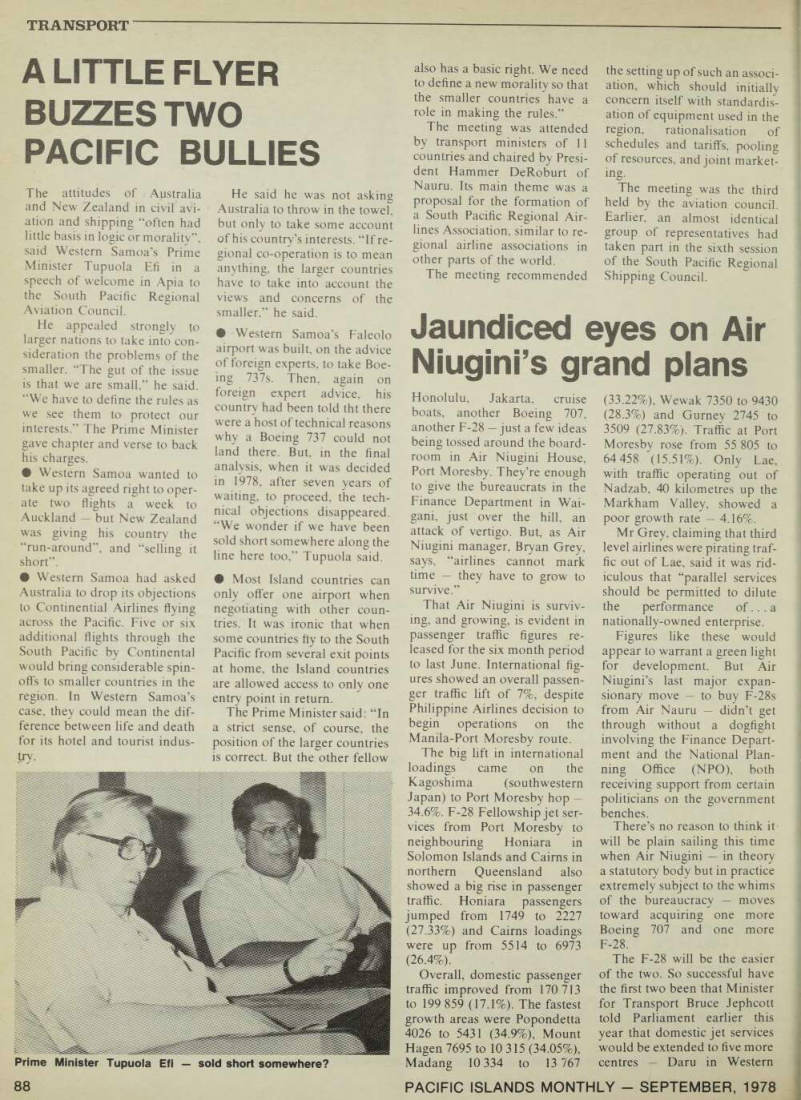
Jaundiced eyes on Air Niugini’s grand plans
Honolulu, Jakarta, cruise boats, another Boeing 707, another F-28 just a few ideas being tossed around the board room in Air Niugini House,
Port Moresby. They’re enough
to give the bureaucrats in the Finance Department in Wai gani, just over the hill, an attack of vertigo. But, as Air
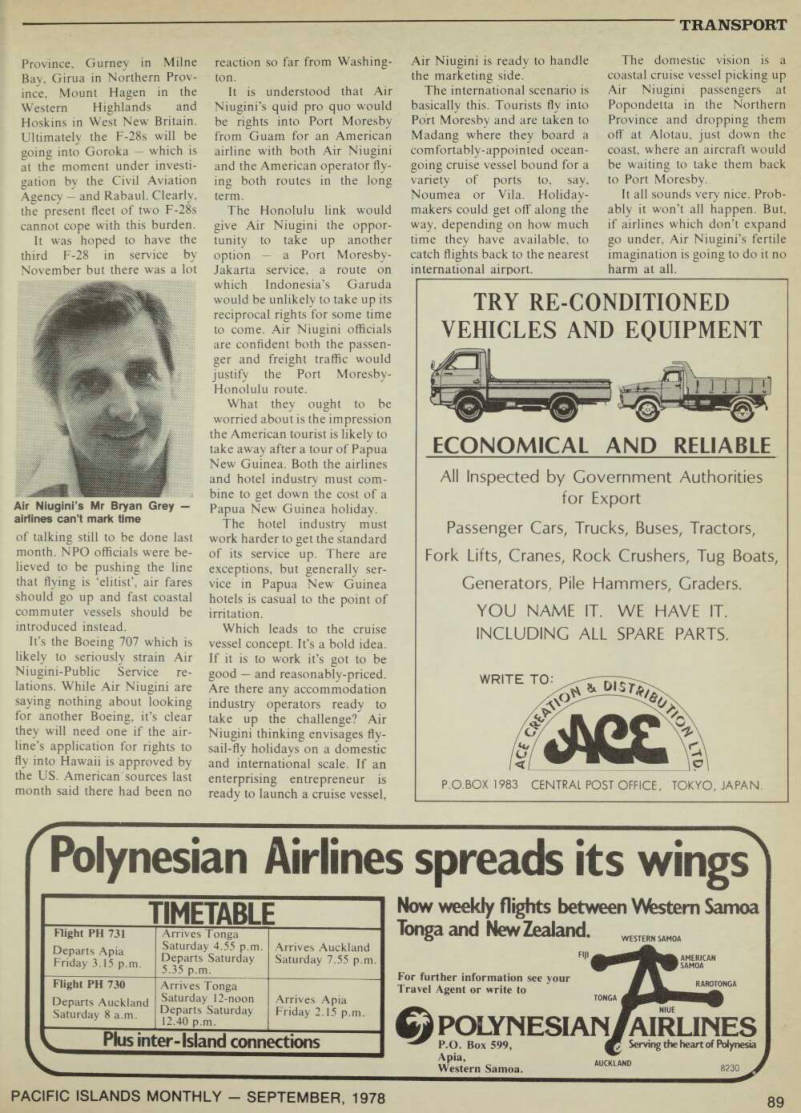
Niugini manager, Bryan Grey,
says, “airlines cannot mark time they have to grow to survive.”
That Air Niugini is surviv ing, and growing, is evident in passenger traffic figures re leased for the six month period to last June. International fig ures showed an overall passen ger traffic lift of 7%, despite Philippine Airlines decision to
begin operations on the
Manila-Port Moresby route.
The big lift in international loadings came on the
Kagoshima (southwestern
Japan) to Port Moresby hop
34.6%. F-28 Fellowship jet ser vices from Port Moresby to neighbouring Honiara in Solomon Islands and Caims in northern Queensland also showed a big rise in passenger traffic. Honiara passengers jumped from 1749 to 2227 (27.33%) and Cairns loadings were up from 5514 to 6973 (26.4%).
Overall, domestic passenger traffic improved from 170 713 to 199 859 (17.1%). The fastest
growth areas were Popondetta
4026 to 5431 (34.9%), Mount Hagen 7695 to 10 315 (34.05%), Madang 10 334 to 13 767
(33.22%), Wewak 7350 to 9430 (28.3%) and Gurney 2745 to 3509 (27.83%). Traffic at Port Moresby rose from 55 805 to 64 458 (15.51%). Only Lae, with traffic operating out of Nadzab, 40 kilometres up the Markham Valley, showed a poor growth rate 4.16%.
Mr Grey, claiming that third level airlines were pirating traf fic out of Lae, said it was rid iculous that “parallel services should be permitted to dilute the performance 0f... a
nationally-owned enterprise.
Figures like these would appear to warrant a green light for development. But Air
Niugini’s last major expan
sionary move to buy F-28s from Air Nauru didn’t get
through without a dogfight
involving the Finance Depart
ment and the National Plan ning Office (NPO), both receiving support from certain politicians on the government benches.
There’s no reason to think it will be plain sailing this time when Air Niugini in theory a statutory body but in practice extremely subject to the whims of the bureaucracy moves toward acquiring one more Boeing 707 and one more F-28.
The F-28 will be the easier of the two. So successful have the first two been that Minister for Transport Bruce Jephcott told Parliament earlier this year that domestic jet services would be extended to five more centres Dam in Western
Province, Gurney in Milne Bay, Girua in Northern Prov ince. Mount Hagen in the Western Highlands and Hoskins in West New Britain.
Ultimately the F-28s will be going into Goroka which is at the moment under investi gation by the Civil Aviation Agency and Rabaul. Clearly, the present fleet of two F-28s cannot cope with this burden.
It was hoped to have the third F-28 in service by November but there was a lot
of talking still to be done last month. NPO officials were be lieved to be pushing the line that flying is ‘elitist’, air fares should go up and fast coastal commuter vessels should be introduced instead.
It’s the Boeing 707 which is likely to seriously strain Air Niugini-Public Service re lations. While Air Niugini are
saying nothing about looking
for another Boeing, it’s clear they will need one if the air line’s application for rights to
fly into Hawaii is approved by
the US. American sources last month said there had been no
reaction so far from Washing ton.
It is understood that Air Niugini’s quid pro quo would be rights into Port Moresby from Guam for an American airline with both Air Niugini and the American operator fly ing both routes in the long term.
The Honolulu link would give Air Niugini the oppor tunity to take up another option a Port Moresby- Jakarta service, a route on which Indonesia’s Garuda would be unlikely to take up its reciprocal rights for some time to come. Air Niugini officials are confident both the passen ger and freight traffic would
justify the Port Moresby-
Honolulu route.
What they ought to be worried about is the impression the American tourist is likely to take away after a tour of Papua New Guinea. Both the airlines and hotel industry must com bine to get down the cost of a
Papua New Guinea holiday.
The hotel industry must work harder to get the standard of its service up. There are
exceptions, but generally ser
vice in Papua New Guinea hotels is casual to the point of irritation.
Which leads to the cruise vessel concept. It’s a bold idea.
If it is to work it’s got to be
good and reasonably-priced.
Are there any accommodation
industry operators ready to
take up the challenge? Air
Niugini thinking envisages fly
sail-fly holidays on a domestic and international scale. If an enterprising entrepreneur is ready to launch a cruise vessel,
Air Niugini is ready to handle the marketing side.
The international scenario is basically this. Tourists fly into Port Moresby and are taken to Madang where they board a
comfortably-appointed ocean
going cruise vessel bound for a variety of ports to, say, Noumea or Vila. Holiday makers could get off along the way, depending on how much time they have available, to catch flights back to the nearest international airport.
The domestic vision is a coastal cruise vessel picking up Air Niugini passengers at Popondetta in the Northern Province and dropping them off at Alotau, just down the coast, where an aircraft would be waiting to take them back to Port Moresby.
It all sounds very nice. Prob ably it won’t all happen. But, if airlines which don’t expand go under. Air Niugini’s fertile imagination is going to do it no harm at all.
Air Niugini’s Mr Bryan Grey airlines can’t mark time