four-letter word
pp. 67-68 · Read in the full issue
Tuna: Much more than just another
Writing from Honolulu, Fiji Times man Robert Keith-Reid takes an in-depth look at the problems faced by the proposed South Pacific regional fisheries agency in particular, the quest by Island Nations for the right to exploit the vast tuna resources inhabiting their economic zones.
Pacific Island historians may
record the 1970 s as being,
among other things, the decade of the great tuna rush. Nations inside and outside the South and Central Pacific are scram bling for the right to control or fish for the tuna that chum
through the region endlessly in
schools adding up to millions of tonnes.
The retail value of fish, mainly tuna, being hauled out of the region is now touching $1 000 million a year, accord ing to a conference which met in Suva in October 1977 to dis cuss the setting up of a regional fisheries agency. But emerging Island nations are unhappily aware that this great catch, much of it made within a few miles of their shores, is not
benefiting them greatly. Most
fishing is being done by the
United States, Russia, Japan, Taiwan and Korea, and the 15% proportion of the value of the catch staying in the region is going mostly to Australia and New Zealand.
For Island countries which in many cases import large quantities of tinned fish, and which see tuna as one of the
few really significant resources
exploitable by them, the pick
ings are relatively lean.
They come as a few can neries, fish-freezing stations and related facilities which are
usually owned, wholly or
partly, by Japanese interests.
There is also a little business in the way of supplying fuel, food and some services to Asian fishing vessels. A bonus for Fiji has been a thriving salvage and
ship repair trade generated by
the frequency with which Asian fishermen find them selves hard aground on coral reefs and the odd reef-bound vessel abandoned by her owners to become a cheap prize for the salvager who has bought her “as is, where is”.
Now the Island governments have decided that they must have a much bigger share of the trade in tuna the lion’s share in fact, if this can be managed.
But their efforts in this direc tion have quickly become a tricky international issue, if not yet quite a dispute, which could, for a start, lead to a con frontation with the United States.
Complications cropped up
last October when, at the direc tion of the South Pacific Forum, the South Pacific Bu
reau for Economic Co operation (SPEC) convened a meeting in Suva for nego tiations on the founding of a re gional fisheries protection agency.
Everyone was there the Islands, a big French dele
gation (reflecting the import
ance France attaches to its vast tuna-rich area of jurisdiction in Polynesia), an even bigger American delegation, and interested observers from Japan, Chile, Canada, Korea and others involved in the tuna stakes.
The meeting seemed to be going well. “We’re 90% agreed,” a SPEC official said in its early stages.
Then came the hurdle that is still to be surmounted: all agreed generally on 200-mile economic zones for each country, and on the broad terms of a constitution for the projected fisheries agency.
But what the Americans would not go along with was the inclusion of tuna in the list of fish to be subject to 200-mile zone controls. As a “highly mi gratory” fish, the US dele
gation blandly explained, tuna
was not suitable for control by individual nations. Only con trols exercised by a major inter national organisation would be accepted by the US. Otherwise, any tuna scooting around inside the zones were for any one to catch as far as America was concerned.
The Americans claim that their policy is tied up with a de sire to achieve sensible inter national conservation policies covering tuna stocks.
But as some Hawaiian ob servers agree, there is more than a touch of hypocrisy in it.
For a start, although US legis
lation covering the procla
mation of an American 200-mile zone from last year
specifically excludes tuna, it in cludes billfish.
The reason: there’s a strong
American sports fishing lobby,
and the big game fishermen get mad as hell when they see
Japanese longliners hauling in
hundreds of 450 kg (1 000 lb) marlin that otherwise might adorn a spot over their mantel
pieces.
But the main reason is that America’s big West Coast tuna fleet does much of its fishing close to the shores of other countries. If the US accepted a South Pacific precedent affect ing tuna, it would have to do so for other areas as well.
America’s influential tuna lobby, which is already having
difficulty maintaining its tra
ditional grounds, opposes the South Pacific concept.
Other pressures may, how ever, change the US stand, par ticularly if some tuna boat
companies operating out of
California begin to try their luck further out in the deep Pa cific, rather than fishing down the South and Central American way.
Hawaii, American Samoa and the US Trust Territory want to back the South Pacific
agency, complaining that they
also are being deprived of fish
by the busy Asians.
Hawaiian-bom Miss Patsy T. Mink, who led the US dele gation to the Suva conference as Assistant Secretary of State for Oceans and International Environmental and Scientific Affairs, officially put over the US stance on tuna. Since then, however, back in Hawaii and in Washington, she has been saying that she really believes America’s Pacific Island terri tories would gain from the con trols sought by the South Pacific Forum group.
The Hawaiian tuna fishing fleet, about 14 old boats fight ing to land a piffling 5 000 tonnes a year, agrees with her.
Hopes remain that the US may modify its policy in a way
that will allow the proposed agency to get cracking in the knowledge that it won’t have problems from America’s direction, at least.
“I think we’re prepared to try to manage tuna,” said Mr Doyle Gates, an official of the National Marine Fisheries Ser vice in Honolulu who was on the US delegation to Suva.
Figures from a yearbook
issued by the United Nations’
Food and Agriculture Organis
ation give some idea of what is at stake as the South Pacific Forum and the Japanese, Americans and others manoeuvre for a secure tuna stakeout. In 1974, the region yielded 979 000 tonnes, includ ing 481 000 tonnes of skipjack, 247 000 of yellowfin, 140 000 tonnes of albacore, 82 000 tonnes of bigeye and 29 000 tonnes of bluefin.
Perhaps about half of this catch was taken in and around Micronesia, which is most eas ily accessible to the most active tuna fishers, the Japanese fleets.
For skipjack, which are much smaller than the other species and tend to frequent shallower areas, the harvest is considered to be well below a sustainable annual yield of be tween 800 000 and 1 000 000 tonnes.
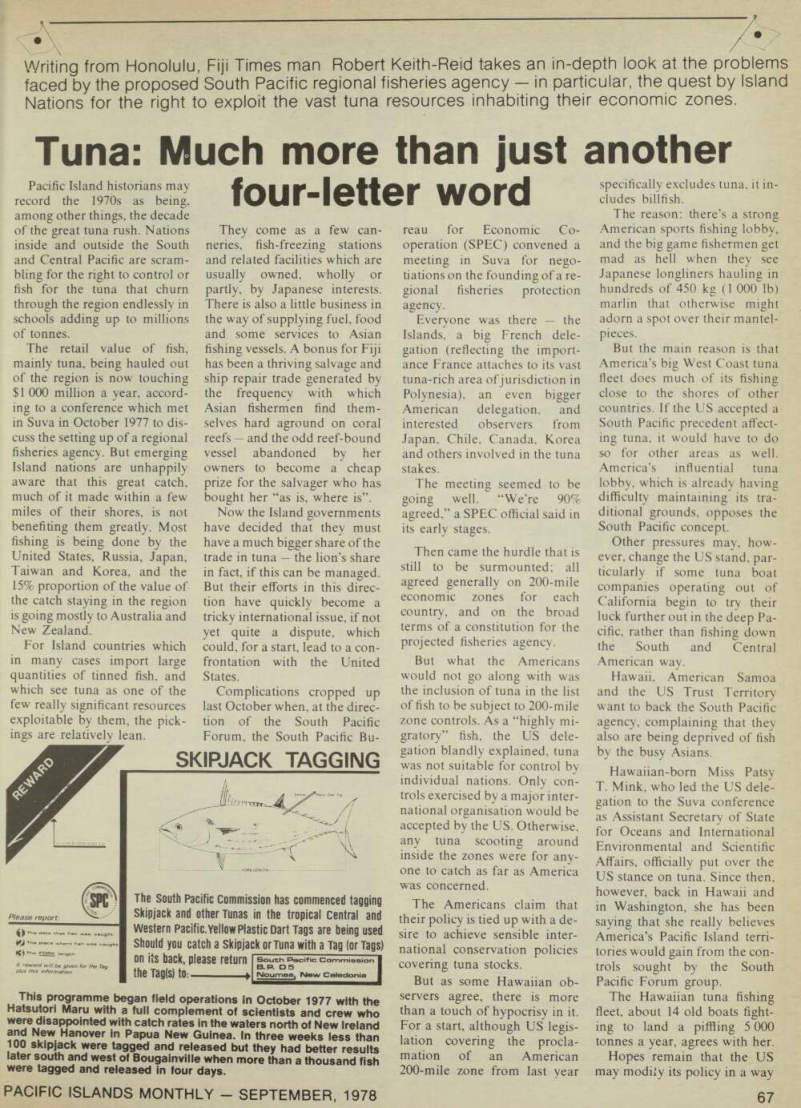
About 30 000 skipjack are being caught each year, tagged and released, and those caught
again are yielding data of help
in planning the launching of
embryo fishing fleets.
If and when the South Pa cific Fisheries Agency gets off the ground a number of Island countries hope to make money
by licensing foreigners to fish
for tuna in their economic zones.
They would also boost local economies by requiring li cences to build, say, a cannery employing so many local
people, processing so much
fish, and probably having a minimum of local equity.
The New Hebrides, the Solomons, Fiji and American Samoa already have canneries or freezing plants in operation, with Fiji and the Solomons
having finally managed to per
suade Japanese companies to accept joint venture deals.
American Samoa has two US owned canneries served by chartered Korean ships.
Papua New Guinea, which has particularly rich tuna grounds to its north, is nego tiating with American and Japanese interests on the pre cise form to be taken by their
future exploitation.
Meanwhile, Fiji seems to have grabbed a lead in max imising the value of skipjack fishing for its own economy. A
cannery, jointly owned by
Japanese interests and the Fiji Government, opened last year at Levuka and the government is building up a fishing fleet.
Last year the government
owned Ika Corporation caught
1 700 tonnes of fish with four boats, and in the first three months of this year, with a fleet of six, landed 978 tonnes.
The Fiji blueprint is one which other Pacific Island governments will want to match.
Some have already taken steps to do so, with Japanese help. Japan has recently sup plied Western Samoa with $550 000 in fishing aid, includ ing a skipjack catcher; Tonga is receiving a $ 1 500 000 grant from the same source; Saipan is yet another recipient of Japanese fishing aid; and the Japanese International Co
operation Agency has been
engaged in a tuna baitfish sur vey for the Gilbertese Govern ment.
The Americans, for all their coyness about tuna, are taking steps to make sure they have a leg in also. They have created the Western Pacific Fisheries Commission, based in Honolulu, to prepare fisheries management plans for billfish, precious corals and lobster; bottom fishing; and fishing on the small but quite rich grounds centred on seamounts the tops of submerged mountains, of which there are many near Hawaii.
Then there is the Pacific Tuna Development Foun dation, launched in 1976 to promote fisheries develop ment, and particularly tuna fishing, for the benefit of Hawaii, Guam, American Samoa, the Trust Territory and the Northern Marianas.