Looking at the family institution
pp. 15-17 · Read in the full issue

among Fiji Indians
SOCIETY —The lot of Fiji Indian children, especially girls, is not always a happy one. A RIM correspondent in Suva, herself of Fiji Indian origin, examines the present state of Fiji Indian family life.
The empty whisky bottle miraculously missed his head and shattered on the concrete floor in countless tiny pieces.
Enraged by her failure, she advanced towards him menacingly, grabbing the nearest thing to hand, an old wooden rolling pin. While the boy recoiled in fear and covered his face with his hands in the universally-pro tective gesture of children, she lunged with her first blow.
He cried out in pain. As the child’s screams increased so did the blows. She seemed like a woman possessed.
To Kamla Reddy, seven year-old Raj for a while was no longer her son. In him she found an outlet for all her pent-up emotions, her frustra tions, failures and unhappi ness. After beating him up to her heart s content she locked him in a room without giving him dinner. Her two other children, mere toddlers, scared by what they had just witnessed and fighting back tears under their mother’s threats, gulped down a few bits of food and went to bed.
As Kamla sat on the doorstep of her house fanning herself with her dingy veil, did she feel guilt about what she had just done? Was she wondering what imprint she was leaving on her children, and how these experiences would affect them when they grew up?
Far from it. Kamla felt a strange sort of satisfaction. As a result of beating up her son she had simmered down. All afternoon her thoughts had aeen centred on Wahab, her over with whom she had been supposed to go on a secret pic aic. Wahab had forgotten heir date again. At first as he seconds ticked away on he kitchen-wall clock, she >ecame impatient, worried, ealous, then angry.
When the phone finally ang she was jittery and rush d to answer it, thinking it was Vahab at last. But the call was rom Sami, her husband, who drunk as usual. He or ered Kamla to prepare some
hot chicken curry and put beer in the fridge. He an nounced he was going to bring home some friends for a booz ing party. When Kamla re plied there was no chicken or beer in the house he shouted “Get it from somewhere’’ swore at her and slammed the receiver down in her ear.
Torn between hatred for Sami, who had been chosen as her husband by her parents, and anger at Wahab, Kamla did not need much of an ex cuse to vent her wrath. A minor squabble among her children in which Raj ap peared the culprit provided the catalyst.
Kamla, like thousands of Indian parents in Fiji, uses her children as “emotional beds”.
Cruelty to children is a com mon thing among the Indian community, although a small section of educated and il literates are among the most wonderful parents any child could have anywhere in the world.
All Indian parents rejoice when a child is born. The
celebrations are more marked when the baby is a boy. He is considered a “gain”, while the girls continue to be looked upon as “burdens”.
It is not that the structure of Indian society, its culture or religion, advocates ill-treat ment of children. The child has indeed been idolised by Hindu saints, philosphers and leaders.
But once a child reaches the age of seven he or she is ex pected to act, think and, par ticularly in rural areas, work like an adult. This means wak ing up with parents at sunrise, toiling on the farm, tending goats, cattle, chickens, look ing after vegetable gardens and selling produce.
But not every child is sub missive. They try to support rebellious arguments with what they learn at school (most of them spend at least some years in high schools), from what they have read in books, or seen in movies. But most often rebellion is no use as the parent has the money and disobedience means being
booted out of the home.
Most of the younger genera tion do not believe in religious differences or in the caste system. But Hindu parents continue to oppose marriage to Muslims and vice-versa, and the caste system is still practised.
For example northern In dians are expected to marry northern Indians, similarly Punjabis, Gujeratis and southern Indians must all marry within their castes.
There are many young people who defy this and marry out side. Often this means total banishment by the girl’s parents, but most such mar riages are quite happy.
Cruelty also extends into later stages of a child’s life.
One of the most glaring exam ples of this is Indian marriges.
Many Indian parents, in cluding so-called “educated" ones, choose their sons’ and daughters’ wives and hus bands. To qualify, a girl has to good at housework. Sewing is an advantage. She must not be too fat or too thin, or have any
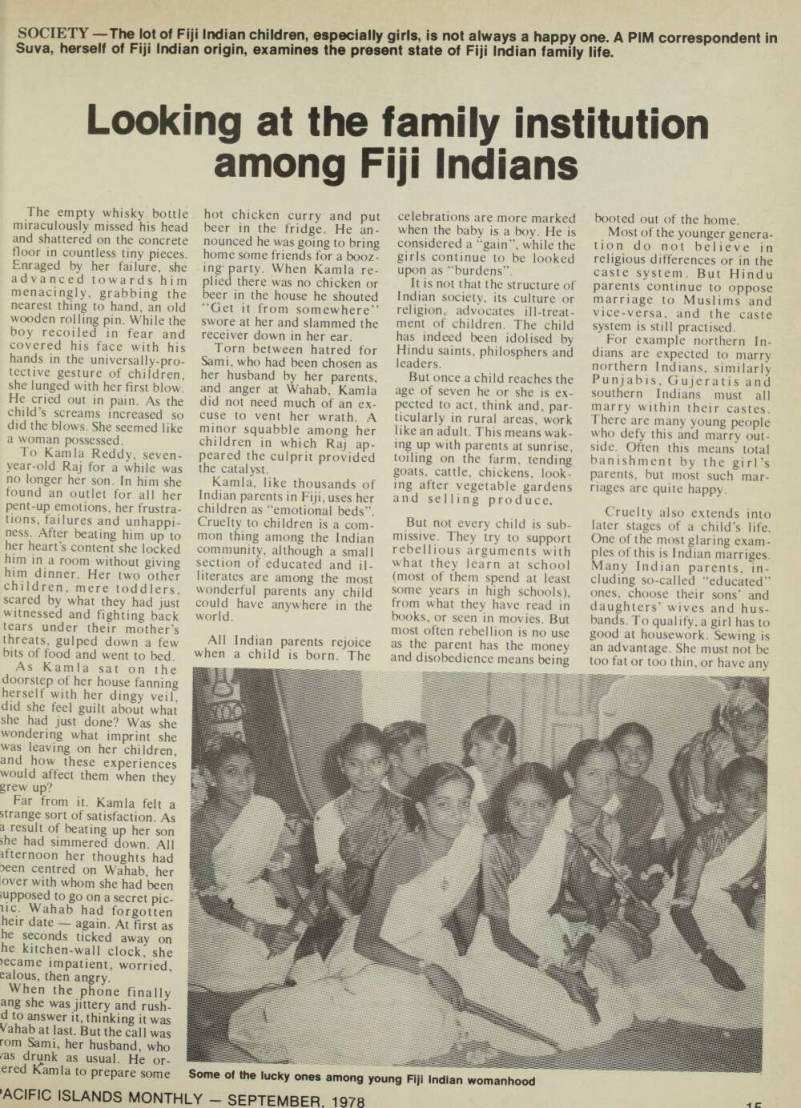
Some of the lucky ones among young Fiji Indian womanhood
abnormalities such as a miss ing finger, and she must not be Westernised. A well-off family and fair skin are
definitely advantages.
Before agreeing to mar riage, her prospective mother in-law samples her work and cooking. Cruelty to teenage daughters-in-law is worst among Fiji’s affluent Gujerati community, although they will furiously and firmly deny this. The Gujerati mother-in law more than any other tries to wield power in the house hold and hold first place in her married son’s affections.
The daughter-in-law usually assumes the role of a “house girl”.
The mother-in-law buys her clothes and underwear and even chooses the colour of things the girl should wear. If the son wants to take his wife out for a social occasion she must get her mother-in-law’s permission first. In most cases this is refused, but the daughter-in-law is not allow ed to tell her husband that. In stead she must plead a headache or some such ex cuse. Often the young woman becomes fanatically involved with religion for consolation.
Daughters who live with fathers who have de-facto wives end up leading Cin derella-like lives. Unfor tunately there are no fairy godmothers or Prince Charm ings to come to their rescue.
Daughters whose mothers have de-facto husbands often end up having to put up with sexual advances from them. In Suva recently a teenage girl, who was adopted by a man as his daughter, was forced to have sex with him. The father was goaled for 10 years. In mitigation he said shamelessly that he had sex with his adopted daughter because he knew other men had already had her.
There are institutions in Fiji where a child in distress can go for help. But not many turn to them. Most children are unaware that the law and these institutions can helo them. F Ironically, the very parents >vho ill-treat their children ire usually the first to expect iternal gratitude from them.
Phis means the children are expected to care for them for he rest of their lives. In most 'ases this is what happens, -laving been subject to blind )bedience for so long, the hildren generally accept the
esponsibility without
[uestion.