House Of
pp. 11-12 · Read in the full issue
Fall Of The
Henry
From STUART INDER, in Rarotonga
The atmosphere in these islands following the dramatic change of government is a mix of relief, shock, puzzlement, joy and bitter ness. But what proportions of each of those varied ingredients make up the final recipe, I don’t know not even after a week in the Cook Islands.
I suspect it is too early for anybody to really know. Sir Albert ‘Papa’ Henry’s Cook Islands Party (CIP) government, in absolute power for 13 years, disappeared in a puff of smoke on July 24.
It was replaced, almost magically, by a government of the oppo sition Democratic Party led by Dr Tom Davis.
Sir Albert’s party had got back into power at the general elec tions of March 30, the party’s fifth election win in a row. In the 22-member Legislative Assembly the victorious CIP got 15 seats to the Democrats’ seven, against 14 seats for the CIP at the 1974 election. But the real interest was in the personal defeat at the March poll of Dr Tom Davis.
Dr Davis, 61 (his degree is in medicine), is a Cook Islander who spent 20 years as an expatriate, mostly in America, before returning home in 1972 to enter politics. He wanted to change the direction in which he believed the country was headed under Sir Albert. As Opposition leader he was the only real thorn in Sir Albert’s side. He rejected several overtures from the wily Sir Albert aimed at getting him to join forces with the CIP and thus shut him up.
Suddenly, Tom Davis was gone. But, although down, he wasn’t out. His supporters launched actions in the Cook Islands High Court under the Electoral Act, alleging electoral corruption against Sir Albert and seven of his fellow party politicians in the vital Rarotonga constituencies which provide nine of the assembly seats. The hearing in the electoral court under Chief Justice Gaven Donne lasted 18 sitting days in May and June five in Auckland, three in Wellington, the balance in Rarotonga.
The Rarotonga sittings provided a sensation as star witness. Sir Albert, unfolded to the court, under examination, an extraordi nary tale of do-or-die electoral compaigning and international finance. A key figure, who to popular regret never appeared in person, was Finbar Kenny, the New Yorker boss of the contro versial Cook Islands Philatelic and Numismatic Bureau which, for years, has made a mint out of its government-supported mon opoly on Cooks’ stamps.
The petitioners claimed that eight CIP politicians bribed elec tors to vote for them, particularly by giving voters free or sub sidised air travel from New Zealand to the Cook Islands, and that they were also guilty of “general corruption of a widespread and general nature, including the corrupt use of public
money”.
Much of the evidence concentrated on one particularly large sum of money 5337,000 advanced by Kenny and $290,000 of it used by Sir Albert for six Ansett charter flights stuffed with selected CIP supporters who were told ftow to vote. Apart from paying S2O each for food en route from NZ to the Cooks and return, they got the flight free. The Democrats also flew in voters, hopefully their own supporters, who had to pay full charter rates for their seats and were given no voting instructions.
The flying voter is peculiar to the Cook Islands which has more of its population out of the country than in it. An estimated 20,000 Cook Islanders live in New Zealand, only about 19,000 at home.
They retain their voting rights but must cast their vote in the Cooks, because there is no absentee ballot.
Was Sir Albert’s $337,000 cheque government money used for illegal party-political purposes? Sir Albert said the money was a personal loan from his good friend Finbar who knew what he needed it for. Sir Albert had merely “laundered” it through a new Cook Islands Government agency set up for the exercise to protect Kenny from the Foreign Corrupt Practices Act. introduced in the US in 1977 following the Lockheed scandals, which precludes Americans from advancing money to political parties. Finbar Kenny, in a message to the inquiry, violently disagreed.
Chief Justice Gaven Donne held that Kenny’s cash was paid and was meant to be paid as an advance from the Philatelic Bu reau to the government against 1978 stamp revenue, and thus Sir Albert had illegally used public money for the charter.
Mr Justice Donne said it wasn’t for him to decide whether or not there had also been a breach of US Federal law. He was not obliged to rule upon the validity “of self-serving explanations given by Sir Albert Henry or Mr Kenny after the event”. The fact was that in his use of the money the Cook Islands premier was guilty of unlawful conduct “of monumental dimensions”. (See separate report on the judgment.) If Mr Justice Donne’s decision was a shock, what followed it was nothing less than stunning.
At the instant the chief justice completed reading his lengthy judgment to a packed Rarotongan court room shortly before 12.30 pm on July 24, the Cook Islands was without a government. What the judgment did was to declare void all the votes cast by the illegal CIP fly-in voters. With these removed. Sir Albert and his seven cohorts immediately lost their seats to the next highest vote getters, who were Dr Davis and seven others.
In addition, the chief justice removed from his seat the member for the island of Mitiaro, David Tetava, over other allegations of corruption, and ordered a by-election.
The cabinet ceased to exist once the premier was unseated but the judgments reversed power in the assembly from 15-7 for the CIP to 15-6 for the Democrats. Democratic Party leader Dr Davis had to be invited to form a new government.
The machinery to make this possible began operating with
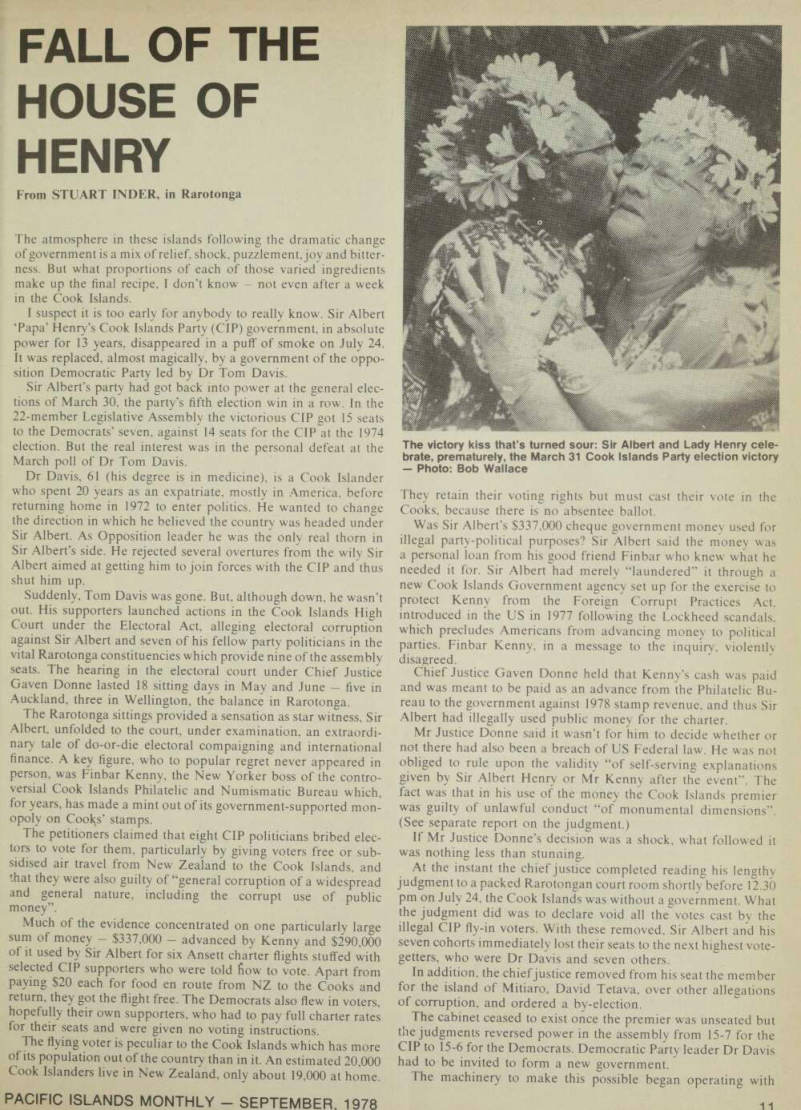
The victory kiss that’s turned sour: Sir Albert and Lady Henry cele brate, prematurely, the March 31 Cook Islands Party election victory - Photo: Bob Wallace
extraordinary swiftness, thanks to the fact that Mr Justice Donne wears two hats.
The Cook Islands since 1975 has had no high commissioner representing the Queen as head of state. But a post called Queen’s Representative was established and is held by the chief justice who exercises the function of high commissioner under the consti tution. So the moment he finished his judgment he put on his Queen’s representative hat, taking charge of the islands as tem porary head of state.
Mr Justice Donne, 64, with 40 years of law behind him, 20 at the New Zealand Bar, and with extensive judicial experience in the South Seas (he’s a former West Samoa chief justice) is a quiet, considerate personality who wouldn’t relish the responsi bility in finding himself a national dictator.
Examination of events after 12.30 pm on July 24 indicate he handed back power to a new government so swiftly that he prob ably created some sort of constitutional record. Chief Justice Donne legally held the reins for less than an hour-and-a half.
But, because of the nature of the operation, his brief authority had dramatic repercussions lasting for several days and brought some public mumblings about overkill.
Certainly the detailed planning would have done credit to any African power broker mounting a sudden palace coup. Here is the order of events; • As Mr Justice Donne began reading his determination, six senior New Zealand police were already on the way from Auckland by Air New Zealand in case of violence. (They arrived later that day and, as it happened, had a pleasant few days in the sun.) • When he completed reading his Mitiaro judgment at mid morning, court officers accompanied by police rushed a legal notice revoking the election to the Government Printer with instructions to stay there until it was printed in the Government Gazette. (Two printers walked out.) • As he completed reading his main Rarotonga judgment, ad ditional legal notices of revocation were also raced off for gazettal, together with a vital proclamation by Mr Justice Donne pro roguing the Legislative Assembly pending appointment of a new premier and cabinet. • Officials rushed copies of the proclamation to the assembly which had been due to open a new session at 1 pm, that is, within minutes, they gave a copy to the speaker, posted others on the notice board and another on the main door after having locked it. A police guard was placed on the building to prevent anybody
entering.
• A legal associate of Mr Justice Donne handed to Dr Davis a note asking him to go immediately to a room of The Rarotongan Hotel, alone. • The manager and all board members of the government-owned Cook Islands Broadcasting and Newspaper Corporation were
handed letters directing that no one except the chief electoral offi cer was now permitted access to the radio station without auth ority of the Queen’s representative; that at 2.30 the Queen’s representative and a new premier would tape messages to the people that were to be played every hour on the hour up to 8 pm and in place of all local news broadcasts the next day. Only regular overseas news broadcasts were to be relayed, together with music and weather and shipping information, or police messages.
These instructions were to remain until countermanded by the relevant minister in the new cabinet, and anybody who disobeyed them would be dismissed on the spot. • By this time Mr Justice Donne was also at The Rarotongan, where copies of the Government Gazette, rushed straight from the printer, were handed to him. Now with legal requirements met, and Dr Davis only too willing, he swore him in as premier in Room 208. Within half an hour the new premier had gathered his fore-warned cabinet, who were also sworn in. (Dr Davis says he had chosen his cabinet many weeks earlier when it had become obvious to him from the court evidence that Sir Albert was in trouble.) • Chief Justice Donne and Premier Davis now went off to the studio to broadcast messages. The chief justice explained the cir cumstances of the change of government. The new premier, nam ing his cabinet, said it was time to look to the future; “The time for rebirth and renewal that I spoke of on New Year’s Day has arrived ... I promise you that I will lead your new government to work towards the welfare of all the people and not just a chosen few . . . The time for dependency on others is finished.”
This was a reference to Sir Albert’s style of leadership in which party supporters are promised the good life if they follow him.
Under Sir Albert, government was a one-man band, with ‘Papa’ involving himself in every level of decision-making, sometimes reversing decisions of cabinet, which one former cabinet minister says he attended infrequently. There was also widespread criti cism of his nepotism, with the ‘Henry clan’ filling key positions, which had caused resentment, particularly in the public service. (Sir Albert’s answer to the nepotism charge is that he picked the best people for the job often with the best education, irrespective
of family relationships.)
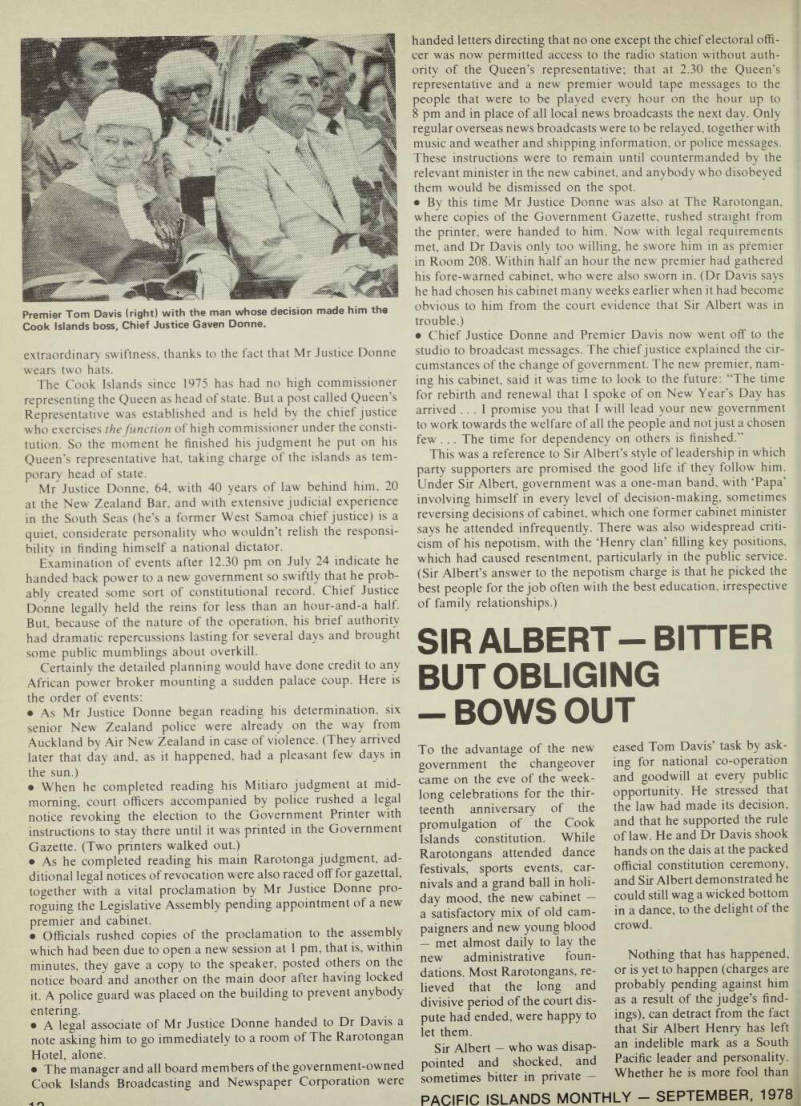
Premier Tom Davis (right) with the man whose decision made him the Cook Islands boss, Chief Justice Gaven Donne.