Business and Development
pp. 61-67 · Read in the full issue
Super-Port For Palau
But At What Cost?
From PAMELA G. HOLLIE on Saipan
Increasing world energy demands have focused attention on Palau, a district in US-administered Micro nesia, where “a new, central, energy distribution and storage port is a most appropriate and economic solu tion to the requirements of the Western Pacific”.
A proposed oil storage facility costing around S4OO million, plus a possible SI billion refinery and re lated industries has been outlined in a 33-page interim report. Backed by Japanese, US and Iranian govern ment interests, the port could store up to three months supply of oil— at least 3.4 million tons—and could be in operation as early as 1980 if all goes well.
When the report was first made public last May, it appeared that Palau had the possibilities of becom ing the energy hub of the Pacific.
Some 3,500 miles from Sydney, 1,000 miles from Manila and 2,000 miles from Tokyo, Palau would become the home of “Port Pacific”.
But as the concept of a massive oil-transshipment and storage port in Palau has aged, the likelihood of its general acceptance—though not its eventuality—has waned. And op position to the possible effects of oil pollution have drawn strong opposition to the port.
Residents of the Palauan hamlet of Ollei, who claim ownership of Kossol reef, the site of the proposed superport, have called for a halt on negotiations on the project.
In a petition to the Palau District Administrator, Ollei residents said, “The proposed superport appears to be too maganimous in scope and its impact on Palau’s environment, cul ture and society can be disastrous”.
While the initial report on Port Pacific, prepared by Robert Panero Associates, New York City, said the transport system would incorporate the most advanced highspeed tech nology with a “zero-leak environ mentally-conscious approach”, the local population— at first said to be
in support of the project—are becom ing increasingly dubious. Zero-leak “approach”, they learned, doesn’t mean zero-leaks.
The plan takes into consideration the harbour’s ability to “naturally flush” itself. The port will also be some miles from Palau’s heavily populated district centre, Koror.
Port Pacific will be sited on Kossol Reef at the northern end of Babel thuap, Palau’s largest island. The harbour was chosen because it is a natural, reef-protected, deep-water anchorage, which is larger than the harbours of New York, Singapore, Kobe or Rotterdam.
Most importantly, it lies in an oil lane only 500 miles from Indonesia and the Philippines. From Palau crude oil would be transferred to smaller tankers for distribution throughout the Pacific area, particu larly Japan.
Kossol Harbour is one of the few harbours that will be capable of handling tankers up to one million tons, a new generation of “super tankers”.
Palau’s intermediary in the talks is Palau Congress of Micronesia senator Lazarus Salii. But, from the outset —Palau has not been a parti cipant in the negotiations, a fact that has resulted in considerable mis understandings and “an atmosphere of confusion, uncertainty and ignor ance . . .” the Ollei petition claims.
Salii, who has been under pressure from proponents and opponents of the superport, has constantly re minded people that the port is only in the planning stages and that Palau
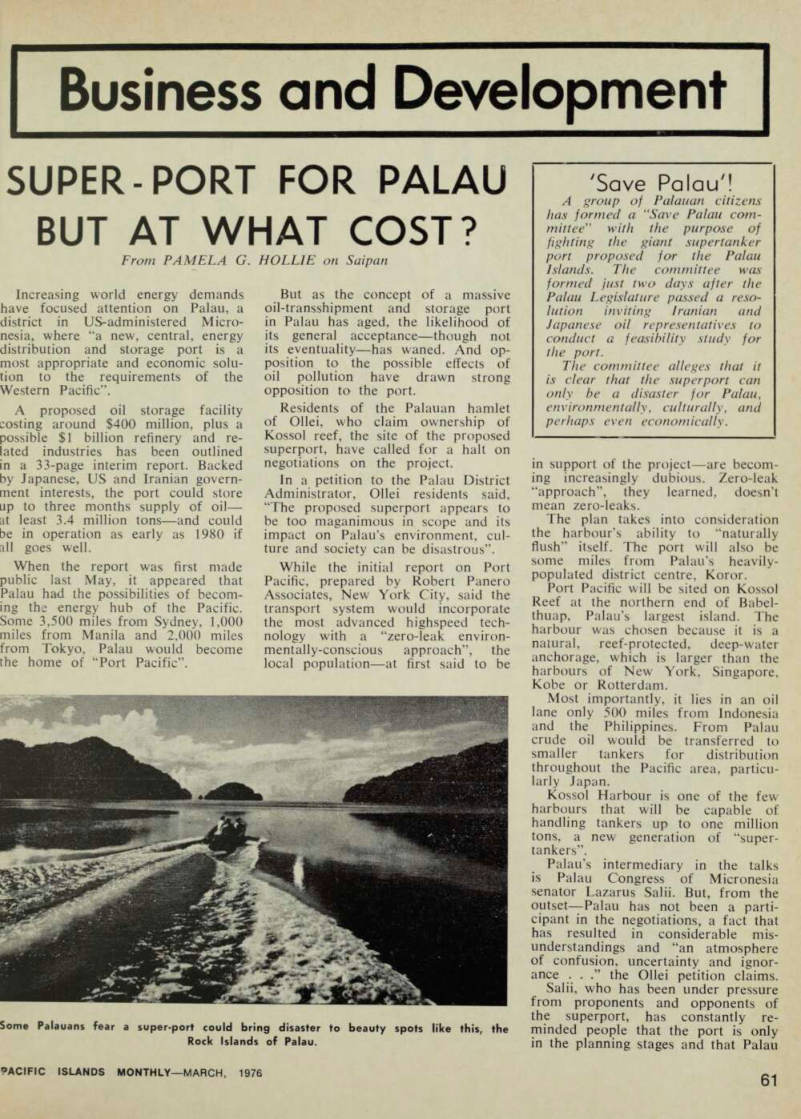
Some Palauans fear a super-port could bring disaster to beauty spots like this, the Rock Islands of Palau.
is only one of many sites under con sideration.
“Some people are prematurely concerned”, he says.
But, as the possibility of the pro ject enters its eleventh month of negotiations, it’s become more ap parent that Palau wants a say in whether or not the port becomes a reality. Salii favours hiring a “neutral consultant” to review the project pro posal, as do other Palauans who have charged that “certain Palauans” stand to gain from the project.
Offsetting some of the complaints about the port are the items in the proposal which stand to benefit the areas south of the “energy-industry zone”. The proposal envisages “a marine biology institute, a sea park, and quality international home and hotel construction”. But, the energy industry zone that would make this possible would include a petro chemical installation and a major oil-fired power plant to provide elec trical energy for electrolytic refining of minerals such as zinc and bauxite.
While it appears that Port Pacific would boost employment, only half of the 5,000 employees might be Palauans and an estimated 1,500 residents may have to leave their homes to make way for the construc tion of the harbour. This has turned some sour on the project.
Of perhaps the most importance to Palau is the implications the port has on the district’s political status.
Right now, Palau is part of the US administered Trust Territory of the Pacific Islands. Whether or not the port is situated in Palau may depend on whether the district intends to remain with the US after the trustee ship ends sometime around 1981.
The report states that “because the Palau Island can reasonably be expected to be under the protection 3f the US Navy for at least a gener ation, investment of very large sums ;o achieve the foregoing can be ustified”.
Palau has asked for separate poli ical status talks with the US, apart Torn the rest of the TT districts, but he US has not made a decision.
Should the unity of Micronesia, vhich is fragile at best, not ade tuately accommodate Palau, the iistrict would be expected to press lard for its separate talks.
“It’s a question of survival and :conomics”, says Senator Salii.
Prominent Palauans on Saipan, ncluding Senator Salii and Eusebio *echucher, Director of the TT De partment of Resources and Develop ment, have sent a letter to the Palau legislature endorsing a feasibility tudy for the port.
The Solomons are feeling the pinch . . .
The Solomon Islands are feeling the pinch through the world recession in copra prices and a sluggish de mand from Japan for forestry pro ducts. The fishing industry was a little depressed in 1975, but prospects for 1976 are brighter.
These points were revealed by the Minister of Finance, Mr Willie Betu, in his 1976 budget speech in the Legislative Assembly.
After enjoying an overseas trade surplus of $1.3 million in 1974, the first nine months of 1975 showed a deficit of $7.3 million—imports were worth $16.4 million and exports $9.1 million.
After a peak of $520 in May, 1974, copra prices fluctuated between $195 and $153 in the first nine months of 1975. However, copra production has held, although in the case of small producers it dropped. That fall was counter-balanced by an increase in plantation production. The Copra Board estimates 1976 exports at 30.000 tons.
The pattern in the fish industry was similar to copra for 1974 and 1975. In 1974, Solomon Taiyo caught 3.000 tonnes of tuna above pro jected landings of 8,000 tonnes, and exported 8,400 tonnes against the forecast of 7,000 tonnes. But 1975 started badly and in the first half of the year the catch was well below average, while the price was down about $5O a tonne. Although there was an improvement in the second half of 1975, it was not expected the total catch would be more than 8.000 tonnes.
The price increased in the second half of 1975, and could well increase in 1976, Mr Betu said. The value of 115,000 cases of canned exports in 1975 was expected to be about $2.5 million. Solomon Taiyo expected to export slightly more in 1976.
Japanese imports of tropical tim ber declined in 1974 and 1975. While it was difficult to forecast Japan’s requirements for 1976, there were some encouraging signs. However, it was unlikely that the demand would approach that of 1974. Japan’s log imports dropped sharply in 1974, but there had since been a recovery.
Prices were rising slowly.
A new sawmill, operated by Fox wood’s, was in production on Guadalcanal Plains, and was ex pected to be producing about 750.000 cubic feet a year by mid -1976, equivalent to 1.5 million cubic feet of logs. A small veneer mill was in operation. Foxwood’s planned to expand by buying logs from sur rounding islands.
Brewers Solomons Associates, which was running a farm project on Guadalcanal Plains, planned to have 5.000 acres under rice by December, 1976, producing 15,000 tonnes a year. The company expected to have a new mill, cleaning drying equip ment and storage silos in operation by July.
Brewer expected to be able to export about 10,000 tonnes of rice each year to neighbouring countries.
There were also hopes for increased egg and boiler fowl production.
Solomon Islands Plantations Ltd was pushing ahead with its palm oil project. The oil mill was expected to be finished in April, and would process more than 4,000 tons of palm oil and kernels with an fob value of $900,000.
Mr Betu, dealing with the 1976 recurrent estimates, said the initial gap was given at $2.76 million. That deficit had to be bridged if the coun try was not to go into independence with a millstone of debt, and if the Solomon Islands dollar was to be a strong currency. Eventually he was able to balance the budget at $10.27 million by increases in revenue of $1.76 million and reductions in ex penditure by $1 million.
The income tax system was sim plified, starting with an initial rate of 11c in the $ and rising by 1c in the $ for each $360. The incomes of both husband and wife will be
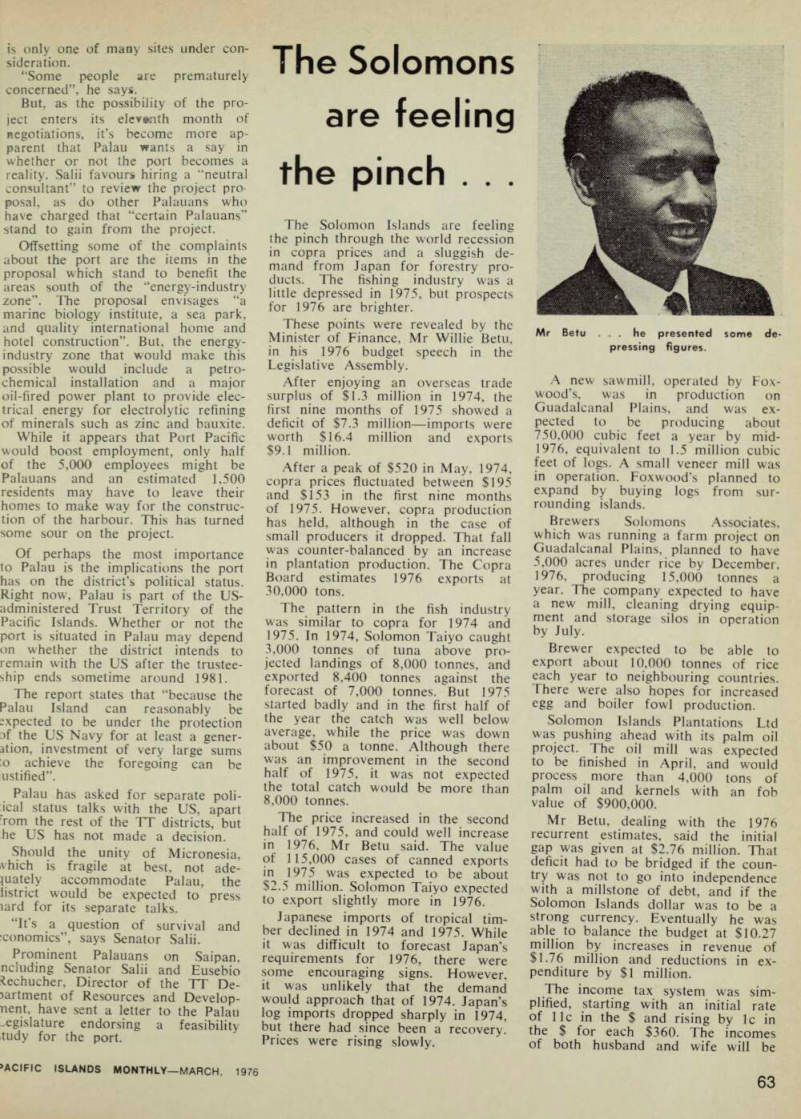
Mr Betu ... he presented some de pressing figures.
aggregated for tax purposes, there will be a combined basic and depen dent allowance of $6OO and an in crease in wife allowance from $4BO to $6OO.
Company tax would be increased from 25 per cent to 30 per cent. . . . While the
workers flex
their muscles
The Solomon Islands are growing up, industrially. Many workers re sorted to industrial muscle to start a rash of strikes soon after the coun try achieved internal self-government.
Businesses caught up in the trouble included a bakery, a tobacco factory, a plantation, an investment company and the Port Authority.
The watersiders went out for 27 days, starting on January 1, in sup port of the Solomon Islands General Workers’ Union and the Government Non-Established Workers’ Union.
They achieved nothing. Port opera tions continued.
In the end, the wharfies, who are also members of the SI General Workers’ Union, were able to return to work, after accepting six condi tions laid down by the Ports Author ity. Two were that they make a pub lic apology to the authority for joining the strike and that a demand for the sacking of three senior staff be withdrawn.
The union president, Mr Bartho lomew Ulufa’alu, wrote that the stevedores regretted any disruption they may have caused. The union acknowledged it did not take more positive steps to dissuade the wharfies from joining the strike.
In other industries, the strikers started to drift back to work while the unions and employers were in negotiation. Mr Ulufa’alu, in a pub lic statement, claimed that through strike action in Honiara most claims had been achieved.
That stung the SI Federation of Employers into a public reply, set ting out in detail just what had not been achieved.
These were some of the adverse results: Loss of wages, holiday pay and, in some cases, jobs; no overall increase in wages as most companies had already given rises; loss of faith by the SI General Workers’ Union as a responsible body acting for the good of employees and development; workers and families went short of bread and money; in nearly all cases there was a return to work on
original terms; loss of production which, in many cases, could not be made up; loss of revenue to the government in export duties and in come tax; loss of foreign confidence in the country; the possibility of local companies closing or reducing activities; and the introduction of fear and uncertainty into the way of life of many Solomon Islanders through the January 2 disturbances and threats and intimidation during the strike.
All that had been achieved was union recognition by some companies, a recognition which would readily have been given without a strike had there been a sensible, responsible approach from the union; refusal by other companies to recognise the unions because of irresponsible action by union leaders; agreement by com panies to negotiate, but only on claims relevant to their businesses and refusal by companies to nego tiate on general claims by the union as many of them were political, and bore no relevance to relationship between employer and employee.
In short, the whole thing seemed to have been a fiasco though the unions deny they made an apology.
Creating markets
for the Solomons
A new shipping company, Oceania Lines, will give the Solomon Islands access to markets in Micronesia for rice and other agricultural products.
Oceania, based at Saipan, will link the Marianas with the Solomons and Australia. The shipping line is owned by five Saipan residents, and is headed by lawyer Edward Pange linan, who is also chairman of the Marianas Status Commission.
The company is aiming at launch ing the service in March or April.
Apart from rice, meat and vegetables, the company’s ships would pick up copra for processing in the new mill at Palau. The only shipping line at present servicing Micronesia from the south is Nauru Pacific.
About the same time as the an nouncement was made about the new shipping line, a mission from the US Trust Territory and Guam was in the Solomons inspecting com mercial developments and looking at what could be bought. The tour was arranged by Brewer Associates, which operates in several areas of agriculture and has its parent com pany in Hawaii.
Members of the mission said the Solomons had a high potential for overseas markets. They were particu larly impressed with the rice poten tial. Brewer Solomons Associates is making quick changes in the deve lopment and improvement of rice
on the Guadalcanal Plains. Once the company is in full production and can meet local demands, rice will be exported to neighbouring Pacific territories.
Mr H. Bowie, of Mariau’s Enter prises, a members of the mission, said his company would buy what ever the Solomons produced—rice, copra, timber, and eventually meat.
With a reliable shipping link, the Solomons export trade could soon “take off”, in spite of the rather de pressing picture painted by the Minister of Finance, Mr Willie Betu, in his 1976 budget speech (see sepa rate report).
PNG biggest loser
over copper slump
The Papua New Guinea Govern ment is the biggest loser in the sharp downturn of the profit of Bougain ville Copper Ltd in 1975. The PNG revenue losses to the extent of K 66 million, compared with 1974, accord ing to the Finance Minister, Mr Julius Chan. In 1974, the govern ment received K 93 million in dividends, taxation and royalties. It was a substantial item on the revenue side of the budget.
For 1975, the PNG Government will get about K 27 million. The re duced revenue from Bougainville, although expected, is a tremendous
blow to the economy of the country when money is desperately needed.
The Bougainville Copper profit for 1975 was $46.1 million, compared with $114.5 million in 1974. A sharp drop in world copper prices, plus reduced sales to Japan, were major factors in the lower profit. The com pany was forced to make sales on world market at low prices when Japanese smelters reduced their orders by 15 per cent.
The company’s sales revenue dropped about $lOO million.
Fiji sugar could
be in trouble
Sugar may not be so sweet for Fiji in 1976. Earnings could drop by about 50 per cent from the 1975 figure of about $lOO million. The independent chairman of the Fiji sugar industry, Mr lan Thomson, in February, warned that the industry was in danger of pricing itself out of the highly-competitive world market.
The return to farmers from the 1975 crop was expected to be about $3O a ton. A big drop could be expected in the price for the 1976 crop. About half the sugar from the 1976 crop would go to Britain, but the price would depend on the Euro
pean Economic Community price.
That price had still to be negotiated between the EEC and countries, in cluding Fiji, which supplied it with sugar.
Mr Thomson said Fiji’s nego tiators would have a tough task get ting an increase on the $449 a ton Britain paid in 1975, That price was agreed to by Britain when a world sugar shortage drove the London daily price up to $692 a ton. The London price had since dropped to as low as $2BB a ton, Britain paid about $77 million to Fiji for sugar in 1975 because of the
Mr W. Marston, who has retired as general manager of the British Phosphate Commission after more than 40 years' service. He has been appointed a mem ber of the Phosphate Commission.
record price negotiated by the EEC and African, Caribbean and Pacific sugar producers. With the sugar shortage overcome, all the EEC, so far, is prepared to pay is a basic mimmum of 5303, which is eight per cent above the current minimum guaranteed price. , Closer to home, the South Pacific Bureau for Economic Co-operation (SPEC) wants Fiji to enter into longterm contracts to sell sugar to other South Pacific Countries. SPEC was P ac *fi c Forum m 1975 to look into the feasibility of the idea. Fiji could be in some
difficulty in a South Pacific market because of commitments elsewhere, Official figures showed that Fiji sugar sales to the end of August, 1975, were worth a little more than 533.5 million, when 149,206 tons of 1975 sugar were sold The UK bought 67,453 tons for about $3O million. NZ bought 11,943 tons for $3,694,621. Sales to South Pacific Island groups were worth- Western Samoa, $359,515; American Samoa $2,498; Solomon Islands, $l5 804 : GEIC, $136,773; Tonga, $67,964.
The sugar harvesting season still had about three months to run when the figures were taken out.
Sharp jolt
tor Fiji tourism
The Fiji tourist industry took a sharp jolt in February when the Skylodge Hotel, at Nadi Airport, closed temporarily for lack of busi ness. The few guests were trans ferred to the nearby Tanoa Hotel.
The hotel needed a 60 per cent occu pancy rate to return a profit. The rate early in February was only 10 per cent, and in January, usually a peak month, it was a mere 40 per cent.
The Skylodge was launched in buildings used in the reconstruction of Nadi Airport in 1959 and 1960.
Its only nearby competitors then were the old Mocambo Hotel and the Nadi Hotel. The mushrooming tourist industry led to the construc tion of many more hotels and guest houses in the area.
About 50 employees were dis missed when the hotel closed. A skeleton staff was retained to reopen the hotel when, and if, business im proves. The hotel has 98 rooms. It charged $l2 to $l5 a room, which makes it one of the cheaper hotels in the Nadi area.
Coincident with the closure of the hotel, the Fiji Visitors Bureau board announced a drastic reorganisation to cope with the big drop in the number of tourists. A new move was to set up a committee of prominent businessmen, all connected with the tourist industry, to advise on market ing and promotion policies.
The committee comprises Messrs Dan Costello, Lautoka, Lyle Cupit, Suva (head of the Carpenter group in Fiji), David Wilson, Suva, Mahen dra Patel, Nadi, and Mr Stanley Quigg, general manager of Air Pacific, or alternatively, the airline’s marketing manager, Mr Ross Keenan.
The board accepted a report by Professor George Hines, of Massey University School of Business, NZ, on the tourist industry. Professor Hines warned that Fiji would lose millions of dollars more in the tour ist trade unless drastic changes were made in the way its holiday attrac tions were sold.
Even with a crash promotion pro gramme, it seemed likely that some hotels in Fiji might have severe financial difficulties in 1976, with the possible loss of employment, overseas earnings and investment.
The board has accepted most of Professor Hines’ recommendations.
Tourism promotion will be the FVB’s primary objective. It has stopped all its local education activi ties. It will appoint a full-time mar keting manager, full-time research officer and an accountant. The
'overnment would be asked to imend the FVB Ordinance to allow or very wide representation on the : VB board.
Professor Hines attended a Feb uary meeting of the board, and mphasised how serious the position /as.
fongo's economy
s taking a beating
The economy of Tonga is not in ood shape. Low prices for copra nd bananas, and fewer Tongans oing to work in New Zealand have reated a situation likely to lead ) severe difficulties later this year, ►n top of that, the Pacific Navi ation is reported to be about SI lillion in debt.
In 1975, Tonga had to export more lan twice as much copra as in 1974 ) lift copra earnings by a mere 12,496 8,107 tons worth 3,180,494 in 1974 and 18,407 tons orth $3,192,990 in 1975. Banana cports also rose in 1975, but the irnings were only fractionally igher than in the previous year.
The Tongan banana industry, ong with that in other Islands, has ken severe knocks recently. One as a report in a New Zealand jwspaper that human faeces were »und in the hold of the Luhesand i arrival in Auckland carrying manas from the islands. While ame was not sheeted home to any mntry, the report was damaging.
Apart from that incident, banana owers, and that includes Tonga, :ed to lift the quality of their pro icts to regain substantial NZ cus m against the competition from :uador. Mr Adolf Johansen, man ner of the Tonga Produce Board, id that unless quality was im oved, Tonga’s allocation for every ipment would be reduced.
Added to the problems of the ipra and banana industries, the lue of desiccated coconut exports 1975 was $83,015 lower than in '74. The value of all exports for •75 was $58,973 lower than the '74 value.
The tourism and handicraft indus es do not expect to do particularly :11 in 1976, with an expected drop 50 per cent in the number of iiise ship visitors.
In the first six months of 1975, ere was a drop of about $250,000 Dm Tongan workers in New Zea id, compared with the first six anths of 1974. In 1975, 3,722 mgans returned home after work ? in New Zealand. New Zealand eruited only 266 new workers in e same year.
In merchant shipping, in spite of
colossal losses incurred in the charter of the Tauloto 11, the Pacific Navigation Co recently took over the running of the Fijian Swift, 2,000 tons, on a bare boat charter for two years. The boat has been renamed Ha’amotaha. It is servicing Nukualofa, Apia, Neiafu and Auckland.
A number of informed people in Tonga are said to be concerned over the charter deal as Pacific Navigation Co is heavily in debt. If the report of the $1 million debt is true then the charter is, according to one comment in Nukualofa, “a foolish one or a courageous one, depending on one’s point of view”.
firm nnonc r r,VJ rirm °P ens
n6W focforv Of Lae
. , 7 n t T airy Products Pty Ltd h . as u, lt a new factory at Lae *° f 9 r the areas requirements for milk, ice cream and ice cream confections. The factory cost more than K 1 million. The company has a similar factory at Port Moresby, Some Lae products are air freighted to Mt Hagen, Goroka and Bulolo. When suitable freezing and refrigeration facilities are available some of the factory’s output will be shipped to Rabaul, Madang, Wewak and Kimbe.