Fiji is the shipbuilder
pp. 56-59 · Read in the full issue

for the Islands
The Fiji Government shipyard in Suva is the only one in the South Pacific Islands with the capacity and knowledge to build the various kinds of ships needed for inter-island and
regional transport.
That is the view of Mr A. Sannergren, a Swede, who was in charge of a three-year shipyard expansion programme involving the United Nations Industrial Development Organisation, the UN Development Fund and the governments of New Zealand and Fiji.
Mr Sannergren was recruited by UNIDO for the work, but was directly responsible to the Fiji Government.
Mr Sannergren introduced ferrocement boats for transporting fish.
The first was a 30 ft boat, followed by four more of the same size, then two of 35 ft and one of 45 ft. The boats, built of reinforcing rod, chicken-wire mesh and cement, stood up well in rough conditions. In a hurricane several years ago, two of these boats were thrown over a reef on to a beach. One was undamaged and was pulled back over the reef into the water.
The second boat struck coral and was then thrown 45 ft on to the beach. A 10 ft hole was punched in one side. The broken concrete was removed. New reinforcing rod and mesh were applied and new plaster was put on. The boat was back in the water in two weeks. Several wooden boats of the same size were destroyed during that hurricane.
The ferro-cement technique has also been used for building caissons
for a lighthouse. Knowing it was difficult to sink piles or build found ations on unprotected reefs, Mr Sannergren suggested a method de veloped in his native Sweden. The caissons were built in the shipyard. floated to the lighthouse site, and sunk with concrete. A steel and re inforced concrete tower was then built over the foundation. Like the ferro-cement boats, the tower has survived rough weather. Two hurri canes, accompanied by waves break ing over the structure, did not cause any damage.
The Fiji Government shipyard is equipped with a 35-ton gantry crane covering two building berths. The largest berth can accommodate ships U P to 200 ft. The workmen recently completed the Kaumtom, 138 ft.
Next on line are a 95 ft passenger ship, scheduled to be finished in 1976, and a 140 ft landing craft, Other new facilities include a pre fabrication shop for construction of ship sections. It is equipped with modern gas-cutting machines and welding equipment. The accounts, stores and purchasing sections have been reorganised, and modern me thods of estimating and planning h|Y e introduced. The drawing office staff has been trained in ship design and hydrostatic and stability calculation. The staff can now design common types of ships for use m region.
Mr Sannergren recently attended a conference in Bangkok, where much interest was shown in the Fiji ferro-cement boats. He also advised the Government of Turkey on the
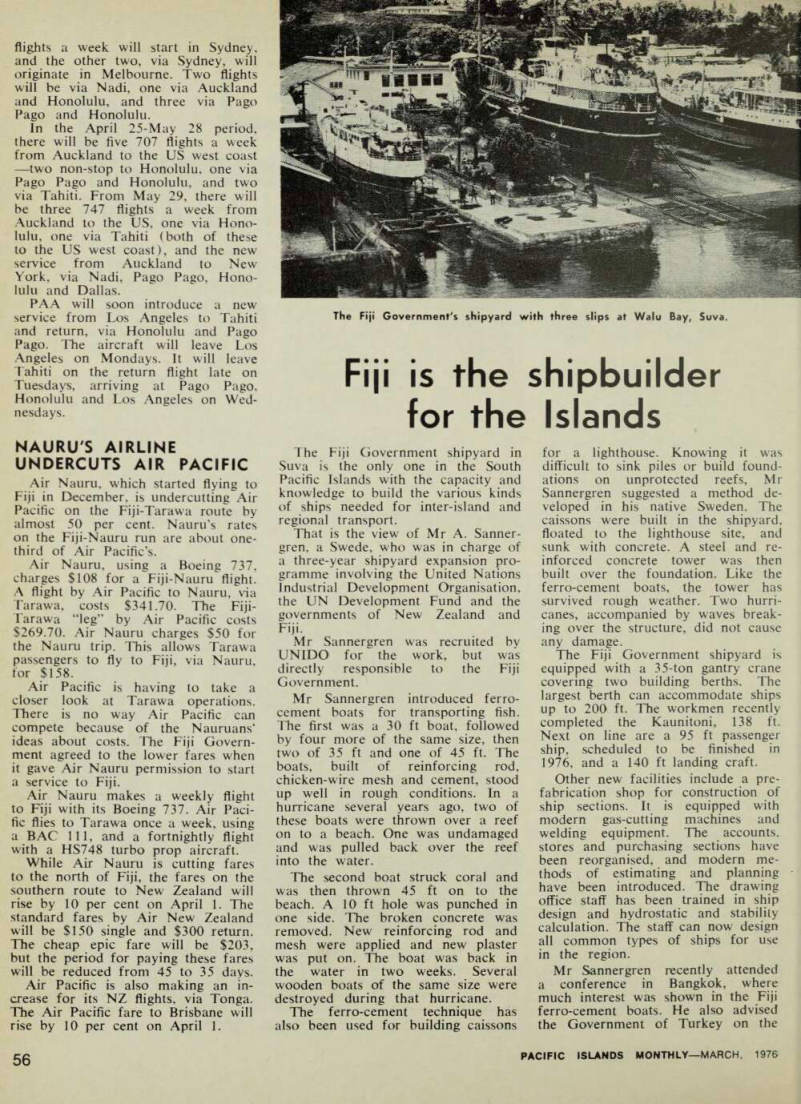
The Fiji Government's shipyard with three slips at Walu Bay, Suva
design and construction of such boats. During a short assignment in Ankara he supervised the building of a 30 ft ferro-cement boat at the Middle East Technical University.
That was the start of a more exten sive programme of ferro-cement construction in the Middle East, The Fiji Government will build a 125 ft passenger/cargo ship for Blue Lagoon Cruises. The ship, which will cost more than $500,000, will be built in the government shipyard and will be the fourth ship built by the government for Blue Lagoon Cruises.
Captain Claude Miller, a director of Blue Lagoon Cruises, said he was satisfied with the excellent perform ance of the other three ships. The new ship is intended to pioneer a six-day tourist cruise from Lautoka, along the north coast of Viti Levu, and the Vanua Levu coastline to Labasa.
The ship will be powered by twin 350 hp General Motors diesel engines. It will have accommodation for 28 passengers in two-berth, air conditioned cabins, with private facilities.
The Ips And Buts Of
Png Coastal Shipping
Rationalisation of coastal shipping in Papua New Guinea is essential if an efficient service is to be provided, but it could come only through a well-organised shipowners’ association in conjunction with user associations.
That is the view of the PNG Transport Department whose spokes man was replying to a complaint by Mr John Edwards, president of the PNG Shipowners’ Association.
Mr Edwards had claimed there was too much shipping for the cargo available. The department agreed there was shipping space available on some PNG routes, because of the general world recession, and the PNG Government's reduced expen diture through budgetary restraints.
There was a general reduction on a world-wide basis of about 15 per cent in cargo movement, which was reflected in PNG coastal and over seas shipping. World trade indicators pointed to an improvement in most maritime nations’ economics, though it was too early to label that indica tion as a trend. If it continued, PNG’s cargo shipments should increase steadily.
The department’s spokesman said that at present no new vessels, other than those considered suitable both in age and efficiency, were being licensed to operate on the PNG coast.
Two days later it was announced
that the Wewak-But Local Govern ment Council had decided to set up a shipping service known as Wewak Islands Shipping Co, to bring a bet ter service to the offshore islands people, who had faced transport diffi culties for some time.
The first boat, the Christopher, had already arrived and was operating between Wewak and outlying islands.
The council planned to buy more boats for the company.
The total coastal shipping cargo capacity of the PNG coastal fleet is about 25,000 revenue tons a month, but the actual carriage rate recently has been only 16,500 tons a month.
There are 10 main shipping com panies, with about 50 ships, operat ing through the 13 main ports of the country. There are also about 200 “feeder” ships, which carry planta tion produce and other raw materials to the main ports.
Mr Jephcott
Cuts The Costs
Mr Bruce Jephcott, the Papua New Guinea Transport, Works and Supply Minister, has embarked on a cost cutting programme. He intends to close unnecessary airstrips and prune maintenance grants for private strips.
Where communities are within 30-45 km by all-weather road of a major airstrip, minor strips will be closed.
The standard of roads would have to be lowered as some projects were beyond PNG’s means. However, the lowering of standards should not affect safety or access. Mr Jephcott has other ideas of saving money, so that works programmes are tailored to the amount the country can afford.
By eliminating overlapping of the functions of departments such as Civil Aviation and Works and Transport, up to KlO million could
be saved. In brief, Mr Jephcott gave warning that the country had to live within its means and get away from the idea that the relatively affluent past was still with it.
Two Korean
Ships On Reef
Two Korean fishing ships, the Tong Wha No 1 and the 209, ended on reefs in the Cook Islands recently.
The Tong Wha No 1 was on the way back to Korea when it caught fire in the kitchen. The fire spread quickly to the engine room. With the power gone, the shop drifted helplessly on to the reef off Raka hanga. Captain Choi Han Tae, the master, and his crew of 17 got ashore safely.
The 209, Captain Kim Joone, de veloped engine trouble near Palmers ton Island. Spare parts were trans ferred to it by another fishing ship.
The 209, after repairs, continued its trip, but it did not get far. It finished on the reef off Palmerston Island.
The ship carried a crew of 22.
New Shipping
Service For Tonga
Warner Pacific Lines, of Tonga, a shipping line, will introduce a new service in May, between Brisbane and Tonga, via Noumea. The line re cently bought the West German-built Kempharn, 540 tons, from an Aust ralian shipping company.
Mr Peter Warner, principal of Warner Pacific Lines, said he hoped to use ships to carry vegetables and other produce to Noumea on the Nukualofa - Noumea “leg”. Mr Warner will be master of the ship.
Siona Fangatua, master of the Ata, will be chief officer. Ten Tongans will make up the crew.
No Money In New
Saipan-Tokyo Route
The chances of either Continental Airlines or Pan American World Airways being granted the Saipan- Tokyo route took a nosedive when the US Department of Transportation opposed it, saying it would be un profitable.
The US Civil Aeronautics Board had recommended that the route be awarded to Continental, but last November President Gerald Ford told the CAB to have another look at it.
President Ford said he wanted more information about the viability of the service. He directed the Trans portation Department to prepare a report for the CAB.
The board said, in effect, that the good old days of rapid transport
growth and general airline profitabil ity were gone. In the past new air line routes were often awarded merely on the ground that air service would be increased and the carriers were willing to service the route.
Current conditions, however, in cluding high cost fuel, inflationary pressures, traffic declines and prob ably slower growth required a change in the justification for new route awards. Instead of seeking new routes, air carriers should improve the present Japan-Guam-Saipan ser vice.
PAA operates the Guam leg, and Continental Air Micronesia flies Guam-Saipan.
“Any realistic level of service operated before the end of fiscal year 1977 at the earliest will not, in our estimate, produce sufficient return to justify its operation and will result in losses for US flag service as a whole”, the Transportation Depart ment reported.
Cooks Welcomes
Its First Dcio
About 6,000 of Rarotonga’s 10,000 population turned out on January 12 to welcome the first Air New Zea land DCIO to land in the Cook Islands. The wide-bodied tri-jet car ried 92 people to the Cook 1,700 miles north-east of New Zealand, and brought back 228.
Air New Zealand substituted a DC 10 for the usual 130-seat DCS on the run to meet the peak demand of islanders returning to New Zea land after Christmas holidays with their families. A DC 10 can carry 247 passengers.
Air New Zealand says there are no immediate plans to replace the DCBs with DC 10s on the route, but this could happen as passenger and cargo demand grows.
The flight was made under the command of Air New Zealand’s Chief Pilot, Captain lan Gemmell. and was given an official welcome by the Premier of the Cook Islands, Sir Albert Henry, and Lady Henry and several government ministers.
Captain Gemmell presented Sir Albert with a model of a DC 10 mounted on a wooden base cut to the shape of the island of Rarotonga and Sir Albert gave Captain Gem mell a tangaroa, a wooden carving of the group’s fertility god.
The trip was a special event for Captain Gemmell. In earlier days he flew flying boats to Aitutaki in the Cooks on the airlines famed Coral Route to Tahiti, and when Sir Albert was living in Auckland, they were friends, playing in the Browns Bay Tennis Club.