Fiji's political blue-print
pp. 16-17 · Read in the full issue
Prime Minister blackens Fiji's political blue-print
From Robert Keith-Reid
in Suva
A chilly silence, broken only by one scornful remark from the Prime Minister, greeted the publication in early February of what is probably the most significant political docu ment concerning Fiji since the coun try won independence from Britain nearly six years ago.
It was the report by a Royal Commission of three British lawyers on how the Fiji system of political representation had worked since In dependence Day in 1970, and how it should be changed.
“I thought that they (the com missioners) tried to please every body, and reports that try to please everybody generally don’t please anybody”, was the immediate brief public reaction of Prime Minister Ratu Sir Kamisese Mara.
And then he clammed up on the subject and the rest of the members of his Alliance Party took the hint.
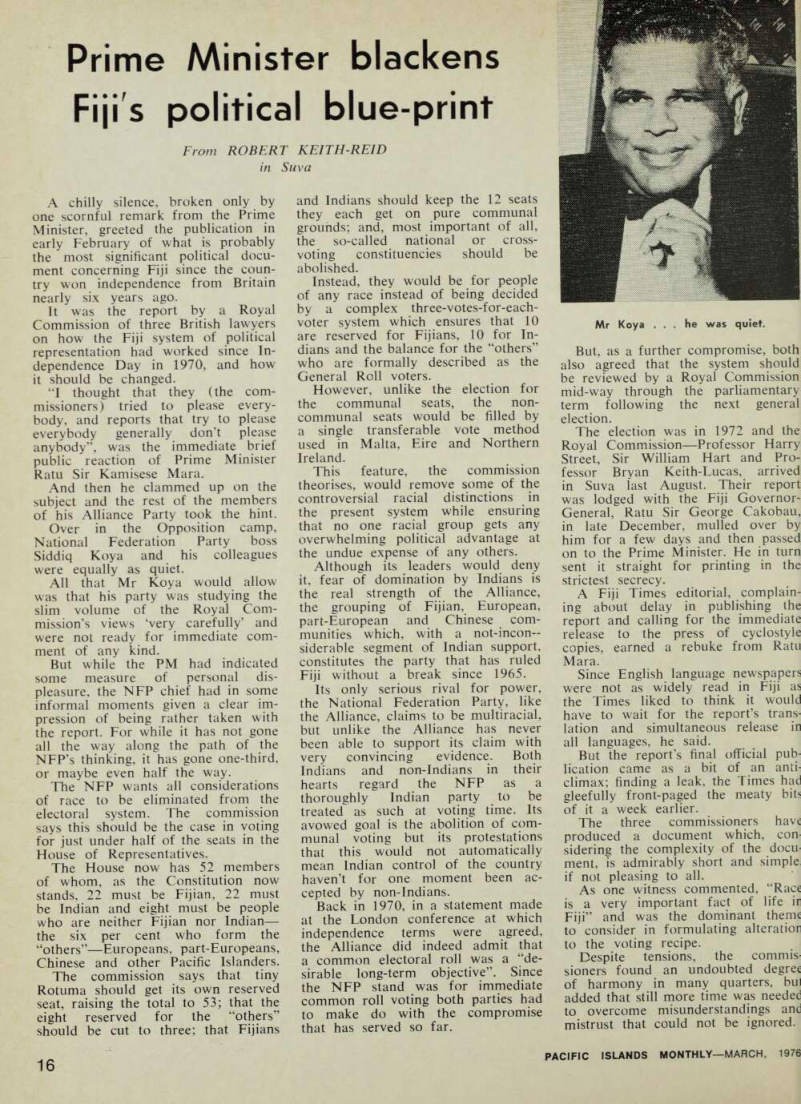
Over in the Opposition camp, National Federation Party boss Siddiq Koya and his colleagues were equally as quiet.
All that Mr Koya would allow was that his party was studying the slim volume of the Royal Com mission’s views ‘very carefully’ and were not ready for immediate com ment of any kind.
But while the PM had indicated some measure of personal dis pleasure, the NFP chief had in some informal moments given a clear im pression of being rather taken with the report. For while it has not gone all the way along the path of the NFP’s thinking, it has gone one-third, or maybe even half the way.
The NFP wants all considerations of race to be eliminated from the electoral system. The commission says this should be the case in voting for just under half of the seats in the House of Representatives.
The House now has 52 members of whom, as the Constitution now stands, 22 must be Fijian, 22 must be Indian and eight must be people who are neither Fijian nor Indian— the six per cent who form the “others” —Europeans, part-Europeans, Chinese and other Pacific Islanders.
The commission says that tiny Rotuma should get its own reserved seat, raising the total to 53; that the eight reserved for the “others” should be cut to three; that Fijians
and Indians should keep the 12 seats they each get on pure communal grounds; and, most important of all, the so-called national or cross voting constituencies should be abolished.
Instead, they would be for people of any race instead of being decided by a complex three-votes-for-each voter system which ensures that 10 are reserved for Fijians, 10 for In dians and the balance for the “others” who are formally described as the General Roll voters.
However, unlike the election for the communal seats, the non communal seats would be filled by a single transferable vote method used in Malta, Eire and Northern Ireland.
This feature, the commission theorises, would remove some of the controversial racial distinctions in the present system while ensuring that no one racial group gets any overwhelming political advantage at the undue expense of any others.
Although its leaders would deny it, fear of domination by Indians is the real strength of the Alliance, the grouping of Fijian, European, part-European and Chinese com munities which, with a not-incon siderable segment of Indian support, constitutes the party that has ruled Fiji without a break since 1965.
Its only serious rival for power, the National Federation Party, like the Alliance, claims to be multiracial, but unlike the Alliance has never been able to support its claim with very convincing evidence. Both Indians and non-Indians in their hearts regard the NFP as a thoroughly Indian party to be treated as such at voting time. Its avowed goal is the abolition of com munal voting but its protestations that this would not automatically mean Indian control of the country haven’t for one moment been ac cepted by non-Indians.
Back in 1970, in a statement made at the London conference at which independence terms were agreed, the Alliance did indeed admit that a common electoral roll was a “de sirable long-term objective”. Since the NFP stand was for immediate common roll voting both parties had to make do with the compromise that has served so far.
But, as a further compromise, both also agreed that the system should be reviewed by a Royal Commission mid-way through the parliamentary term following the next general election.
The election was in 1972 and the Royal Commission—Professor Harry Street, Sir William Hart and Pro fessor Bryan Keith-Lucas, arrived in Suva last August. Their report was lodged with the Fiji Governor- General, Ratu Sir George Cakobau, in late December, mulled over by him for a few days and then passed on to the Prime Minister. He in turn sent it straight for printing in the strictest secrecy.
A Fiji Times editorial, complain ing about delay in publishing the report and calling for the immediate release to the press of cyclostyle copies, earned a rebuke from Ratu Mara.
Since English language newspapers were not as widely read in Fiji as the Times liked to think it would have to wait for the report’s trans lation and simultaneous release in all languages, he said.
But the report’s final official pub lication came as a bit of an anti climax; finding a leak, the Times had gleefully front-paged the meaty bits of it a week earlier.
The three commissioners have produced a document which, con sidering the complexity of the docu ment, is admirably short and simple, if not pleasing to all.
As one witness commented, “Race is a very important fact of life in Fiji” and was the dominant theme to consider in formulating alteration to the voting recipe.
Despite tensions, the commis sioners found an undoubted degree of harmony in many quarters, bul added that still more time was needed to overcome misunderstandings and mistrust that could not be ignored.
Mr Koya ... he was quiet.
“For the moment the electoral system must in our judgment retain a considerable racial element” they said. “The question is what steps can be taken now to start moving towards a more truly democratic system, a process which may well not be completed until programmes of race relations and education have shown their effect. But it is not now possible to forecast politically when that can be”.
The commission rejected claims for separate Muslim and immigrant Pacific Islanders political represent ation as being something which would be a mistake to meet since only further racial elements would be brought into the voting mixture.
But Rotuma, the little island 350 miles north of the main Fiji group, and populated by 3,000 Rotumans should get its own reserved seat purely on the grounds of remoteness From the rest of the country.
The communal element still aeeded would be preserved by the etention of the 12 Fijian and 12 Indian communal seats, the com missioners said. They recommended he reduction in the number of ‘general” communal seats because hey didn’t think the number of general voters’ seats could be justi ied by their numbers.
What general electors would lose
would be balanced, the commissioners maintained, by the chance to win some of the 25 non-communal seats.
The change could be achieved, the three commissioners said, by creating five constituencies, each returning five members without regard to race or religion.
However, some “rather surprising” information disclosed that there was only a difference of 10 in the estimated number of Indians eligible to vote in the 1972 election (111,860) and the number of Fijians (111,870), while the figure for General voters was 11,270.
Furthermore, while Indians still outnumber Fijians, the Indian population is increasing less rapidly than the Fijian. If present population trends continued Fijian numerical superiority could be restored in a few years time.
Questioned after the report’s publication, Ratu Sir Kamisese refused to be drawn except to clear up one very vital point.
The report has quoted extracts from the NFP’s submissions, and these quoted extracts from a statement the PM had made at the 1970 London conference. The statement, the NFP submitted, amounted to an Alliance undertaking to write the report into the Constitution.
The quotation, Ratu Sir Kamisese
stressed, was “out of contex”. He had made it very clear in London that it was for parliament to take anything out of the report for writ ing into the constitution, In Fiji, the will of Parliament does not necessarily reflect the wishes of the party forming the govern ment.
Any change to the Constitution needs not only the backing of three quarters of the members of the House of Representatives, but also threequarters of the members of the Senate. Any vote for change must include at least six of the eight senators nominated by the Great Council of Fijian chiefs, Opposition from only three chiefs would amount to a complete veto of an amending bill that might have the unanimous support of the House of Representatives and the rest of the Senate.
Such a veto is quite possible since some chiefs would buck the party line to prevent what they might re gard as a weakening of the Fijian position.
A House of Representatives meet ing was due to start on February 16 and the report was expected to be tabled formally to Parliament then. Then, it has to lie before the House for three months before it can be debated.