A Bleak, Unstable Future'
pp. 8-11 · Read in the full issue
Papua New Guinea: 'Heading For
By Chris Ashton
To many Australians with strong attachments to Papua New Guinea, and who were spec tators to the finale played out in Port Moresby last September, the single most striking symbolical act was the lowering of the Australian flag. Not a joyous occasion; nor was this intended. Above a tense, packed , silent stadium lowering clouds threatened a deluge that never came. Platoons of soldiers gave a dazzling exhibition of firing by column that excited awe, but not applause. A thin, reedy bugle blew as the ensign came down. It was the kind of theatre which the military does so well, heightened in retrospect by that large, ruddy presence in morning suit, the man who was so soon to make an in delible mark on Australian history, Australian Governor-General Sir John Kerr.
Among the PNG Government’s official guests were numbers of weatherbeaten Australian faces, men and women with much of their adult lives behind them as missionaries, government officers or businessmen in a country adopted as their own.
These were grave faces, some chok ing back tears, moved by the sense of occasion, by feelings of pride and loss, and regret for things left un done. It was all the more moving because Australians have a sense of themselves as earthbound people, not given to shows of feeling.
But in the wanton way that journalists have, my magpie mind was distracted from this by the terri torial struggle to the side of the official dais, by police against cameramen and photographers, who were cordoned off in a small corral.
It was an unequal struggle, which proved the truncheon far mightier than the camera lens. And for me, the most striking symbol of the tran sition had happened four days earlier, unexpected and unrehearsed.
The peace of Port Moresby, that dusty, sprawling and most improb able of capitals, was shattered by the roar of five Machi jets, the RAAF aerobatic team, streaking overhead in tight formation, turning and re grouping to criss-cross the city again.
Inexplicably, it was this display of mechanical and human precision, its speed and grace and power, a spec tacle unique to Port Moresby in the years I had lived there, that brought home the finality of what was hap
pening.
1 had shared, with the politicians, lawyers and fellow journalists who watched the bitter, elephantine pro gress of the constitutional debate, a feeling of jadedness, a cynicism born of watching for too long the political processes at play. It had soured the euphoria that indepen
dence deserved. And yet I was pro foundly moved.
I talked at length of the impression PNG’s independence made upon me because with many others, Papua New Guineans and expatriate, it was a psychological watershed, a realis ation of an end, and of something about to begin. For four years there had been speeches, reports, decisions and press releases; lobbying and politicking of public servants, poli ticians and their advisers in Canberra and Port Moresby.
But it wasn’t that independence would serve to dilute the overwhelm ing Australian presence—its political and cultural pressures, its psycho logical weight and commercial domi nance: a force for stability and a standing mockery of the boast of independence. Independence was im portant because it marked for me the time to go. 1 had been in and out of the coun try since 1960; had settled in Port Moresby before Somare came to power; had experienced the euphoria of the coalition’s early days in office when everything and anything seemed possible; and the challenges, mounted with increasing shrillness by the Papuan separatist movement and the radical bloc routed. I saw Bougain ville’s threat to secede, growing from strength to strength. 1 watched the constitutional debate as the same issues were argued time and again inside and outside parliament until one had the nightmare sense of being aboard the Flying Dutchman, doomed to sail on for ever without hope of reaching port.
Independence came at last —subdued, polite, well-orchestrated — with none of the atmosphere of Mardi Gras that foreign journalists had come to record for a waiting world.
No dancing in the streets, no singing, no raised fists, no latent fear of vio lence. Few people ventured into the streets at midnight to see the fire works or the 101-gun salute that ushered in the new nation.
By the end of the week the coun try had returned to work as if the celebrations had never been, and the
foreign media departed, exasperated.
The rugby league grand final at Port Moresby’s Hubert Murray stadium the following Saturday was far more frenzied than anything we had seen the previous week.
The one unscheduled event that gave independence flair was the
Christopher Ashton spent several years in PNG as a broadcaster, film-maker and as a journalist representing a number of leading overseas newspapers. He is currently headed for South Africa to write a series for the Melbourne Herald group. Before he left, PIM asked him to distil his PNG experience in a special article and to say how he felt PNG would develop. This is the article.
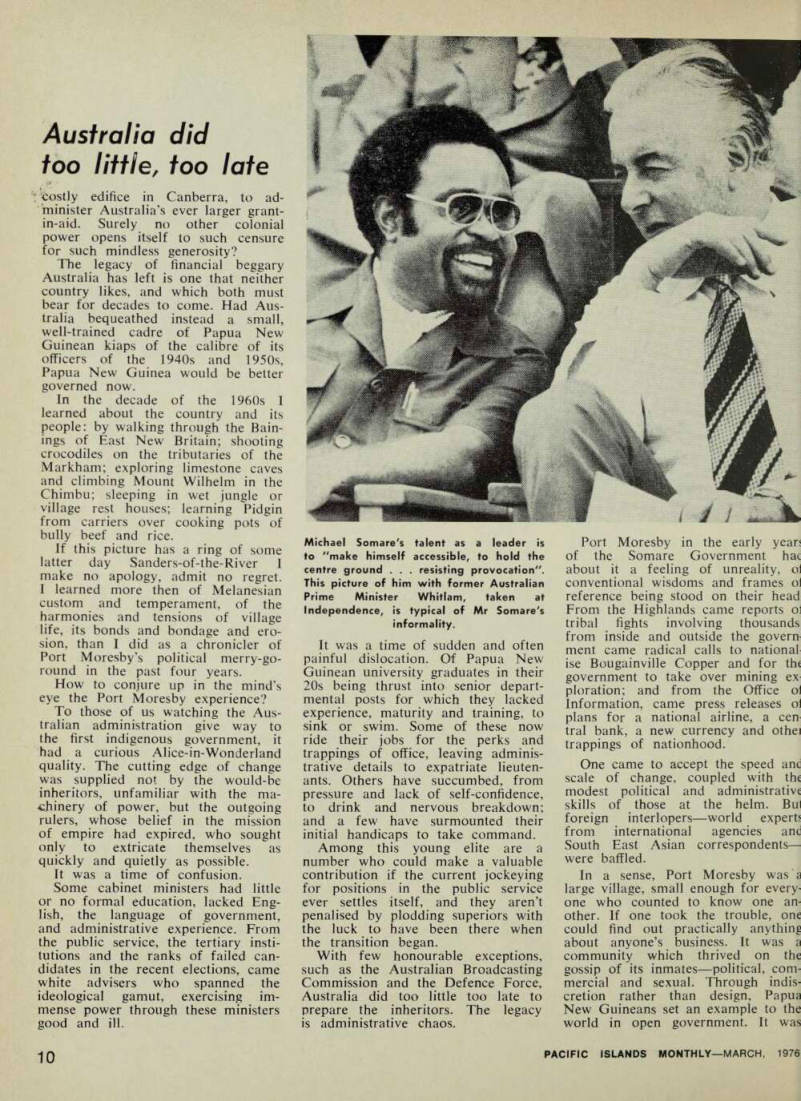
rrival of the First Lady of the f hilippines, Imelda Marcos. She ame on an unscheduled flight in a rivate aircraft too heavy for Port Moresby’s runway on the morning f the great day. She brought 40 etainers for whom there was no ope of accommodation; she jumped le protocol queue in the presenta on of credentials to the new Jovernor-General; tried to enter arliament as Prince Charles was pening it, and dispensed lavish gifts trough her entourage wherever she ent—imperial, diaphanous and par enu. Australia’s interest in PNG’s idependence was enshrined by the age one picture in the Sydney Morn ig Herald: Gough embracing nelda.
It was time to go. I had come for le first time in 1960, the year when 7 African colonies won indepen ;nce, the year of the Congo, the :ar of Harold Macmillan’s Winds : Change address to the South frican parliament.
But in Papua New Guinea the ilf between white and black, ruler id ruled, was at that time complete id inviolable. I was told that the mntry was neither willing nor able accept independence this century.
Perhaps it would in the 21st, or ternatively, be absorbed into Aus alia as another state.
I remember the Highlands High ay, a rutted, four wheel-drive track; e seemingly tens of thousands of
Highlanders along the road, all in traditional costume and headdress and carrying weapons, waving and cheering to the occasional passing truck.
I remember an expatriate Old Timer, a remnant of the Edie Creek goldrush, explaining that Papua New Guineans were the sons of Ham, to be hewers of wood and drawers of water.
I saw “boys” being thrashed by their “masters” for cheekiness;
plantations paying labourers thirty
shillings a month and keep; and I remember the kiaps—the officers of the Department of Native Affairs— administering small kingdoms with no more than the white man’s mys tique and an arbitrary code of laws which at least had the virtue of being intelligible to the subject people.
Though I single out the planters and the kiaps, they are, with the missionaries, much maligned by the new nationalism. Their contribution to nation-building, their hardships and meagre rewards, go unrecognised by the army of short-term expatriate (public servants, academics and white advisers) who have been lured with fat salaries and leafy bunga lows, to serve the new government and foster nationalist ideals in its student elite.
During the development decade, the 19605, I came and went at inter vals. I saw the ban on alcohol sales to Papua New Guineans lifted in 1964. Politically, it was imperative that this should be done, but in im plementation—the wholesale adop tion of Australian drinking habits and trading hours without thought of modification for black and white alike—it was the most socially destructive blessing of our rule.
The 1960 s also saw the beginning of a crash education programme the goal of universal primary education, a system geared to training clerks before tradesmen (who are still re cruited abroad).
And the 19605, the development decade, saw the growth across the country of factories and air-condi tioned motels, of large-scale resource industries, of urban drift and urban unemployment.
It was the decade which saw the sudden burgeoning of the public ser vice, modelling itself on the vast and
[?]nscheduled... the arrival of the First Lady of the Philippines, who jumped the [?]tocol queue, and dispensed lavish gifts". Here she's seen with PNG Governor- General Sir John Guise.
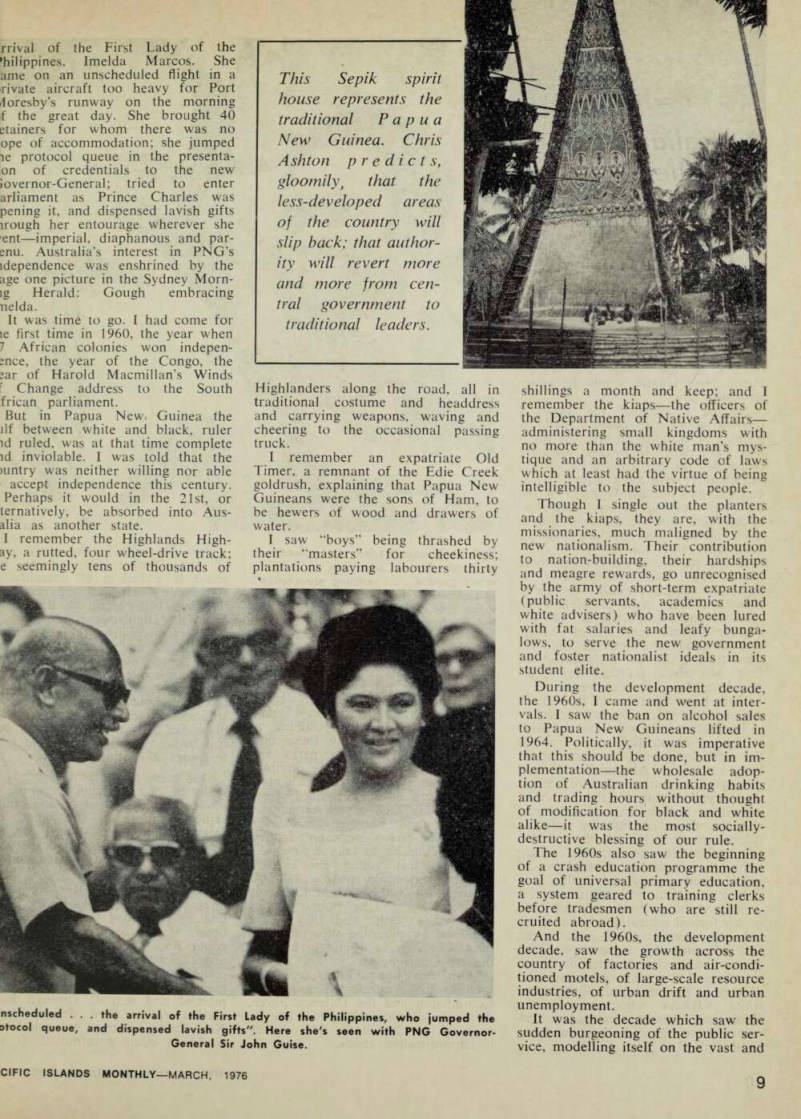
This Sepik spirit house represents the traditional Papua New Guinea. Chris Ashton predicts, gloomily, that the less-developed areas of the country will slip back; that author ity will revert more and more from cen tral government to traditional leaders.
Australia did too little, too late
costly edifice in Canberra, to ad minister Australia’s ever larger grant in-aid. Surely no other colonial power opens itself to such censure for such mindless generosity?
The legacy of financial beggary Australia has left is one that neither country likes, and which both must bear for decades to come. Had Aus tralia bequeathed instead a small, well-trained cadre of Papua New Guinean kiaps of the calibre of its officers of the 1940s and 1950s, Papua New Guinea would be belter governed now.
In the decade of the 1960s I learned about the country and its people: by walking through the Bain ings of East New Britain; shooting crocodiles on the tributaries of the Markham; exploring limestone caves and climbing Mount Wilhelm in the Chimbu; sleeping in wet jungle or village rest houses; learning Pidgin from carriers over cooking pots of bully beef and rice.
If this picture has a ring of some latter day Sanders-of-the-River I make no apology, admit no regret.
I learned more then of Melanesian custom and temperament, of the harmonies and tensions of village life, its bonds and bondage and ero sion, than I did as a chronicler of Port Moresby’s political merry-go round in the past four years.
How to conjure up in the mind’s eye the Port Moresby experience?
To those of us watching the Aus tralian administration give way to the first indigenous government, it had a curious Alice-in-Wonderland quality. The cutting edge of change was supplied not by the would-be inheritors, unfamiliar with the ma chinery of power, but the outgoing rulers, whose belief in the mission of empire had expired, who sought only to extricate themselves as quickly and quietly as possible.
It was a time of confusion.
Some cabinet ministers had little or no formal education, lacked Eng lish, the language of government, and administrative experience. From the public service, the tertiary insti tutions and the ranks of failed can didates in the recent elections, came white advisers who spanned the ideological gamut, exercising im mense power through these ministers good and ill.
It was a time of sudden and often painful dislocation. Of Papua New Guinean university graduates in their 20s being thrust into senior depart mental posts for which they lacked experience, maturity and training, to sink or swim. Some of these now ride their jobs for the perks and trappings of office, leaving adminis trative details to expatriate lieuten ants. Others have succumbed, from pressure and lack of self-confidence, to drink and nervous breakdown; and a few have surmounted their initial handicaps to take command.
Among this young elite are a number who could make a valuable contribution if the current jockeying for positions in the public service ever settles itself, and they aren’t penalised by plodding superiors with the luck to have been there when the transition began.
With few honourable exceptions, such as the Australian Broadcasting Commission and the Defence Force, Australia did too little too late to prepare the inheritors. The legacy is administrative chaos.
Port Moresby in the early year; of the Somare Government hac about it a feeling of unreality, oJ conventional wisdoms and frames ol reference being stood on their head From the Highlands came reports oi tribal fights involving thousands from inside and outside the govern ment came radical calls to national ise Bougainville Copper and for the government to take over mining ex ploration; and from the Office oi Information, came press releases oi plans for a national airline, a cen tral bank, a new currency and othei trappings of nationhood.
One came to accept the speed and scale of change, coupled with the modest political and administrative skills of those at the helm. Bui foreign interlopers—world experts from international agencies and South East Asian correspondents— were baffled.
In a sense, Port Moresby was a large village, small enough for every one who counted to know one an other. If one took the trouble, one could find out practically anything about anyone’s business. It was a community which thrived on the gossip of its inmates —political, com mercial and sexual. TTirough indis cretion rather than design, Papua New Guineans set an example to the world in open government. It was
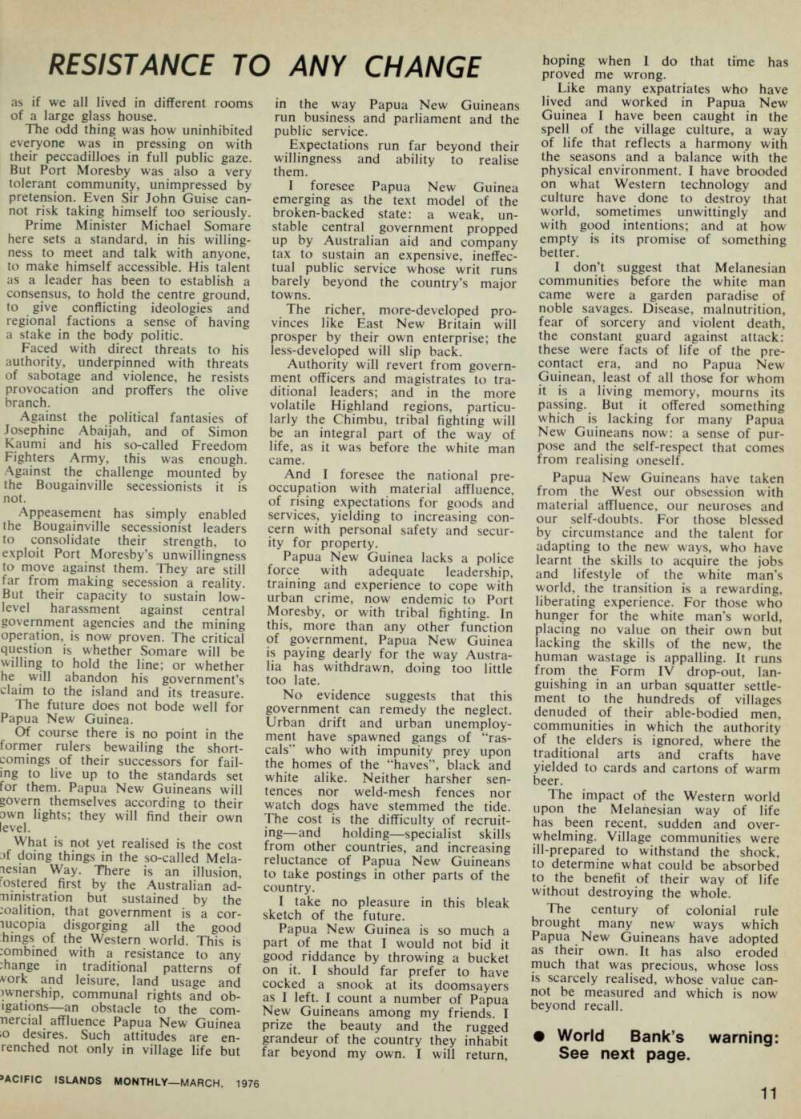
Michael Somare's talent as a leader is to "make himself accessible, to hold the centre ground . . . resisting provocation".
This picture of him with former Australian Prime Minister Whitlam, taken at Independence, is typical of Mr Somare's informality.
Resistance To Any Change
as if we all lived in different rooms of a large glass house.
The odd thing was how uninhibited everyone was in pressing on with their peccadilloes in full public gaze.
But Port Moresby was also a very tolerant community, unimpressed by pretension. Even Sir John Guise can not risk taking himself too seriously.
Prime Minister Michael Somare here sets a standard, in his willing ness to meet and talk with anyone, to make himself accessible. His talent as a leader has been to establish a consensus, to hold the centre ground, to give conflicting ideologies and regional factions a sense of having a stake in the body politic.
Faced with direct threats to his authority, underpinned with threats of sabotage and violence, he resists provocation and proffers the olive branch.
Against the political fantasies of Josephine Abaijah, and of Simon Kaumi and his so-called Freedom Fighters Army, this was enough.
Against the challenge mounted by the Bougainville secessionists it is not.
Appeasement has simply enabled the Bougainville secessionist leaders to consolidate their strength, to exploit Port Moresby’s unwillingness to move against them. They are still far from making secession a reality.
But their capacity to sustain low level harassment against central government agencies and the mining operation, is now proven. The critical question is whether Somare will be willing to hold the line; or whether he will abandon his government’s claim to the island and its treasure.
The future does not bode well for Papua New Guinea.
Of course there is no point in the former rulers bewailing the short comings of their successors for fail ing to live up to the standards set for them. Papua New Guineans will govern themselves according to their awn lights; they will find their own level.
What is not yet realised is the cost af doing things in the so-called Mela riesian Way. There is an illusion, fostered first by the Australian ad ministration but sustained by the :oalition, that government is a cor lucopia disgorging all the good hings of the Western world. This is :ombined with a resistance to any :hange in traditional patterns of vork and leisure, land usage and ownership, communal rights and ob igations—an obstacle to the com mercial affluence Papua New Guinea ;o desires. Such attitudes are en renched not only in village life but
in the way Papua New Guineans run business and parliament and the public service.
Expectations run far beyond their willingness and ability to realise them.
I foresee Papua New Guinea emerging as the text model of the broken-backed state: a weak, un stable central government propped up by Australian aid and company tax to sustain an expensive, ineffec tual public service whose writ runs barely beyond the country’s major towns.
The richer, more-developed pro vinces like East New Britain will prosper by their own enterprise; the less-developed will slip back.
Authority will revert from govern ment officers and magistrates to tra ditional leaders; and in the more volatile Highland regions, particu larly the Chimbu, tribal fighting will be an integral part of the way of life, as it was before the white man came.
And I foresee the national pre occupation with material affluence, of rising expectations for goods and services, yielding to increasing con cern with personal safety and secur ity for property.
Papua New Guinea lacks a police force with adequate leadership, training and experience to cope with urban crime, now endemic to Port Moresby, or with tribal fighting. In this, more than any other function of government, Papua New Guinea is paying dearly for the way Austra lia has withdrawn, doing too little too late.
No evidence suggests that this government can remedy the neglect.
Urban drift and urban unemploy ment have spawned gangs of “ras cals” who with impunity prey upon the homes of the “haves”, black and white alike. Neither harsher sen tences nor weld-mesh fences nor watch dogs have stemmed the tide.
The cost is the difficulty of recruit ing—and holding—specialist skills from other countries, and increasing reluctance of Papua New Guineans to take postings in other parts of the country.
I take no pleasure in this bleak sketch of the future.
Papua New Guinea is so much a part of me that I would not bid it good riddance by throwing a bucket on it. I should far prefer to have cocked a snook at its doomsayers as I left. I count a number of Papua New Guineans among my friends. I prize the beauty and the rugged grandeur of the country they inhabit far beyond my own. I will return,
hoping when I do that time has proved me wrong.
Like many expatriates who have lived and worked in Papua New Guinea I have been caught in the spell of the village culture, a way of life that reflects a harmony with the seasons and a balance with the physical environment. I have brooded on what Western technology and culture have done to destroy that world, sometimes unwittingly and with good intentions; and at how empty is its promise of something better.
I don’t suggest that Melanesian communities before the white man came were a garden paradise of noble savages. Disease, malnutrition, fear of sorcery and violent death, the constant guard against attack: these were facts of life of the pre contact era, and no Papua New Guinean, least of all those for whom it is a living memory, mourns its passing. But it offered something which is lacking for many Papua New Guineans now: a sense of pur pose and the self-respect that comes from realising oneself.
Papua New Guineans have taken from the West our obsession with material affluence, our neuroses and our self-doubts. For those blessed by circumstance and the talent for adapting to the new ways, who have learnt the skills to acquire the jobs and lifestyle of the white man’s world, the transition is a rewarding, liberating experience. For those who hunger for the white man’s world, placing no value on their own but lacking the skills of the new, the human wastage is appalling. It runs from the Form IV drop-out, lan guishing in an urban squatter settle ment to the hundreds of villages denuded of their able-bodied men, communities in which the authority of the elders is ignored, where the traditional arts and crafts have yielded to cards and cartons of warm beer.
The impact of the Western world upon the Melanesian way of life has been recent, sudden and over whelming. Village communities were ill-prepared to withstand the shock, to determine what could be absorbed to the benefit of their way of life without destroying the whole.
The century of colonial rule brought many new ways which Papua New Guineans have adopted as their own. It has also eroded much that was precious, whose loss is scarcely realised, whose value can not be measured and which is now beyond recall. • World Bank’s warning: See next page.