LASH ships will boost PNG trade
pp. 73-77 · Read in the full issue
An extension of Pacific Far East Line’s lighter aboard ship (LASH) service between Australia and the American west coast will help to boost Papua New Guineas trade in North America, and will give the country a wider service from New Zealand and Australia. The ships used on the service, the Golden Bear, China Bear to be renamed New Zealand Bear and Australian Bear, after calling at Australian ports will run to Lae, Rabaul and Kieta This will give Papua New Guinea a direct service every 20 days to a range of ports from Vancouver down to Los Angeles. On the outward voyages from North America, the ships pass through Auckland and ports on the Australian east coast from Melbourne to Brisbane.
PNG Minister for Transport and Civil Aviation Mr lambakey Okuk, said the LASH ships, carrying all cargo in either containers or barges, would have priority berthing at most ports, and were therefore expected to keep close schedules. The barges and containers would be loaded before the ship’s arrival. Discharge of the units would be after the ship sailed.
All that would minimise the time a ship spent in port.
PEEL LASH ships sail from American west coast ports (Vancouver, Tacoma, Portland, San Francisco and Los Angeles) for Pago Pago, and Papua New Guinea, via Australia. PFEL is also looking at other Pacific ports, particularly Port
Moresby and Honiara, which would be new markets, There have been studies of other groups, but no decision has been made about introducing the LASH services for them. The studies are a con , inuing pr ocess. —,* 4 , . The barge-type lighters, each hold m 8 U P tons of cargo, are lifted to fr° m the ships by onboard travelling cranes. The ship need not wait for congested docks to clear; it £?n discharge and load in deep water, Tugs move the lighters from the docks to the ship. They may also be loaded while the mother ship is at sea * LASH ships, working both crane and gantry, may be loaded to capa city in 24 hours. The ships have huge capacity for cargo. They are flexible, and can carry bulk cargo, liquid, baled, containerised, palletised, shrink-pack, -efrigerated and large single pieces in the same ship. Each ship has a capacity for 73 lighters, and can carry a number of standard containers.
The usual practice is to leave the barges, which may be unpacked at the consignee’s leisure, and pick them up on the next trip. a further development in LASH services is an entirely new type of offshore terminal designed by Nautical Service (Aust) Pty Ltd, a Melbourne based marine consultant and port development engineering company, The design is based on the use of
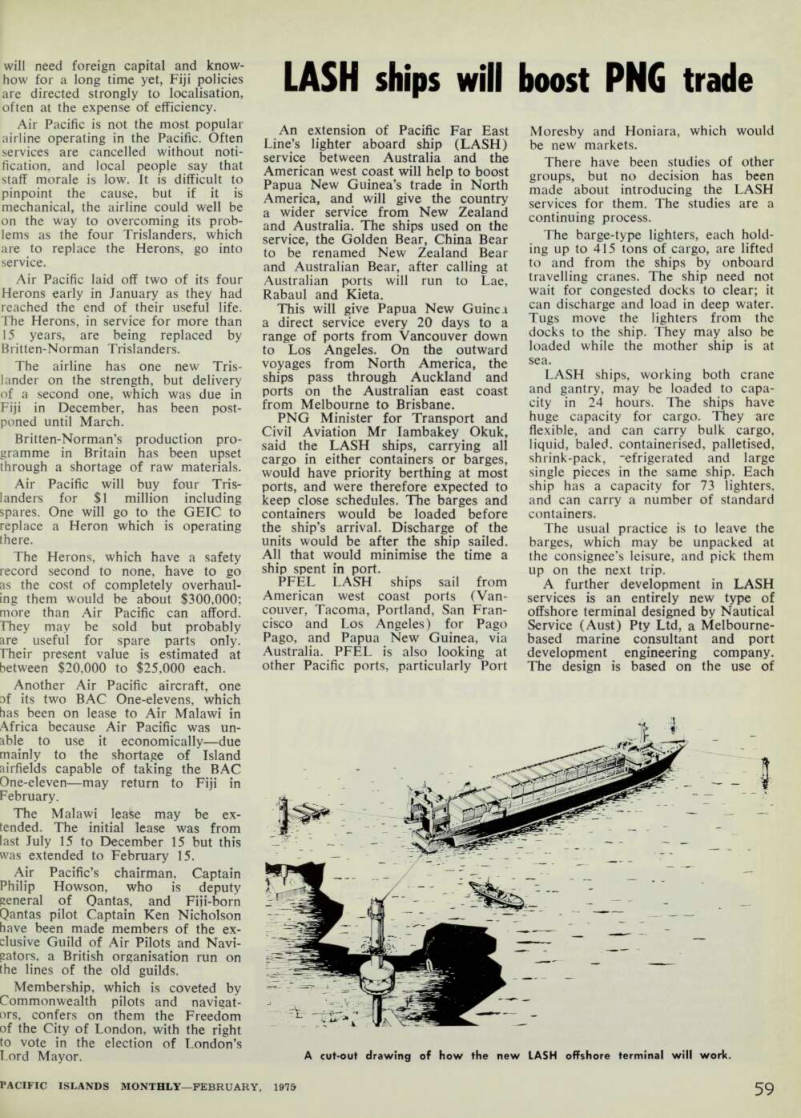
A cut-out drawing of how the new LASH offshore terminal will work
four Sarus towers to which specially designed LASH ships are moored offshore, while their barges are loaded and off-loaded.
The towers form a rectangle within which the ship is positioned for mooring. The design allows the ship’s orientation to be altered as much as 60 degrees during adverse weather.
This manoeuvrability eases loading and discharge at the stern in relatively calm conditions.
Basically, a Sarus tower is a vertical cylindrical metal structure, which incorporates a buoyancy chamber joined by a universal coup ling to a seabed deadweight chamber.
The articulated link provides the re quired elasticity, which enables the tower to bow under excessive stress without loss of security of function.
The system, known as the Whitaker Offshore Lash Terminal System, is leased to the Waterman Steamship Corp, of New York. Waterman had three specially designed LASH ships built for the system. Each carries 80 500 ton barges. Forty barges can be offloaded and loaded in 12 hours.
Haapai Will Have
Airfield Soon
Haapai’s airfield, which will give the island aerial links with Tonga tapu and Vavau, is expected to be finished early in February. Late last year enough work had been done to allow a Britten-Norman Islander to land.
Work on the airfield started in January, 1974. The cost of the 2,300 ft coral runway is estimated at $49,000 about 22i per cent above the original estimate. Work was hindered throughout 1974 by bad weather and shipping delays.
Cooks Sampan
Runs Out Of Fuel
The Cook Islands Government fishing sampan Ravakai, returning from the northern Cooks on Decem ber 26, ran out of fuel 60 miles north of Rarotonga. The MV Manu vai, in Avatiu harbour at the time, went to her aid with three drums of diesel fuel and Ravakai made port safely.
On board her were Canadian yachtsmen Dirk Heiss and Gary McKay of the ketch Tangerine, and five official passengers. The Cana dians had agreed to take the vessel north to deliver food supplies and pick up official passengers and a cargo of pearl shell and live turtles.
At Palmerston they off-loaded cabin bread, sugar, fruit and veget ables and uplifted 106 turtles destined to start a turtle farm at Aitutaki Island.
Because bad weather prevented sights from being taken, they had trouble finding Manihiki and used extra fuel to do so.
Fiji's Port System S
Flabby, Says Expert
The waterfront industry in Fiji can expect a big shake-up with the arrival from Singapore of Mr Lou Heng Kee to set up the Fiji Ports Authority. The decision to set up the authority was made after a commission of inquiry into the ports system.
On his arrival in Suva, Mr Lou described the system under which Suva worked as “flabby, depressing”.
It urgently needed a herculean effort to bring it up to overseas standard, That is his main aim—to make the Suva port equal to those of other countries. His first task will be to integrate control of the present fragmented management system under one authority, and provide leadership, motivation, and clear ob jectives.
He recognises congestion as a No 1 problem, which he hopes to partly overcome by setting up buffer zones to cater for most of the surplus cargo on the wharf, and relieve a tight congestion situation. He had the first buffer zone, an inland freight station,
in operation in December in the old RNZAF hangar at Laucala Bay.
He hopes to improve productivity with new concepts. Should he suc ceed he will please the variety of port users, and also the many people who receive a stock answer on in quiring the whereabouts of goods on order—“ They are on the wharf”.
Mr Lou worked for the Singapore Harbour Board for 27 years before going to Fiji. In 1960 he was ap pointed the Singapore board’s traffic manager, and in 1964 he became director of operations. He has writ ten a number of papers on wharf matters.
Bougainville
Takes To The Air
The Bougainville Provincial Government has committed itself to operating air and sea services with the purchase of an airline and a steel cargo ship. Recently, it paid $200,000 to Mission Aviation Fellowship for Bougainville Air Services, and will form it into Bou gainville Air Services Pty Ltd. In volved in the deal were three light aircraft, hangars, housing, vehicles, spare parts and equipment.
Another aircraft will soon be added to the fleet. The new owners intend to introduce scheduled air services around Bougainville. The board of Bougainville Air Services Pty Ltd will comprise four Bougain villeans, and three from Mission Aviation Fellowship, who will pro vide expert knowledge of aviation.
The Bougainvilleans are Aloysius Noga, John Bakeni, John Teosin and Leo Hannett.
The government paid $55,000 to Seafreight, of Lae, for the cargo ship, the Minnesota, which will be renamed Bougainville Chief. The ship will operate to atolls and islands m Bougainville District.
More Bad Luck
For Fiji's Tabu Soro
Trouble continues to dog the $350,000 Tabu Soro, delivered to Fiji recently from Norway. Recently she drifted for more than four hours after the fuel pumps seized. A pass ing ship, which picked up a distress signal flashed out with a mirror, towed the ship out of danger after it looked certain to run on to a reef.
The rescuing ship was the Nei Kuana, which belongs to Rabi Hold ings.
The Tabu Soro was on the way back to Suva after a maiden trip to Labasa. Her delivery voyage from Norway took about seven months.
She had to put into several ports for repairs.