In Wild New Britain
pp. 65-67 · Read in the full issue

It’s been noted often enough that we lack accounts of the experiences of early Pacific adventurers because the men concerned usually were not the type capable of, or inclined to bother about, recording their activities on paper. They got on with the business of life. First-hand accounts of these times have been left to the administrators or missionaries, usually better equipped although not necessarily having more valuable information.
Thus The New Guinea Memoirs of Jean Baptiste Octave Mouton, published as number 7 in the Australian National University Press Pacific History Senes, comes as an unexpected windfall.
True, Belgian-born Mouton, who was a settler, planter and trader in New Guinea between 1880 and the 19305, and who died in Sydney only in 1946, was no writer of distinction —his English sometimes was garbled and his spelling was weird—but he knew what he wanted to say, and his memoirs also have the advantage of first-rate editing by Peter Biskup, now of Canberra. Dr Biskup properly does not alter Mouton s text (where and when the memoirs were wntten !s unknown perhaps there is a PIM reader somewhere who can shed some light on this), but he adds most useful information in his footnotes and in an introduction.
Jean Mouton got to New Guinea in 1881 as a 14-year-old boy, when he migrated with his father on the last of four expeditions from Europe to the “Free Colony of Port-Breton” —otherwise known as Free France.
This was the infamous, inglorious New Ireland colonisation scheme planned by Charles Bonaventure du Breuil, better known as the Marquis de Rays—a character whom history
has yet to decide as being either a swindler or madman, or both, Between 1879 and 1881, some 700 sett ers , eft Europe for New , reland under the scheme; about half of them died in New Guinea or at sea, about 70 returned to Europe, about 200 settled in Australia and only about a dozen remained in New Guinea, none of them in New Ireland. The Moutons were among those dozen, although within a few years Mouton Snr was dead, too, and these are the memoirs of the younger Mouton.
In the early part of the book he describes the long and trying trip out, j n cockroach-ridden, cramped vessels often un der the command of savage captains, the troubles, including food shortages, of the infant colony and its eventual abandonment in con fusion. It’s a vivid account of the strange life in Port-Breton, told with out rancour and also without humour, for one gathers that neither of the Moutons had much of that, For them life had always been tough, but in New Guinea they faced death, at first from disease, but later their lives were threatened by raiding and looting parties. The Moutons became traders, pitting their wits particularly against Thomas Farrell, common law husband of the remark
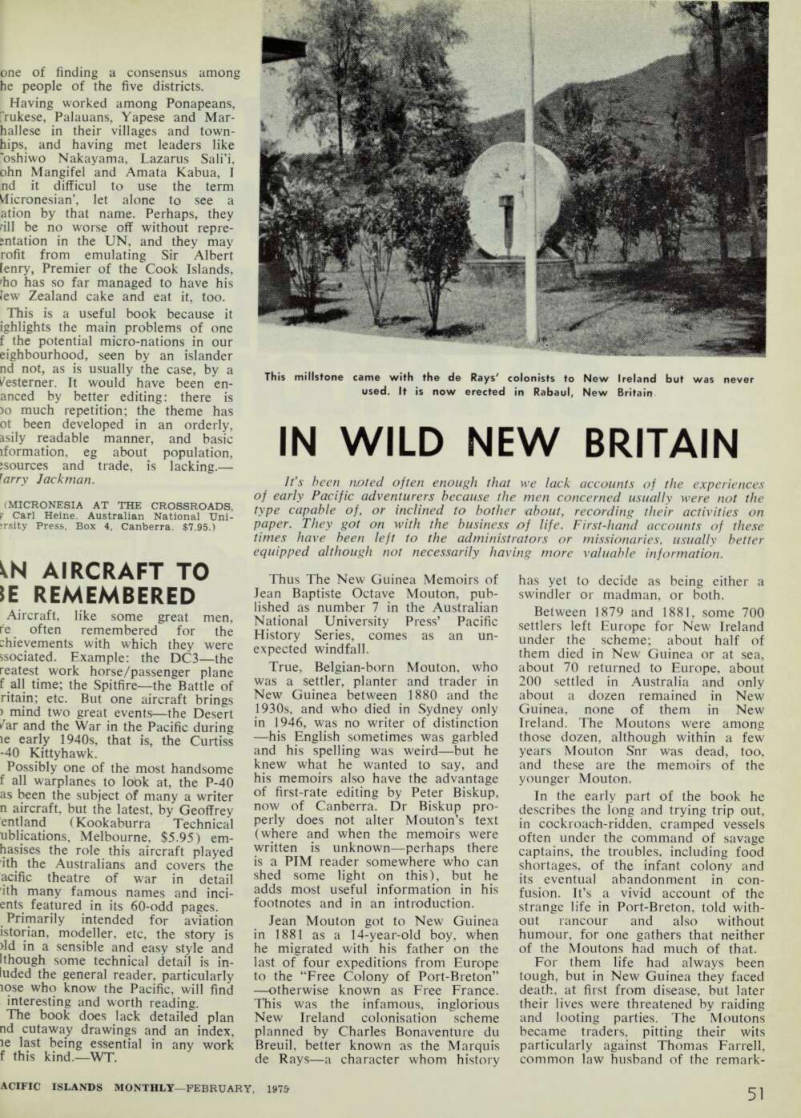
This millstone came with the de Rays' colonists to New Ireland but was never used. It is now erected in Rabaul, New Britain
ible “Queen Emma”, then on New Britain building his own empire, Ithough he didn’t live to enjoy its ull fruits. Emma later carried on nd expanded.
Farrell is painted by young Mou jn as a particularly nasty character, billing to stop at nothing to advance is own interests ahead of others, /hite or black.
When Mouton senior died, young louton was one of that small num er of settlers and traders who perated in that rich area around the of today, where Emma held tvay—so much early settler history f the Gazelle Peninsula is in this ook —including accounts of land jquisitions which were as loose and robably as illegal as those con ucted by the notorious Higginson i the New Hebrides last century.
Often in those early days of trad ig Mouton escaped death narrowly 5 his store was raided or ambush ;tempts were made. His knowledge f local languages and customs, and is physical fitness and his fearless to survive, rather than is possession of firearms, enabled m to keep going.
On one occasion one is reminded ; the experience of J. K. McCarthy
among the Kukukuku of the NG mainland in the 19305, when Mc- Carthy narrowly missed death from large boulders deliberately run down a hill at him—only a few minutes later to be greeted happily by his antagonists and congratulated on his escape, everything forgotten. Mouton tells how in Bougainville in 1900 he was recruiting when he noticed some natives making a “very funny move ment” when coming towards his boat, and another man who kept his arms close to his body. When he chal lenged them he found one man was concealing a hatchet and the others were dragging spears beneath the water with their toes, attempting to get close enough to use them.
“However”, he says, “having dis covered their deceitful plan and see ing it was a failure they acted as if nothing had occurred and I recruited them just as if nothing had hap
pened ... in fact when I told them in a laughing manner, turning the whole matter as a joke, just what their plan and action was they laughed, and they say I know too much, that day I did a good recruit ing day, though they were prepared to kill me and the crews”.
On another occasion in New Ireland he had to stand by while raiders killed, cooked and ate a five year-old boy they had captured (“later presenting me with a piece ol the child which looked like pork, I told them white men were not eat ing each other like them”). Mouton had earlier contemplated putting a bullet into the head of the child to put him out of his misery, but thought better of it through reasons of his own safety.
He tells these stories with a matter-of-factness which lends cre dence to his narrative, and as Harry Maude, general editor of the Pacific series, says in a foreword, one can be elated at “a fortuitous discovery of the calibre of the Mouton
memoirs”.-
Stuart Inder.
(The New Guinea Memoirs Of
Jean Baptiste Octave Mouton.
Edited by Peter Biskup. Published by Aus tralian National University Press, Box 4, Canberra. $8.95.)