Turtle and the royal mats
pp. 58-60 · Read in the full issue
The legend of Sangone the Turtle and the royal mats
By Atunaisa Have A Katoa
Along time ago, a man called Lekapai lived in Samoa. In his garden he grew breadfruit, plantains, bananas, yam, taro and many other kinds of fruit and vegetables.
Then, as time went on, there was a great hurricane, and his plantation was almost ruined. After it was over, Lekapai set to work to replant his gardens. But alas, there was an other hurricane the next year, and the next, so that three food crops were destroyed one after the other.
Poor Lekapai became disheartened and, after pondering what he should do, said to his relatives: “I shall go and try to find out where the wind lives, and ask why he seeks out and destroys my plantation”.
So Lekapai launched his boat and sailed south towards Tonga to where the wind comes from. After he had journeyed for several days, he saw a big rock ahead of him. When he drew near to it, he could not find a landing place anywhere. So he sprang up, grasped the branch of a white-flowered pandanus tree, and managed to clamber ashore. He then saw a narrow pathway and followed it, down and down into the ground.
On and on he went, and presently, looking ahead, he saw a woman fac ing him. (They say that she was a very beautiful woman.) “Where do you come from?” she asked him, “and how did you find the way down here?”
“I have come”, answered Lekapai, “to try to find out where the wind lives—the wind that keeps destroy ing my garden”.
“You have come to the right place”, replied the woman. “The winds are my children. And if you wish to see them, come with me and I will call them”.
“Thank you”, said Lekapai, “for making my journey worthwhile”.
They went on a little further, and the woman called out: “Let the strong north wind blow this way!”
And immediately it blew, becoming stronger and stronger.
“Let the whirlwind come!” the woman commanded. And the whirl wind began to sweep round and round.
“Let the gale come!” the woman called. And the coconut palms began swaying and snapping, and all round them trees of all kinds came crash ing down.
“Let the hurricane come!” the woman called out. And at once the wind blew, and this time it was so strong that Lbkapai could no longer stand against it, and the earth began to split, and great rocks began to fly. Lekapai was afraid and begged the woman to tell the winds to for bear and rest. “I don’t want to see any more”, he said. “I am nearly dead with fear. I do not mind about my gardens. I only wish to return home safely to Samoa”.
So the woman spoke again. “Go away and rest”, she said. At once the strong wind eased off, the sun shone again, and the breeze that now blew was warm and pleasant.
They then came back and went to the woman’s home, and she told Lekapai that her name was Hina.
"And mine is Lekapai”, he said. Then Hina said, “Stay here for a while and when my mother goes, she will take you with her”.
A few days passed, and Lekapai asked again to go back to his own country. “Then go and get some co conuts to take with you”, said Hina.
So he went and picked them.
When Lekapai came, Hina was sitting there with a turtle beside her.
“This is my mother, who is now a turtle”, she said. “She will take you with her. If you want a drink while you are out on the ocean, do not break your coconut on the turtle’s head, but on its back. And when you reach Samoa”, she added, “go and bring a piece of tapa cloth, and a bottle of oil, and a large coconut leaf, and give them to the turtle to bring back to me. Her name is San gone, the sacred turtle. Do not be tray her or evil will surely befall you and your family”.
They then said goodbye, and Leka pai mounted on the turtle’s back, and Sangone swam with him out to sea.
Soon Lekapai became thirsty, and not believing the truth of Hina’s story or caring to obey her, he took a coconut and broke it on the turtle’s head. Whm they reached Samoa, he took the turtle ashore, killed it, cut it up and divided it out among his relatives; and the shell of the turtle they buried secretly beside a candle nut tree where no one could find it.
Then, noticing that a boy named Lafaipana had observed them, Leka pai called to him to come. When the boy came running across, Lekapai put out his hand and laid it on Lafaipana’s head, and said. “So that you may not reveal my secret, you will be Little Lafaipana: slow be your growth, and small your stature!
And on the day that Sangone, the Turtle, is found you will die!”
So Lafaipana grew very slowly; and he soon forgot the threat about his death. For he was but a boy and death has no meaning for children.
Many, many years passed and then the Tui Tonga, Tuitatui, heard a rumour about what had happened to Sangone the Turtle in Samoa, He gave orders for his brother, Fasi ‘apule, to go to Samoa and find, if possible, Sangone’s shell, and return it to Tonga. So Fasi‘apule set out.
When he reached Samoa, however, he could not find anyone who seemed old enough to remember where Sangone was buried. So after drinking with the Samoan people in accordance with the custom of that land, he gave them a riddle to solve.
“Guess this one”, he said. “O that I might drink a clap-it-and-it-smokes”.
So they all began asking one an other what he had meant. Then
finally, Lafaipana, now a very old man, told them to go and bring some tiny pieces of dried kava root which sent up dust like smoke when they were clapped between the hands. So they brought some and gave them to Fasi‘apule; and at once he began to wonder whether there was an old person still living who had solved the answer to the riddle and who might know the secret of Sangone’s burial place.
The pieces of kava root were then pounded and mixed with water. They drank this and Fasi'apule gave them another riddle. “Guess this one”, he said. “A stalk fainting in the forest”.
So the people ran to Lafaipana and asked him what it meant. “Go and find a bunch of plantains that has fallen and has ripened lying on the ground out in the forest”, he said.
So they searched and found one, and gave it to FasLapule. He was delighted, and gave them yet a third riddle to solve. “Guess this one! A leaf that sings. Guess that! A leaf that cries and makes a noise like a parrot”.
They asked Lafaipana again, and he told them to bake a fowl and wrap it in young taro leaves, which made a faint singing sound when they are stripped. This they prepared and brought to Fasi'apule, and he gave them still another riddle. “Guess this one. Grunting and lying down”.
They ran and asked Lafaipana,
and he told them to bake a huge pig that was no longer able to stand, but which just lay there grunting all the time. So they killed a big pig and baked it, and took it along to Fasi‘apule. Then he knew that there was an old and wise person who could answer the riddle of Sangone’s hiding place.
So he asked the people who it was that had enabled them to solve his riddles. “It was Lafaipana”, they con fessed. So he ordered them to bring Lafaipana to him. When Lafaipana sat before him, Fasi'apule asked him whether he knew where Sangone the Turtle was buried. “I know the place”, he replied, “and I will lead you to it”.
So off they went, and Lafaipana directed them to the candlenut tree, where he had gone so many years before. They dug down, and found that he was right. And it is said that when Sangone’s shell was brought from the ground, it shone almost like a flame. As soon as it appeared —Lafaipana cried out and fell dead, and they buried him with fine mats in the grave of Sangone.
Fasi‘apule and his attendants then prepared to return to Tonga. The Samoan chiefs gave him two finely woven mats to accompany the shell of Sangone to Nuku’alofa.
As soon as Fasi‘apule arrived in Tonga, he took the shell, as the cus tom required, to give to his brother, the Tui Tonga. And the Samoan mat, which he had been presented with, was called Hau ‘o Momo (the honour shown to Momo). The other
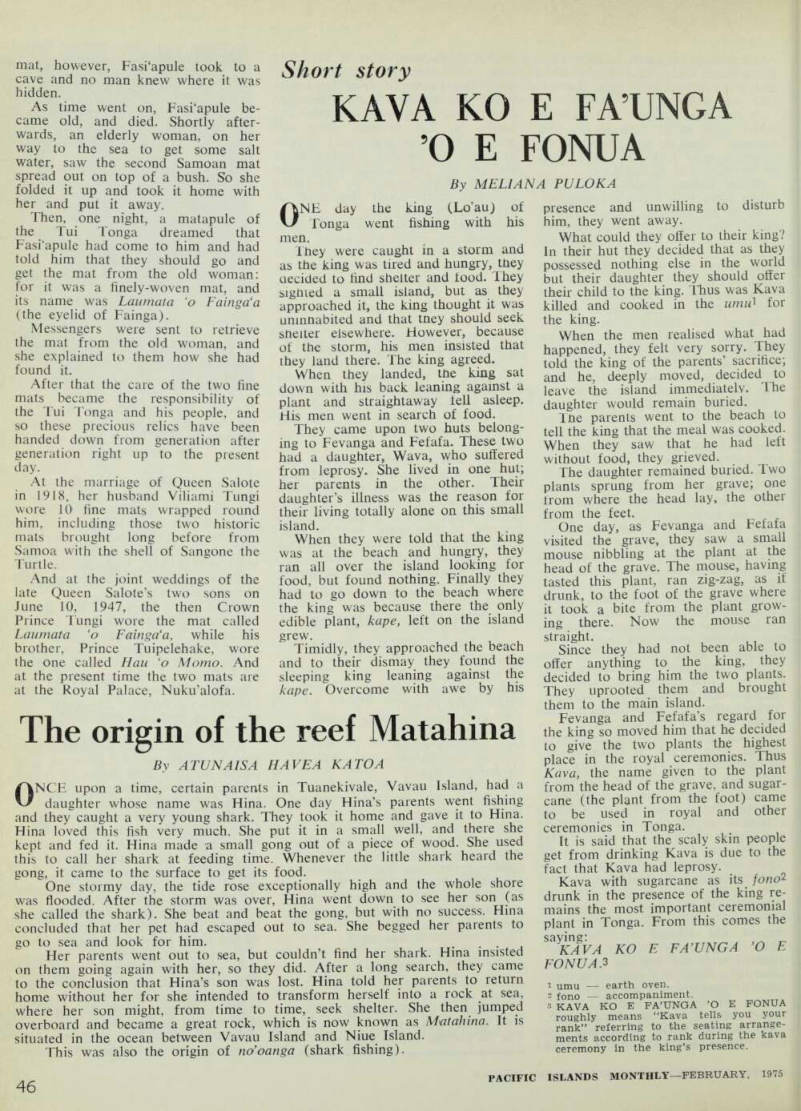
The late Queen Salote of Tonga and her consort, Prince Tungi. At their marriage in 1918 Prince Tungi wore the two legendary mats.
mat, however, Fasi‘apule took to a cave and no man knew where it was hidden.
As time went on, Faskapule be came old, and died. Shortly after wards, an elderly woman, on her way to the sea to get some salt water, saw the second Samoan mat spread out on top of a bush. So she folded it up and took it home with her and put it away.
Then, one night, a matapule of the Tui Tonga dreamed that Faskapule had come to him and had told him that they should go and get the mat from the old woman: for it was a finely-woven mat, and its name was Laumata ‘o Fainga‘a (the eyelid of Fainga).
Messengers were sent to retrieve the mat from the old woman, and she explained to them how she had found it.
After that the care of the two fine mats became the responsibility of the Tui Tonga and his people, and so these precious relics have been handed down from generation after generation right up to the present day.
At the marriage of Queen Salote in 1918, her husband Viliami Tungi wore 10 fine mats wrapped round him, including those two historic mats brought long before from Samoa with the shell of Sangone the Turtle.
And at the joint weddings of the late Queen Salote’s two sons on June 10, 1947, the then Crown Prince Tungi wore the mat called Laumata ‘o Fainga'a, while his brother, Prince Tuipelehake, wore the one called Hau ‘o Momo. And at the present time the two mats are at the Royal Palace, Nuku’alofa.