Magazine Section
pp. 55-57 · Read in the full issue
Midway's Tale Of Murder, Missiles,
Battles, Birds And Golf Courses
By W. G. Coppell
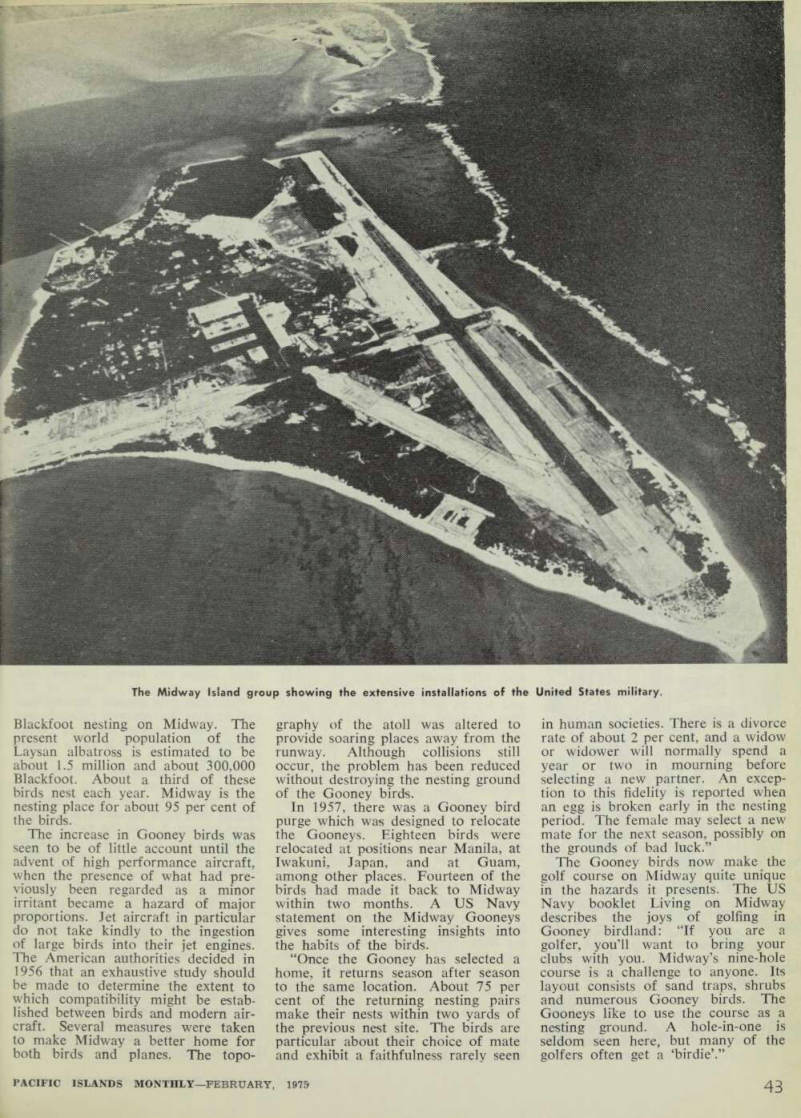
Today, Midway Island, an atoll of two islets. Eastern and Sand, is a US Navy facility concerned with oceano graphic research and is the base for a weather service detachment and the Pacific missile range facility. The latter unit locates the impact points of missiles and data capsules which fall within the area.
The US Navy describes Midway, with its lagoon 24 kilometres in cir cumference as “the navy’s beautiful isle”. Perhaps, Midway’s most recent claim to world attention was that it was there that presidents of the US and South Vietnam met on June 8, 1969, to discuss the withdrawal of American forces from South Viet nam.
The events of World War II and the screen heroics of armies of John Waynes are probably the basis for the view most people would have of Midway. The Japanese Navy first shelled the island on December 7, 1941. It was during this skirmish that Lieutenant George C. Cannon became the first US marine to win the Medal of Honour in World War 11. when he was killed manning a gun during the first attack.
However, Midway’s great moment in history came during the naval battle which bears its name, and which took place in the waters off the atoll. On June 3, 4 and 5, 1942, fighter aircraft based on Midway took a leading part in what was to become recognised as one of the most de cisive war encounters at sea.
Midway, which was first known as Middlebrook Island, was discovered by Captain N, C. Brooks, of the American ship Gambia in 1859, and was uninhabited. In the years im mediately after its discovery it was thought that the lagoon would make a suitable coaling station for ships on Pacific Ocean routes. Some work was carried out, but never completed.
For many years the atoll was only visited by vessels engaged in shark fishing or bird-catching and it was one of the former that brought high drama to Midway.
On November 16, 1886, the schooner General Siegel, of Hono lulu, went on the reef during a terrible gale and Captain Asberline decreed that the crew, all of whom survived the wreck, should stay on the island until the arrival of a rescue ship. The sailors took shelter in a small house which had been con structed during the abortive coaling station development, but tragedy struck almost immediately when Peter Larkin blew his right hand off while fishing with dynamite, and died 10 days later.
One of the men who survived the sojourn on Midway, .E. Olsen, was later to record the details of a sequence of horrific events.
A boat from the Dunottar Castle, which had been lost off Ocean Island, drifted ashore and the men began to repair it; but, as it was too small to accommodate all hands, they also worked on a Japanese sampan which had been left behind by the Hawaiian schooner Kaulilua. At this time Captain Asberline, Jorgensen, the mate, and Brown, a sailor, went on an exploration visit to Eastern Island.
The captain had a shotgun and ammunition and Jorgensen took a Winchester rifle. Jorgensen returned unaccompanied to Sand Island in the afternoon, stayed overnight and the next day returned alone to Eastern Island.
His was the only seaworthy boat, and although the others were con cerned because they could see no sign of Asberline or Brown, they could not make the crossing of the lagoon. When the party on Sand Island had finished work on the sam pan they tested its reliability and the
same night Jorgensen came across from Eastern Island.
Olsen indicates that his party may have had premonitions about Jorgen sen’s intentions as he wrote, “I think that his intention was to have killed the entire party for I found in his hammock a notebook in which was written, ‘Six men left for Marshall Islands at the beginning of June’. 1 also found a loaded revolver and a shotgun.”
The next day the whole party crossed to Eastern Island and, as the others had been, were now convinced that there had been foul play there.
Before they reached the shore Jorgensen said, “I tell you boys, the captain killed Brown and I have been keeping him company to prevent him from killing himself. I wouldn’t be surprised to find that he has made away with himself”. As soon as Jorgensen was on land the others beat a hasty retreat to Sand Island and prepared to quit Midway by packing everything they needed into the Japanese sampan.
The ship’s boy was deputed to keep a watch on the mate’s move ments, but the latter apparently tore his clothes to pieces and used the strips to lash together a raft on which he made the crossing of the lagoon and was able to hide himself in the head-high brush which grew behind the house.
Towards evening, two of the men went down to the lagoon to put out of action the Dunottar Castle ship’s boat. It was at this time that Jorgensen, naked and armed with a rifle, appeared at the door of the house and, pointing the weapon at Olsen, demanded to know why the others left him alone on the other island. A struggle ensued during which Olsen was able to wrest the rifle away from the mate, who then said “Now you can shoot me.” Olsen
Accidentally shot '
called to the other men but they were afraid to return to the house, and made for the sampan.
Olsen recounted the final stages in this part of the story, “I returned to the house and Jorgensen said, ‘Tie me up and take me with you’. I went down to the boat and told the others what he had said, but they were afraid for their lives and said he would be better off where he was, as they might all be drowned and never reach land.”
The small party set off for the Marshall Islands, which they reached in 20 days. They then moved from one island to another over a period of several months before they split up with two of them leaving in a canoe for an island 400 miles distant.
Olsen and the boy were eventually found by the New Zealand brig Ahukai, and taken to Jaluit. They were transferred to the Lilian, from Honolulu, which eventually returned them to their home port on Decem ber 6, 1887.
During their stay on Midway the survivors had not gone short of rations as Olsen said he would rather eat goonies (albatross) flesh than any meat obtainable in Honolulu, and that the eggs of the birds were so palatable that he used to eat them raw. were so thick on the island that it was impossible to walk a vard without breaking some.
Mullet was very plentiful and the castaways used to fry them in their own fat.
The next act in the drama was played when the ship Wandering Minstrel, under Captain Walker called at Midway. As it approached a man was seen waving a rag, which in fact was his shirt. Because of heavy weather it was three days be fore the Wandering Minstrel entered the lagoon. John Cameron recounts the meeting with Jorgensen in John Cameron’s Odyssey, “We found him in a small wooden building, the sole inhabitant of the island. To my astonishment he greeted me bv name. ‘How do you do Captain Cameron? My name is Jorgensen. I met you in Honolulu’.
“I had no recollection of him. ‘How did you come here?’ I asked. ‘On the General Siegel,’ he said. ‘We were bound from Honolulu on a sharking cruise. The vessel was wrecked, and my shipmates cleared out leaving me behind’.”
The erstwhile mate of the General Siegel gave Cameron his side of the
story. “One day he (Captain Asber line) and Brown went to Eastern Island; and the captain returned alone. To our questions he replied coolly that Brown had shot himself by accident and that he had buried the body where it fell. Of course I suspected murder, and I made up my mind to learn the truth. On the next day I went to Eastern Island with Jacobson and a German boy. The captain showed me the grave; I dug up the body, keeping a weather eye on the captain as I did so; pulled the corpse from the pit, scraped off the sand that stuck to it, and searched for a wound. It was a bullet hole— in the back of the head. No man can shoot himself from behind, Cameron.
The captain looked on indifferently Despite this macabre incident, ac cording to Jorgensen, he and the captain remained for several days on Eastern Island and he claimed that one day “I sauntered to the boat and sat waiting for the captain. He did not return; I searched for him; no trace could I find. I returned be wildered to Sand Island and reported his disappearance. To mv horror my shipmates accused me of murder. I protested my innocence; but they roared me down.”
He was probably much closer to the truth when he recounted his re turn to Sand Island, “My brain burned with hate of my shipmates.
At that time I had a mind to kill them all. This would have been no crime; only just punishment for their attempt to murder me with starvation and thirst”.
Cameron seems to have taken Jorgensen’s side as he wrote, “Three years afterwards, I met one of his shipmates in the Marshall group. He laid all the responsibility on Jorgen sen; yet closed like a clam when I asked him some pertinent questions.
I told him that Jorgensen was in the archipelago and would certainly kill him should they meet; for my part, I concluded, I would not blame the Dane in the least.” Jorgensen im pressed his story on the people of the Wandering Minstrel, so much so that he was made second mate of the ship, but this cannot be seen as a good omen for her, as shortly afterwards she also was wrecked on Midway.
The editor of Cameron’s biography sums up the evidence of the case: “We cannot even surmise what oc curred between Jorgensen and Asber line and Brown on Eastern Island; perhaps Jorgensen, at the worst, corn
mitted nothing more than man slaughter. I do not believe that he could justly have been found guilty of that much. That he was insane I cannot doubt . .
Midway Island is home to one of the world’s most intriguing bird populations. The Gooney bird is synonymous with Midway and its development by man. Olsen, in his account of the Jorgensen affair, makes reference to the presence of large numbers of albatrosses but it seems that the birds were only mak ing intermittent use of the island _as a breeding place until the Pacific Cable Company began operations there in 1903.
In 1905, the Director of the Ber nice P. Bishop Museum visited Eastern Island and he was able to report on the depredations wreaked on the birds by gangs of Japanese bird catchers.
“Everywhere great heaps, waist high, of dead albatrosses were found.
Thousands upon thousands of both species had been killed with clubs, the wing and breast feathers stripped off to be used as hat trimmings, or for other purposes, and the carcases thrown in heaps to rot.
“Two species of albatross make their home on Midway and their numbers have increased in very large proportions as man has cleared the atoll and created the runways, take off areas and landing places that the birds desired.
Australian ironwood trees were planted by the cable company and these provide ideal shelter for the birds and the long needles of the trees make ideal nesting material. As the numbers of birds increased so did the activities of the bird catchers.
David Heenan writing in the maga zine, Mid-Pacific, in 1922 said, “The raiders, composed mostly of Japanese, had landed on the island in May, 1909, and by the fall of that year had slaughtered upwards of 300.000 birds. Not content with securing the feathers, the hunters had adopted singularly cruel methods.
One practice was to throw the birds, after they were caught, into an old cistern and there let them slowly starve to death. In this way the fatty tissue next to the skin was used up and there was consequently little or no cleaning necessary when the skins were removed.
“In 1910, action was taken against the bird poachers and 23 were arrested and taken to Honolulu. The two species which are referred to as Gooney birds are the Laysan and Blackfoot albatross. In 1930 it was estimated that there were some 20.000 Laysan and 30,000 pairs of
Blackfoot nesting on Midway. The present world population of the Laysan albatross is estimated to be about 1.5 million and about 300,000 Blackfoot. About a third of these birds nest each year. Midway is the nesting place for about 95 per cent of the birds.
The increase in Gooney birds was seen to be of little account until the advent of high performance aircraft, when the presence of what had pre viously been regarded as a minor irritant became a hazard of major proportions. Jet aircraft in particular do not take kindly to the ingestion of large birds into their jet engines.
The American authorities decided in 1956 that an exhaustive study should be made to determine the extent to which compatibility might be estab lished between birds and modern air craft. Several measures were taken to make Midway a better home for both birds and planes. The topo
graphy of the atoll was altered to provide soaring places away from the runway. Although collisions still occur, the problem has been reduced without destroying the nesting ground of the Gooney birds.
In 1957, there was a Gooney bird purge which was designed to relocate the Gooneys. Eighteen birds were relocated at positions near Manila, at Iwakuni, Japan, and at Guam, among other places. Fourteen of the birds had made it back to Midway within two months. A US Navy statement on the Midway Gooneys gives some interesting insights into the habits of the birds.
“Once the Gooney has selected a home, it returns season after season to the same location. About 75 per cent of the returning nesting pairs make their nests within two yards of the previous nest site. The birds are particular about their choice of mate and exhibit a faithfulness rarely seen
in human societies. There is a divorce rate of about 2 per cent, and a widow or widower will normally spend a year or two in mourning before selecting a new partner. An excep tion to this fidelity is reported when an egg is broken early in the nesting period. The female may select a new mate for the next season, possibly on the grounds of bad luck.”
The Gooney birds now make the golf course on Midway quite unique in the hazards it presents. The US Navy booklet Living on Midway describes the joys of golfing in Gooney birdland: “If you are a golfer, you’ll want to bring your clubs with you. Midway’s nine-hole course is a challenge to anyone. Its layout consists of sand traps, shrubs and numerous Gooney birds. The Gooneys like to use the course as a nesting ground. A hole-in-one is seldom seen here, but many of the golfers often get a ‘birdie’.”
The Midway Island group showing the extensive installations of the United States military