proposals.. .
pp. 35-37 · Read in the full issue
Caledonians 'non'to tax proposals.. .
... But others bow to increases
From a Noumea correspondent
New Caledonians have refused to introduce new taxes to raise almost SAIO million proposed by the French administration to overcome the island’s Budget deficit for 1975.
The Territorial Assembly’s budget debate ended just before Christmas with members refusing to vote the bulk of the administration proposal of a total tax increase of 1,500 mil lion CFP (SAI4 million). Members blame Paris for the nickel island’s financial crisis and were awaiting the late January visit of French Overseas Territories Minister, Mr Olivier Stirn, to see what solution he might sug gest.
If France refuses to subsidise the territory again this year, the French parliament could introduce personal income tax on the island.
The French administration plans a territorial budget expenditure of 10,000 million CFP (SA9O million), most of which is absorbed by the functioning of the public service, leaving less than $A400,000 for in vestment expenditure.
The French authorities propose that the island should contract an extra 4,000 million CFP loan money (almost SA4O million) to finance infrastructure projects in 1975. Such enormous debts mounting up over the past few years are destined, according to Caledonian autonomist leaders, to “deliver the nickel island, hands and feet tied, to France”.
Meanwhile, the French adminis tration is making a gesture of con cession by announcing the cutback of public servants in the field of agriculture. During the regime of immediate-past-Governor Louis Ver ger, a new service was created to direct all rural activities. It was
headed by a highly-paid civil servant from France, Mr A. Jattiot.
Governor Eriau plans, however, to cut back staff by about 30 persons by abolishing this superfluous bureaucracy and regrouping the three departments of agriculture, livestock and rural engineering, to form a single Department of Rural Econ omy, in addition to the Forestry Department.
But as the New Year was ushered in, the ever-sparking Caledonian de bate centred on a new political sug gestion. The French Territories Minister was quoted by Caledonian solicitor Jean Leder as considering a proposal to divide New Caledonia into two distinct regions—the main land separate from the offshore Loyalty Islands—each region with their own elected representatives in cluding separate deputies and senat ors to Paris.
Was this just another red herring to entertain the Caledonians, or a new move in the “divide and rule” tradition, to split the autonomist vote?
Main speculation over the Minis ter’s January visit, however, centred on the budget impasse and the question of whether France would insist upon the introduction of per sonal income tax and force the islanders to pay for the prestigious projects undertaken by French plan ners who have failed to match this expenditure with the nickel industry expansion needed to produce the required revenue.
By a staff writer
There are several similarities in the 1975 budgets for the Solomon Islands and the GEIC. Each expects record revenue, thanks to high world prices for copra. The GEIC also enjoys the added benefit of high phosphate prices. Each has decided to abolish commonwealth preference tariffs, and adopt a single line metri cated tariff. In each country it was the first budget brought down under a Chief Minister.
The Solomon Islands Financial Secretary, Mr J. F. Yaxley, showed how copra contributed to buoyant revenues. By the end of 1974, it was expected that the Copra Board would have exported 23,000 tons, valued at $lO million. The comparative figures for 1973 were 15,000 tons, valued at $2.8 million.
Spectacular gains in copra were offset to some extent by a decline in timber exports, chiefly because of a slow-down in economic activity in Japan. Mr Yaxley was gloomy about the future of timber, unless there was an upturn in the Japanese economy.
Canned fish, a relatively new indus try, earned about $3 million in the first 10 months of 1974 (from 8,000 tons), but a long-term pattern had not had time to emerge.
The draft estimates contained pro posals to spend $15,556,460 in 1975,
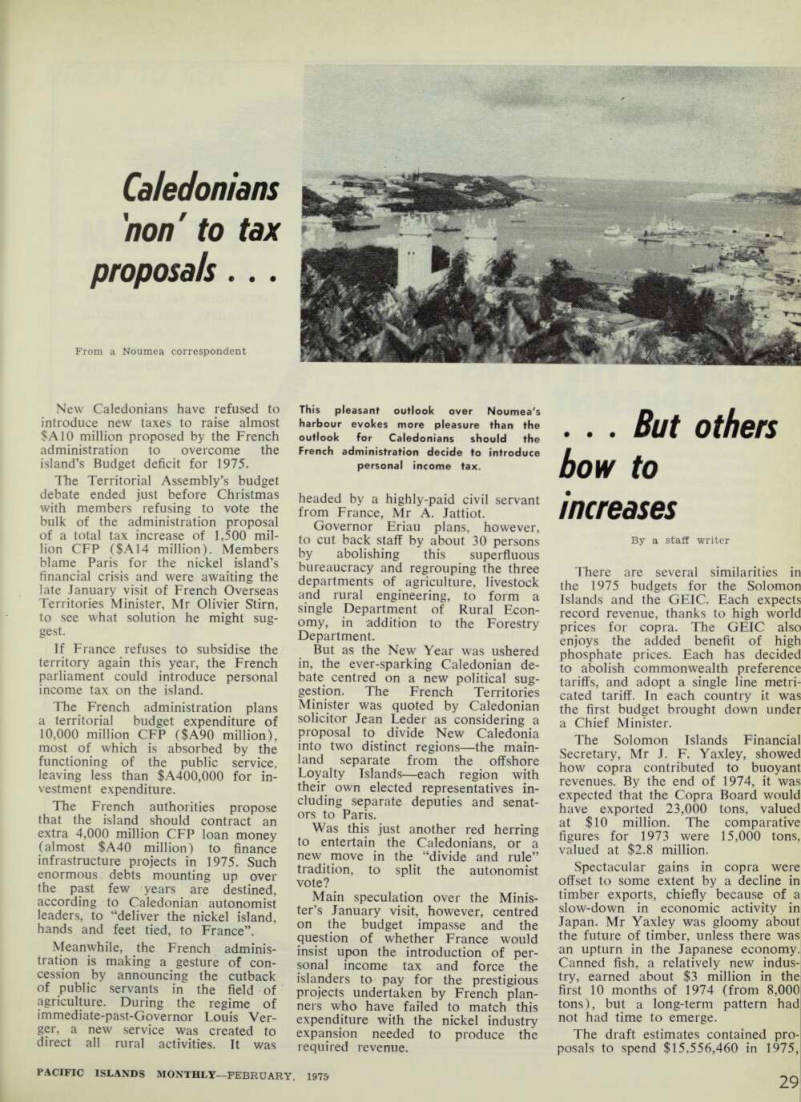
This pleasant outlook over Noumea's harbour evokes more pleasure than the outlook for Caledonians should the French administration decide to introduce personal income tax.
Threat To Geic
the biggest spending in the history of the Solomons, and $3 million more than in 1974. There was also $375,480 in statutory expenditure— spending authorised by laws other than the annual Appropriation Ordin ance. Only half the amount to be spent in 1975 will come from the Solomons’ own resources. The coun try looks to aid sources to meet the gap between revenue and expenditure, and in most cases that means the British taxpayer.
Expenditure in the capital budget for 1975 is put at $6l million, most of which will come from UK deve lopment aid grants. Although the UK provides a greater part of the money for development, and an increasing amount each year, the percentage of the total is declining. In 1975, about $1 million will come from sources outside the UK.
Mr Yaxley said the new customs tariff was designed, not so much to raise additional revenue, but to streamline the structure and prepare the country for a more independent role in managing its affairs. The in tention was that in fiscal terms the revenue from customs would be the same, assuming current trading pat terns continued. The duty on some basic foodstuffs was reduced or abolished altogether.
To offset loss of revenue, the duty on cigarettes was lifted about 3c on a packet of 20. The duty on im ported fresh meat was doubled and a 20 per cent duty was imposed on spices to protect local industries. A small duty was imposed on a number of food items which previously were allowed in free from Commonwealth sources. A wide variety of other goods is affected. On some duty is abolished, and on others imposed for the first time or increased.
Export duties have been increased —gold from five per cent to 10 per cent, frozen fish from seven per cent to nine per cent. For the first time a duty, 10 per cent ad valorem, is imposed on export of articles of wood, stone or other material, in tended for a gift or sale as a curio.
The copra tax, which was abolished in 1971, to give some relief when prices were low, was reintroduced, and fixed at a specific rate of $7.
A new scale of duty has been introduced to give more revenue when copra prices are high. The rates are—On the first $lOO of fob value, nil; first $4O above $lOO, 26 per cent; next $l6O, 13 per cent; above $3OO, 20 per cent.
Mr Pat Reardon, the GEIC Financial Secretary, although cauti ously optimistic about the immediate future, warned how dependent the GEIC was on revenue from copra and phosphate. If prices of those two commodities fell as quickly in the next 12 months as they had risen in the previous 12 months, the GEIC would be in serious economic trouble, he said.
He expects total revenue for 1975 to be $19,560,760, which is an in crease of 247 per cent over the revenue actually collected in 1973 (the final figures for 1974 would not have been available at the time he presented the budget in December), which was due almost entirely from the increased yield from phosphate.
Mr Reardon forecast expenditure at exactly the same as revenue, $19,560,760, which would give one of the most neatly-balanced budgets ever known.
After putting aside $14,067,128 as a contribution to the revenue equal isation reserve fund and the capital budget, the real operating cost of government will be $5,493,632, an increase of 18.77 per cent over the two years since 1973. Personal emoluments are expected to take 47.65 per cent of the operating cost, compared with 40.79 per cent in 1974.
Mr Reardon described this as an excessive rise in 12 months, and said steps would be taken in 1975 to rectify the position. He expected that health, education, welfare and train ing would take 38.7 per cent of the total ordinary expenditure, but natural resources would get only 5.82
per cent. Works services, which in cluded telecommunications, postal services, civil aviation, meteoro logical, marine division and recurrent works would absorb about 30 per cent of the budget.
Mr Reardon also announced that pay-as-you-earn taxation would be introduced. This would ensure the taxpayer was no longer faced with an annual tax bill, which often placed hardship on him and his family. As it would be the employ ers’ responsibility to deduct tax, many persons who had failed to sub mit returns would be caught in the overall tax net. Income tax was not changed for 1975.
The principles in the single line metricated tariff structure were simi lar to those presented with the Solomon Islands’ budget.
As a final warning, Mr Reardon said that as the House of Assembly had approved the separation of the Ellice Islands, it would be necessary to work out the effects that move would have on the economy and future budgets. He proposed to re view the revenue so that additional revenue raising measures could be introduced to meet the situation, and ensure that everybody contributed equitably towards the economy and the way of life in the islands. • Mr John Long, dismissed from his job as manager of Guadalcanal Plains Ltd when the company went into receivership, applied in the High Court at Honiara for a declaration that his dismissal was invalid. Chief Justice Sir Jocelyn Bodilly rejected his application.