Tropicalities
pp. 16-19 · Read in the full issue
A bit of
NG history
“Here’s an interesting bit of New Tuinea history”, said PlM’s founder Mr R. W. Robson in January, He was referring to a letter he has re vived from an “esteemed, old friend”, Mr V. T. Sanders of Port Moresby, who described a find he had made which, says Mr Robson, fills an im portant gap in his book Queen Emma.
“Having re-read your Book, Queen Emma of New Guinea, many times, I was out at Ralum the other day”, Mr Sanders wrote. “A friend of mine, while examining the remains of the steps which led to Queen Emma’s house (Gunantambu), pointed out that red bricks comprised part of the construction.
“We both presume that these bricks could have been part of the 180,000 mentioned on page 118 as from the de Rays expedition. They are prob ably the only bricks left today out of that shipment; but add a bit more colour to history. Little did the brickmakers in faraway France real ise that the results of their labours would end up half-way around the world in the land of the cannibals!”
Comments Mr Robson: “Mr San ders has filled in an important gap in my Queen Emma-Marquis de Rays history which I missed. Among the mass of stuff dumped on the beach at Port Breton from the Chandernagore or at Irish Cove from the India in 1880 were build ing material and equipment for the Roman Catholic cathedral which was part of the de Rays plan.
“Eventually, Emma bought all this stuff and stored it at Mioko (Duke of York Islands), and when, soon afterwards, she began construction of ‘Gunantambu’ (across the Strait, at Ralum) she used much of it.
“That, of course, is how the bricks got there; but I missed the point when compiling my history. I did, however, discover that Emma adapted the altar intended for the cathedral, so that it became part of the equipment of Gunantambu lounge and, incidentally, the first cocktail bar known in the South
Pacific Islands. Emma insisted that the altar had never been consecrated but there was much argument about that.
“I examined Gunantambu at Ko kopo in the ‘Thirties (before the famous bungalow was destroyed during the Japanese occupation) but there was no cocktail bar there then.
I think the equipment was removed to a more suitable place by the Catholic missionaries.
“I hope that those Gunantambu steps, with the bricks, are preserved as an interesting bit of New Guinea history. But, when last I saw them (1973) they were rapidly disappear ing, along with Ralum. Scarcely a trace of the once-famous little For sayth port now remains”.
The Is
are raining
Papua New Guinea Rugby League teams will play under the name of Kumuls, emulating the Australian Kangaroos, the New Zealand Kiwis and the British Lions. Kumul, derived from several Highland languages is the Melanesian pidgin word for the bird of paradise. The bird of para dise emblem appears on the country’s flag, the national air fleet and the coat of arms.
National teams will play in gold jumpers, with three-inch red vees and black collars. Socks will be of black and red hoops with gold tops.
The emblem will be in a white shield on the left breast of the jumper.
The code in PNG is now con trolled by a central body, the PNG Rugby League, which is mapping out a programme for the coming season. The Kumuls (will they ever become as famous as New Zealand’s All Blacks or South Africa’s Spring boks?) will make their first appear ance in May in the Pacific Cup com petition at Port Moresby. Other cup contenders will be a NZ Maori team, Victoria and Western Australia. In June there will be a match against a team from England (Yorkshire and Lancashire). A match against an Australian under-25 side in October is possible, and there are hopes of a tour of France in 1976.
A dragon on tilie
ocean door
The Golden Dragon, a restaurant in American Samoa, has given its name to a huge crack which has been discovered in the ocean floor west of American Samoa.
The crack was found by the re search vessel Thomas Washington belonging to the University of Cali fornia’s Scripps Institute of Oceano graphy in San Diego.
The crew, with memories of en joyable evenings spent at the Golden Dragon Restaurant, voted to name their discovery the Golden Dragon Fracture, a name which will appear on future charts of the ocean bed.
A piece of volcanic rock dredged up from the fracture has been sent to the restaurant owners, Dr and Mrs George Lee.
Good health
Samoan-style
Continual usage has immunised Western Samoans from disease through drinking Apia’s contamin ated water. Only visitors are liable to suffer from “Samoan Tummy”.
Dr Solia Tapeni Faaisaso revealed this recently following reports of dead animals being found in the re servoir, and a strong hint that it was filled with things unmentionable.
Lealiifano Filipo, whose job it is to keep the reservoir clean, strongly denied the suggestion that there was anything objectionable in the reser voir, saying that people would think he had been negligent in his work.
He had done his best to keep the water free of leaves, and “other dead things”, but on occasions he had to remove dead birds from the water.
As he had no boat he had to swim in the water to get the dead birds.
However, it was impossible to keep the water free of dirt. The dirt built up against the walls of the reservoir. Once every five years, Lealiifano is supposed to let the water out and clean the walls. But even if the reservoir is kept com pletely clean, the water has a long
way to go before entering the pipes for Apia, on the way, passing through a large pipe to drive the power station turbines.
Another source of contamination is from the sewerage system. At high tide the system reverses itself and flows inward instead of outward, and through various factors can enter the town supply.
There was a recent report that the bacteria content of the Apia water supply was at least five times higher than WHO standards. The warning issued by the authorities was stan dard; Boil all water before using it.
Tbird lime
was unlucky
Kousourata, the New Hebrides travel and tourist magazine, came out for the third—and last—time in December.
The brave little venture by Jean and Penny Barbier, the husband and wife team who once edited the news paper Nakamal, finally crashed on the rocks of readership indifference.
Kousourata just didn’t sell and the cost of the printing was too high.
Now the Barbier family flies out to Paris, saddened by their failure to produce an independent publication to reflect all shades of opinion in the New Hebrides.
Final straw for the Barbiers was the purchase of Property and General Ltd’s printing facility by Phillipe Delacroix—their old boss from Nakamal days. Delacroix im mediately upped the production price of the magazine, and the Barbiers went out of business.
“Naturally we are sorry to go”, said Penny Barbier. “We had thought that at one time we could settle down here, and raise our family in the New Hebrides, but it was a hopeless situation without big
capital backing . . .
“And anyone with that kind of backing wanted an editorial rein to hold. That is something we were not prepared to consider”.
Elrides in the
inflation spiral
Bride prices in Papua New Guinea have been caught in the inflationary spiral. A Morobe man, recently asked to pay $5OO for his bride, complained to Lutheran Bishop Zurewe Zurenuoc, who said people sold their daughters like goods from trade stores. He said the price was rising rapidly, compared with some motor vehicles.
It was not a Christian way of life
for people to buy their wives for hundreds and hundreds of dollars.
Women were not animals to be sold for money to raise businesses for the families’ living.
Church leaders, councillors and young people from the Reef Islands in the BMP are making a determined attack on inflation—of bride prices.
They consider the price is too high.
Young men and women have to give up the idea of getting married be cause the men cannot afford to pay current rates, which go as high as
$Boo.
But the old people insist that it is entirely up to the bride’s parents to say how much an individual has to give them. The high payment for a bride has been the Reef Islands’ custom and they want to see it kept.
Two recent meetings failed to re solve the issue. Another meeting was to be held. The churches in the BSIP have been concerned for some time about the high payments for brides. They have suggested a maxi mum price of $5O.
The Reef Islands custom money is made from feathers of a small bird known as nuopla. The length of the feather varies from 30 ft and is normally valued between $lOO and $2OO.
Seeds kill
sea birds
An unusual relief operation was launched south of Noumea in late December to rescue birds being destroyed by seeds fallen from island trees.
Mr Jean Godot, well-known Cale donian diver and fishing enthusiast, discovered that seagulls, terns and noddies were dying on offshore islands, after being rooted to the ground by sticky seeds. A relief ex pedition including scientists from the ORSTOM research centre and members of the local Bird Lovers’
Association managed to free about 100 birds by peeling from their feet the gluey seeds of Pizonias Grandis trees, principal vegetation on the islands.
Other birds arriving to nest in the trees earlier in the season had obviously been caught in a deadly trap but by their death they left the way less treacherous for later nest ing arrivals.
The situation poses a problem for the future. Will the Bird Lovers’
Association enlist the French Navy’s aid to include the saving of seabirds among its varied Caledonian rescue operations, or will Mother Nature be left to exercise her harsh birth control methods at sea?
Squash, squash
and squash
A sure buyer of the next edition of the Guinness Book of Records will be Suva squash player Devlin Ah Sam. His name will be in it; that’s if he isn’t pipped on the post by an other squash player.
Devlin broke the world’s squash endurance record in De cember by two hours and five minutes. With a minute rest be tween games, he played 485 games, winning 301 of them. It took him 62 hours and 15 minutes.
Previous holder was Dennis Glennon, of Zambia who played 925 games, winning 610, but if he had a minute rest between games, then Devlin’s perform ance was even better than the time suggests. In 62 hours and 15 minutes, his minute rests amounted to 485 minutes; Glen non’s to 925 minutes.
In the first 34 hours he played against 68 opponents.
Devlin played without a meal for more than 24 hours. His first meal was eggs and fruit and after that he kept going on fruit and vegetables. We’re not told how long he slept after his mara thon effort. Wonder if he dreamed about squash!
it ’s worth
getting the bird
There’s money in cassowaries.
Prices in New Guinea have been very high recently—up to $4OO for a big bird. As there are not enough to go round, the PNG Government has launched a project to safeguard the existing industry, and possibly expand it.
New Zealand is actively helping as one of its first aid projects for PNG.
Mr Brian Reid, deputy head of the NZ Wildlife Service, is spending six months in the Mendi area to lay the foundations of a wildlife project, in volving the management of the casso wary industry in that area.
The wildlife section of the Depart ment of Agriculture will help villages to safeguard the industry, through preservation of the breeding forests in the natural breeding areas, and in finding where the main losses of the birds occur.
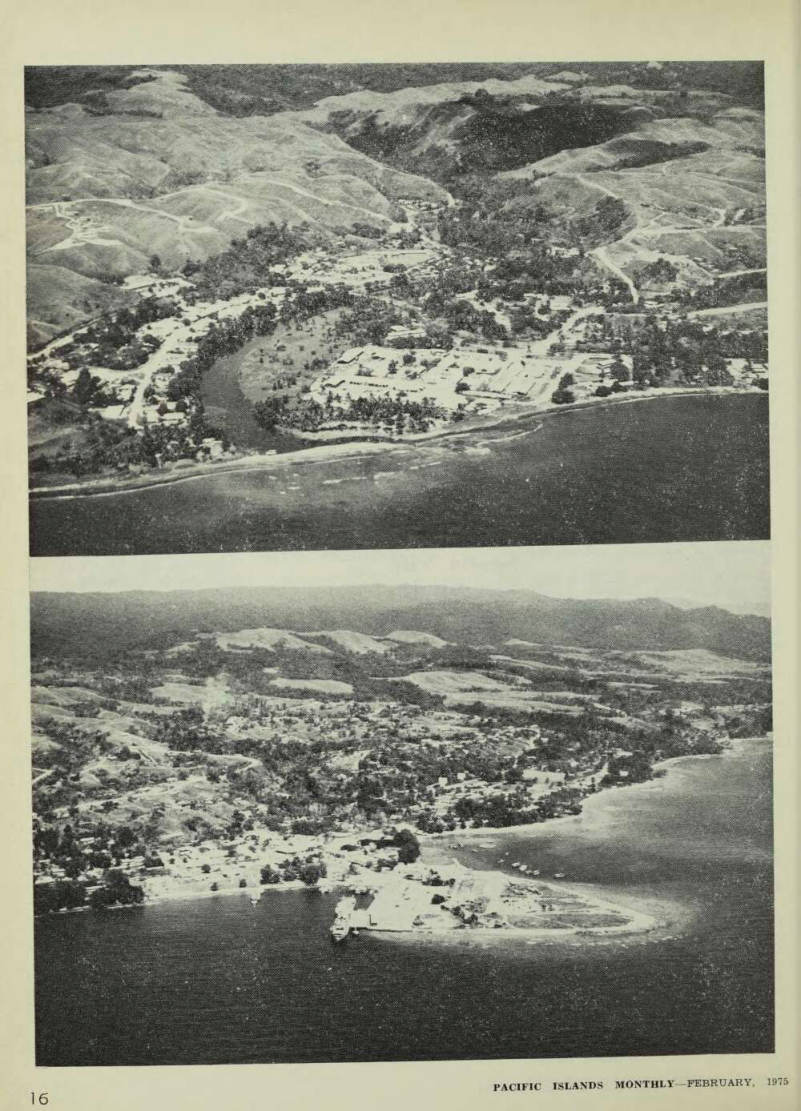
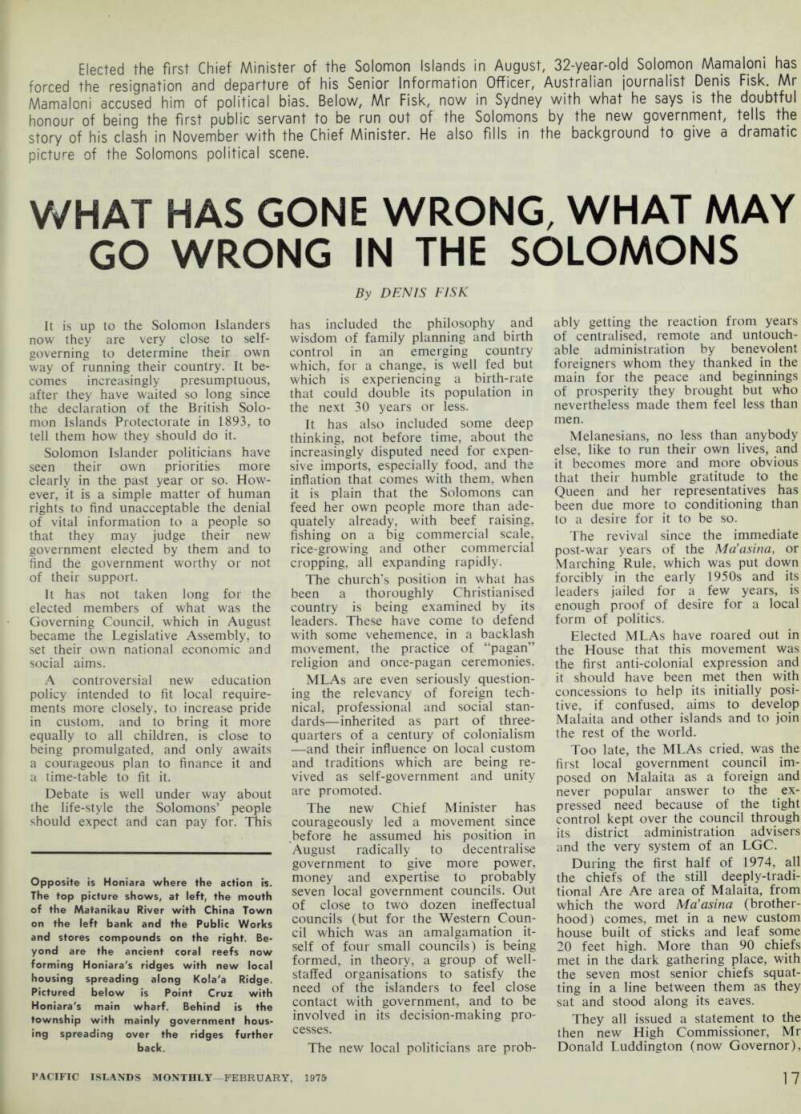
Opposite is Honiara where the action is.
The top picture shows, at left, the mouth of the Matanikau River with China Town on the left bank and the Public Works and stores compounds on the right. Be yond are the ancient coral reefs now forming Honiara's ridges with new local housing spreading along Kola'a Ridge.
Pictured below is Point Cruz with Honiara's main wharf. Behind is the township with mainly government hous ing spreading over the ridges further back.