talks fail
p. 14 · Read in the full issue
Micronesia talks fail over land
From a Saipan correspondent A spanner has been thrown into the works which seemed to be run ning smoothly for an agreement be tween the Congress of Micronesia’s Joint Committee on Future Political Status and the United States Govern ment. But, who’s to blame is a matter of opinion.
Senator Lazarus Salii announced in December that he had recommended termination of the talks between the joint committee and the US because the Americans had decided, unilater ally, on returning Micronesia’s public lands by executive order instead of under an agreement with the Congress of Micronesia.
The Micronesians have felt all along that under an executive order, instead of under an agreement be tween the US Congress and the Con gress of Micronesia, there would not be full legal protection for the Micro nesians; that an executive order could be varied without consultation and that this decision left the way open for the US military to ride roughshod over the Micronesians if, in the future, events in the Pacific required strong action by the US military forces.
If the Americans were perturbed by the joint committee chairman’s announcement, they didn’t show it.
Instead, they proceeded to widen the gulf between the two sides. US In terior Secretary Rogers C. B. Morton signed the order, effective on Decem ber 26, which transferred public lands to district control. The execu tive order became part of the Trust Territory Code and, presumably, is out of the hands of both congresses.
The new law, reports the Micro nesian News Service, authorises each of the Trust Territory district legis latures to “create or designate a legal entity within its jurisdiction to hold title to public lands in trust for the people of that district”.
The definition of public lands ex cludes “those lands designated as military retention lands held, used or occupied by the United States under use or occupancy agreements and not returned to the public domain .
Thus, the order cuts right across the Congress of Micronesia’s in tention that the lands should pass into the custody of the Congress with such legal safeguards as would give the Micronesians absolute control
over the lands and preclude American military action except with the agree ment of the Congress of Micronesia.
Senator Sal i i did a little back tracking, however, later in December, although he’s still adamant that the Joint Committee will do no more negotiating. He suggested that the Joint Committee might wait until the Micronesian Constitutional Conven tion establishes a new Government of Micronesia which the Congress of Micronesia would insist on even be fore the termination of the US trusteeship. The new government would then carry cut the negotiations with the Americans.
Another suggestion he made was that Micronesians might try direct contact with the US Congress. The final possibilitv was an indefinite continuation of the trusteeship with talks resumed at a later date.
Meanwhile, the separate negoti ations between the Marianas and the US for altered status for the Marianas are going well. Common wealth status has been agreed on.
According to the Micronesian News Service, Senator Pangelinan said the Marianas would have to be republican in form but it would not have to be modelled after the US Constitution.
Land would not become US pro perty as in Guam but would be leased to America from the Marianas Gov ernment which would hold the land in trust for the people. Ownership of land by people not of Marianas descent would be prohibited and they might be able to regulate immigration locally.
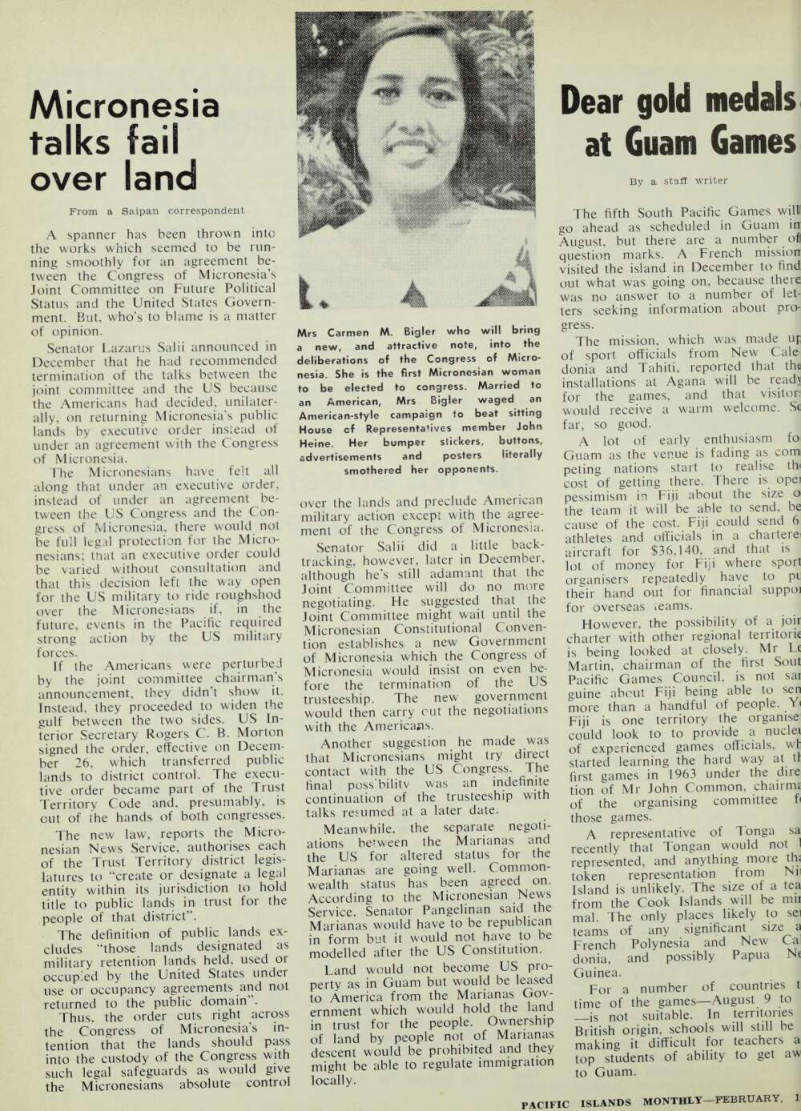
Mrs Carmen M. Bigler who will bring a new, and attractive note, into the deliberations of the Congress of Micro nesia. She is the first Micronesian woman to be elected to congress. Married to an American, Mrs Bigler waged an American-style campaign to beat sitting House of Representatives member John Heine. Her bumper slickers, buttons, advertisements and posters literally smothered her opponents.