Of 'Industrial Revolution’
pp. 12-13 · Read in the full issue
Western Samoa On Threshold
From FELISE VA’A in Apia
Industrialisation is emerging as one of the key issues in Samoan politics.
A prolonged trade deficit going back at least to 1961, and the more recent phenomenon of a regular balance of payments deficit is forcing the government to take a more realistic view of economic conditions.
Since the 19th century. Western Samoa's wealth depended largely on agricultural exports like coconut oil (later copra), cocoa, at one time cotton, and bananas.
At first, these exports were organised through the trading firms owned by Americans, British and Germans operating in Western Samoa during the 19th century.
Later, with the exception of the Western Samoa Trust Estates Cor poration (the remnant of a large German firm) individual Samoan planters and companies were re sponsible for the majority of these exports.
Up to about 1960, the country’s trade balance and balance of pay ments were very favourable. But this was so only because up to that time, import needs were quite simple as most Samoans (population 114,000 in 1961) lived on a subsistence basis.
After 1962, however, when Western Samoa became independent, needs became more complex as economic development, speeded up by foreign aid, primarily from New Zealand, advanced.
This resulted in the need for more imports. But, whereas the demand for imports of all sorts arose, agricul tural exports tended to decrease rapidly. The 1966 and 1968 hurri canes, which destroyed as much as 50 per cent of the crops, were only partly responsible. Temporary drops in overseas prices were also to blame, and poor motivation, despite the best efforts of the Agriculture Depart ment’s extension officers, was another factor.
Statistics show that the country’s trade balance has been deteriorating rapidly. In 1961 there was a deficit of 5W51,147,000; in 1965 a deficit of $2,414,000—5ti1l not too bad at all.
But five years later, the deficit had jumped to $6,400,000 and by 1972 it had reached the imposing figure of $9,658,000.
The following year, there was a
very minor drop in the deficit, and largely because of Finance Minister Saili’s economic belt-tightening, there may be a further reduction in the trade balance deficit in 1974.
But economic belt-tightening only relieves a situation. It does nothing to promote economic progress. Hence, the present Mataafa government cer tainly has every right to consider the question of industrialising the country, for Western Samoa is not yet a mem ber of the society of industrialised nations. It is still primarily an agri cultural exporting country, with almost 70 per cent of the work force employed in agriculture.
Industrialisation, however, is some thing new. True, there are some small industries in the country but they are far from sufficient to meet the country’s social and economic needs. So, the government is forced to turn to industrialisation in a big way.
And the present government does this through the idea of an industrial free zone. Overseas companies will be asked to set up business in the zone encouraged by generous incen tives like tax concessions, duty-free import of raw materials and favour able labour policies.
In turn, the government is expected to seek some shareholding in these companies. The zone will operate along lines similar to those used in Taiwan and other places in South east Asia.
When the measure for establishing such a zone was introduced in the Western Samoan Parliament towards the end of 1974, there was a lot of debate. The Opposition maintained that it was being introduced too soon as members had not had a chance to examine the new Five Year Economic Development Plan 1975-1979.
According to a report in the Samoa Times, “A bid by Lauofo Meti, MP, to delay the reading for six months failed, but not before a large number of members had fired a number of relevant questions to the Minister of Finance, Sam Saili”.
The government won by a comfort able majority (at least five votes) in putting the Industrial Free Zone Bill through its second reading. Later the bill passed third reading comfortably.
An industrial free zone for Western
Samoa, which was already beirr planned before the present goveri ment came into power in early 197! is now a certainty.
In retrospect and apart from th merits of the proposed free zone, tH Opposition scored a convincing pon when it protested against the ear; introduction of the bill before it hs a chance to examine everything ii volved, and its relationship to tf whole Five Year Development Pla< But it appears this was precise; what the government had intended to introduce the bill before everyoi is ready. And there is logic in The government feared that by givu the Opposition too much time to coc
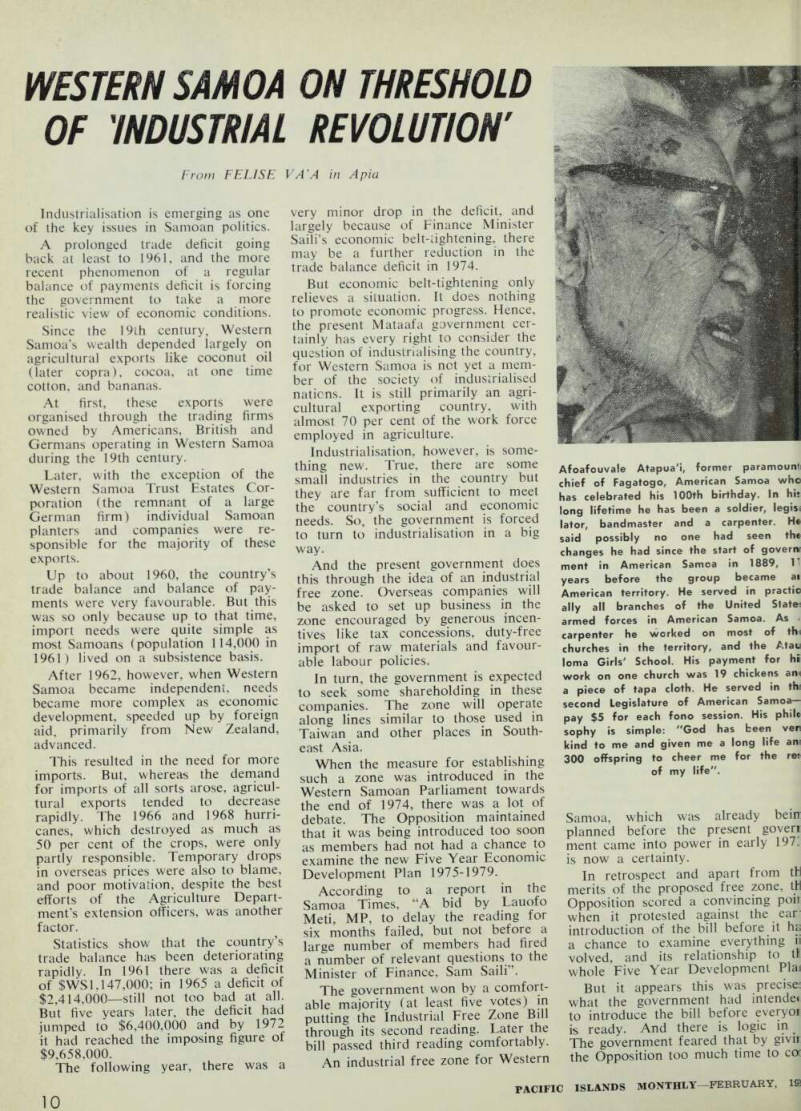
Afoafouvale Atapua'i, former paramount chief of Fagatogo, American Samoa who has celebrated his 100th birthday. In his long lifetime he has been a soldier, legist lator, bandmaster and a carpenter. He said possibly no one had seen the changes he had since the start of govern ment in American Samoa in 1889, 11 years before the group became a[?] American territory. He served in practio[?] ally all branches of the United States armed forces in American Samoa. As carpenter he worked on most of th[?] churches in the territory, and the Atau[?] loma Girls' School. His payment for hi work on one church was 19 chickens an[?] a piece of tapa cloth. He served in thr[?] second Legislature of American Samoa pay $5 for each fono session. His phil[?] sophy is simple: "God has been ve[?] kind to me and given me a long life an[?] 300 offspring to cheer me for the re[?] of my life".
sider everything involved, there may be difficulty in passing it.
Samoa’s prime ministers have found out from experience that at crucial moments they have been let down by parliament so they have tended to place their trust more in their own ingenuity to get things done.
This was not stated in the House, but the Finance Minister urged the members that the bill had to be passed in a hurry otherwise Western Samoa might miss out on the in dustrial aid promised by the NZ Gov ernment consisting of generous incen tives to New Zealand entrepreneurs to set up business in the islands (not just in Western Samoa).
“If we do not take this opportunity now, we may miss out to other South Pacific countries like Fiji or Tonga,” the minister said. The plea worked.
The government has jumped the first big hurdle towards the establish ment of a duty-free zone but its problems are far from being over.
The Opposition, for example, has pointed out that the establishment of such a zone would place a heavy burden on the country’s infra structural system.
There could be a need for more roads, another port, more power and more educational and health services for the many foreigners and their 'hildren who will be entering the country. Then, also, what did the government intend to do if these Jeople or their children born here ook up Western Samoan citizenship?
Would this mean the gradual dis >lacement of the Samoans from their >wn rightful heritage? Would they )e driven to the hills?
It is conceded that the Samoans vill have to pay a price with the ►amoan economy becoming more and nore a dependent one. The social tincture, customs and traditions may liter. J But to have a dependent economy s not a shame if this involves security or a people and a higher standard ® living. Social structure, customs nd traditions may be replaced by ven better ones but these will have o be sought out and cherished. , At the moment, therefore, Western amoa, a traditional society, stands >n the threshold of the 20th century -and it will enter once its politicians nd community leaders, if they are nse, recognise the importance and eed for industrialisation.
Whether this industrialisation is chieved through an industrial free one or other means is not so impor *nt but industrialisation will be. If ■ ls not accepted gracefully, it will M'ce itself on the Samoan people.