Pacific Islands Monthly
pp. 6-7 · Read in the full issue
Independence? No Such Word In
French -English Dictionaries!
From Jean-Eudes Barrier ,
former editor of the New Hebrides newspaper Nakamal.
The results of the recent London Conference have not failed to arouse the most enlivened and the most diversified debate in the New Hebri des. Relief all around as far as the European community is concerned: the word independence does not appear in any of the communiques or reports issued at the end of the minis terial discussions.
Mr Olivier Stirn, French Minister for Overseas Territories, in an inter view published in the very conserva tive Bulletin of the French Residence, states quite unashamedly “that it is quite useless to envisage any new abstract systems for the future”. And even that it must be “left to experi ence to judge if the measures taken are useful ones”. Actually, it would appear that certain of the Minister’s remarks were purely and simply cen sored by Mr Fabre, Chancellor at the French Residency! Mr Stirn’s words actually vaguely evoked the possi bility of independence for the Heb ridean archipelago. But looking well ahead, obviously—about 30 years off when all the preparatory stages have been gradually worked through.
This extremely cautious attitude of the French Government towards the burning question of independence is obviously nothing new. Such an atti tude has continually dominated the political thinking of the French Re sidency over recent months. By an extreme, if not systematic, neutralis ing of news, the French Residency has perpetually sought as much as possible to minimise the influence of those clamouring for independence, whose numbers have increased throughout the territory over the past two years. And what is the result?
It is obvious that the thought of a “premature independence” had, until recently, considerably disturbed even the projects of European business operators. On this matter the Lon don Conference has helped to dispel much torment.
As far as the National Party is concerned, first reactions seem to indicate there are differences of opinion. The president, the Rev Walter Lini, did not hide his satis faction at the outcome of the London discussions. He said he was particu larly concerned about the strict and speedy execution of what is com monly known in Vila as “the pro gramme of democratising the poli tical institutions”. This attitude of Father Lini, reflected in a speech he made during a meeting specially organised by the National Party for public discussion on the democratis ation programme, was in striking contrast to the attitude later adopted by the fiery Kalkot-Matas Mele, a student at the University of Papua New Guinea in Port Moresby.
“The decisions made in London meet a large proportion of our major demands; let us get to work” say the
elders of the National Party. Kalkot- Matas does not seem to share their view: “There are 90,000 of us New Hebrideans. Not one of us was in vited to attend this conference. Is that the meaning of the highly vaunted white democracy?” was his message before an audience delighted with such impertinence.
According to observers, Walter Lini today leads the so-called moder ate faction of the National Party, anxious to maintain a continuing dialogue with the administration and, no doubt, gain a good number of seats in the future legislative assem bly through the system of universal suffrage which has just been outlined.
Kalkot-Matas is content, for the time being, to channel off and build up all the resentment of an ambitious younger generation which is frus trated, and muzzled by the powers of an “imported” society to which it does not happen to belong and which, henceforth, it rejects com
pletely.
As for the parties directed by a handful of Europeans, the UCNH and the MANH, are they going to exaggerate, on the eve of the first true elections, the internal conflicts in the National Party? Certainly such a strategy would not lead them very far. For after all, it is only a matter of a difference in approach, which should do nothing to alter the ulti mate objective always pursued by the National Party—the political in dependence of the archipelago. This independence should naturally lead to a decision over the economic op tions to be followed, as worked out by the New Hebrideans themselves.
The UCNH, the MANH and Jimmy Stevens’ Na Griamel have recently come to an agreement to co-operate to increase their strength against the National Party. But without the numerical support of the Na Griamel, the other two parties formed in Vila and Santo to oppose
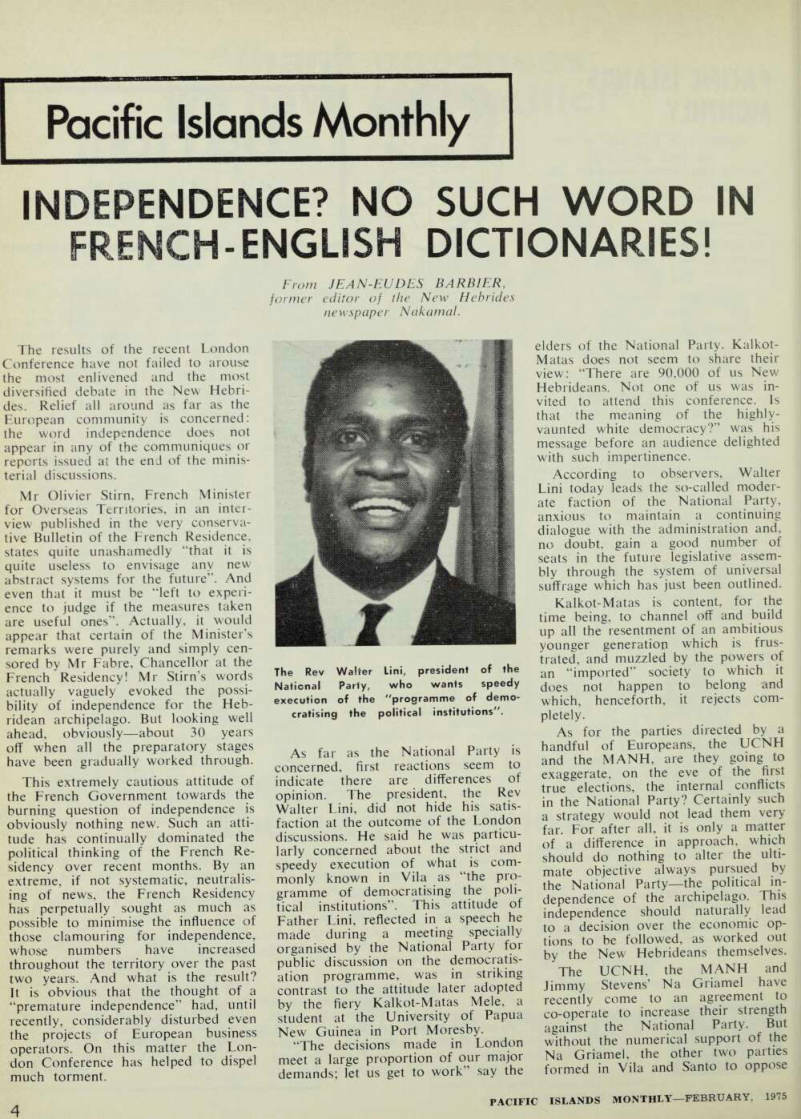
The Rev Walter Lini, president of the National Parly, who wants speedy execution of the "programme of demo
cratising the political institutions".
the rise in the independence move ment, would represent nothing but minority interests.
It has been recently rumoured that Kalkot-Matas will make an informa tion and propaganda tour through out the territory. The young man is not unaware of the fact that a com munity’s move towards independence must depend on the unification of its town and country dwellers.
It is not unlikely that, in the near future, Kalkot-Matas will find sym pathisers in Na Griamel, especially among the young members, prepared not to reject an alliance with the National Party.
A union of the two large Mela nesian groups is essential.
The alternatives for the white population would then be quite simple: either to collaborate, without pretence, with the Melanesian elite, and, of course, accept their domi nation; or else leave the New Heb rides, without hope of returning. • The National Party’s target date for independence for the New Heb rides is 1977. The party’s president, the Rev Walter Lini, held a series of meetings on Tanna in December, stressing at each that the party ex pected to “keep the date”.