Air Pacific Feels The Squeeze
pp. 105-107 · Read in the full issue
Chris Ritchie did not take long to make his presence felt when he re turned to Fiji early in April as general manager of Air Pacific. He immediately warned a fare increase was inevitable because of a 100 per cent rise in fuel costs, and that the airline would apply for further in creases with each rise in the price of fuel.
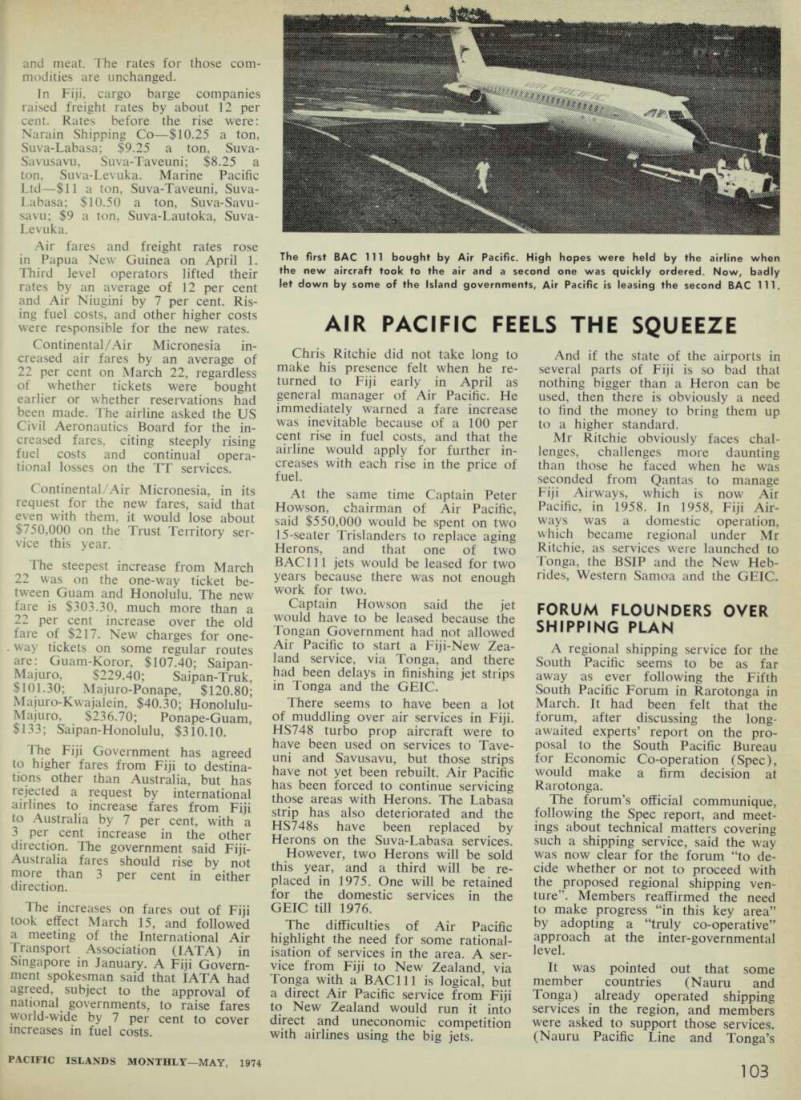
At the same time Captain Peter Howson, chairman of Air Pacific, said $550,000 would be spent on two 15-seater Trislanders to replace aging Herons, and that one of two BACIII jets would be leased for two years because there was not enough work for two.
Captain Howson said the jet would have to be leased because the Tongan Government had not allowed Air Pacific to start a Fiji-New Zea land service, via Tonga, and there had been delays in finishing jet strips in Tonga and the GEIC.
There seems to have been a lot of muddling over air services in Fiji.
HS74B turbo prop aircraft were to have been used on services to Tave uni and Savusavu, but those strips have not yet been rebuilt. Air Pacific has been forced to continue servicing those areas with Herons. The Labasa strip has also deteriorated and the HS74Bs have been replaced by Herons on the Suva-Labasa services.
However, two Herons will be sold this year, and a third will be re placed in 1975. One will be retained for the domestic services in the GEIC till 1976.
The difficulties of Air Pacific highlight the need for some rational isation of services in the area. A ser vice from Fiji to New Zealand, via Tonga with a BACIII is logical, but a direct Air Pacific service from Fiji to New Zealand would run it into direct and uneconomic competition with airlines using the big jets.
And if the state of the airports in several parts of Fiji is so bad that nothing bigger than a Heron can be used, then there is obviously a need to find the money to bring them up to a higher standard.
Mr Ritchie obviously faces chal lenges, challenges more daunting than those he faced when he was seconded from Qantas to manage Fiji Airways, which is now Air Pacific, in 1958. In 1958, Fiji Air ways was a domestic operation, which became regional under Mr Ritchie, as services were launched to Tonga, the BSIP and the New Heb rides, Western Samoa and the GEIC.
Forum Flounders Over
Shipping Plan
A regional shipping service for the South Pacific seems to be as far away as ever following the Fifth South Pacific Forum in Rarotonga in March. It had been felt that the forum, after discussing the long awaited experts’ report on the pro posal to the South Pacific Bureau for Economic Co-operation (Spec), would make a firm decision at Rarotonga.
The forum’s official communique, following the Spec report, and meet ings about technical matters covering such a shipping service, said the way was now clear for the forum “to de cide whether or not to proceed with the proposed regional shipping ven ture”. Members reaffirmed the need to make progress “in this key area” by adopting a “truly co-operative” approach at the inter-governmental level.
It was pointed out that some member countries (Nauru and Tonga) already operated shipping services in the region, and members were asked to support those services. (Nauru Pacific Line and Tonga’s
The first BAC 111 bought by Air Pacific. High hopes were held by the airline when the new aircraft took to the air and a second one was quickly ordered. Now, badly let down by some of the Island governments. Air Pacific is leasing the second BAC 111.
Pacific Navigation Co Ltd already operate services for forum members from Australia to Nauru, Fiji, Western Samoa and Tonga). It was also said that other members were not well-served by available ship ping.
The forum agreed, as a first step, to set up a regional shipping council, consisting of ministers or their repre sentatives from all forum members.
This council would, through Spec, organise necessary studies and in vestigations which would be needed so that the forum could decide whether to set up a regional shipping service, and take other practical steps to improve the region’s shipping services.
Spec will do the ground-work in setting up the council, and will also prepare a report on future action to be considered at the forum’s next meeting. (This will be a report on the Spec report, which was based on a United Nations report on a re gional shipping service).
Nauru was doubtful about the financial aspect of setting up a regional line. Where would the various governments raise the money?
Would they guarantee finance, or ask banks to give guarantees? Nauru also suggested that a regional line could be based at Honiara, but the Spec report suggested Fiji.
The director of Spec, Mr Mahe Tupouniua, said any organisation or corporation set up to run a regional service would have to decide how to raise the necessary finance. Only governments could guarantee loans.
Senator Don Willesee, Australia’s Minister for Foreign Affairs, said it was too early for the forum to de cide on setting up a regional shipping line. Australia accepted there was an urgent need for a more satisfactory shipping arrangement, and would continue to help in preliminary studies.
The Prime Minister of Fiji, Ratu Sir Kamisese Mara, was in the chair during much of the discussion about a regional line, and did not advance any views, or comment on the views of other speakers.
President Deßoburt showed his memory of the unhappy Enna G affair when the ship was “blacked” n Wellington in 1973, had not dim med. He appealed to New Zealand o help Tonga and Nauru to operate mccessful services. That help was uta m securing wharf berths, mnkers and other services.
New Zealand is ready to’ help, but whether she can bring the recal itiant maritime unions into line is mother matter.