Pacific Transport
pp. 101-103 · Read in the full issue
Shippers' Blistering Attack On
Micronesian Port Handling
The exasperation of principal San Francisco suppliers with the “chaotic” conditions of Micronesian ports and services, and the lack of government support in righting serious deficien cies, erupted late in March when the suppliers sent a blistering letter to Washington.
It was addressed to Mr S. S.
Carpenter, director of the US Office of Territorial Affairs, in the Depart ment of Interior, and referred to Trust Territory negligence, and instances of fraud, worthless gua rantees and large financial losses that have affected shippers.
They sent copies of the letter to several shipping lines, one of them being the Nauru Pacific Line, which is launching a new service from San Francisco to Majuro and Ponape, and another service from Australia
via New Guinea to Guam and Ponape with chartered ships (see story later in this section).
The other shipping lines to receive a copy were Daiwa Line, Nanyo Poeki Kaisha and Shinyo Koeki Kaisha.
Others to receive a copy of their letter were the High Commissioner for the Trust Territory, Mr Edward E. Johnston, the Maritime Admini stration in Washington, the Trustee ship Council of the United Nations, and a stevedoring company in the Philippines.
The suppliers are Albatross Trading Co Inc, Ansor Corporation, California Pacific Associates, Campa Mercantile Inc, Connell Bros Co Ltd, Carlton J.
Siegler and Pacific International Rice Mills, all of San Francisco.
The Trust Territory Government
gave vague assurances about moving cargo after withdrawal of the Trans pac franchise. An interim service pending more permanent arrange ments for some replacement of the Transpac services is urgently needed.
This is what the suppliers wrote to Mr Carpenter: We find that for over 10 years we have been subjected to repeated sub stantial losses in Micronesia because of the inability of the Trust Territory Government to establish, conduct and enforce certain accepted rules of international commerce. All Micro nesian importers have similarly suf fered very large losses and we learn that suppliers from Japan, Australia and other areas have experienced similar difficulties.
These total losses have been ex tremely large and have had a very adverse bearing upon the economic development of the Trust Territory.
Each of the various shipping lines has failed to provide a workable transportation service to Micronesia with disastrous effect upon the economy.
In every instance these shipping lines have not been able to discharge the terms of an ocean bill of lading.
These terms are clearly defined in the Act of Carriage of Goods by Sea enacted by the Congress of the United States and recognised as the basis of international trade in every country of the world except in Micro nesia. The problems of the shipping lines have been magnified by the chaotic conditions existing in the ports of Micronesia which have pre vented them from delivering cargo in accordance with the terms of the legal shipping documents.
It is our understanding that while the shipping lines made some feeble attempts to enforce their obligations, they could never gain the support of the government. This can be attributed to the lack of trained personnel, lack of adequate port facilities and to political expediency. Indeed, while in numerous cases the terminals default ed in their obligation to the shipping
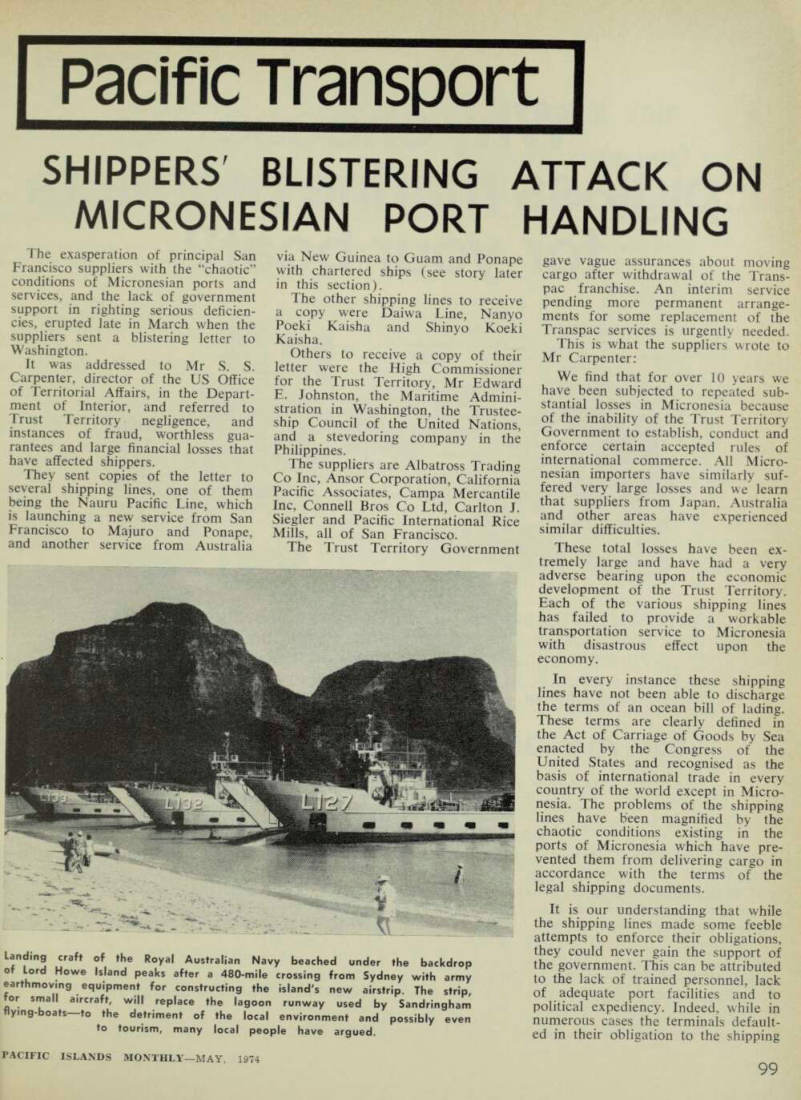
Landing craft of the Royal Australian Navy beached under the backdrop of Lord Howe Island peaks after a 480-mile crossing from Sydney with army earthmoving equipment for constructing the island's new airstrip. The strip, for small aircraft, will replace the lagoon runway used by Sandringham flying-boats to the detriment of the local environment and possibly even to tourism, many local people have argued.
lines, we do not know of one single case where any attempt was made to recover documented cases of fraud or negligence.
Consequently, the shipping lines have been helpless to provide a normal flow of commerce. They also have been unable to provide basic documentation and paper work necessary to the operation of a shipping service. The terminals are not bonded and generally have not carried any responsibility or rendered the services necessary to any shipping line.
Extremely large losses are so prevalent as to have become routinelv accepted in the islands without any possibility to establish responsibilitv due to the lack of documentation.
Too often worthless guarantees or valueless cheques are accepted by terminals in lieu of proper legal documents.
Fvnnrtprc oc • Exporters as well as consignees in Micronesia are very seldom if ever fries 0 t ° 4 , ,l eir in -
municatiom Ti lhp SSnA* COm ‘
t t . S sb |PP in S lines or ma ° n Dep “ tment re ‘ ma '" una n swe red. i\ew shipping arrangements are presently being made and several new compames will be enticed to carry cargo to Micronesia. They will no doubt expect to encounter normal
port conditions, good experienced management and personnel, sufficient docks and warehouses to handle cargo. Instead, they will encounter tbe same problems which have existed f° r man y years unless the government can Provide and enforce a commercial code and facilities that will render a normal operation possible, The Trust Territory and its Depart ment Transportation and Com rnunication have failed to discharge the ter ms of the UN Trusteeship Agreement, not only in providing ade , quate shipping necessary to this V u St ?5 ea , but also m . esta blishing shore3lde laws and organisation neces- ? ar 7 • or the last and most im Portant lin * m a transportation system.
Tour early consideration of this urgent problem would be appreciated, as . we . feel that Prompt remedial action is necessary for us to insure the continued supply of the Islands 0 f Micronesia a further story from Norfolk Island ‘ells of Say!™” “ ll ? n indignation, at the growth of pilferage of cargoes arriving at the « seems 8 that thieves ha« taken , he hitherto avoided road of tampering with her Majesty’s mails, Fifteen bags of mail had mysteri ously been opened on the Slevic in March, and goods valued at over $2,000 were missing.
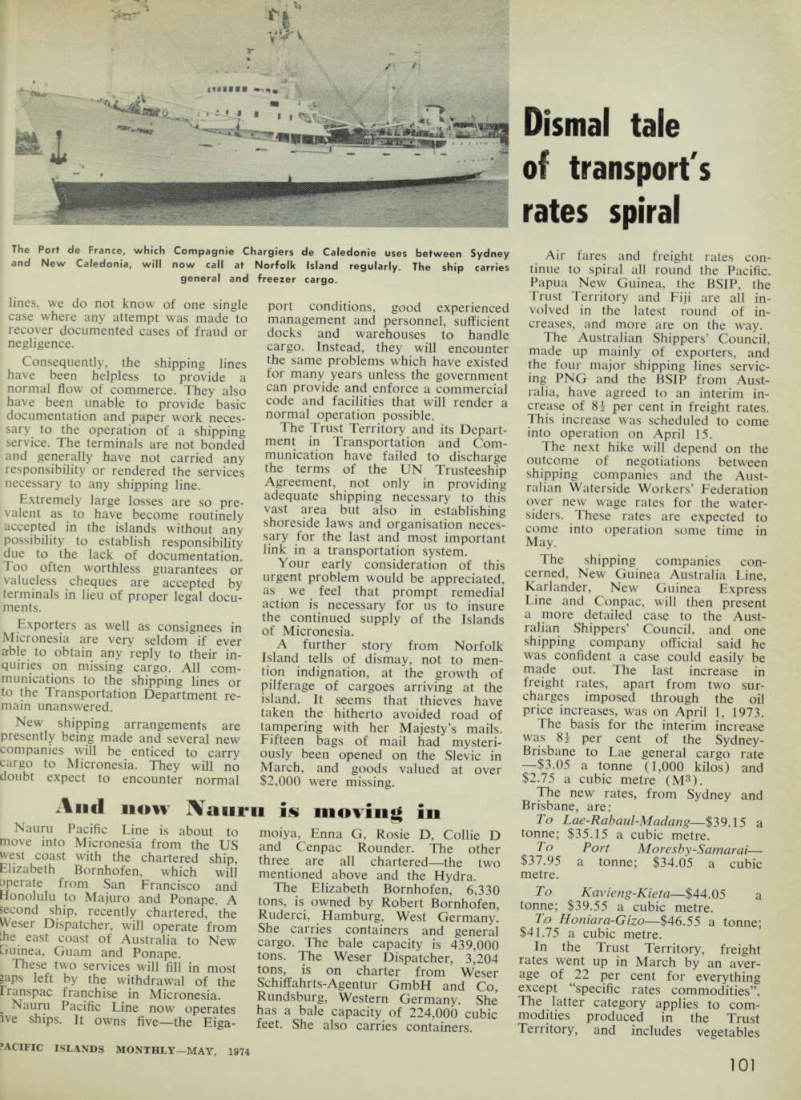
The Port de France, which Compagnie Chargiers de Caledonie uses between Sydney and New Caledonia, will now call at Norfolk Island regularly. The ship carries general and freezer cargo.