Books, Reviews, Writers
pp. 93-95 · Read in the full issue
John Bates Thurston, The Man
Behind A Shaky Fijian Throne
This is a fitting year for the publi cation of a biography of John Bates Thurston.
October 10 is the centenary of the signing of the Deed of Cession, by which sovereignty over the islands of Fiji passed, at the declared wish of Cakobau and his fellow chiefs, to the British Crown.
As chief minister in the Cakobau Government which preceded cession, as chief secretary and auditor-general in the first Colonial governments, and finally as the new colony’s third governor, Thurston exerted strong and continued influence in Fiji affairs at a critical time.
The first part of a two-volume bio graphy by Deryk Scarr is entitled I the Very Bayonet, from a nickname comparing Thurston’s driving force with that in the sting at the end of the ray’s pointed tail (hence, by derivation, a bayonet).
When the direction of the drive turned in the 1870 s against European demands for domination in the gov erning of Fiji, it came to be bitterly resented by many of Thurston’s fellow settlers. This resentment is the domi nant theme—almost to the point of obsession—in this volume of Dr Scarr’s book.
Cakobau had another interpretation for the nickname. In this, Thurston was the “pilot fish” who explored the way ahead and then led the chiefs along a recommended path.
At the formal signing of the Deed of Cession, Cakobau spoke of Thurs ton to Queen Victoria’s representa tive, Sir Hercules Robinson.
“He has a good many enemies who will not hesitate to say all bad things of him but ... he is a good man, and has been a faithful servant to me, and to Fiij and my people. He is the one man whom I trust before anyone else and the chiefs repose en tire confidence in him.”
Thurston came to Fiji from England after a wide-ranging sea career of some distinction. But he was always a man of wide interests, and it was his enthusiasm for botany that was the direct cause of his arrival in Levuka.
Through prolonging his search for specimens on the island of Rotuma, he delayed the ship in which he was travelling. During the delay, a storm sprang up and the ship was wrecked.
He then found a berth in a mission schooner and his travels about Fiji gave him detailed knowledge of the islands and increasing regard for the Fijian people. In Levuka he found a former shipmate in the British Consul, Captain Jones, VC, and as a result became the consul’s assistant, and eventually acting consul when Jones was transferred from Fiji with out the immediate appointment of a successor.
This was when Thurston first be came a political force. A notable achievement was to block the path of the speculators of the Melbourne based Polynesian Company who offered to pay the American debt which plagued Cakobau, but who asked, in return, to be given 200,000
acres of Fiji’s land—in effect the ownership of the country.
Thurston’s ability and integrity in the consul’s post impressed Levuka’s traders and laid the foundations for Cakobau’s confidence.
He seemed a natural for permanent appointment as consul, but distant London decreed otherwise and when Marsh, a man of far lower calibre, appeared at Levuka, a disappointed TTiurston left the consulate to become a planter—first at Bureta, on the other side of Ovalau from Levuka, and then at the northern end of Taveuni.
Here a strong friendship with the Tui Cakau and his family deepened his interest in Fijian affairs and his love for the Fijian people.
In 1871 he returned to Levuka from a labour-recruiting trip (with some botanical research and photo graphy on the side) to the New Hebrides, to find the Cakobau Gov-
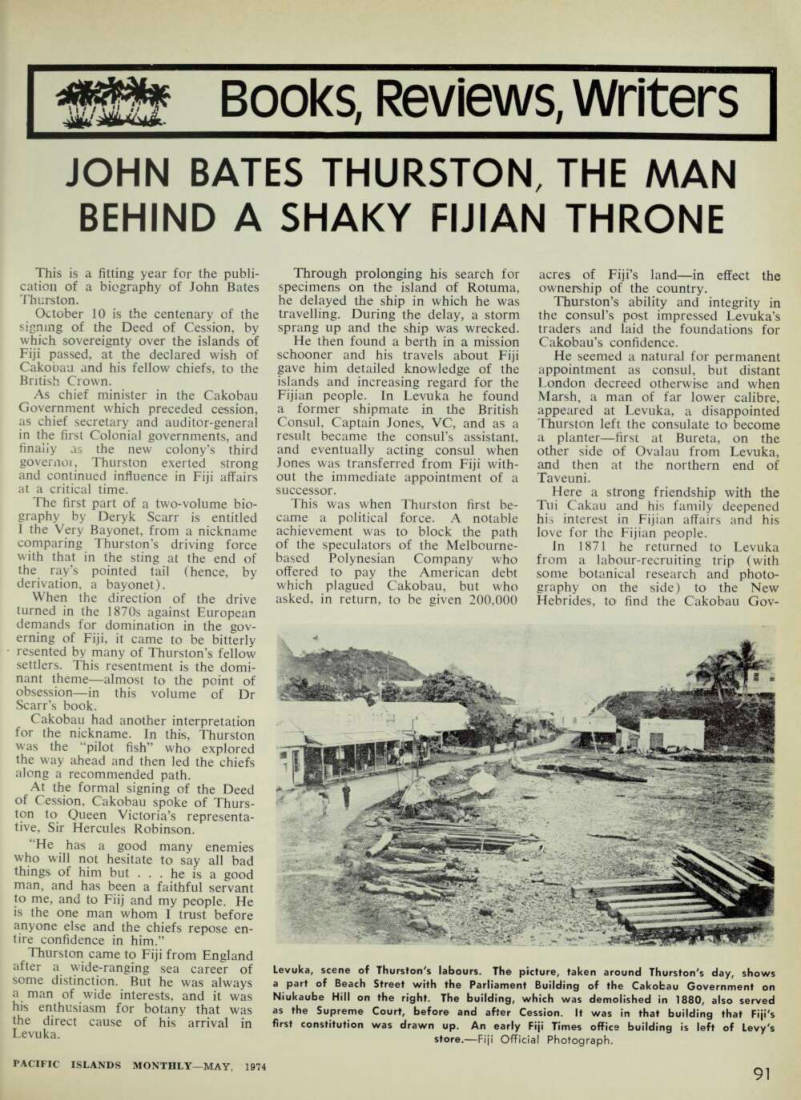
Levuka, scene of Thurston's labours. The picture, taken around Thurston's day, shows a part of Beach Street with the Parliament Building of the Cakobau Government on Niukaube Hill on the right. The building, which was demolished in 1880, also served as the Supreme Court, before and after Cession. It was in that building that Fiji's first constitution was drawn up. An early Fiji Times office building is left of Levy's store. — Fiji Official Photograph.
ernment, which had been formed by Lt George Woods and associates of decidedly-mixed calibre, in disarray and disrepute. Its nominal authority by this time ran throughout Fiji and it offered the opportunity of a unified country. But extravagance, in experience and obvious self-seeking on the part of some of the ‘ministers’ had bought it to a low ebb.
When Thurston was elected by his fellow planters to represent North Taveuni in Parliament he agreed, but only after much persuasive pressure crowned by an urgent appeal from Cakobau himself, to give up his satis fying plantation life to return to full time politics, not just as a simple member of parliament but as head of the government.
The Fiji Times acclaimed him as “a man in whom the whole of Fiji reposes confidence owing to his career while representing Great Britain.”
There were soon no more such kind words from this source, and in succeeding months an opposition that developed into near-hatred grew among the majority of the 2,000 or so Europeans in Fiji who felt themselves betrayed by one of their own kind.
No man in high office is universally popular, but the basic cause of the settlers’ condemnation of Thurston was that he consistently and effectively opposed any government for Fiji that would have placed power exclusively in European hands.
There were other grievances, too, the growing cost of government and official ineptitude prominent among them, but the author of I the Very Bayonet paints the conflict between Thurston and his fellow-settlers as an
almost-unrelieved picture of goodies and baddies or, rather, one goody against a body of baddies with the arch-villain, the “racist editor of the Fiji Times”, as their virulent mouth piece.
But things are never quite as simple as that and name-calling labels are no real substitute, in a historian, for a detached and balanced view of the whole scene.
In present-day eyes, the settlers’ demand for domination was in defensible, and Thurston did Fiji a service of immeasurable value by his stand. But equally indefensible was the Cakobau Government’s law that Fijians defeated in battle and ad judged rebels should be leased out as plantation labour.
Thurston found this legislation of slavery embarrassing.
The Fiji Times on the other hand, as Dr Scarr records, had “denounced the measure from the start”.
In writing of the disastrous measles epidemic of 1875, the author declares that Thurston “found the Fiji Times insinuating that he had connived the epidemic’s introduction with intent to decimate the Fijians”.
Dr Scarr gives no authority for this allegation of venomous irresponsi bility, but a search of the Fiji Times files leaves little doubt that he is re ferring to the editorial of February 24, 1875.
This is, as was characteristic of the times, of inordinate length and written in the style of the period when Disraeli described Gladstone as “intoxicated with the exuberance of his own verbosity”.
It appeared at the height of the epidemic that was then bringing death to growing thousands in Fiji, and sought to find the cause of the disaster.
Had the captain of HMS Dido, which bought Cakobau and his en tourage back from Sydney, failed to notify Levuka port authorities that there were cases of infectious disease aboard? If the health authorities were so informed, why were Fijians allowed to swarm aboard to welcome the returning chiefs, and then to gather in crowds at Nasova to con tinue the welcome?
Why, in particular, had the govern ment chartered a vessel to return the welcomers to homes on other islands, and so spread the disease so devas tatingly throughout the group?
In the one direct reference to Thurston, the editorial comments, with heavy-handed sarcasm, that if the dispatch of the chartered ship was not part of Thurston’s new native
policy, “which we venture to> say is in slight opposition to that of Mr Swanston” and contrary to missionary precepts, then “we fail to recognise the causes, either immediate or dis tant, that have weighed on the great brain of our Colonial Secretary and caused him, like Voltaire of old, to ignore until too late the dictates of Christianity and all recognition of a superior Being”.
This is ponderous stuff, but it is not the same as “rabidly insinuating” that Thurston “connived the epi demic’s introduction” with the aim of “decimating the Fijians”.
The great value (and it is great indeed) of I the Very Bayonet is not in its judgments, either on men or events, but in the massive research that has gone into the book.
When some day somebody writes a more rounded and human study of a truly remarkable man, whose ability and influence served Fiji so well at a major turning point in her history, I the Very Bayonet will be an indis pensable treasure house of reference.
L. G. Usher.
(I The Very Bayonet, By Deryk
Scarr, Australian National University Press, Canberra, ACT, Australia. Price $10.95.)
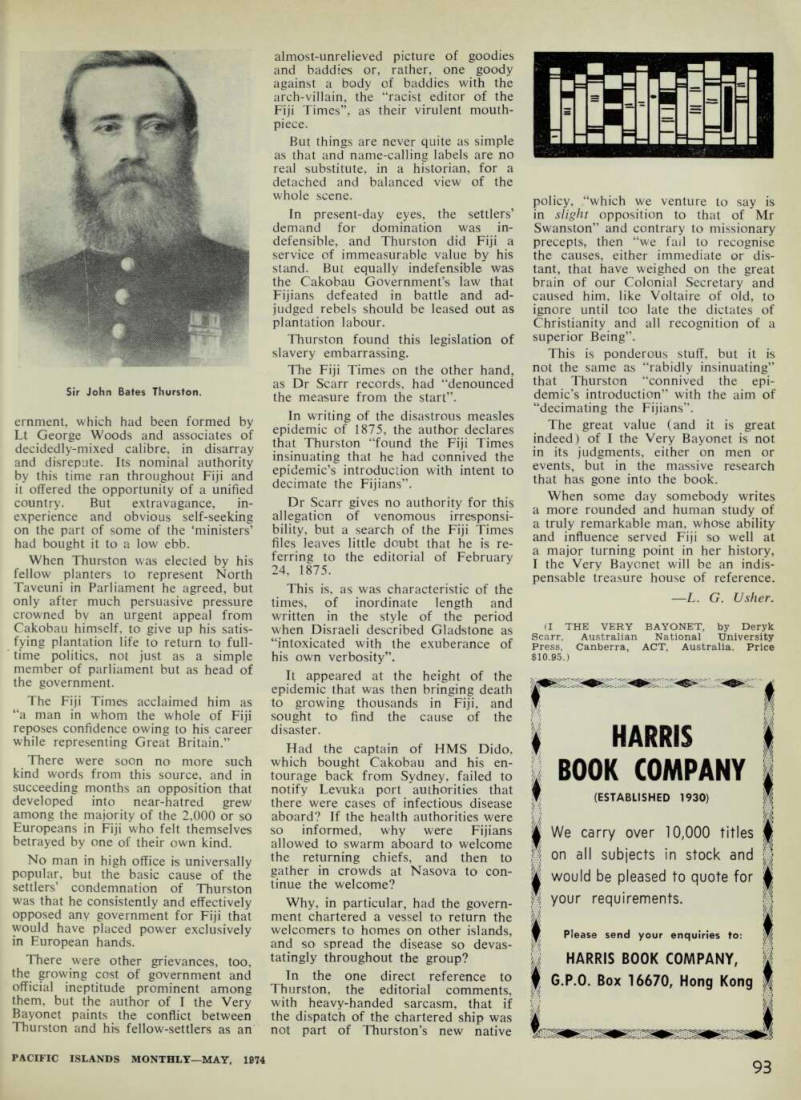
Sir John Bates Thurston.