Literature Bureau
pp. 89-90 · Read in the full issue
Papua New Guinea’S
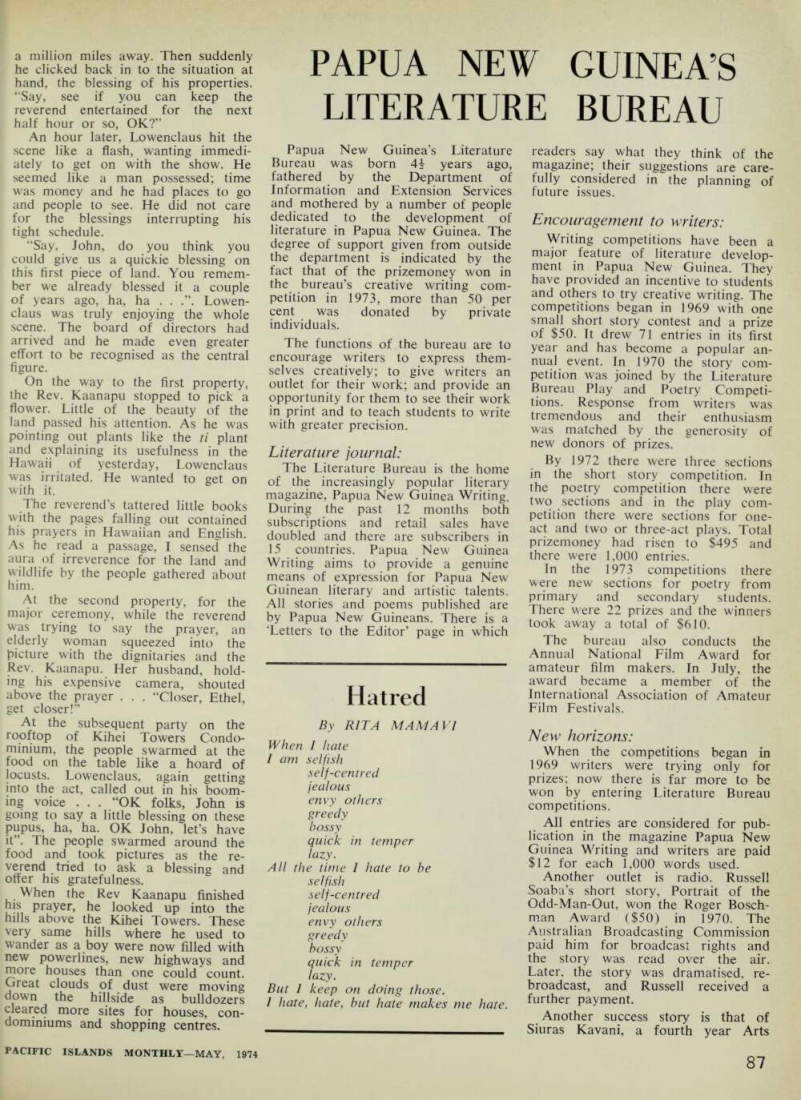
Papua New Guinea’s Literature Bureau was born 4\ years ago, fathered by the Department of Information and Extension Services and mothered by a number of people dedicated to the development of literature in Papua New Guinea. The degree of support given from outside the department is indicated by the fact that of the prizemoney won in the bureau’s creative writing com petition in 1973, more than 50 per cent was donated by private individuals.
The functions of the bureau are to encourage writers to express them selves creatively; to give writers an outlet for their work; and provide an opportunity for them to see their work in print and to teach students to write with greater precision.
Literature journal:
The Literature Bureau is the home of the increasingly popular literary magazine, Papua New Guinea Writing.
During the past 12 months both subscriptions and retail sales have doubled and there are subscribers in 15 countries. Papua New Guinea Writing aims to provide a genuine means of expression for Papua New Guinean literary and artistic talents.
All stories and poems published are by Papua New Guineans. There is a ‘Letters to the Editor’ page in which
readers say what they think of the magazine; their suggestions are care fully considered in the planning of future issues.
Encouragement to writers: Writing competitions have been a major feature of literature develop ment in Papua New Guinea. They have provided an incentive to students and others to try creative writing. The competitions began in 1969 with one small short story contest and a prize of $5O. It drew 71 entries in its first year and has become a popular an nual event. In 1970 the story com petition was joined by the Literature Bureau Play and Poetry Competi tions. Response from writers was tremendous and their enthusiasm was matched by the generosity of new donors of prizes.
By 1972 there were three sections in the short story competition. In the poetry competition there were two sections and in the play com petition there were sections for one act and two or three-act plays. Total prizemoney had risen to $495 and there were 1,000 entries.
In the 1973 competitions there were new sections for poetry from primary and secondary students.
There were 22 prizes and the winners took away a total of $6lO.
The bureau also conducts the Annual National Film Award for amateur film makers. In July, the award became a member of the International Association of Amateur Film Festivals.
New horizons: When the competitions began in 1969 writers were trying only for prizes; now there is far more to be won by entering Literature Bureau competitions.
All entries are considered for pub lication in the magazine Papua New Guinea Writing and writers are paid $l2 for each 1,000 words used.
Another outlet is radio. Russell Soaba’s short story, Portrait of the Odd-Man-Out, won the Roger Bosch man Award ($5O) in 1970. The Australian Broadcasting Commission paid him for broadcast rights and the story was read over the air.
Later, the story was dramatised, re broadcast, and Russell received a further payment.
Another success story is that of Siuras Kavani, a fourth year Arts
student at the University of Papua New Guinea. In 1972 he entered both the short story and the poetry competitions and won the top prize ($5O) in each! His winning story was published in the national daily news paper the Post-Courier, and in Papua New Guinea Writing, for two further payments. Then the story was selected by the ABC for radio dramatisation which gave Siuras another payment.
Meanwhile his winning poem was both published and broadcast.
Just peeping over Papua New Guinea’s literary horizon is another
exciting medium, the motion picture.
The Film Unit of the Department of Information and Extension Services is considering stories from Papua New Guinea Writing with a view to making them into dramatic films.
Courses: Each year the Literature Bureau conducts Creative Writing courses in districts where they have been re quested. Students are pre-selected from each secondary school and sent to the main district centre where the class of 20 or 30 is tutored in poetry, fiction and drama.
Staff:
The officer in charge of the Literature Bureau and editor of Papua New Guinea Writing is Roger Boschman. Working with him and rapidly learning the work of the bureau is assistant editor, Jack Lahui.
A graduate of Sogeri Senior High School, Jack did further in-service studies at the Administrative College.
He is best known as a poet; his work has been published in Overland, Poetry Australia and the book Modern Poetry from Papua New Guinea as well as in Papua New Guinea Writing. In 1971 and again this year, Jack attended the Poetry
from the South Pacific seminar held at Macquarie University in Sydney.
Jack pays particular attention to poetry submitted for publication but is also taking on responsibility for all facets of the work of the bureau.
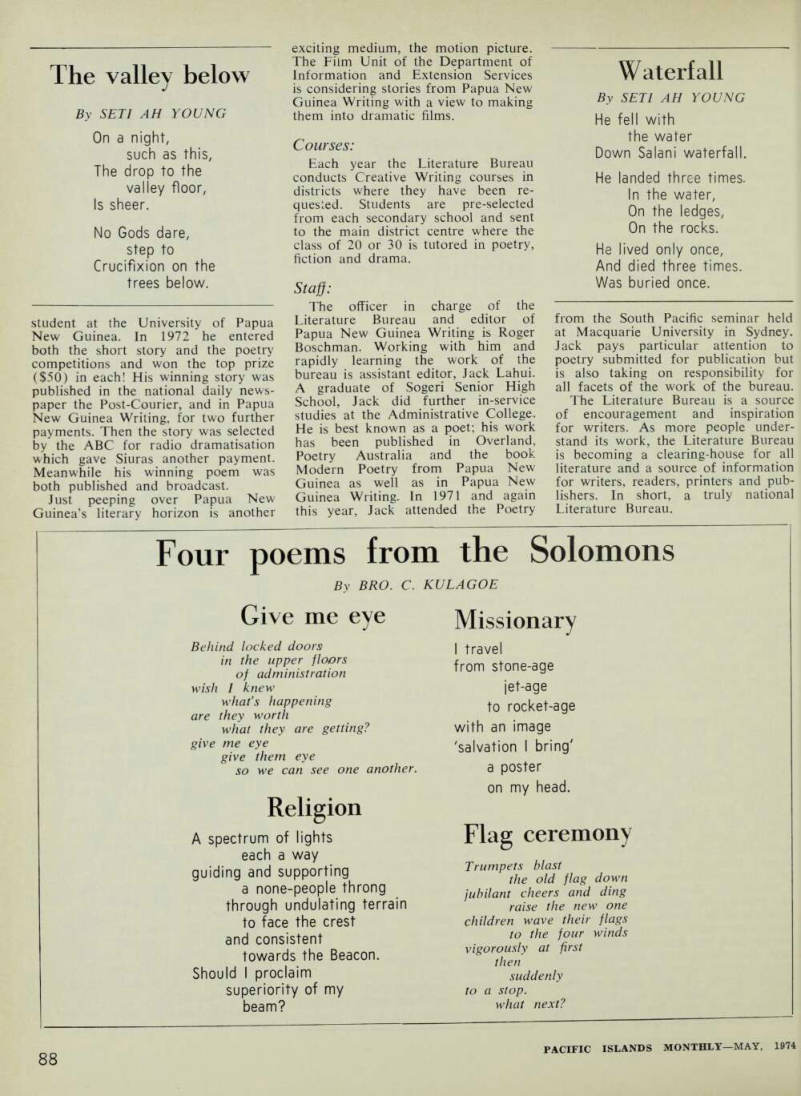
The Literature Bureau is a source of encouragement and inspiration for writers. As more people under stand its work, the Literature Bureau is becoming a clearing-house for all literature and a source of information for writers, readers, printers and pub lishers, In short, a truly national Literature Bureau.