A political
pp. 43-45 · Read in the full issue
groundswell in the New Hebrides
From Kalkot Matas-Kele Political parties are playing an in creasingly active role in the New Hebrides. At the present time there are no less than four parties vying for the support of the population and doing their best to influence national developments.
Of these, only one, the New Heb rides National Party, the first to be formed, reflects predominantly Me lanesian interests rather than those of the New Hebrides’ foreign com munity. It was established in August 1971 and made its first public ap pearance with a demonstration against land speculation. The National Party’s main aims were ex pressed as “the advancement of New Hebrideans socially, educationally, economically and politically in re lation to New Hebridean culture and western civilisation”. By the end of 1971 the party had the support of 1,000 Melanesian members, mainly in the towns of Vila and Luganville.
Another party which was formed in 1971 was the Union de la Population des Nouvelles-Hebrides (UPNH) which emerged in Decem ber. Although the organisers of UPNH were French colons, some three-quarters of the estimated party membership of 200 were Mela nesians, mainly French-educated and including a significant number of small businessmen and taxi operat ors. In contrast to the National Party, which openly seeks radical changes to the political structures, UPNH advocates the continuation of the condominium and the intro duction of a number of moderate reforms.
By February 1974, some influen tial members of UPNH, dissatisfied with the Melanesian orientation, which their party had been taking,
had dissociated themselves from the party and formed the Union des Communautes des Nouvelles-Hebrides (UCNH). The primary interests of this newest party are openly connected with the local and foreign communities of the New Hebrides, not only French but including Americans, Australians and New Zealanders. The party’s aims include legal reforms and the maintenance of law and order—but with no recognition of the need for political changes or of Melanesian political rights.
Instead, UCNH hopes to gather Melanesian support through its general aim of involving (in its own words) “all the communities in the New Hebrides in the affairs of the archipelago”, The fourth party, also formed this year in January, is the Mouvement Autonomiste des Nouvelles-Hebrides (MANH). The party is even more clearly a French planters’ party than UCNH and its interests are directed towards the evolution of a political system in the New Hebrides similar to that already operating in New Caledonia and French Polynesia.
Both MANH and UCNH, essentially foreign parties, are currently canvassing for Melanesian support in an attempt to broaden the bases of their parties.
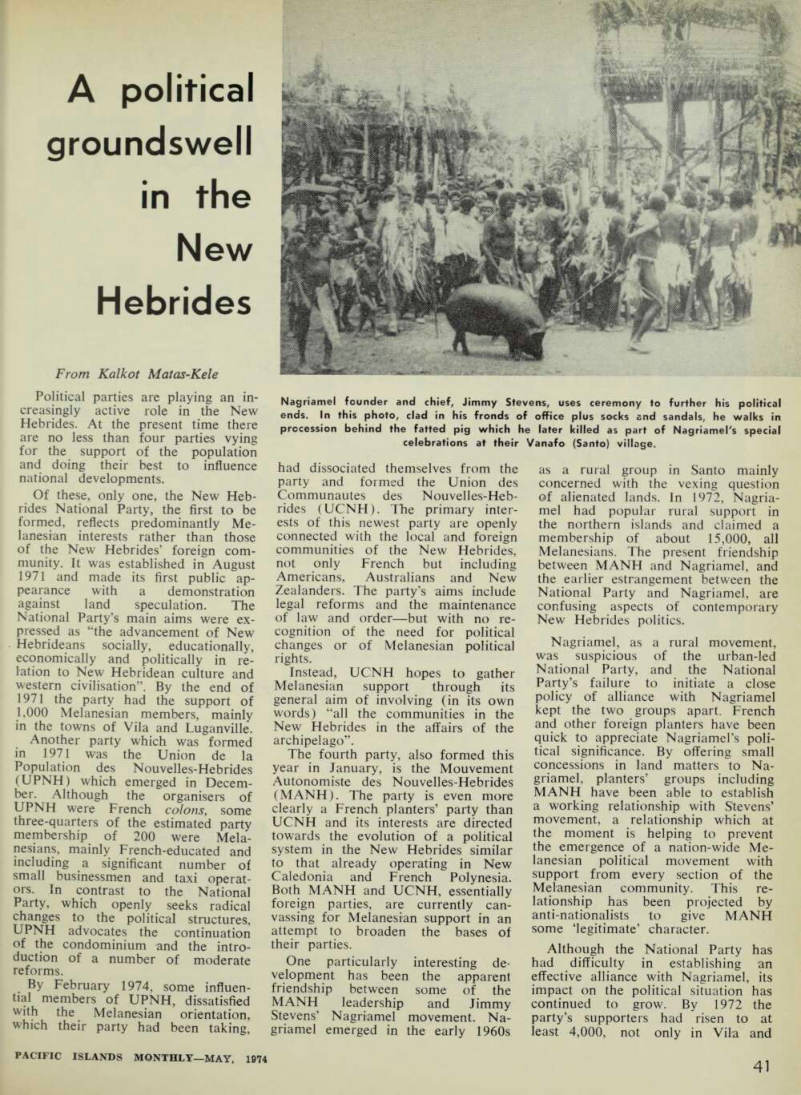
One particularly interesting development has been the apparent friendship between some of the MANH leadership and Jimmy Stevens’ Nagriamel movement. Nagriamel emerged in the early 1960 s
as a rural group in Santo mainly concerned with the vexing question of alienated lands. In 1972, Nagria mel had popular rural support in the northern islands and claimed a membership of about 15,000, all Melanesians. The present friendship between MANH and Nagriamel, and the earlier estrangement between the National Party and Nagriamel, are confusing aspects of contemporary New Hebrides politics, Nagriamel, as a rural movement, was suspicious of the urban-led National Party, and the National Party’s failure to initiate a close P° lic y of alliance with Nagriamel ke Pt the two groups apart. French an ? other foreign planters have been quick to appreciate Nagriamel’s poli tical significance. By offering small concessions in land matters to Na gnamel, planters’ groups including MANH have been able to establish a working relationship with Stevens’ movement, a relationship which at the moment is helping to prevent the emergence of a nation-wide Me lanesian political movement with support from every section of the Melanesian community. This re lationship has been projected by anti-nationalists to give MANH some ‘legitimate’ character, Although the National Party has had difficulty in establishing an effective alliance with Nagriamel, its impact on the political situation has continued to grow. By 1972 the party’s supporters had risen to at least 4,000, not only in Vila and
Nagriamel founder and chief, Jimmy Stevens, uses ceremony to further his political ends. In this photo, clad in his fronds of office plus socks and sandals, he walks in procession behind the fatted pig which he later killed as part of Nagriamel's special celebrations at their Vanafo (Santo) village.
Church Involved
Luganville but also in Aoba and Pentecost.
Last year the general assembly of the Presbyterian Church in the New Hebrides advocated more rapid pro gress towards self-government and eventual independence for the coun try. As an institution which repre sents about half the population of the country the church’s contribution to future political developments will be very important. Its political role has already led to some sectarian rivalries, not least because some of the National Party’s leadership are also church leaders.
Since last August, when the National Party petitioned the United Nations for the establishment of a single system of government to re place the condominium, the party has been increasingly active. The single most important event was a conference called by the National Party in January/February. The conference had the overall effect of consolidating its hitherto fragmented island and district leadership. Im portant policy decisions which emerged from the conference in cluded proposals to tighten the im migration laws, a call for the exam ination of the present elitist education systems, plans for nation alising all expatriate-owned land, and further encouragement of co-operative society trading as a basis for economic development.
The significance of this conference lies not only with the National Party, being a milestone in its his tory, but also in that it signalled a surge in the political groundswell in the New Hebrides. Thus, it is interesting to note that the UCNH emerged only a few days after the National Party published its new lands nationalisation policy. Simi larly, MANH was formed (under the popular slogan of law-and-order) only a few weeks after the condo minium authorities had agreed to consider some basic judicial re forms demanded by the National Party in December 1973.
Attention is now focused on the struggle which has emerged between the National Party and the two planter-based parties, MANH and UCNH. Although the National Party, asserting itself as the con science of the people, is hopeful that Melanesian support for these rival parties will dwindle and that it can form an alliance with Nagriamel, there are few who believe that either MANH or UCNH will subside be fore pressure. On the contrary, it seems likely that the political inter
ests of the foreign planter commun ity will become even more clear in the months ahead, and that open conflict between the planters and the National Party will occur.
At the crux of the contest for political influence is the question of land and it is possible that the planters’ ultimately conservative position on land reform will lead rural groups like Nagriamel back into the camp of the National Party.
If, and when, a genuinely national alliance among Melanesian groups is formed, the political options avail
able will be much more limited than they appear to be today. A straight fight between Nevv Hebridean nationalists and the foreign planters would seem to offer only two long term possibilities: the adoption of changes along the lines aspired for by the nationalists, or a severe escalation of the contest in a man ner so far not experienced in the Pacific.
The events of the next few months seem likely to decide the manner and direction of political develop ments in years to come.