struggle
pp. 9-10 · Read in the full issue
Power struggle in the Solomons
From a Honiara correspondent The British Solomons will prob ably get its new constitution and a cabinet government in June, but in late April nobody could say with any certainty what party or parties will be in power then.
The constitution was supposed to have been introduced in the March session of the Governing Council, but there was delay in London (for the details see Tropicalities, p 14).
It now looks as if the important document will be ready in May, but, as most members of the Governing Council will be overseas making various tours at that time, it is un likely that the constitution will come into force until a special meeting of the council, probably in June. Until then, the Western Pacific High Com missioner, Mr Donald Luddington, will retain his high-sounding title.
But when the constitution is promul gated he reverts to being Governor of the Solomons, and his other res ponsibility, for British affairs in the New Hebrides, is transferred to Lon don.
Selection of a new leader as Chief Minister of the Solomons will come from the People’s Progressive Party or the United Solomon Islands Party. The PPP announced itself in February. Its leader is Solomon Mamaloni, chairman of Local Government in the Govco and mem ber for West Makira. Its membership has not been disclosed.
On April 1, the USIPA was re constituted under leader Benedict Kinika, but on the very next night there was a statement over the Solomons radio quoting a politician as saying that USIPA did not have the majority of 13 in the House that Kinika said it had, as there had been eight defections from USIPA.
Whatever the truth, Kinika has certainly been battling to keep the party together and is said to be pre pared to resign from leadership to keep it from splitting wide open.
Nothing has yet been announced as to just what USIPA’s problems are but it might have something to do with the fact that neither the
leader nor deputy leader are Malai tans. Deputy leader is Dr Gideon Zoloveke, Chairman of Communi cations and Works, and member for Choiseul.
Meanwhile USIPA still claims 13 members, PPP is thought to have six and there are five independents in the 24-member House which, after the new constitution is promulgated, will become the Legislative Assem bly. The Chief Minister will be elected by the elected members. De fections from any of the three groups are possible between now and June, but it is certain that independence will be holding the key to political stability and probably the Solomons will end up with a coalition govern ment like its next-door neighbour, Papua New Guinea.
While the lobbying goes on, the civil servants are frustrated and the private sector uncertain.
Predictions are that USIPA will be the strength in the coalition, but in any case the aims of both it and PPP are very similar. Neither is shouting for independence, and in fact some of the top civil servants express surprise that politics in the Solomons are not more strident than they are.
Main aims of USIPA are to “seek internal self-government as soon as possible and ultimate independence from colonial rule at a pace in keep ing with its principles”. Its principles include those of preserving the dig nity of the Solomon Islanders, to abide by the provisions of the De claration of Human Rights, to pro vide an even distribution of wealth and “to build the Solomon Islands into a politically, economically and socially strong and stable unified nation”.
Its platform on commerce and industry says that it welcomes foreign investments so long as people are not unjustly exploited, and in big development projects USIPA wants
the government as equal partner.
USIPA says that it wants close asso ciation with the United Kingdom even after independence.
Meanwhile in the space of a few short months the front row of the British “presence” in the Solomons has completely changed face.
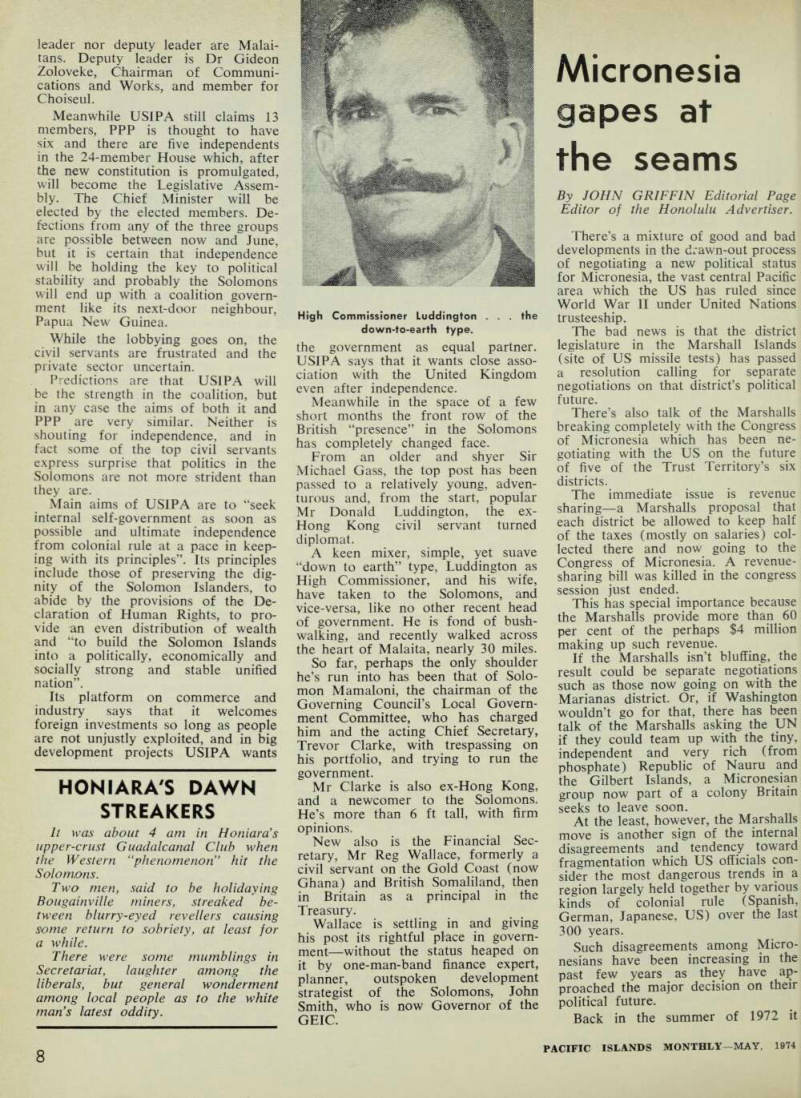
From an older and shyer Sir Michael Gass, the top post has been passed to a relatively young, adven turous and, from the start, popular Mr Donald Luddington, the ex- Hong Kong civil servant turned diplomat.
A keen mixer, simple, yet suave “down to earth” type, Luddington as High Commissioner, and his wife, have taken to the Solomons, and vice-versa, like no other recent head of government. He is fond of bush walking, and recently walked across the heart of Malaita, nearly 30 miles.
So far, perhaps the only shoulder he’s run into has been that of Solo mon Mamaloni, the chairman of the Governing Council’s Local Govern ment Committee, who has charged him and the acting Chief Secretary, Trevor Clarke, with trespassing on his portfolio, and trying to run the government.
Mr Clarke is also ex-Hong Kong, and a newcomer to the Solomons.
He’s more than 6 ft tall, with firm opinions.
New also is the Financial Sec retary, Mr Reg Wallace, formerly a civil servant on the Gold Coast (now Ghana) and British Somaliland, then in Britain as a principal in the Treasury.
Wallace is settling in and giving his post its rightful place in govern ment—without the status heaped on it by one-man-band finance expert, planner, outspoken development strategist of the Solomons, John Smith, who is now Governor of the
Geic.
High Commissioner Luddington ... the down-to-earth type.