Business and Development
pp. 95-103 · Read in the full issue
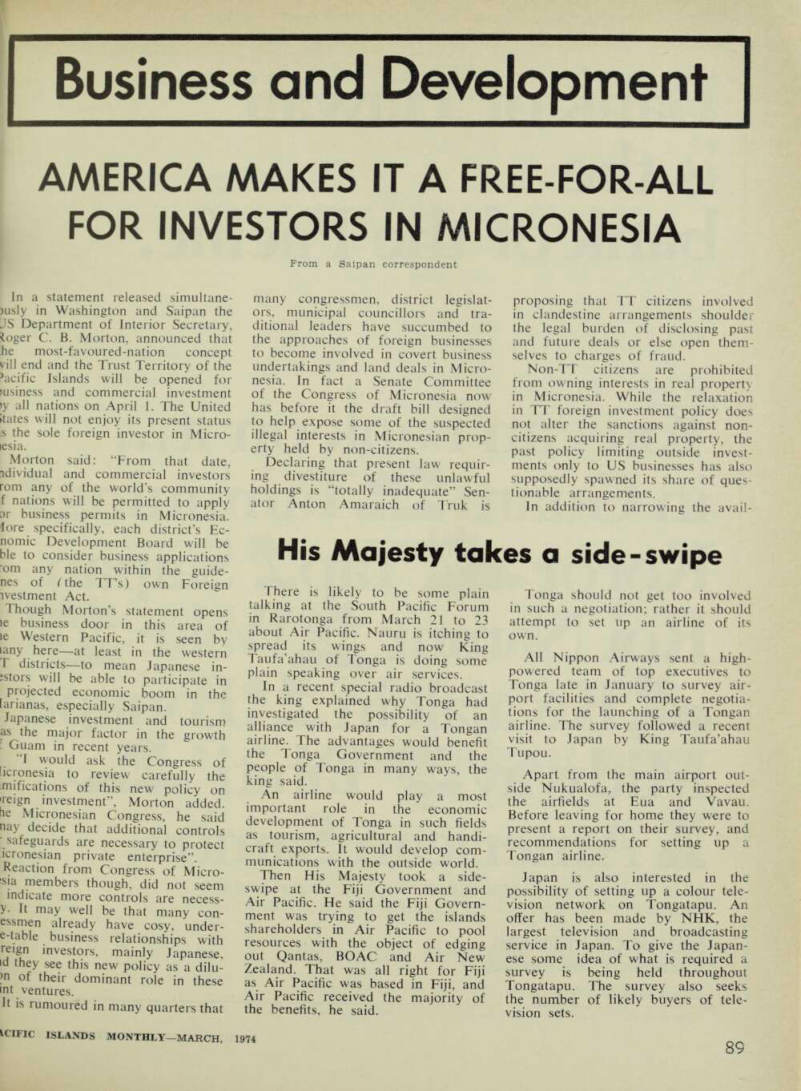
America Makes It A Free-For-All
For Investors In Micronesia
From a Saipan correspondent
In a statement released simultane )usly in Washington and Saipan the JS Department of Interior Secretary, *oger C. B. Morton, announced that he most-favoured-nation concept vill end and the Trust Territory of the *acific Islands will be opened for (usiness and commercial investment ly all nations on April 1. The United itates will not enjoy its present status is the sole foreign investor in Micro icsia.
Morton said: “From that date, idividual and commercial investors rom any of the world’s community f nations will be permitted to apply ar business permits in Micronesia, lore specifically, each district’s Ec nomic Development Board will be ble to consider business applications ’om any nation within the guide nes of (the TTs) own Foreign ivestment Act.
Though Morton’s statement opens ie business door in this area of ie Western Pacific, it is seen by lany here—at least in the western T districts—to mean Japanese in ;stors will be able to participate in projected economic boom in the [arianas, especially Saipan.
Japanese investment and tourism as the major factor in the growth : Guam in recent years.
“I would ask the Congress of ticronesia to review carefully the mifications of this new policy on 'reign investment”, Morton added, tie Micronesian Congress, he said nay decide that additional controls safeguards are necessary to protect icronesian private enterprise”.
Reaction from Congress of Micro tia members though, did not seem indicate more controls are necess y. It may well be that many con essmen already have cosy, under
e-table business relationships with
reign investors, mainly Japanese, id they see this new policy as a dilu m of their dominant role in these mt ventures.
It is rumoured in many quarters that
many congressmen, district legislat ors, municipal councillors and tra ditional leaders have succumbed to the approaches of foreign businesses to become involved in covert business undertakings and land deals in Micro nesia. In fact a Senate Committee of the Congress of Micronesia now has before it the draft bill designed to help expose some of the suspected illegal interests in Micronesian prop erty held by non-citizens.
Declaring that present law requir ing divestiture of these unlawful holdings is “totally inadequate” Sen ator Anton Amaraich of Truk is
proposing that TT citizens involved in clandestine arrangements shoulder the legal burden of disclosing past and future deals or else open them selves to charges of fraud.
Non-TT citizens are prohibited from owning interests in real property in Micronesia. While the relaxation in TT foreign investment policy does not alter the sanctions against non citizens acquiring real property, the past policy limiting outside invest ments only to US businesses has also supposedly spawned its share of ques tionable arrangements.
In addition to narrowing the avail-
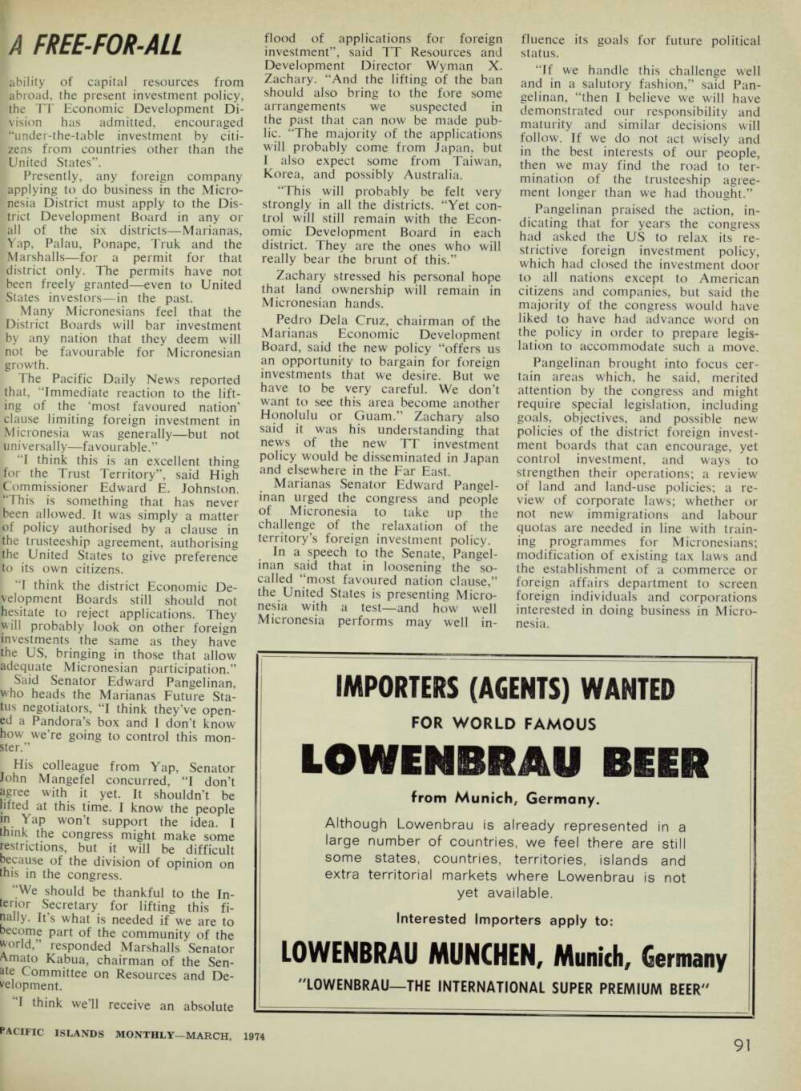
A Free-For-All
ability of capital resources from abroad, the present investment policy, the TT Economic Development Di [ vision has admitted, encouraged I “under-the-table investment by citi zens from countries other than the United States”.
Presently, any foreign company applying to do business in the Micro nesia District must apply to the Dis trict Development Board in any or all of the six districts—Marianas, Yap, Palau, Ponape, Truk and the Marshalls—for a permit for that district only. The permits have not been freely granted—even to United States investors—in the past.
Many Micronesians feel that the District Boards will bar investment by any nation that they deem will not be favourable for Micronesian growth.
The Pacific Daily News reported that, “Immediate reaction to the lift ing of the ‘most favoured nation’ clause limiting foreign investment in Micronesia was generally—but not universally—favourable.” “I think this is an excellent thing for the Trust Territory”, said High [Commissioner Edward E. Johnston.
“This is something that has never been allowed. It was simply a matter of policy authorised by a clause in the trusteeship agreement, authorising the United States to give preference to its own citizens.
“I think the district Economic De velopment Boards still should not hesitate to reject applications. They will probably look on other foreign investments the same as they have the US, bringing in those that allow adequate Micronesian participation.”
Said Senator Edward Pangelinan, who heads the Marianas Future Sta tus negotiators, “I think they’ve open ed a Pandora’s box and I don’t know how we’re going to control this mon ster.”
His colleague from Yap, Senator John Mangefel concurred, “I don’t agree with it yet. It shouldn’t be lifted at this time. I know the people m Yap won’t support the idea. I think the congress might make some restrictions, but it will be difficult because of the division of opinion on this in the congress.
“We should be thankful to the In terior Secretary for lifting this fi nally. It’s what is needed if we are to become part of the community of the 'vorld,” responded Marshalls Senator Amato Kabua, chairman of the Sen ate Committee on Resources and De velopment. ‘I think we’ll receive an absolute
flood of applications for foreign investment”, said TT Resources and Development Director Wyman X.
Zachary And the lifting of the ban should also bring to the fore some arrangements we suspected in he past that can now be made pubhe The majority of the applications will probably come from Japan, but I also expect some from Taiwan, Korea, and possibly Australia.
“This will probably be felt very strongly in all the districts. “Yet contro! will still remain with the Economic Development Board in each district. They are the ones who will really bear the brunt of this.
Zachary stressed his personal hope that land ownership will remain in Micronesian hands.
Pedro Dela Cruz, chairman of the Marianas Economic Development Board, said the new policy “offers us an opportunity to bargain for foreign investments that we desire. But we have to be very careful. We don’t want to see this area become another Honolulu or Guam.” Zachary also said it was his understanding that news of the new TT investment policy would be disseminated in Japan and elsewhere in the Far East.
Marianas Senator Edward Pangelman urged the congress and people of Micronesia to take up the challenge of the relaxation of the territory’s foreign investment policy.
In a speech to the Senate, Pangelat * n l° osen * n 8 sou tt . most f avo V re d nation clause,” the United States is presenting Micronesia with a test—and how well Micronesia performs may well in-
fluence its goals for future political status. [f we handle this challenge well and in a sa l u tory fashion," said Pan gelinan, ‘‘then I believe we will have demonstrated our responsibility and maturity and similar decisions will fo ow . If we do not act wisely and in the best interests of our people, the n we may find the road to ter mination of the trusteeship agree merit longer than we had thought.”
Pangelinan praised the action, in dicating that for years the congress had asked the us to relax its re . strictive foreign investment policy, which had closed the investment door to all nations except to American citizens and companies, but said the majority of the congress would have liked to have had advance word on the . policy in order to prepare legis lation to accommodate such a move, Pangelinan brought into focus cer tain areas which, he said, merited attention by the congress and might require special legislation, including goals, objectives, and possible new policies of the district foreign invest ment boards that can encourage, yet control investment, and ways to strengthen their operations; a review of land and land-use policies; a re view of corporate laws; whether or not new immigrations and labour quotas are needed in line with train ing programmes for Micronesians; modification of existing tax laws and the establishment of a commerce or foreign affairs department to screen foreign individuals and corporations interested in doing business in Micro nesia.
Australia opens
import door wider
Pacific Islands goods may now en ter Australia under a new tariff scheme which gives them preference.
The basis of the scheme is to give developing countries a duty rate be low the general rate to help their products become more competitive in Australia.
The new system differs from the previous scheme as it has been con siderably broadened and includes a wide range of primary products. In addition, some items previously the subject to quotas, may now be ex ported to Australia either dutv free or at low duty rates and without quota.
Traditional handicrafts will still be allowed in duty free. Soap, previously on a quota, may now be exported to Australia duty free and without any limitations on quota. Paints and var nishes, previously subject to a quota, are now subject only to low duty.
Among 860 items, roughly a third °f the total number of items in the Australian tariff, are now duty free when imported from developing countries. A wide range of other items may enter at 10 per cent or more below existing general tariff rate.
Excluded from the scheme are items in which developing countries are already competitive, or likely to become competitive at the general tariff rate. For certain other sensitive items, quotas will apply.
These new concessions for de veloping countries are additional to the. 25 per cent reduction in all tariffs, which the Australian Government in troduced in July, 1973.
But island bananas will still not get a look-in.
Mixed fortunes
for Caledonian nickel
New Caledonia’s exports of nickel ore last year rose 24 per cent while shipments of nickel metal fell by 16
per cent. In 1973, the island exported 2.8 million tons of ore to Japan, against 2.2 million tons in 1972.
Production of nickel metal re mained almost constant, reaching 57,235 tons in 1973, against 59,315 tons the previous year. However, metal exports last year totalled 50,142 tons against 60,003 tons in 1972. The difference is largely due to the 1972 decision to create a 10.000-ton nickel stockpile in France.
Meanwhile, in view of the current oil crisis, together with the rising value of the SUS and the effective 5 per cent devaluation of the French franc which began “floating” in January, Caledonians have grown in creasingly pessimistic over the pos sibility of a second nickel factory being built in the north of the island.
Vila gets a
new slaughter house
A new abattoir, costing $388,000, now under construction at Vila, is ex pected to open on April 1 for the slaughter of cattle and pigs. The abattoir could be the forerunner of a large beef industry in the New Hebrides. It will be of particular value to the local people involved with cattle through the co-operative movement.
The abattoir is owned by a Vila registered company, New Hebrides Abattoirs Ltd. The capital was largely subscribed in the New Heb rides, New Caledonia and Tahiti.
Associated with the abattoir are a freezing works, a treatment plant for by-products and a smallgoods section.
Cattle will be killed on behalf of owners, boned and stored. The owners will be responsible for market, ing it. As an alternative, if the cattle owner wishes, New Hebrides Abattoirs will buy cattle on a live weight basis. The company will then be responsible for marketing the beef.
The company expects that most of the cattle will come from French plan ters.
The estimate is that 1,400 head of cattle will be slaughtered in the first year, 2,500 head in the second year and 3,500 head in the third year. Pigs will be supplied by New Hebrides Rural Development Ltd, which operates a piggery at Mele. Killings are estimated at 1,800 in the first year, 2,500 in the second year and 5,000 in the third year.
This is architect Jean-Marie Galimard's design for the New Hebrides Co-operative Federation's newest project a few kilo metres out of Vila—a landscaped com plex comprising shop and offices (left), bulk store (centre) and clubhouse (right).
In charge of the project is English volun teer engineer, Philip Owen, and construc tion is by the first indigenous New Hebridean building firm, Efate Construc tion Co Ltd, owned by Tabia Kalsakau.
It's their biggest job to date, and should be finished by August.
From mission centre
to department store
The former Lutheran Mission sup ply centre at Madang has been trans formed into a flourishing commercial complex with an annual turnover ex ceeding $1 million. The marketing concept is to supply the needs of “the man in the street”. The business is probably the largest department store in Papua New Guinea, catering almost exclusively for local shoppers.
The business is the Madang Supply Centre, jointly owned by the Sullivan group, and Coltra Enterprises, of Mt Hagen. The Lutheran Mission set up the supply house in the late 1940 s to supply the regular needs of the mis sion’s own field staff, following prob lems in securing essential items as required in those difficult days.
In time, the scope of the supply house expanded gradually it grew into wholesale/retail store, involving certain management difficulties. As the Lutheran Mission started to phase out its operations in favour of a local organisation, the Sullivan group and Coltra Enterprises took over the com plex, plus the staff.
Most of the old-established retail stores in Papua New Guinea have traditionally aimed at expatriates. The new directors of Madang Supply Centre anticipating the trend of events, decided that the future of the store lay with the local people. This, of course, meant certain changes in the type of merchandise offered, so the shelves were stocked with items within the reach of shoppers with lower incomes and buying power.
Thus, builders’ supplies were phased out in favour of the handy man’s hardware, clothing and footwear were imported from the Far East, emphasis was placed on, for example, 6 oz cans of milk instead of 14 oz cans, and so on.
PNG minister's
takeover call
Papua New Guinea’s Mr John Kaputin has come down strongly in favour of the government expropriat ing or buying copra plantations “to return to the people”. He took full opportunity of rather a spectacular
achievement by the New Guinea De velopment Corporation Ltd to ex pound his views. Mr Kaputin is chairman of the corporation, and is also Minister of Justice.
The corporation, in about eight months recouped its initial investment in a copra plantation at Vunapit. It
bought the 600-acre plantation from a Chinese businessman for $51,000.
“Unfortunately, in the past, Papuans and New Guineans, have never been in a position to demon strate their own capacity,” Mr Kaputin said. “And now that we have demonstrated this fact, the sooner the government expropriates or re purchases the plantations to return to the people, the better off the country is going to be in the long run.”
“The argument used by the white people that Papuans and New Guineans cannot handle plantations is nothing more than a method of pacifying and brain-washing the people. Plantations are very good in-
The new department store at Madang.
come earners for the expatriates and they will attempt to keep them for as long as possible. This must not be allowed to continue and it is high time the government moved to ex propriate or re-purchase all the plan tations.”
The Deputy Leader of the Oppo sition, Mr Paul Langro, said the gov ernment should concentrate on ac quiring plantations that were con tributing nothing to the country, rather than attempt to expropriate all expatriate - owned plantations. The government should also make sure that local people with ability ran such plantations.
“Many of these expatriate-owned plantations contribute quite a bit to the country in terms of income tax and providing labour,” Mr Langro said. “If some action is wanted in respect of these plantations I think it would be better to impose heavier taxes, rather than expropriate them.”
Development plan
for PNG tobacco
Early February, PNG Minister of Agriculture, Mr lambakey Okuk, said that discussions had started be tween the government and represen tatives of Rothmans and W. D. & H. O. Wills on the future of PNG’s tobacco industry. These two com panies now manufacture about 85
per cent of the tobacco used in the country.
They have been working closely with the Department of Agriculture, Stock and Fisheries for several years on the development of tobacco crops.
Mr Okuk said he saw tobacco as a suitable crop to be cultivated by village farmers.
L
Utah pulls out ot
BSIP minerals search
Utah Development Company, which had been prospecting for minerals on Guadalcanal in the Solomon Islands since 1967, quietly
began sending its employees home late in 1973, and closed its operation completely in January without any announcement.
Governing Council’s Natural Resources Committee revealed on January 31 that the company had had disappointing results from its 1973 diamond drilling programme, and the future of the mineral prospects at Koloula and Betilonga on the weather coast, and in the Malango area, were Utah was looking mainly for porphyry copper in the central and south central parts of Guadalcanal, while also trying to find whether there was zinc or gold in any quantity.
Mr Kevin Dring has been appointed manager, South Pacific Islands, for W. D. & H. O. Wills (Aust) Ltd, tobacco manu facturers. He will be responsible for ex port sales to South Pacific markets and for liaison with associated companies in Papua New Guinea, Fiji and the British Solomon Islands. He commenced his career with Wills in South Australia, and during the past three years has been responsible for brand development and management at the company's Sydney head office. Mr Dring succeeds Mr David Angus, a well known figure in the South Pacific, who has been appointed assistant sales manager.