attitude to regional shipping
pp. 83-87 · Read in the full issue
Ratu Mara dismayed at unions' attitude to regional shipping
Militant maritime unions in Australia and New Zealand shocked Fiji’s Prime Minister, Ratu Sir Kamisese Mara, with their attitude towards the idea of Pacific Islands-owned ships.
He said recently in Suva he was concerned about the feasibility of a South Pacific regional shipping line because of opposition from seamen and dock workers in Australia and New Zeaai o ♦ c- • , , Ratu Sir Kamisese, who was speak-
ing about regionally-owned transport, referred to the 1973 ban placed on the Enna G in Wellington, and the more recent Melbourne ban on the same ship over an industrial issue.
In beginning a shipping venture the Pacific Islands should ask whether they would get support, instead of being frustrated, as Nauru was.
Ratu Sir Kamisese’s comments were timely, as the possibility of a regional shipping line will become a live issue
in the next few months. It is likely to get an airing at the next South Pacific Forum, when a special report is discussed.
Speaking about air transport, he said that when Fiji became indepen dent in 1970 he spoke against the idea of a national airline for Fiji be cause it would be a status symbol the country could not afford. Govern ments which succumbed to national enterprises were a real danger to the concept of regional co-operation.
"But I think we are beginning to realise that we can only afford one airline in the region for regional transport, and I hope that through the South Pacific Bureau for Econo mic Co-operation we will move to wards this view,” he said.
His attitude is interesting, and he may have to do some strong talking to convince some of his neighbours who are adopting expansionist ideas for air transport, neighbours like Nauru, Western Samoa and Tonga.
The Enna G came under a ban by maritime unions in January—in sup port of office staff of the Nauru Paci fic Line in Melbourne, who went on strike over a log of claims. Old mariners, after the Enna G’s ex perience in Wellington, would be in clined to say the ship was jinxed.
The ban was lifted after talks be tween officials of the shipping line and the Australian Shipping Officers’
Association ended in a settlement.
But Mr Willy Starr, a spokesman for the line, refused to disclose the terms of settlement.
The Enna G was stranded in Wel lington for several months in 1973 when maritime unions imposed a ban, ostensibly in support of a pay claim for the Fijian crew.
Ex-Navy Officer In
Bsip Charter Service
A former Royal Australian Navy officer. Captain John Robertson, plans to set up a charter service in the BSIP with a yacht built for him in Taiwan.
The vessel is a 41 ft two-masted ketch, which has been named Taholi.
Captain Robertson was in command of the aircraft carrier, Melbourne, when she was involved in a collision with the Voyager in Februarv. 1964.
The second of two royal commissions into the collision absolved Captain Robertson from any blame.
Dockworkers' Leader
Fined For Assault
Taniela Veitata, who was secretary of the deregistered Fiji Dockworkers’ and Seamen’s Union, was fined $3O in Suva Magistrate’s Court recently for criminal trespass. He had also been charged with having assaulted Mirza Namarud Buksh, but when the
case came on for hearing the prose cution said the parties had become reconciled. That charge was with drawn.
Veitata then pleaded guilty to hav ing entered the compound of Vijay Prasad with intent to assault Buksh.
He asked for leniency. He said he was provoked and lost his temper, Veitata is now secretary of the Fiji Waterside Workers’ and Sea men’s Union, which is seeking regis tration.
Korean Ship
Snatched From Reef
The San Pedro No 55, 200 tons, a Korean fishing ship, was dragged from a reef about 60 miles north west of Labasa, Fiji, three days after it grounded in heavy seas whipped up by Cyclone Pam on February 3.
After salvage attempts by sister ships failed, tugs belonging to Marine Paci fic Ltd and Salvage Pacific Ltd were involved. It was a difficult task in big waves. It took about 55 minutes to drag the ship clear.
The hull was badly damaged from a battering on the reef. The rudder and propellers were also badly damaged. The San Pedro is now in Suva for repairs.
A. Airlines May Be
Stuck With Losses
American Airlines may have to continue flying on the unprofitable South Pacific route. Other airlines and the American Samoa Govern ment are objecting to the plan, an nounced late in 1973, for PAA to take over these services in exchange for Caribbean routes.
Mr Ron Hunt, Fiji manager of American Airlines, told a recent meeting of the Fiji Visitors Bureau board of the objections, and added that a decision, from the US Civil Aeronautics Board might be months off. Airlines which objected to the change were Continental, United, Eastern and Allegheny. The Ameri can Samoa Government objected be cause there might be fewer flights through Pago Pago.
Mr Hunt said his company lost $3l million on the South Pacific routes in four years. The loss in the last year was $5 million.
Two of the airlines objecting to the “swap”, Eastern and United, each had a leg in before American was granted the routes by President Nixon in 1969. The CAB recom mended Eastern Airlines, but Presi dent Johnson over-ruled the CAB and selected Continental, only to see his decision upset after he stepped down.
The Adi La Isa
Air Terminal
The new terminal building at La basa Airport, Fiji, has, appropriate ly, been named after the late Adi Laisa Ganilau, wife of Fiji’s Deputy Prime Minister, Ratu Sir Penaia Ganilau. Both were prominent in “northern” affairs. Adi Laisa suffered a heart attack in an aircraft which had taken off from Labasa, and died before the plane was able to get back to the runway.
Work at the airport, extending over 18 months, cost $160,000. This included building the new terminal complex, and strengthening and lengthening the runway to take HS74B aircraft. The terminal build ing consists of a passenger concourse, waiting and seating accommodation, luggage handling facilities and a refreshment bar.
New Type Fish Catcher
For Micronesians
A new type of fishing boat for the US Trust Territory has literally been designed round the bait wells. It is part of a plan aimed at putting quali fied Micronesian fishermen in tuna ships which they can own and operate themselves. The new type of ship will replace the wooden-hulled Okinawan-Japanese type of boat at present in use, which has limitations.
The naval architect of the TT Marine Resources Division, Mr Wen dell H. Calkins, after consulting the Van Camp Sea Food Co, and local fishermen, designed a new steel live bait ship. The design provides for a ship with a range of 1,500 miles, able to travel at nine knots, and carry a crew of 14. It is 61 feet long, and has a 19 ft beam and a 5 ft draft.
The fish capacity is 29 tons in insu lated holds.
The bait wells will allow the ship to carry live bait which will enter the wells through underwater doors.
Another Rise
In Freight Surcharge
The freight rate picture for cargo from Australia to the Pacific Islands is not a pretty one. On February 1. further imposts were added to the 2J per cent surcharge imposed in November because of the fuel shortage.
Since then, the Arab oil sheiks have considerably increased the price, and the effects of that, on top of the earlier shortage, are now beginning to be felt. The surcharge from Australia to Papua New Guinea and Fiji has been increased to 8.9 per cent, and to New Caledonia and the New Heb rides by 6.37 per cent.
Early in February there was a pos sibility of a further increase in the
surcharge to Fiji, at a time when the government is battling inflation.
There is no relief in sight. Fuel prices are not likely to drop, unless there is a change of heart on the part of the Arabs, which will probably mean that the surcharges will be built into the normal freight rates.
In May, the Australian waterside workers are expected to receive a substantial lift in wages, which will probably be passed on in higher freights.
No wonder a shipping manager in Sydney commented that he expected freight rates from Sydney to the Pacific Islands to be 20 per cent higher by the end of 1974. Apart from sending up the cost of living in the Islands, these higher rates apply to Pacific Islands exports, making them dearer in world markets.
Fiji Airline Rights
Talks Break Down
Fiji has had mixed success in ar ranging reciprocal landing rights for Air Pacific. Hard on the heels of sign ing an air service agreement with Britain, Fiji was in disagreement with France and the United States over landing rights for New Caledonia, French Polynesia and Pago Pago.
The Fiji-Britain agreement confirms rights to operate services between Fiji and British territory.
Fiji is also attempting to get land ing rights at Pago Pago for Air Paci fic. So far the Americans have re fused to agree. Pan American Air ways and American Airlines fly through Nadi at present.
Until Fiji reaches agreement with the United States and France, Air Pacific’s jet planes will continue to operate below their capability, but the BAC 1-1 Is will add a new route to their list when work on upgrading the GEIC’s airport at Bonriki is com pleted in the near future. A jet service between Fiji and Tonga (Nukualofa) is already operating but the Tonga runway is not yet up to standard to allow Air Pacific to fly a Fiji-Auckland service via Tonga.
Air Nz Buys More Dclos
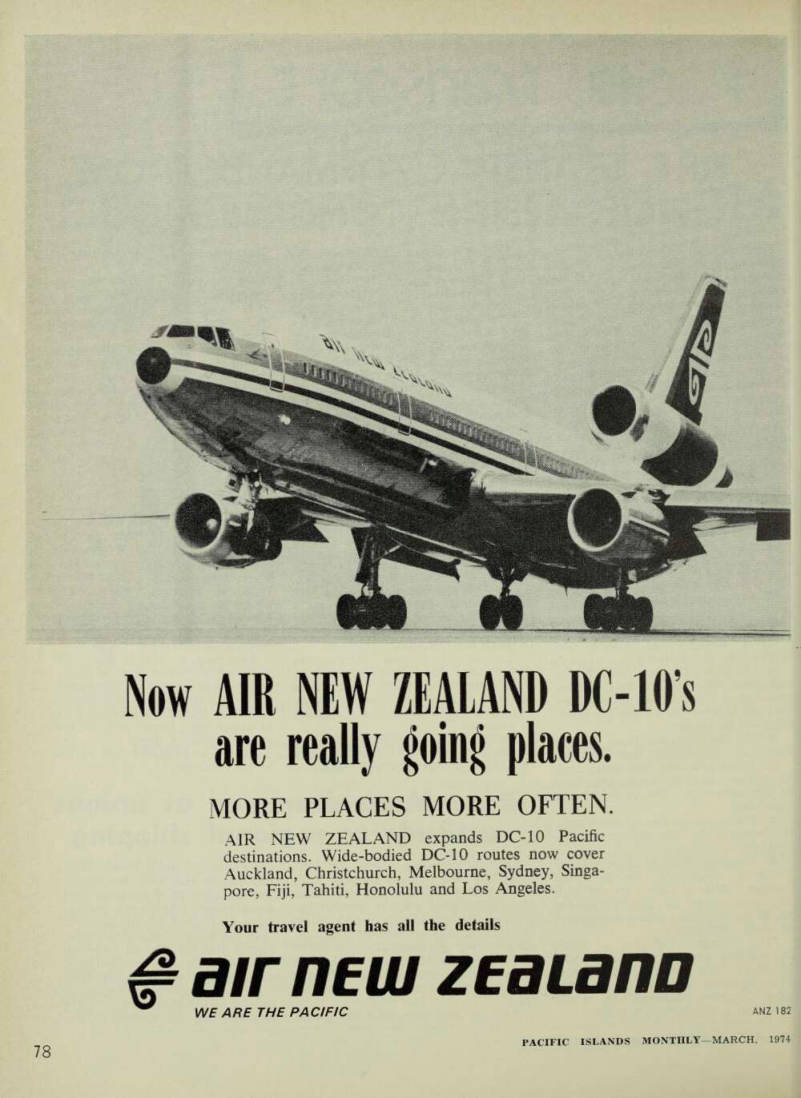
Wide-bodied DC 10 jet aircraft will take over the daily Air New Zealand return services between New Zealand and North America in a few weeks.
This follows Air NZ taking posses sion in January of its third DC 10 from the manufacturers, and a de cision to buy three more DC 10s.
The three new aircraft were bought m a package deal, which included spares and support equipment, of SUSBB million. The first of these ]ets will be delivered in December, 1974, the second in March, 1975, and the third at the end of 1975.