Books, Reviews, Writers
pp. 75-77 · Read in the full issue

More Imagination Than Eroticism
In This Primitive Art!
Primitive Erotic Art, is one of a major three-volume history of erotic art, the others being Erotic Art of the East and Erotic Art of the West.
The jacket notes state that, “Far more of our culture than is usually recognised is based on deep-rooted sexual symbolism and ancient erotic customs. With new insight drawn from psychoanalysis and anthro pology, this fully illustrated, scholarly book explores in detail the true mean ing and significance of the sexual imagery of primitive peoples”, and that “each (section) is written by an acknowledged expert and edited by an established art historian and author”.
Careful examination of the book, however, makes one wonder whether the person who wrote these notes ac tually looked between the covers.
Hardly a picture could be truly clas sified as erotic, while the text fails to live up to the stated claims to in terpret the erotic desires of the primi tive artists, and to correlate them with his art.
The authors, in an apparent attempt to justify the title of this book, must have stretched their imagination to their limits. They in terpret every primitive art object from prehistoric rock carvings to Trobriand Islands dance wands as having erotic intent.
Anything which depicts, suggests, or could be classified as representing an unclothed human must, in their opinion, have been made with the pur pose of arousing sexual desire on the part of the viewer. With the aid, presumably, of the forementioned psychoanalysis, even the sexual hang ups of the earliest cave artists are now fully understood.
This is not to suggest that many ot the objects illustrated were not made for use in rituals of an erotic nature, or to assure their possessors sexual prowess. The fact is that the art forms in themselves are not erotic, and were, in most cases, sym bols of fertility, which is a rather ditterent thing to eroticism.
Philip Rawson, the editor of the book, is the curator of the Gubenkian Museum of Oriental Art at the Uni versity of Durham. His section of the book Early History of Sexual Art
is interesting in its relating prehistoric art with assumed ritual, and the asso ciation of present-day primitives with similar art and ritual.
However, these rituals were, and are, used to ensure continuation of the species, and provision of good crops, plentiful supply of game, or to placate the spirits.
Part 7, Equatorial Islands of the Pacific Basin by Tom Harrisson, is less informative. Mr Harrisson was curator of the Sarawak Museum for some 20 years. He is the proud pos sessor of “a beautiful Borneo tattoo done on my 21st birthday in 1932”. (Dr) Harrisson spent some four de cades in and around Borneo, and is an authority on native customs in that region. His knowledge of the rest of the South Pacific is far less ex tensive, although he is, of course, well known for his book, Savage Civi lisation (about the New Hebrides) published before the war. With the exception of the Sepik, Massim and Asmat regions of New Guinea, there is very little which concerns Melanesia. Polynesia is dismissed with a few sketchy references to art objects in New Zealand and Easter Island.
We are treated to extensive de scriptions of the use of penis bars in Borneo (which could hardly be classi fied as art objects), a statue of a urinating Dutchman which shows the natives’ distaste of displaying genitalia, and a poem about someone who has lost a pet pigeon.
There is a free plug for the Catho lic Mission in Wewak which has sup posedly “done much to preserve Sepik standards of carving and secure reasonable prices for the artists”. (I have yet to learn of any mission which has had any but a devastating effect on the art and culture of so called primitives). We are also in formed that the Mt Hagen craftshop sells mainly Sepik carving.
The illustrations fall far short of erotica, which seems to Tom Harrisson to be merely the representation of
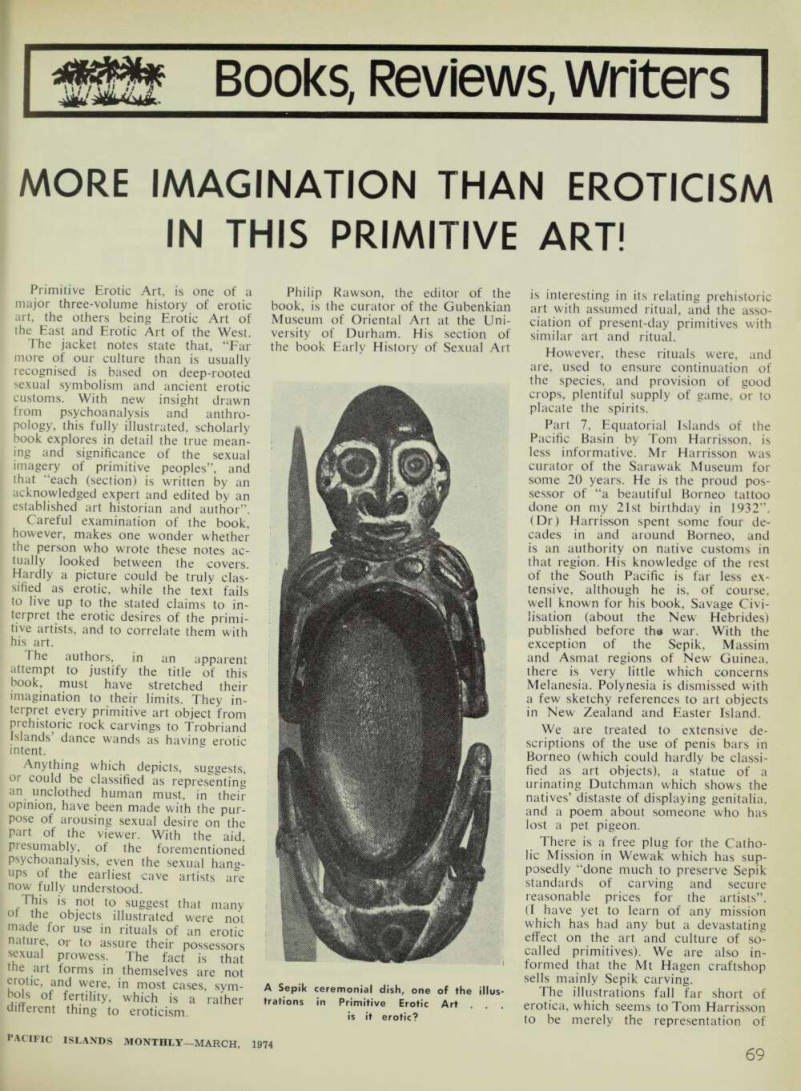
A Sepik ceremonial dish, one of the illus trations in Primitive Erotic Art . . . is it erotic?
naked male or female figures showing phalli, or, as he repeatedly states, pudenda.
There is reference to the “Men’s ritual club house” or Haus Tambaran at Angoram. This building was never used as a men’s house, but was built as a salesroom for Sepik artifacts. The bulk of the decoration inside and out side is not even representative of the Angoram district. Also, a figure he describes in Angoram was commis sioned, along with several others, as decoration for the hotel yard.
The carver who executed these had what was required described to him by Europeans. Or, as is most evident in one statue, adapted from photos of a Maori carving which is reproduced in this section.
The whole book abounds in un supported theory, and fails to con vince that it is either informative or authoritative. It is definitely not the book for a student of primitive art, or, for that matter, a connoisseur of erotica. Perhaps its purpose was to convince the purchaser of souvenirs from so-called primitive areas that his hitherto unsuspected statue, mask, club or pot is full of erotic imagery.
L. Marshall.
( PRIMITIVE EROTIC ART, edited by Philip Rawson, Weldenfeid and Nicholson, St John’s Hill, London. $17.50).